Texas Health Insurance, PPO & Networks Robert Adams Texas Health Insurance, PPO & Networks Robert Adams

Texas 2026 Health Insurance Premiums: What to Do Before Prices Jump

Texas marketplace insurers are signaling higher 2026 premiums. Here’s how to lower costs—plan timing, private PPO options, and Rx strategy

Texas • Premium Watch

Texas 2026 Health Insurance Premiums: What to Do Before Prices Jump

Fast take: Texas marketplace insurers have filed for notable premium increases for 2026. Costs are being driven by higher medical prices, utilization, and pricey drugs. If enhanced federal subsidies expire after 2025, some households could see larger net costs. Here’s how to prepare—and options to compare now.

What’s behind the increase?

  • Medical inflation & utilization: Providers and hospitals are charging more, and people are using more care.
  • High-cost drugs: GLP-1 medications and other specialty drugs are materially affecting trend.
  • Policy uncertainty: If enhanced ACA subsidies end after 2025, net premiums may rise for many families.

Moves to consider now

1) Audit your plan type

Check whether your current plan fits your usage. If you travel or work across state lines, a nationwide PPO may offer better access and predictable costs on the road.

2) Time your enrollment

Open Enrollment later this year sets your 2026 price. We can compare multiple options side-by-side—including marketplace plans and other eligible choices—so you don’t overpay.

3) Consider private PPO with medical underwriting

For healthy individuals and families, private, medically underwritten PPO options can offer lower premiums than unsubsidized ACA plans, broad nationwide PPO access, and predictable day-to-day costs. Eligibility depends on underwriting; we’ll pre-screen quickly and confirm network access so you know if it’s a fit.

4) Rx strategy

Know your drug tiering and prior auth rules. When appropriate, ask about generics, patient assistance, or discount programs to lower out-of-pocket costs.

How RKA helps Texans

  • Plan matching: We compare options from major carriers and traveler-friendly PPOs.
  • Cost projection: We estimate your annual cost with premiums + likely usage so you choose confidently.
  • Fast enrollment: We can place coverage quickly and help you avoid gaps.

Quick FAQs

Will 2026 marketplace prices impact my plan right away?
They typically apply starting January 1, 2026. The choices you make during Open Enrollment later this year will determine your 2026 costs.
Are there alternatives if I’m healthy and want lower premiums?
Depending on eligibility, some households may consider different plan structures. We’ll walk you through options that fit your needs and travel patterns.
Can RKA verify if my doctors are in-network?
Yes—send us the names and we’ll confirm network status and expected costs before you enroll.

For education only; benefits and eligibility vary by carrier and state. Always review official plan documents.

Read More

Traveler-Friendly Health Insurance: Stay Covered Wherever You Go

Traveler-friendly health insurance with nationwide PPO access. Get urgent care & ER coverage on the road. Compare options & enroll fast with RKA.

Traveler‑Friendly Health Insurance: Stay Covered Wherever You Go | RKA Insurance Advisors

Travel Health Coverage

Traveler‑Friendly Health Insurance: Stay Covered Wherever You Go

Updated Aug 28, 2025 • Originally published Feb 29, 2025 • By

Whether you’re on the road for work, chasing weekend getaways, or planning a cross‑country move, having reliable coverage that travels with you matters. Traveler‑friendly plans—often built on nationwide PPO networks—help you access urgent care, ERs, and a broad set of in‑network doctors across the U.S.

Tip: Before you go, add your plan ID card to your phone wallet and bookmark your carrier’s provider search. If you’re unsure about a facility, text or call us and we’ll verify network status for you.

Why traveler‑friendly health insurance?

If you spend time outside your home area, a PPO gives you flexibility without referrals and, on many plans, nationwide in‑network access. That can mean lower bills and faster check‑in when you need care away from home.

Key features frequent travelers value

1) Nationwide provider access

Tap into large, national networks so you can see in‑network providers in most cities and states, from urgent care to specialists.

2) Emergency & urgent care coverage on the road

Emergencies don’t wait. With the right plan, ER and urgent care visits while traveling are covered per your policy terms, with predictable cost sharing.

3) Help coordinating care

We’ll confirm network participation, estimate costs, and schedule appointments for you—so you focus on the trip, not the paperwork.

4) Options for international travel

Going abroad? Pair your domestic plan with short‑term travel medical for overseas emergencies and evacuation benefits.

How RKA Insurance Advisors helps

  • Plan matching: We compare traveler‑friendly PPO options across carriers in the 30+ states where we’re licensed.
  • Concierge verification: Message us a clinic name, and we’ll check network status and expected costs before you go.
  • Fast enrollment: Same‑day enrollments available in many cases; options exist year‑round depending on your situation.

Want proof you’re in good hands? See our Google reviews and learn about our services.

Traveler FAQs

Does PPO health insurance cover me while traveling out of state?
Yes. With a PPO network, members typically have nationwide access to participating providers for urgent care, ERs, and many outpatient services. Benefits depend on the plan; verify provider participation and any out‑of‑network cost sharing before you go.
Do I need separate travel medical insurance for international trips?
U.S. plans often have limited or no coverage abroad. For international travel, a short‑term travel medical policy can cover emergencies and evacuation. We’ll help you compare options.
What’s better for travelers: PPO or HMO?
PPOs offer broader, often nationwide networks and don’t usually require referrals—ideal for frequent travelers. HMOs tend to be regional and referral‑based; out‑of‑area care is typically emergency‑only.
How do I check if a provider is in‑network while traveling?
Use the carrier’s provider lookup or call member services. Or text/call us—we’ll verify and estimate costs.
Can I get short‑term coverage just for a trip?
Yes—short‑term medical or travel medical may fit. We’ll review dates, destinations, and needs to recommend the right fit.
Robert Adams • President & Licensed Agent • NPN 19540130
Licensed in AL, CO, DE, FL, GA, IA, IL, IN, KY, KS, LA, MD, MI, MO, MS, MT, NC, NE, NV, OH, OK, SC, SD, TN, TX, UT, VA, WI, WV, WY
Read More

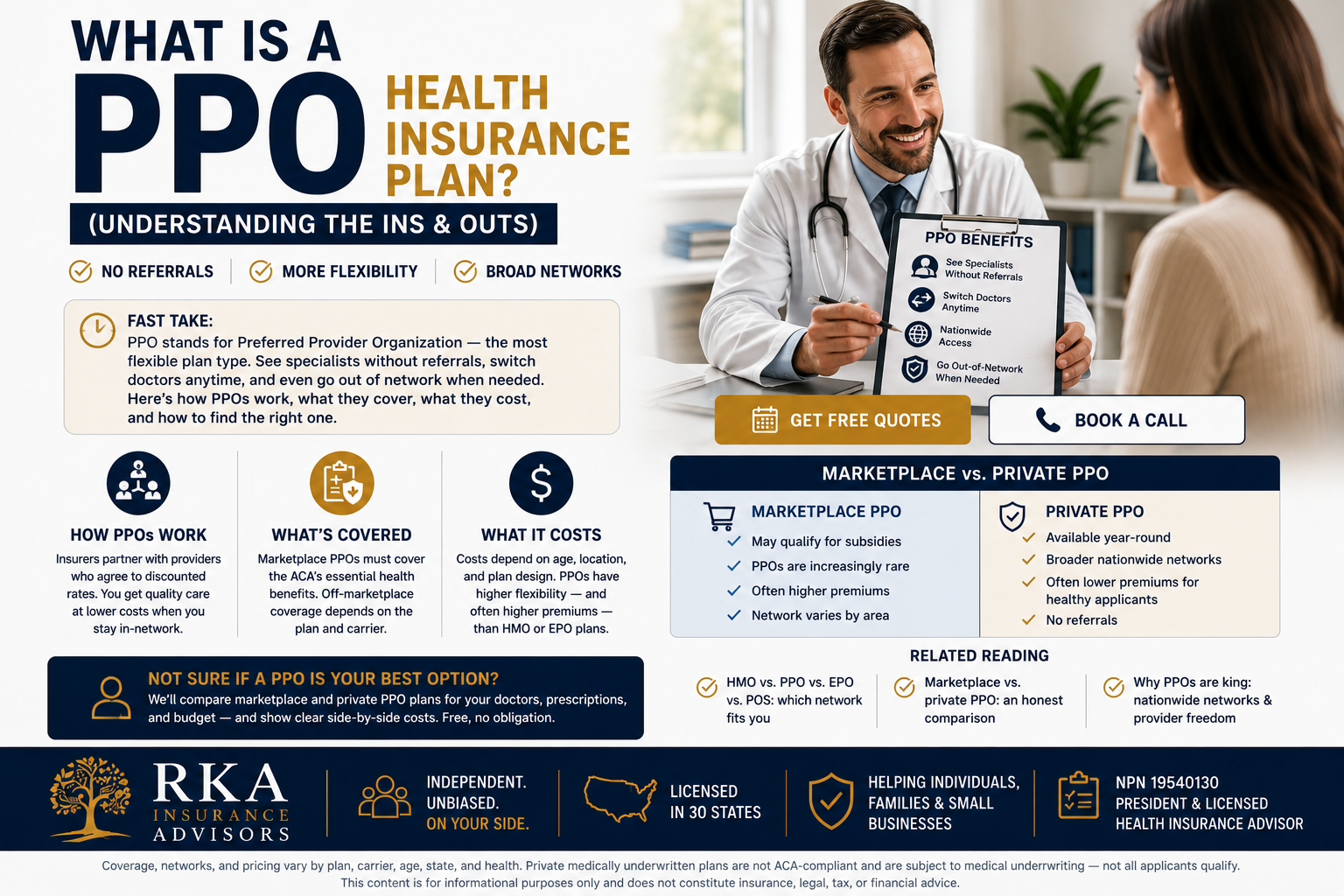
What Is A PPO Health Insurance Plan?

PPO plans explained in plain English — how they work, why there are no referrals, the out-of-network flexibility, what they cost, and how marketplace and private PPO options compare.

PPO • Health Insurance Basics

What Is a PPO Health Insurance Plan? (Understanding the Ins & Outs)

Fast take: PPO stands for Preferred Provider Organization — the most flexible and popular plan type. No primary care doctor required, no referrals to see specialists, and you can even go out of network if you need to. Here’s how PPOs work, what they cover, what they cost, and how to find the right one.

What a PPO is — and how it works

A PPO contracts with a network of doctors, hospitals, and facilities that agree to charge set rates for their services. Stay in-network and you get significant savings versus going outside it. The reason it works is simple: insurers bring the members, providers bring the care, and both agree on a discounted rate up front — a win for the carrier, the provider, and, most importantly, you.

The feature people love most is flexibility. Unlike an HMO, a PPO doesn’t make you pick a primary care physician, and you don’t need a referral to see a specialist.

What’s covered

  • Marketplace PPOs must cover the ACA’s essential health benefits
  • Off-marketplace coverage depends on the specific plan and carrier
  • Most PPOs offer broad coverage thanks to large provider networks

How much does a PPO cost?

Cost comes down to a few things: your age, how many people are covered, your ZIP code, and the plan’s network size, copays, deductible, and out-of-pocket maximum. One catch on the marketplace: true PPOs are increasingly hard to find there, and when they exist they’re often pricier than HMO or EPO options.

Off the marketplace, private PPOs are available in most areas. Some are short-term plans that are technically PPOs but provide limited benefits — always talk to a licensed advisor before enrolling in one. Others are medically underwritten: because the risk pool is healthier, the carrier can often offer lower rates, real PPO networks, and stronger benefits for people with a smaller claims history.

Marketplace vs. private PPO: if you qualify for a subsidy, a marketplace plan may win — but true PPO networks are getting rare there. If you’re healthy or above the subsidy line, a medically underwritten private PPO often delivers a broader network for less. The only way to know is to compare both for your situation.

Where to start your search

The best place to start is right here. We take an educational approach and review all the options available in your area — marketplace and private — so you can see the full picture. It’s worth a conversation even if you just want a second opinion on your current plan.

Not sure if a PPO is your best option?

We’ll compare PPO options — marketplace and private — for your doctors, prescriptions, and budget, and show clear side-by-side costs. Free, no obligation.

Get Free Quotes Book a Call

Related reading

Frequently asked questions

Do I need a referral with a PPO?

No. PPOs let you see specialists directly, without a referral from a primary care doctor — one of the main reasons people choose them.

Can I use out-of-network doctors with a PPO?

Yes, though you’ll usually pay more than in-network. The flexibility to go out of network when you need to is a core PPO benefit.

Are PPOs available on the marketplace?

Fewer than there used to be, and they’re often more expensive than HMO or EPO plans there. Many true PPOs are found off-marketplace as private plans — worth comparing both.

Is a private PPO cheaper than a marketplace plan?

For a healthy household above the subsidy line, a medically underwritten private PPO is frequently less expensive with a broader network. If you qualify for a subsidy, a marketplace plan may win. Compare both to be sure.

Short-term plans are not ACA-compliant and provide limited benefits — always review the details with a licensed advisor before enrolling.

Robert Adams · President & Licensed Agent · NPN 19540130 · Licensed in 30 states. Coverage, networks, and pricing vary by plan, carrier, age, state, and health. Private medically underwritten plans are not ACA-compliant and are subject to medical underwriting — not all applicants qualify. This content is for informational purposes only and does not constitute insurance, legal, tax, or financial advice.

PPO • Preferred Provider Organization • health insurance basics • private PPO • HMO vs PPO • provider networks

RKA Insurance Advisors

Robert Adams
https://www.RKAInsuranceAdvisors.com

Read More