HMO vs PPO vs EPO vs POS: Which Network Fits Your Needs?
Confused by HMO, PPO, EPO, and POS health plans? This guide breaks down the differences in networks, referrals, flexibility, and costs so you can choose the best fit in minutes.
HMO vs PPO vs EPO vs POS
Which Network Fits Your Needs?
Health Insurance Guides • Enrollment Help • Sep 7, 2025 • Written by Robert Adams
Confused by health‑plan acronyms? In this guide we break down HMO, PPO, EPO and POS plans—networks, referrals, premiums and flexibility—so you can decide in minutes. We’ll verify your doctors and medications, compare plans side by side and show clear costs.
HMO (Health Maintenance Organization)
- ✓ You must choose a primary care doctor (PCP) in the network who coordinates your care and provides referrals.
- ✓ Coverage is limited to network providers except for emergencies; out‑of‑network care typically isn’t covered.
- ✓ Premiums are usually lower, and some plans have low or no deductible options.
PPO (Preferred Provider Organization)
- ✓ Lets you see any doctor in the network without referrals and offers the option to go out of network at a higher cost.
- ✓ Provides flexibility if you travel or want a wide choice of specialists.
- ✓ Premiums and deductibles tend to be higher because of broader access.
EPO (Exclusive Provider Organization)
- ✓ You can see any doctor within the network; no referral is required to see a specialist.
- ✓ No out‑of‑network benefits; care outside the network is generally not covered.
- ✓ Deductibles may be higher but monthly premiums are often lower than a PPO.
POS (Point‑of‑Service)
- ✓ Combines features of HMO and PPO: you have a primary doctor who gives referrals.
- ✓ Some out‑of‑network coverage is available, but you’ll pay more compared with in‑network care.
- ✓ Good compromise if you want occasional out‑of‑network flexibility without paying full PPO premiums.
How to Decide in Minutes
Pick an HMO or POS if…
- ✓ You want lower premiums and you’re comfortable staying within a local network.
- ✓ You prefer having one doctor coordinate all care and provide referrals.
- ✓ You rarely travel or need specialists outside your area.
Pick a PPO or EPO if…
- ✓ You want the freedom to see specialists without referrals and value a larger network.
- ✓ You travel often or need access to doctors across multiple states.
- ✓ You’re willing to pay higher premiums to avoid network restrictions or referrals.
Still undecided? We’ll compare all four plan types with your doctors and medications in mind and show clear, side‑by‑side costs—so you can choose quickly and confidently.
Need help choosing the best plan in your ZIP?
We’ll verify your doctors and meds, compare HMO vs PPO vs EPO vs POS and show clear costs. No pressure—just answers.
Get Free Quotes Book a CallFAQ
What’s the main difference between an HMO and a PPO?
HMOs require you to pick an in‑network primary care doctor who refers you to specialists. PPOs let you see doctors in or out of network without referrals but come with higher premiums.
Do EPOs cover out‑of‑network care?
EPOs typically only cover care within the network; there are no benefits for out‑of‑network doctors except in emergencies.
Do POS plans require referrals?
Yes. POS plans combine elements of HMOs and PPOs—you have a primary doctor and need referrals for specialists, but you still have some out‑of‑network coverage.
Which plan type is best for frequent travelers?
If you travel often or need a large network, a PPO provides broader access and doesn’t require referrals, though an EPO can work if you stay in network.
How can I find out whether my doctor is covered?
Use the insurer’s provider search tools or work with a licensed advisor who can verify that your doctors and medications are in the network before you enroll.

Understanding Insurance Networks: A Key Component of Your Health Coverage
HMO, PPO, EPO, POS—your plan’s network determines which doctors you can see and what you’ll pay. Learn the key differences, when referrals apply, how out-of-network care works, and which network type best fits your doctors, prescriptions, and travel needs.
Guide • Networks & Access
Understanding Health Insurance Networks: HMO vs PPO vs EPO vs POS
Fast take: Your network determines where you can get care and what you’ll pay. If you have must-keep doctors, travel frequently, or want nationwide access, choose your network type first—then compare deductibles and copays.
The four common network types
HMO — “Stay in the circle”
- Primary Care Physician (PCP) and referrals usually required.
- No out-of-network coverage (except emergencies).
- Often lower premiums; tight local networks.
PPO — “More flexibility”
- No referrals needed to see specialists.
- Out-of-network benefits (higher costs); national networks vary.
- Good for travelers or multi-state families.
EPO — “HMO-like, no referrals”
- Referrals typically not required.
- Little to no out-of-network coverage beyond emergencies.
- Popular on ACA Marketplace; check local access.
POS — “Hybrid”
- PCP + referrals for in-network care.
- Some out-of-network benefits at higher cost.
- Useful when you want a PCP gatekeeper with flexibility.
Key rules to check before you enroll
- Provider verification: Search by doctor name + NPI and confirm at the practice level.
- Facility alignment: A doctor can be in network while their preferred hospital is not—verify both.
- Prior authorization: Imaging, infusions, surgeries, and some meds may need pre-approval.
- Rx formulary & tiers: Confirm your drugs, quantity limits, and preferred pharmacies.
- Out-of-area care: If you travel or have college students away from home, read the away-from-home rules.
Which network should I choose?
- Keep local doctors, low cost: HMO/EPO may work—verify providers and prior-auth rules.
- Travel frequently / multi-state family: PPO or a plan with nationwide access is usually safer.
- Want a coordinating PCP but some flexibility: POS can balance referrals with out-of-network options.
Quick FAQs
Are urgent care visits covered out of network?
My doctor says they “take” my plan—am I safe?
Can I change networks mid-year?
For education only; benefits and eligibility vary by carrier and state. Always review official plan documents.
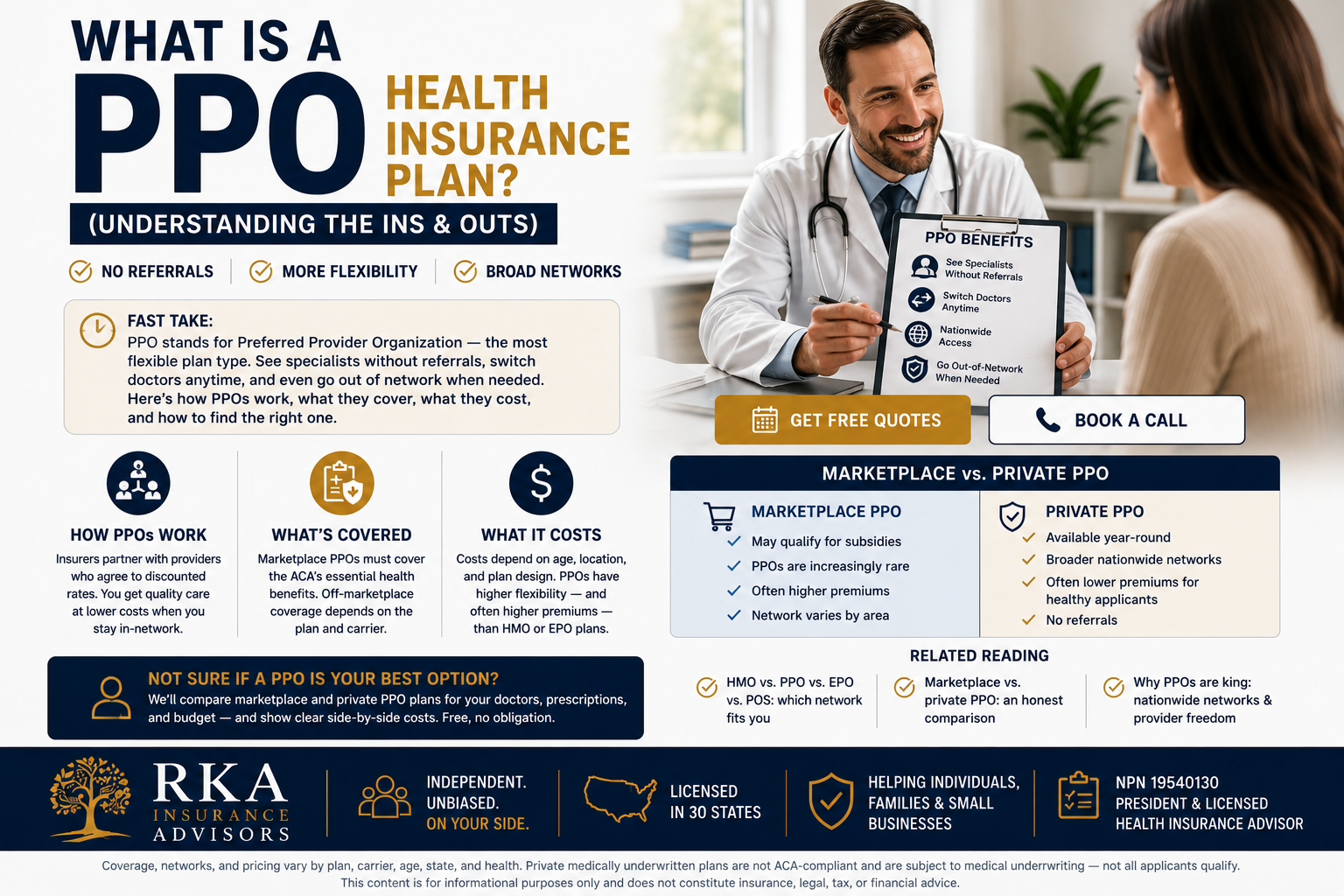
What Is A PPO Health Insurance Plan?
PPO plans explained in plain English — how they work, why there are no referrals, the out-of-network flexibility, what they cost, and how marketplace and private PPO options compare.
PPO • Health Insurance Basics
What Is a PPO Health Insurance Plan? (Understanding the Ins & Outs)
What a PPO is — and how it works
A PPO contracts with a network of doctors, hospitals, and facilities that agree to charge set rates for their services. Stay in-network and you get significant savings versus going outside it. The reason it works is simple: insurers bring the members, providers bring the care, and both agree on a discounted rate up front — a win for the carrier, the provider, and, most importantly, you.
The feature people love most is flexibility. Unlike an HMO, a PPO doesn’t make you pick a primary care physician, and you don’t need a referral to see a specialist.
Why PPO flexibility matters
- See a specialist without a referral — saves time and a co-pay
- Don’t like a doctor? Switch to another in-network doctor, no approval needed
- Skip routine visits or see any in-network doctor whenever you want
What’s covered
- Marketplace PPOs must cover the ACA’s essential health benefits
- Off-marketplace coverage depends on the specific plan and carrier
- Most PPOs offer broad coverage thanks to large provider networks
How much does a PPO cost?
Cost comes down to a few things: your age, how many people are covered, your ZIP code, and the plan’s network size, copays, deductible, and out-of-pocket maximum. One catch on the marketplace: true PPOs are increasingly hard to find there, and when they exist they’re often pricier than HMO or EPO options.
Off the marketplace, private PPOs are available in most areas. Some are short-term plans that are technically PPOs but provide limited benefits — always talk to a licensed advisor before enrolling in one. Others are medically underwritten: because the risk pool is healthier, the carrier can often offer lower rates, real PPO networks, and stronger benefits for people with a smaller claims history.
Where to start your search
The best place to start is right here. We take an educational approach and review all the options available in your area — marketplace and private — so you can see the full picture. It’s worth a conversation even if you just want a second opinion on your current plan.
Not sure if a PPO is your best option?
We’ll compare PPO options — marketplace and private — for your doctors, prescriptions, and budget, and show clear side-by-side costs. Free, no obligation.
Get Free Quotes Book a CallRelated reading
Frequently asked questions
Do I need a referral with a PPO?
No. PPOs let you see specialists directly, without a referral from a primary care doctor — one of the main reasons people choose them.
Can I use out-of-network doctors with a PPO?
Yes, though you’ll usually pay more than in-network. The flexibility to go out of network when you need to is a core PPO benefit.
Are PPOs available on the marketplace?
Fewer than there used to be, and they’re often more expensive than HMO or EPO plans there. Many true PPOs are found off-marketplace as private plans — worth comparing both.
Is a private PPO cheaper than a marketplace plan?
For a healthy household above the subsidy line, a medically underwritten private PPO is frequently less expensive with a broader network. If you qualify for a subsidy, a marketplace plan may win. Compare both to be sure.
Short-term plans are not ACA-compliant and provide limited benefits — always review the details with a licensed advisor before enrolling.
Robert Adams · President & Licensed Agent · NPN 19540130 · Licensed in 30 states. Coverage, networks, and pricing vary by plan, carrier, age, state, and health. Private medically underwritten plans are not ACA-compliant and are subject to medical underwriting — not all applicants qualify. This content is for informational purposes only and does not constitute insurance, legal, tax, or financial advice.

Robert Adams
https://www.RKAInsuranceAdvisors.com