
Health Insurance for Travel Nurses: PPO Coverage That Moves With You
Travel nurses change states every few months — most health plans don't keep up. Here's how nationwide private PPO coverage works for contract nurses, how to bridge gaps between assignments, and when the ACA marketplace still wins.
Health Insurance for Travel Nurses: Coverage That Moves With You
Why travel nurse coverage is its own problem
Most people pick a health plan once a year and keep the same doctors. A travel nurse's life doesn't work that way. You might start the year in Phoenix, take a summer contract in Seattle, and finish in Tampa — three states, three provider networks, and possibly a two-week gap between each assignment. The coverage questions that matter for you are different from the ones a typical employee ever thinks about:
Will it travel?
Does your plan's network actually cover providers in the next state you're assigned to — or only your "home" region?
What about the gap?
If a contract ends Friday and the next starts in three weeks, are you uninsured in between?
Can you enroll mid-year?
You rarely line up with a tidy open-enrollment window. Can you get covered the month you actually need it?
Your three real options
Agency / staffing plan
- Convenient, payroll-deducted
- Often ends the day your contract ends
- Coverage can lapse between assignments
- You lose it if you switch agencies
ACA marketplace
- Covers pre-existing conditions, no underwriting
- Subsidies if your income qualifies
- Network usually tied to one state — you may re-shop when you move
- Enroll only in OEP or with a qualifying life event
Private PPO (underwritten)
- One nationwide PPO network — travels with you
- Enroll any month, no window
- Fixed premium based on age/health, not income
- Health underwriting — best for healthy applicants
The gap between contracts is where nurses get burned
The single most common coverage mistake we see with contract nurses is assuming the agency plan carries them through downtime. Many don't. When the assignment ends, so does the plan — sometimes effective the last day worked. If you've got a two- or three-week break before the next contract, that's a window where one ER visit or accident is entirely out of pocket.
A nationwide private PPO sidesteps this because it isn't tied to any one assignment. It stays in force month to month regardless of where you're working — so the gap between contracts stops being a gap in coverage. You own the plan, not the agency.
When the marketplace still wins
We're an independent brokerage, so the honest answer matters more than the sale. A private PPO is not the right call for every travel nurse. Lean toward the ACA marketplace when:
Your income qualifies for subsidies
If a subsidy makes a marketplace plan dramatically cheaper, that often beats an unsubsidized private premium — even with a narrower network.
You have significant pre-existing conditions
Private plans are medically underwritten and can exclude or decline. The marketplace can't — it may be your broader-coverage path.
For a healthy, higher-earning contract nurse who's above the subsidy line and crossing state lines all year, the math more often tips toward a nationwide PPO. The only way to know your answer is to put real numbers side by side.
What to check before you pick any plan
- Network reach: confirm it covers providers in the states you're likely to be assigned, not just your home base.
- Effective date flexibility: can it start the first of next month, mid-contract, or after a gap?
- Telehealth: useful when you're new in a city and don't have a local doctor yet.
- Continuity: does it stay in force between assignments and when you change agencies?
- Your providers: if you have a specialist you fly back to see, verify they're covered before you enroll.
One plan that follows you state to state
We'll compare nationwide private PPO and marketplace options side by side — verify your providers, check effective dates around your contract schedule, and tell you straight which one wins for your situation. Free, no obligation.
Frequently asked questions
Will a private PPO cover me in every state I take a contract in?
Nationwide PPO networks access providers across the country, so the plan generally travels with you rather than resetting each time you move. Before you enroll we verify the network reaches the states and provider systems you're likely to work in, so there are no surprises on your next assignment.
What happens to my coverage between contracts?
That's the key advantage of owning your own plan. A private PPO stays in force month to month regardless of whether you're currently on assignment, so a break between contracts doesn't create a coverage gap. Agency plans, by contrast, often end when the contract does.
Can I enroll if it's not open enrollment?
Private underwritten PPO plans are available year-round with no enrollment window — you can apply between assignments or whenever your agency coverage ends. ACA marketplace plans generally require open enrollment or a qualifying life event such as losing other coverage.
I'm a 1099 / independent contract nurse. Does that change anything?
It often makes a private PPO more attractive, because you don't have an employer plan and your income may be above the subsidy threshold. Premiums are fixed by age and health rather than fluctuating with your income, which is helpful when contract pay varies through the year.
How does RKA help travel nurses specifically?
We compare marketplace and nationwide private PPO options side by side for your situation, verify your providers and the network's reach in the states you work, and match effective dates to your contract schedule so you're never caught in a gap. We're independent and licensed in 30 states. NPN 19540130.
Robert Adams · President & Licensed Agent · NPN 19540130 · Licensed in 30 states. Premium estimates are illustrative and based on general market data — actual premiums vary by age, state, health profile, and underwriting outcome. Private medically underwritten plans are not ACA-compliant and are subject to medical underwriting — not all applicants qualify. This content is for informational purposes only and does not constitute insurance, legal, tax, or financial advice.

ACA Subsidy Cliff 2026: What Self-Employed Earners Above $60K Need to Know
Enhanced ACA subsidies expired December 31, 2025. If you earn above $60,240, you now pay the full unsubsidized Marketplace premium. Here's what changed — and what self-employed professionals in good health can do about it.
Private PPO * ACA 2026 * Self-Employed
ACA Subsidy Cliff 2026: What Self-Employed Earners Above $60K Need to Know
What changed in 2026
Before (2021-2025)
- Enhanced credits capped premiums at 8.5% of income
- Subsidies available at any income level
- Higher earners still got meaningful help
Now (2026)
- Subsidies cut off at $60,240 (individual)
- Above that - 100% full unsubsidized rate
- Full-price Silver plans average $600-$900/mo*
- Deductibles typically $4,000-$8,000
Marketplace vs Private PPO
- Guaranteed issue - no health screening
- Subsidies if income under $60,240
- Often HMO/EPO - referrals common
- Open enrollment window only
- Income reconciliation at tax time
- Full price if above subsidy threshold
- Health underwriting required
- Premiums based on health - not income
- Nationwide PPO access - no referrals
- Available any month - no enrollment window
- No subsidy reconciliation at tax time
- Can cost significantly less for healthy applicants*
Who Private PPO works best for
Income above $60K
- No subsidies available anyway
- Private PPO often cheaper
Variable income
- No mid-year reconciliation risk
- Fixed premium regardless of earnings
Missed open enrollment
- No qualifying event needed
- Coverage can start within days
How RKA helps
What we do
- Confirm your exact subsidy eligibility
- Verify your doctors in both ACA and PPO networks
- Project total annual cost - premium + deductible
- Pre-screen PPO eligibility before you apply
What you get
- Side-by-side ACA vs PPO comparison
- No surprises at application or tax time
- Coverage that fits your income and health
- A licensed advisor - not a call center
We verify your doctors, check your prescriptions, and compare ACA vs private PPO with real numbers. No pressure, no obligation.
Frequently Asked Questions
What is the ACA subsidy cliff in 2026?
The income point where premium tax credits phase out entirely - $60,240 for individuals in 2026. Earn $1 above that and you pay the full unsubsidized rate.
Are private PPO plans available if I missed open enrollment?
Yes. Private medically underwritten PPO plans are available year-round. No qualifying life event required.
How much could I save with a private PPO?
It depends on your age, state, and health history. For healthy applicants above the subsidy threshold, savings can be significant. We run the exact comparison for your situation at no cost.
What does medically underwritten mean?
The insurer reviews your health history before approving coverage. We pre-screen your eligibility so you know where you stand before submitting a full application.
Robert Adams * President & Licensed Agent * NPN 19540130 * Licensed in 30 states. For educational purposes only. *Premium estimates based on publicly available 2026 rate data and vary significantly by age, state, and plan. Speak to a licensed advisor for exact figures.
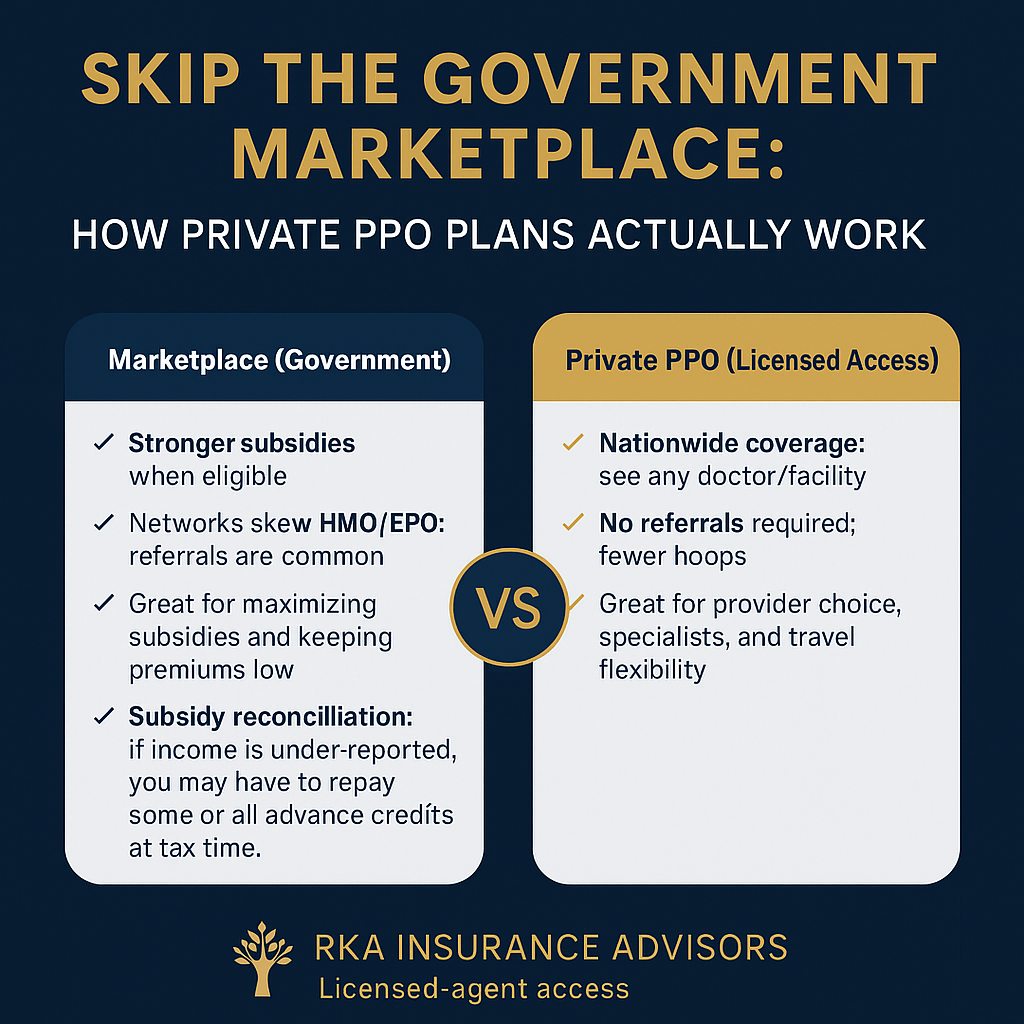
Skip the Government Marketplace: How Private PPO Plans Actually Work
Fast guide to non-Marketplace Private PPOs—how they bill, who they fit, and what to verify first. We’ll confirm your doctors, compare options, and show clear costs.
Skip the Government Marketplace: How Private PPO Plans Actually Work
Prefer private, licensed-access coverage? Here’s the fast, practical guide—what it is, how it bills, and how to check if it fits your doctors, travel, and budget.
Why some people skip the Marketplace
- Keep specific doctors/hospitals. Many Marketplace options are HMO/EPO with referrals.
- Travel flexibility. Want nationwide, not just local networks.
- Fewer gatekeepers. Prefer no referrals for specialists or imaging.
- Income too high for meaningful subsidies—or you don’t want tax-credit involvement.
- If your income qualifies, Marketplace can be the cheapest route.
- Credits reconcile on your tax return; under-reporting income can create payback.
- Private PPOs skip subsidies entirely—pricing is based on age, ZIP, benefits, and network.
How Private PPO actually works
- Nationwide PPO access in eligible networks—keep your specialists and preferred hospitals.
- No referrals for specialists (typical), fewer hoops to schedule care.
- Enroll through a licensed agent; options vary by state and carrier.
- Premiums aren’t tied to ACA income credits.
- Your exact doctors and facilities are in-network (we check for you).
- Copays vs coinsurance on high-ticket items (imaging, outpatient surgery).
- Prescription tiers and any prior-auth on key meds.
- Out-of-pocket maximum is a number you can live with.
What drives price (non-subsidized)
The big levers
- Age rating for adults; kids usually add less than another adult.
- ZIP/county + network breadth.
- Deductibles, coinsurance, copays, and the out-of-pocket max.
Ways to keep it efficient
- Don’t overbuy—match benefits to how you actually use care.
- Choose networks that include your real providers (not just brand names).
- Use generics when clinically appropriate; we’ll check formulary tiers.
Who typically chooses Private PPO
Strong fit
- Self-employed/1099 families who want broad doctor choice.
- Frequent travelers or multi-state households.
- People who dislike referral bottlenecks.
Maybe not a fit
- Households whose main goal is max subsidies and the lowest possible premium.
- Anyone who does not have specific providers to keep and rarely needs out-of-area care.
Want the best non-Marketplace fit in your ZIP?
We’ll verify your doctors and meds, compare PPO options, and show clear costs. No pressure—just answers.
FAQ
Are Private PPOs the same as Marketplace plans?
Do Private PPOs need referrals?
Will I owe taxes if I’m not using subsidies?
How do I know if my doctor is covered?
How do we start?
This overview is educational, not tax or legal advice. Plan availability and rules vary by state and carrier. Eligibility and enrollment subject to underwriting/plan terms where applicable.