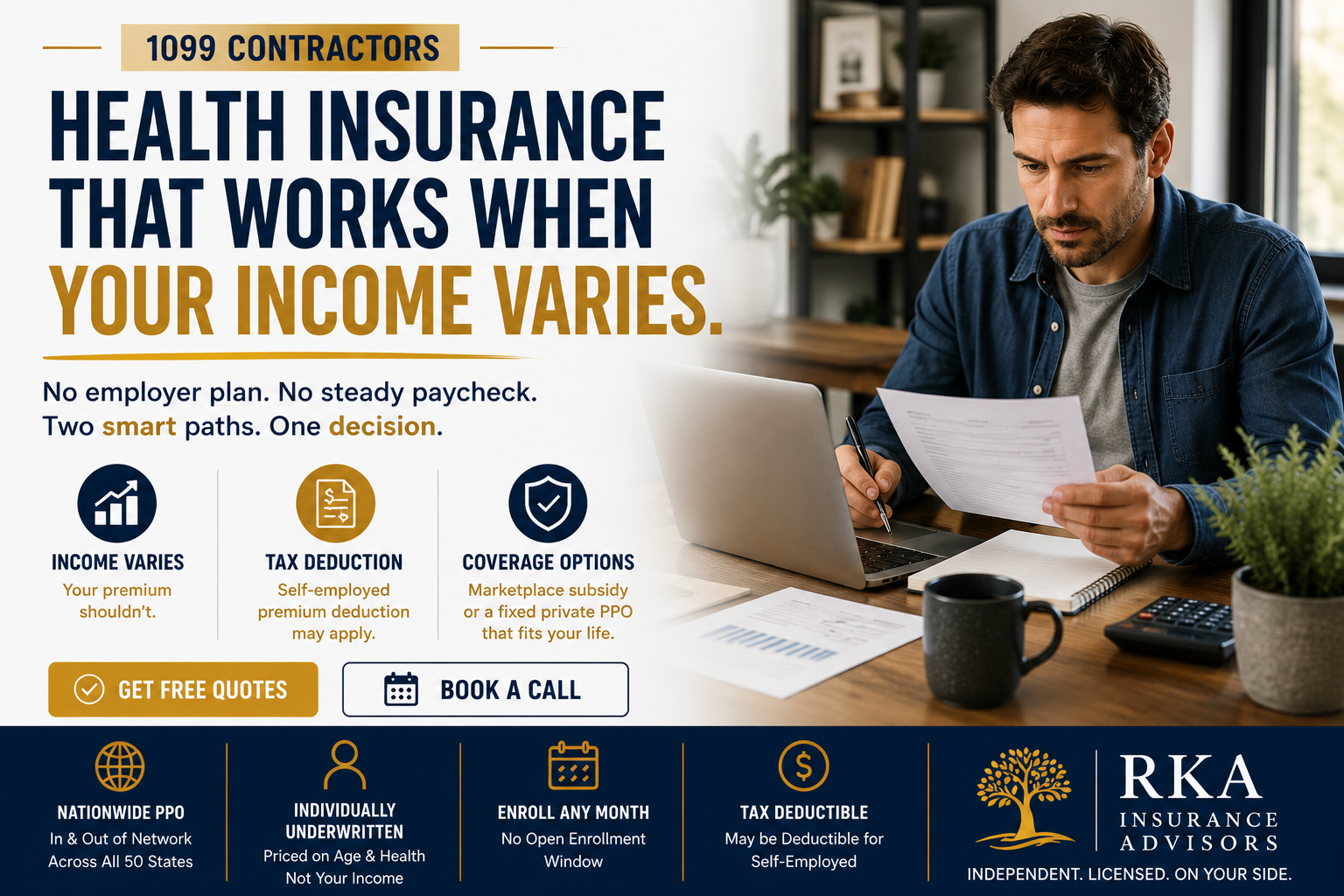
1099 Contractor Health Insurance: How to Get Covered When Your Income Varies
When you're 1099, there's no employer plan and no steady paycheck to size a premium against. That makes two things matter more than usual: estimating income for a subsidy you can't predict, and the self-employed premium deduction. Here's how contractors get covered.
Self-Employed • Private PPO • Individual Coverage
1099 Contractor Health Insurance: How to Get Covered When Your Income Varies
Why 1099 coverage is a different problem
A W-2 employee picks a plan once a year, has a fixed salary, and lets payroll deduct the premium. None of that is true for you. There's no employer splitting the cost, no HR portal, and — the part that trips people up — no predictable income to base a subsidy on. When your earnings swing month to month, the usual advice doesn't fit. The two questions below are the ones that actually decide your best move.
Question 1: Can you even predict your income?
Marketplace subsidies are based on your projected annual income. You estimate it when you enroll, the subsidy is paid in advance based on that estimate, and at tax time the IRS reconciles what you actually earned on Form 8962. For a salaried employee that's simple. For a contractor whose income depends on how many contracts close this year, it's a guess — and guessing wrong cuts both ways.
If you underestimate
- You collect a bigger subsidy during the year than you were owed
- You repay the difference at tax time — sometimes a large bill in April
- A single big contract late in the year can trigger it
If you overestimate
- You get a smaller subsidy during the year than you qualified for
- You get the difference back as a credit at tax time
- But you fronted more cash all year than you had to
The predictable alternative: a nationwide private PPO is priced on your age and health, not your income. The premium doesn't move when your income does, and there's nothing to reconcile at tax time. For a healthy contractor with variable or higher income, that predictability is often worth more than a subsidy you have to gamble on.
Question 2: Are you taking the self-employed deduction?
If you're self-employed and turn a profit, you may be able to deduct your health insurance premiums — for yourself, your spouse, and your dependents — on your federal return, whether you take the standard deduction or itemize. It's an "above-the-line" deduction, which is more valuable than most write-offs. It applies to private plans and unsubsidized marketplace plans, but not to the portion of a premium already covered by a subsidy.
This matters for the comparison: a private plan that looks more expensive on paper can be cheaper after the deduction than a partially-subsidized marketplace plan. The exact benefit depends on your tax situation, so confirm the specifics with your tax professional — but don't leave it out of the math.
Your two ways to get covered
ACA Marketplace
- Guaranteed issue — no health questions, no one is declined
- Subsidies possible if your projected income qualifies
- You must estimate income; the IRS reconciles it at tax time
- Enroll only during Open Enrollment or with a qualifying life event
- Most plans in many areas are regional HMO/EPO
Nationwide Private PPO
- Priced on health and age, not income — premium doesn't move
- Available any month, no enrollment window
- Nationwide PPO — see specialists anywhere, no referrals
- No subsidy, so nothing to reconcile at tax time
- Medically underwritten — you have to qualify
Not sure which fits your 1099 income? Let's run both.
We'll model a subsidized marketplace plan against a fixed private PPO for your actual situation — factor in the self-employed deduction, verify your doctors, and tell you straight which one wins. Free, no obligation.
Which path tends to win, honestly
Lean marketplace if…
- Your income is modest and reasonably predictable
- A subsidy makes the net premium clearly lower
- You have a health condition that underwriting might exclude
Lean private PPO if…
- You're healthy and above the subsidy line
- Your income swings and you'd rather not gamble on an estimate
- You want nationwide access and no reconciliation at tax time
This is the same honest fork we walk through with gig and rideshare workers — if you want the version focused on total cost and network freedom, see our gig workers and 1099 coverage guide.
Related reading
- Health insurance for gig workers and 1099 contractors
- Marketplace vs private PPO: an honest comparison
- Health insurance for the self-employed
Frequently asked questions
How do I estimate my income for a marketplace subsidy if I'm 1099?
You project your expected annual net income for the year and enter it when you enroll. The subsidy is paid in advance based on that number, then reconciled against your actual income on Form 8962 at tax time. Because contractor income is variable, build in a realistic buffer — underestimating means repaying subsidy in April. If your income is genuinely hard to predict, a private plan priced on health rather than income avoids the guesswork entirely.
Can I deduct my health insurance premiums as a 1099 contractor?
If you're self-employed and profitable, you generally can deduct premiums for yourself, your spouse, and your dependents as an above-the-line deduction — even without itemizing. It doesn't apply to any portion covered by a subsidy. It can make a private plan cheaper after taxes than it looks on paper. Confirm the specifics with your tax professional for your situation.
Can I get covered outside of Open Enrollment?
Private medically underwritten PPO plans are available year-round with no enrollment window — you can apply any month. Marketplace plans generally require Open Enrollment or a qualifying life event such as losing other coverage, moving, or marriage. That year-round availability is one reason contractors between contracts often look at the private path.
My income changes every month — does that affect a private plan?
No. A private plan's premium is set by your age and health at enrollment, not your income, so it doesn't move when your earnings do. That's the core appeal for contractors with variable income: a fixed cost you can budget around, and no year-end reconciliation. The tradeoff is that you have to qualify through medical underwriting.
I'm healthy and earn well — is the marketplace still worth checking?
Yes, always check both. If your income is above the subsidy line, an unsubsidized marketplace plan and a private PPO are both on the table, and the private PPO often wins on cost and network for a healthy applicant. But we compare them side by side rather than assume — occasionally a specific marketplace plan fits better, and we'll tell you when it does.
How does RKA help 1099 contractors?
We compare a subsidized marketplace plan against a fixed nationwide private PPO for your specific income and health, factor in the self-employed premium deduction, verify your doctors and prescriptions, and give you the honest call. We're independent and licensed in 30 states. NPN 19540130.
Get a fixed number you can actually budget around.
When your income isn't predictable, your health coverage can still be. We'll price both paths, factor the deduction, and pre-screen private eligibility — at no cost.
Robert Adams * President & Licensed Agent * NPN 19540130 * Licensed in 30 states. Premium estimates are illustrative and based on general market data — actual premiums vary by age, state, health profile, and underwriting outcome. Private medically underwritten plans are not ACA-compliant and are subject to medical underwriting — not all applicants qualify. Tax treatment depends on your individual circumstances — consult a qualified tax professional. This content is for informational purposes only and does not constitute insurance, legal, tax, or financial advice.
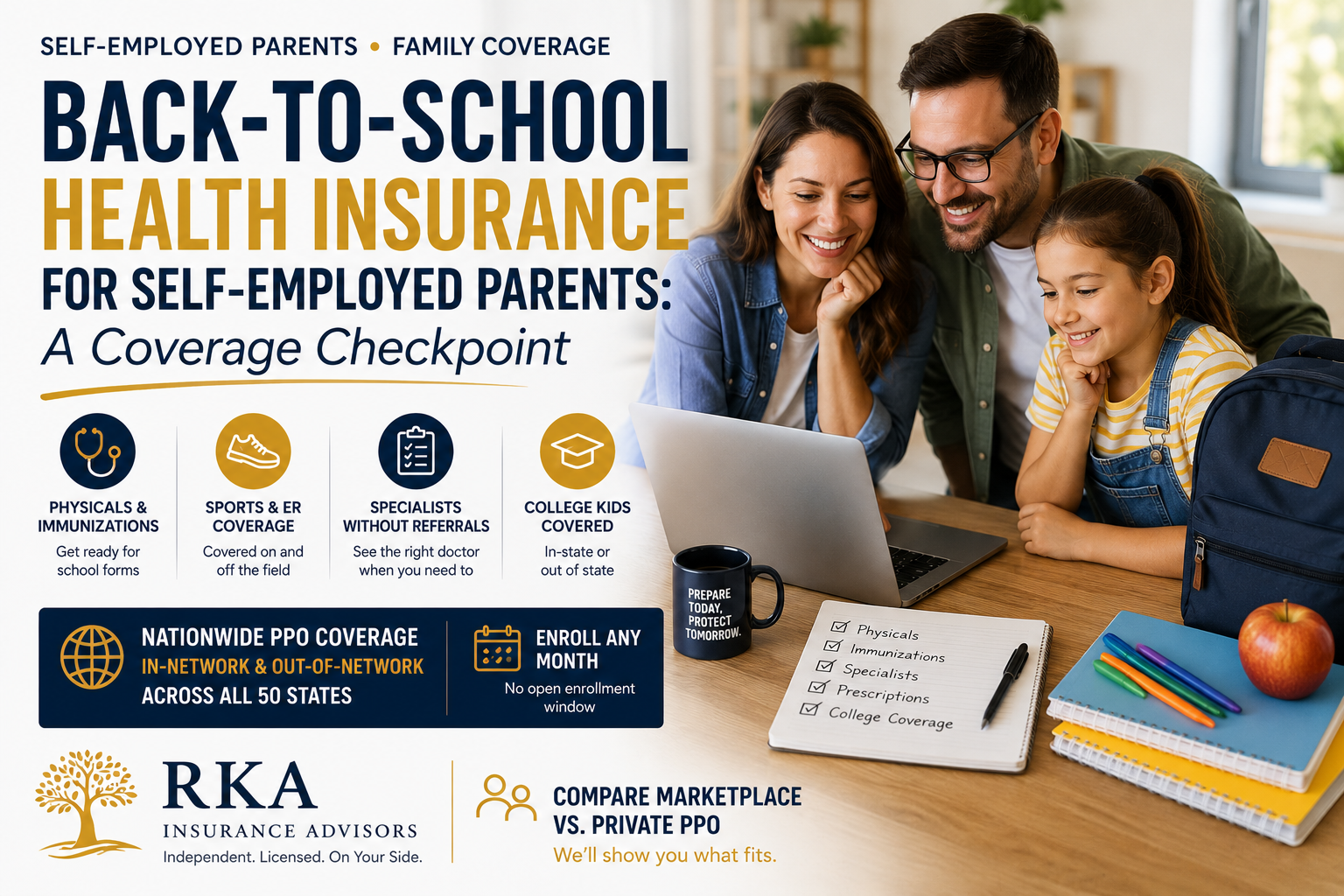
Back-to-School Health Insurance for Self-Employed Parents: A Coverage Checkpoint
Back-to-school season is a natural coverage checkpoint for self-employed parents — sports physicals, school forms, new prescriptions, and kids who may be aging off your plan. This guide covers the five things to confirm before September, why a nationwide PPO often fits families better than an in-state marketplace HMO for specialists and travel-sports injuries, when a marketplace subsidy is still the smarter family move, and a tax perk many self-employed parents miss.
Back-to-School Health Insurance for Self-Employed Parents: A Coverage Checkpoint
Why back-to-school is the right time to check your family's coverage
Summer ends and the paperwork begins: physical forms, immunization records, sports clearances, and a fresh round of "does our plan cover this?" It's also the season when kids actually use their coverage — checkups, urgent care, and the occasional trip to the ER. That makes late summer the natural checkpoint to make sure your family plan fits before you need it, not after. And because a private PPO enrolls year-round, you're not stuck waiting for open enrollment to fix a plan that no longer works.
The checklist: what to confirm before September
Physicals & immunizations
Confirm your plan's preventive-care coverage and that your pediatrician is in-network before the fall rush of forms and appointments.
Sports injuries & the ER
A broken wrist or a torn ligament means urgent care, imaging, and orthopedics — sometimes out of network. Check what your plan pays when it's not a scheduled visit.
Keep the pediatrician & specialists
Make sure the doctors your kids already see are covered — and whether you need a referral to reach a specialist.
Prescriptions
Recheck the drug list. Formularies change every year, and a medication that was covered can move tiers or drop off.
A kid aging off your plan
Children can stay on a parent's plan until 26. If one is turning 26 this year, plan their transition before there's a gap.
A college kid out of state
If a child is heading to school in another state, confirm they're actually covered there — many in-state plans aren't.
The network problem parents feel first
Cost matters, but for families the network is usually what bites first. Most ACA marketplace plans today are HMOs or EPOs built around one state or region. They often require referrals to see a specialist, and they typically pay nothing out of network outside of a true emergency. For a family, that shows up in very specific moments: a pediatric specialist across the state line, a travel-sports tournament three states away, a college freshman two time zones from home, or co-parenting across state lines.
Marketplace HMO / EPO
- Covers pre-existing conditions, guaranteed issue
- Subsidies if your household income qualifies
- Usually no out-of-network coverage (except emergencies)
- Network tied to your home state or region
- Referrals often required to see specialists
- Enroll only in open enrollment or with a qualifying life event
Private nationwide PPO (medically underwritten)
- One of the nation's largest PPO networks
- Works in and out of network across all 50 states
- No referrals needed to see a specialist
- Plan designs with deductibles as low as $0
- Enroll any month — no window
- Medically underwritten — best for healthy families, and not designed for significant pre-existing conditions
Same family, two plans: why the cheapest premium can cost more
Here's the trap in plain figures. Two family plans, same healthy household — and remember the premium is only the sticker price. What you actually pay is premium plus deductible, copays, and the out-of-pocket maximum, plus where the plan actually works:
Plan A — lower premium, higher exposure
- Lower monthly premium
- Family out-of-pocket max often $18,000+
- In-state HMO — no out-of-network coverage
- Referrals to reach pediatric specialists
- A single bad season can expose the full max
Plan B — nationwide PPO
- Modestly higher premium
- $0 deductible designs available
- Lower family out-of-pocket max
- In and out of network across all 50 states
- No referrals — see the specialist directly
Plan A can look cheaper every month right up until a kid breaks an arm at an away game or needs a specialist your HMO doesn't cover — then the low premium is beside the point. Paying a little more for Plan B often isn't spending more; it's buying thousands of dollars of protection and the freedom to get your kids care anywhere in the country. (Figures are illustrative — your actual numbers depend on ages, state, health, and plan design.)
See your real family options — free
Tell us your family's ages, health, doctors, and income, and we'll line up a marketplace plan against a nationwide PPO — total cost and network, side by side. No cost, no pressure.
When the marketplace still wins for families
A private PPO isn't automatically the answer, and being honest about that is the whole point. If your household income is modest, you may qualify for a marketplace subsidy, and in the lower-income cost-sharing reduction (CSR) range a Silver plan can come with sharply reduced deductibles, copays, and out-of-pocket maximums for the whole family. That can be a genuinely strong deal.
Even then, go in with eyes open: those plans are usually still in-state HMOs or EPOs, so the network limits and referral rules remain. And if a family member has significant pre-existing conditions, the marketplace is generally the better route, because a private PPO is medically underwritten and not everyone qualifies. The right move is to weigh your family's total cost against your need for network freedom. For a deeper side-by-side, see our Marketplace vs Private PPO breakdown.
A perk many self-employed parents miss: your premiums may be deductible
If you're self-employed and not eligible for coverage through a spouse's employer, the self-employed health insurance deduction may let you deduct your family's health, dental, and qualifying long-term-care premiums — which can meaningfully lower the true cost of a family plan. It's an above-the-line deduction, so you don't have to itemize. The rules depend on your business structure and net income, so confirm the details with your tax professional. (This is general information, not tax advice.)
How to decide, in four steps
1. Map how your family actually uses care
Which doctors do you want to keep? Do kids travel for sports or head out of state for school? Any regular prescriptions? This drives the network decision more than the premium does.
2. If income is modest, check the marketplace — including CSR
A subsidy, and especially a cost-sharing-reduction Silver plan, can lower your family's total cost substantially. Get that price as your benchmark.
3. Compare total exposure, not premium
Line up premium + deductible + copays + family out-of-pocket max across every option. The lowest monthly price is often not the lowest yearly cost.
4. Weigh network freedom
An in-state HMO vs a nationwide PPO that works in and out of network is a real difference for a family — decide what that's worth to you.
Common questions from self-employed parents
Why does back-to-school matter for my health insurance?
Because it's when your family actually uses coverage — physicals, forms, new prescriptions, urgent care, and sports injuries all cluster around the start of the school year. Checking now means you catch problems before you need care, not after. And since a private PPO enrolls any month, you can act on what you find right away.
My kids play sports — what coverage matters most?
Injuries rarely happen on a schedule, so look at urgent care, imaging, orthopedics, and the ER — and whether your plan pays out of network. Most marketplace HMOs cover little to nothing outside their home-state network except in a true emergency. A nationwide PPO covers your kids in and out of network across all 50 states, which matters for travel sports and away games.
One of my kids is heading to college out of state — will our plan cover them there?
Often not, if you have an in-state HMO or EPO — those typically only cover emergencies out of state. A nationwide PPO works across all 50 states, so a college student keeps full coverage away from home. It's one of the most common reasons families switch before fall.
My income varies — should I look at the marketplace or a private PPO?
If your household income is modest, check the marketplace first — you may qualify for a subsidy, and a cost-sharing-reduction Silver plan can carry low deductibles and out-of-pocket costs for the family. If you're healthy and above the subsidy range, a nationwide private PPO often wins on network and total cost. We price both so you can see the full comparison.
Can I deduct my family's health insurance premiums?
Many self-employed parents can, through the self-employed health insurance deduction, if you're not eligible for coverage through a spouse's employer plan. It can lower the real cost of a family plan meaningfully. The specifics depend on your business structure and income, so confirm with your tax professional — this isn't tax advice.
Do I have to wait for open enrollment to change our plan?
For a marketplace plan, generally yes — you need open enrollment or a qualifying life event. A private medically underwritten PPO enrolls any month of the year, so if your back-to-school check turns up a problem, you don't have to wait to fix it.
Get your family's coverage right before the school year starts
One quick conversation and you'll know your total cost and your network for every option — marketplace and private PPO — with your kids' doctors verified. Free, and no pressure.
Robert Adams · President & Licensed Agent · NPN 19540130 · Licensed in 30 states. Premium, deductible, and out-of-pocket figures are illustrative and vary by age, state, health profile, plan design, and underwriting outcome. Subsidy and cost-sharing-reduction eligibility depend on household income, size, and location. Private medically underwritten plans are not ACA-compliant and are subject to medical underwriting; not all applicants qualify, and they are not designed for significant pre-existing conditions. Tax information is general and not tax advice; consult your tax professional. This content is for informational purposes only and does not constitute insurance, legal, tax, or financial advice.
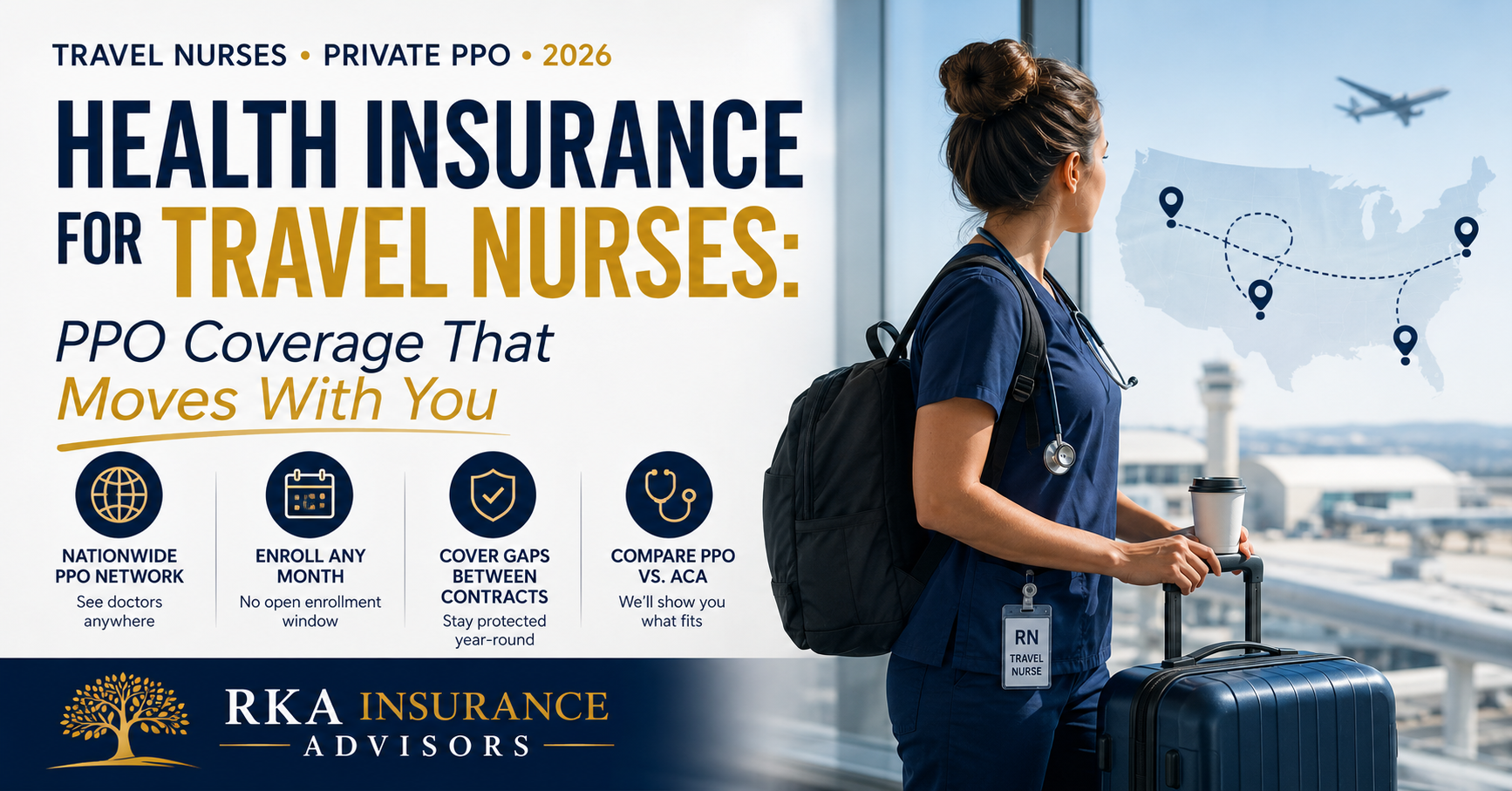
Health Insurance for Travel Nurses: PPO Coverage That Moves With You
Travel nurses change states every few months — most health plans don't keep up. Here's how nationwide private PPO coverage works for contract nurses, how to bridge gaps between assignments, and when the ACA marketplace still wins.
Health Insurance for Travel Nurses: Coverage That Moves With You
Why travel nurse coverage is its own problem
Most people pick a health plan once a year and keep the same doctors. A travel nurse's life doesn't work that way. You might start the year in Phoenix, take a summer contract in Seattle, and finish in Tampa — three states, three provider networks, and possibly a two-week gap between each assignment. The coverage questions that matter for you are different from the ones a typical employee ever thinks about:
Will it travel?
Does your plan's network actually cover providers in the next state you're assigned to — or only your "home" region?
What about the gap?
If a contract ends Friday and the next starts in three weeks, are you uninsured in between?
Can you enroll mid-year?
You rarely line up with a tidy open-enrollment window. Can you get covered the month you actually need it?
Your three real options
Agency / staffing plan
- Convenient, payroll-deducted
- Often ends the day your contract ends
- Coverage can lapse between assignments
- You lose it if you switch agencies
ACA marketplace
- Covers pre-existing conditions, no underwriting
- Subsidies if your income qualifies
- Network usually tied to one state — you may re-shop when you move
- Enroll only in OEP or with a qualifying life event
Private PPO (underwritten)
- One nationwide PPO network — travels with you
- Enroll any month, no window
- Fixed premium based on age/health, not income
- Health underwriting — best for healthy applicants
The gap between contracts is where nurses get burned
The single most common coverage mistake we see with contract nurses is assuming the agency plan carries them through downtime. Many don't. When the assignment ends, so does the plan — sometimes effective the last day worked. If you've got a two- or three-week break before the next contract, that's a window where one ER visit or accident is entirely out of pocket.
A nationwide private PPO sidesteps this because it isn't tied to any one assignment. It stays in force month to month regardless of where you're working — so the gap between contracts stops being a gap in coverage. You own the plan, not the agency.
When the marketplace still wins
We're an independent brokerage, so the honest answer matters more than the sale. A private PPO is not the right call for every travel nurse. Lean toward the ACA marketplace when:
Your income qualifies for subsidies
If a subsidy makes a marketplace plan dramatically cheaper, that often beats an unsubsidized private premium — even with a narrower network.
You have significant pre-existing conditions
Private plans are medically underwritten and can exclude or decline. The marketplace can't — it may be your broader-coverage path.
For a healthy, higher-earning contract nurse who's above the subsidy line and crossing state lines all year, the math more often tips toward a nationwide PPO. The only way to know your answer is to put real numbers side by side.
What to check before you pick any plan
- Network reach: confirm it covers providers in the states you're likely to be assigned, not just your home base.
- Effective date flexibility: can it start the first of next month, mid-contract, or after a gap?
- Telehealth: useful when you're new in a city and don't have a local doctor yet.
- Continuity: does it stay in force between assignments and when you change agencies?
- Your providers: if you have a specialist you fly back to see, verify they're covered before you enroll.
One plan that follows you state to state
We'll compare nationwide private PPO and marketplace options side by side — verify your providers, check effective dates around your contract schedule, and tell you straight which one wins for your situation. Free, no obligation.
Frequently asked questions
Will a private PPO cover me in every state I take a contract in?
Nationwide PPO networks access providers across the country, so the plan generally travels with you rather than resetting each time you move. Before you enroll we verify the network reaches the states and provider systems you're likely to work in, so there are no surprises on your next assignment.
What happens to my coverage between contracts?
That's the key advantage of owning your own plan. A private PPO stays in force month to month regardless of whether you're currently on assignment, so a break between contracts doesn't create a coverage gap. Agency plans, by contrast, often end when the contract does.
Can I enroll if it's not open enrollment?
Private underwritten PPO plans are available year-round with no enrollment window — you can apply between assignments or whenever your agency coverage ends. ACA marketplace plans generally require open enrollment or a qualifying life event such as losing other coverage.
I'm a 1099 / independent contract nurse. Does that change anything?
It often makes a private PPO more attractive, because you don't have an employer plan and your income may be above the subsidy threshold. Premiums are fixed by age and health rather than fluctuating with your income, which is helpful when contract pay varies through the year.
How does RKA help travel nurses specifically?
We compare marketplace and nationwide private PPO options side by side for your situation, verify your providers and the network's reach in the states you work, and match effective dates to your contract schedule so you're never caught in a gap. We're independent and licensed in 30 states. NPN 19540130.
Robert Adams · President & Licensed Agent · NPN 19540130 · Licensed in 30 states. Premium estimates are illustrative and based on general market data — actual premiums vary by age, state, health profile, and underwriting outcome. Private medically underwritten plans are not ACA-compliant and are subject to medical underwriting — not all applicants qualify. This content is for informational purposes only and does not constitute insurance, legal, tax, or financial advice.
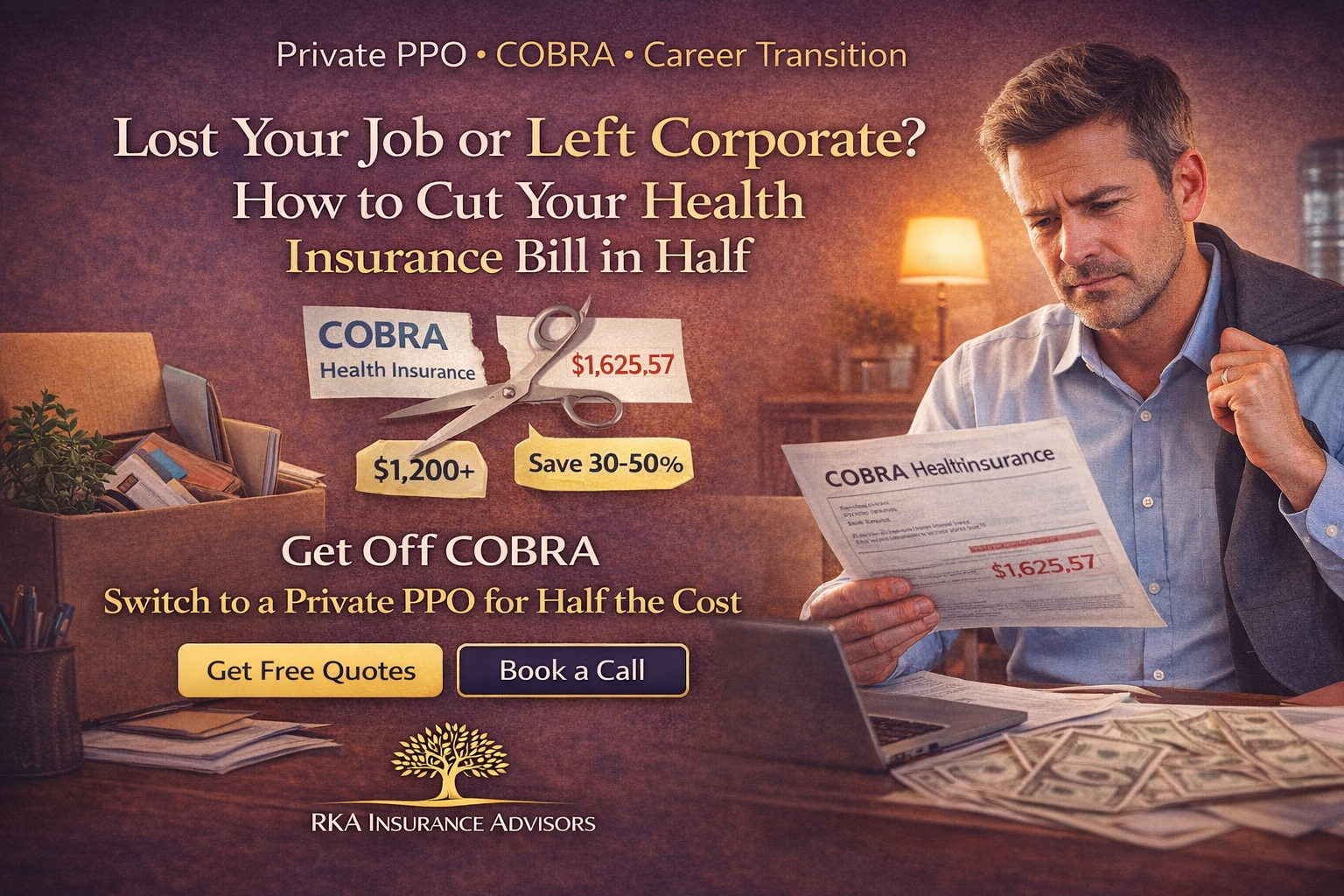
Lost Your Job or Left Corporate? How to Cut Your Health Insurance Bill in Half
Leaving a corporate job is one of the most common health insurance triggers. COBRA keeps your coverage but at full price — your share plus your employer's share. For healthy people, a private medically underwritten PPO often costs half as much with the same nationwide network. Here's how to make the switch.
Private PPO • COBRA • Career Transition
Lost Your Job or Left Corporate?
How to Cut Your Health Insurance Bill in Half
The COBRA surprise nobody prepares you for
When you leave a job, HR gives you a COBRA election notice. It's familiar, it's straightforward, and it keeps your exact same plan — same doctors, same pharmacy, same network. So most people elect it without comparing anything else.
Then the first bill arrives.
When you were employed, your employer was quietly covering 70–80% of your health insurance premium. That portion disappeared the moment you left. COBRA makes you whole on the coverage — but you now owe 100% of the group premium plus a 2% administrative fee. For a plan that cost you $180/month as an employee, COBRA might run $800/month or more.
Most people stay on COBRA because they assume it's the only option, or because they're worried about a gap in coverage. Neither is true.
What actually happens to your coverage when you leave
Your last day
- Group coverage ends — typically last day of the month
- COBRA election notice issued within 14 days
- 60-day window to elect COBRA begins
- COBRA is retroactive if you elect it within the window
Days 1–60
- You are technically uninsured — but COBRA can cover retroactively
- Best time to apply for a private plan
- Also qualifies for ACA Special Enrollment Period
- Private plan underwriting takes 2–4 weeks
After day 60
- COBRA election window closes permanently
- ACA Special Enrollment Period also closes
- Private PPO still available — no enrollment window
- Next ACA option: Open Enrollment (Nov–Jan)
COBRA vs your alternatives — side by side
- Exact same plan — no disruption
- Same doctors, same pharmacy
- No health screening
- Retroactive — elect within 60 days
- Full premium — yours + employer's share
- Plus 2% administrative fee
- Expires at 18 months
- $600–$1,800+/mo depending on plan
- Guaranteed issue — no health screening
- Job loss = Special Enrollment Period (60 days)
- Subsidies possible if income is lower this year
- Subsidy estimate based on projected annual income
- Often HMO/EPO — regional networks
- Full unsubsidized rate if income is high
- Premium based on your health — not income
- Nationwide PPO — see any specialist, no referrals
- Deductible options from $0 and up
- Available any month — no enrollment window
- No income reconciliation at tax time
- Frequently 30–50% less than COBRA for healthy people
- Health questionnaire required
What the cost difference actually looks like
The gap between COBRA and a private plan depends on your age, the quality of your former group plan, and your health profile. Here are typical ranges for healthy individuals in 2026:
Individual coverage — healthy, age 35
- COBRA (typical): $650–$900/mo
- ACA unsubsidized: $380–$520/mo
- Private PPO: $220–$320/mo
- Annual savings vs COBRA: $4,000–$8,000+
Individual coverage — healthy, age 50
- COBRA (typical): $900–$1,400/mo
- ACA unsubsidized: $550–$780/mo
- Private PPO: $380–$560/mo
- Annual savings vs COBRA: $6,000–$12,000+
*Estimates based on 2026 market data. Actual figures vary by state, plan, and underwriting outcome.
Who qualifies for a private medically underwritten plan
Likely to qualify
- No major chronic conditions
- No hospitalizations in the past 2–3 years
- Minimal or no ongoing prescription medications
- No active or planned specialty care
- Non-smoker or quit 12+ months ago
May not qualify
- Type 1 or Type 2 diabetes
- History of cardiac events or active heart disease
- Active cancer or recent remission
- Multiple ongoing specialty medications
- Autoimmune conditions (MS, lupus, RA)
If you don't qualify for private underwriting, COBRA or the ACA marketplace remain the right path. Job loss qualifies you for a Special Enrollment Period — we'll show you the best available ACA options for your situation and income level.
We compare COBRA cost, ACA options, and private PPO side by side for your specific situation — no pressure, no obligation.
What if you're already on COBRA — can you switch?
Yes. You can leave COBRA and switch to a private medically underwritten plan at any time. There is no enrollment window for private plans — they're available year-round. You simply apply, go through underwriting, and your new coverage starts on the first of the following month. Your COBRA coverage ends when your new plan begins.
People stay on COBRA for months — sometimes the full 18 months — without realizing they could have left at any point. If you've been on COBRA for 3, 6, or 12 months and you're healthy, it's worth getting a comparison now.
How to use the 60-day window correctly
If you just left a job
- Apply for private plan immediately — don't wait
- Underwriting takes 2–4 weeks
- If approved, new plan starts first of next month
- COBRA backstop available if underwriting extends past 60 days
- Don't elect COBRA until you know your underwriting result
If you're currently on COBRA
- Private plans available any month — no window needed
- Apply now, coverage starts next month
- Cancel COBRA when new plan activates
- Prorated COBRA premium refunded for unused days in some cases
- No gap in coverage if timed to first of month
Frequently Asked Questions
How long do I have to elect COBRA after leaving a job?
60 days from the date you lost coverage — or the date of your COBRA election notice, whichever is later. COBRA is retroactive, so if you elect it on day 59, your coverage is treated as continuous from the day you lost employer coverage. This gives you the full window to explore alternatives before committing.
Can I leave COBRA early if I find a better plan?
Yes. You can cancel COBRA at any time. There's no penalty and no minimum term. If you're approved for a private PPO or enroll in an ACA plan, you simply cancel COBRA with your plan administrator and your new coverage takes over.
What if I get a new job while on a private plan?
If your new employer offers group health insurance, you can enroll during their open enrollment or new-hire enrollment period. You'd cancel your private plan at that point. Some people keep their private plan if the employer's group coverage is expensive or has a limited network.
Does leaving a job qualify me for ACA Special Enrollment?
Yes. Losing employer-sponsored health coverage qualifies as a life event that triggers a 60-day Special Enrollment Period on the ACA Marketplace. If your income this year will be lower due to the job change, you may also qualify for subsidies you didn't have before. We model both scenarios.
What if I'm between jobs and my income is hard to estimate?
Private PPO premiums are not income-based — they're based on your age and health profile. This is actually an advantage during an income transition: your premium stays the same regardless of whether you find a new job quickly or take longer. No subsidy reconciliation, no income reporting required.
How do I know if my doctors are in the private PPO network?
We check network participation for your specific providers before you apply. Private plans use nationwide PPO networks — most physicians, specialists, and hospital systems that accept PPO insurance are in-network. We confirm before you commit to anything.
Most healthy people who left a job are surprised at how much they can save. We run the comparison and pre-screen underwriting eligibility at no cost.
Robert Adams * President & Licensed Agent * NPN 19540130 * Licensed in 32 states. Premium estimates are illustrative ranges based on 2026 market data and are not guaranteed. Actual premiums vary by age, state, tobacco status, plan selection, carrier, and underwriting outcome. Private medically underwritten plans are not ACA-compliant and are subject to medical underwriting — not all applicants qualify. COBRA costs and timelines vary by employer plan. Consult your benefits administrator and a licensed advisor for your specific situation. This content is for informational purposes only and does not constitute insurance or legal advice.
Health Insurance for Gig Workers and 1099 Contractors: How to Get Covered
Gig and 1099 work spans rideshare to six-figure consulting — and none of it comes with benefits. Here's how independent workers really compare coverage: why the monthly premium is only the sticker price, how deductibles, copays, and out-of-pocket maximums decide what you actually pay, and why a nationwide PPO's in- and out-of-network freedom often beats an in-state HMO or EPO — plus when a marketplace subsidy still makes sense.
Health Insurance for Gig Workers and 1099 Contractors: How to Get Covered
The premium is the sticker price — not the real cost
When you buy coverage, the monthly premium is simply what you pay for the product. It tells you almost nothing about what that product will actually cost you over a year, because a health plan has four separate cost levers, and premium is only one of them:
Premium
What you pay every month just to hold the plan — whether or not you ever use it.
Deductible
What you pay out of pocket before the plan starts sharing costs. Can be $0 on some plans, $9,000+ on others.
Copays & coinsurance
What you pay per visit, per prescription, or as a percentage — every time you get care.
Out-of-pocket maximum
The most you can pay in a bad year. This is the number that protects you when something serious happens.
A plan with a low premium and a high deductible isn't "cheap" — it's a bet that you won't need care. If that bet is wrong, you can end up paying far more than you would have on a plan that cost a little more each month. That's why the premium alone should never decide it.
Same person, two plans: run the real numbers
Here's the trap, in plain figures. Two plans for the same healthy person:
Plan A — low premium, high exposure
- $150 / month premium
- ~$9,200 deductible and out-of-pocket max
- In-state HMO/EPO network — no out-of-network coverage
- One serious event and you're exposed to the full $9,200
Plan B — slightly higher premium, far less exposure
- $200 / month premium
- $0 deductible
- ~$3,000 out-of-pocket max
- Nationwide PPO — in and out of network, anywhere in the U.S.
Plan B costs about $50 more a month — roughly $600 a year. But the moment you have a real claim, Plan A can expose you to $6,000+ more than Plan B, and Plan A only works inside your home state. Paying the extra $50 isn't spending more; for a lot of people it's buying thousands of dollars of protection and the freedom to see any doctor in the country. (Figures are illustrative — your actual numbers depend on age, state, health, and plan design.)
Where can you actually use it? HMO/EPO vs nationwide PPO
Cost is half the story. The other half is network — and this is where the two products really diverge. The majority of ACA marketplace plans today are HMOs or EPOs. Those plans are generally built around one state or one region, and they typically pay nothing if you go out of network (outside of emergencies). Travel, move between states, or want a specialist across the country, and you're on your own.
Marketplace HMO / EPO
- Covers pre-existing conditions, guaranteed issue
- Subsidies if your income qualifies (more on that below)
- Usually no out-of-network coverage at all
- Network tied to your resident state or region
- Out-of-pocket maximums often $9,000+
- Enroll only in open enrollment or with a qualifying life event
Private nationwide PPO (medically underwritten)
- One of the nation's largest PPO networks
- Works in and out of network, across all 50 states
- Plan designs with deductibles as low as $0
- Out-of-pocket max options as low as around $3,000
- Enroll any month — no window
- Medically underwritten — best for healthy applicants, and not designed for significant pre-existing conditions
Stop comparing premiums. Compare what you'll actually pay.
Tell us a little about your health, your income, and how you live, and we'll show you the total cost and the network for each option — side by side, in plain numbers. No cost, no pressure.
When the marketplace still makes sense
A private PPO isn't automatically the answer — it depends on your situation, and being honest about that is the whole point. If your gig income is modest, you may qualify for a marketplace subsidy, and in the lower-income cost-sharing reduction (CSR) range, a Silver plan can come with sharply reduced deductibles, copays, and out-of-pocket maximums. That can be a genuinely strong deal on cost.
Even then, run it with eyes open: those plans are still usually in-state HMOs or EPOs, so the network restrictions and lack of out-of-network coverage remain. And if you have significant pre-existing conditions, the marketplace is generally the better route, because a private PPO is medically underwritten and not everyone qualifies. The right move is to weigh your total cost against your need for network freedom. For a deeper side-by-side, see our Marketplace vs Private PPO breakdown.
How to actually decide, in four steps
1. Map how you actually use care
Do you travel or move? Want a specific hospital or specialist? Take regular prescriptions? This drives the network and out-of-pocket decision more than the premium does.
2. If your income is modest, check the marketplace — including CSR
A subsidy, and especially a cost-sharing-reduction Silver plan, can lower your total cost substantially. Get that price as your benchmark.
3. Compare total exposure, not premium
Line up premium + deductible + copays + out-of-pocket max across every option. The lowest monthly price is often not the lowest yearly cost.
4. Weigh network freedom
An in-state HMO/EPO vs a nationwide PPO that works in and out of network is a real quality-of-coverage difference — decide what that's worth to you.
Common questions from gig and 1099 workers
Isn't the plan with the lowest monthly premium the cheapest?
Not usually. The premium is only what you pay to hold the plan. A low-premium plan often carries a $9,000+ deductible and out-of-pocket max and no out-of-network coverage, so the first real claim can cost you far more than a plan that was a little more per month. Compare total exposure — premium plus deductible, copays, and out-of-pocket maximum — not the premium alone.
What's the real difference between a marketplace HMO/EPO and a private PPO?
Most marketplace plans are HMOs or EPOs built around one state, and they generally pay nothing out of network. A private nationwide PPO uses one of the country's largest networks and works in and out of network across all 50 states — useful if you travel, move, or want a specific doctor. Some private PPO designs also offer $0 deductibles and out-of-pocket maximums as low as around $3,000.
I drive rideshare or deliver part-time. What should I look at first?
If your total annual income is modest, check the marketplace first — you may qualify for a subsidy, and in the cost-sharing-reduction range a Silver plan can have low deductibles and out-of-pocket costs. Just know it's usually an in-state HMO/EPO. If you're healthy and want nationwide, in-and-out-of-network coverage with a low out-of-pocket max, we'll price a private PPO against it so you can see the full comparison.
My income is irregular. Does that affect my options?
A private PPO premium is based on your age and health, not your income, so it doesn't move month to month and there's no year-end income reconciliation. You can also enroll any month — no waiting for an open-enrollment window between gigs. Marketplace subsidies, by contrast, are tied to your estimated annual income.
How does RKA help gig and 1099 workers?
We compare the whole picture for you — total cost and network across a marketplace plan and a private PPO — verify your doctors are covered, and explain the trade-offs in plain English. There's no one-size-fits-all answer, which is exactly why a personalized comparison matters. We're licensed in 30 states, and it's free.
Get the full picture — free
One quick conversation and you'll know your total cost and your network for every option, not just the monthly price. That's how you actually get the right plan.
Robert Adams · President & Licensed Agent · NPN 19540130 · Licensed in 30 states. Premium, deductible, and out-of-pocket figures are illustrative and vary by age, state, health profile, plan design, and underwriting outcome. Subsidy and cost-sharing-reduction eligibility depend on household income, size, and location. Private medically underwritten plans are not ACA-compliant and are subject to medical underwriting; not all applicants qualify, and they are not designed for significant pre-existing conditions. This content is for informational purposes only and does not constitute insurance, legal, tax, or financial advice.

Kentucky Derby 2026 — The Health Insurance Problem Horse Country Doesn't Talk About
Kentucky's horse industry employs 60,000+ people — jockeys, trainers, grooms, exercise riders, equine vets — and almost all of them are 1099. Almost none have group health insurance. Here's why ACA fails this workforce in 2026, and what private PPO options actually look like for healthy self-employed Kentucky workers.
Private PPO • Kentucky • Self-Employed • 2026
Kentucky Derby Week — and the Health Insurance Problem Nobody in Horse Country Talks About
The workforce behind the roses
The Kentucky Derby is the most watched two minutes in sports. Churchill Downs, the pageantry, the fashion, the horses — it's one of the great American spectacles. But behind every race is a workforce that operates almost entirely outside the traditional employment model.
Jockeys are independent contractors. Trainers run their own operations as self-employed business owners. Grooms, exercise riders, hot walkers, and stable hands are often paid per horse or per week — no benefits, no HR department, no group health plan. Veterinarians in private equine practice are self-employed professionals. The entire horse racing ecosystem in Kentucky and beyond runs on 1099 workers.
And virtually none of them have health insurance that actually works for the way they live and work.
Why this workforce is chronically underinsured
The ACA problem for horse industry workers
- Income is often variable — per horse, per race, per season
- Subsidy reconciliation creates tax risk when income varies year to year
- ACA premiums up 18–20% in 2026 — largest increase since 2018
- Kentucky marketplace often offers limited plan choices in rural counties
- HMO/EPO networks are regional — don't work when traveling to other racing states
Why private PPO fits this workforce
- Premium based on health — not income variability
- No subsidy reconciliation — no year-end tax surprise
- Nationwide PPO — works in Kentucky, Florida, California, New York, anywhere they race
- No referrals — see any specialist, any state, any time
- Available any month — no enrollment window
- For healthy applicants, often significantly less than ACA
The travel problem — and why ACA often fails horse industry workers
The racing calendar doesn't stay in Kentucky. Trainers, jockeys, and their teams follow the horses — Keeneland in the spring, Churchill Downs for Derby week, Saratoga in August, Gulfstream in Florida, Santa Anita in California, Belmont in New York.
An ACA marketplace plan purchased in Kentucky often uses a Kentucky-based HMO or EPO network. The moment you're in Florida or California, you're out of network — and you're paying out of pocket for everything except emergencies.
A nationwide private PPO has no such restriction. You're in-network at any participating provider in any state. For a workforce that moves with the horses, this isn't a nice-to-have. It's the difference between usable coverage and coverage that fails you exactly when you need it.
What does private PPO actually cost in Kentucky?
For healthy applicants in Kentucky, private medically underwritten plan estimates in 2026:
Age 25–35, healthy
- $125–$255/month typical range
- $0 deductible options available
- Nationwide PPO access
Age 35–50, healthy
- $225–$415/month typical range
- Multiple deductible options
- Works in all 50 states
vs ACA Kentucky (unsubsidized)
- Silver: $345–$520/month
- Gold: $420–$620/month
- Often regional network only
- Up 18–20% in 2026
*Estimates for healthy non-smokers. Actual premiums vary by age, plan, health history, and underwriting outcome.
Who this applies to beyond horse country
The same coverage gap exists for self-employed professionals across Kentucky — not just those in the horse industry. Independent contractors in Louisville, Lexington, Bowling Green, and across the state face identical challenges with ACA marketplace plans and the same opportunity with private PPO.
Horse industry workers
- Jockeys — independent contractors
- Trainers — self-employed
- Grooms and stable hands — variable income
- Equine veterinarians — private practice
- Exercise riders — per-horse compensation
Other Kentucky self-employed
- Real estate agents across Kentucky
- Independent contractors in Louisville's logistics sector
- Bourbon industry consultants and independent distillers
- Freelancers and remote workers statewide
- Small business owners without group plans
The common thread
- 1099 income or self-employed
- No employer group plan available
- Often healthy — priced well for private PPO
- May travel or work in multiple states
- ACA full rate is expensive without subsidies
We compare ACA marketplace vs private PPO options for your specific situation. We're licensed in Kentucky and 31 other states. No pressure, no obligation — just an honest comparison.
Frequently Asked Questions
Is RKA Insurance licensed in Kentucky?
Yes. RKA Insurance Advisors is licensed in Kentucky and 31 other states. We work with self-employed professionals and 1099 workers across Kentucky — from Louisville and Lexington to rural horse country.
Can I get coverage that works in multiple states if I travel with the racing circuit?
Yes — this is exactly what private medically underwritten PPO plans are designed for. A nationwide PPO gives you in-network access at any participating provider anywhere in the country, with no referrals and no prior authorization for most services. It's the only plan type that genuinely works for someone who follows the racing calendar across multiple states.
My income varies by season. Does that affect my premium?
No — private PPO premiums are based on your health, not your income. This is a significant advantage over ACA marketplace plans, where income fluctuation can create subsidy reconciliation issues and unexpected tax bills. With private PPO, your rate is set at underwriting and doesn't change based on what you earn that year.
What if I've been injured before — does that affect eligibility?
It depends on the nature and timing of the injury. Minor, fully resolved injuries often don't affect private plan eligibility. Ongoing orthopedic issues, surgeries within the past few years, or chronic conditions may affect underwriting. We pre-screen applicants before submitting a formal application so you have a realistic picture before anything goes on record.
What if I don't qualify for private PPO?
If private underwriting isn't available based on your health history, ACA marketplace coverage remains a solid option — and losing previous coverage is a qualifying life event that opens a special enrollment period. We'll give you an honest side-by-side comparison of both paths.
Independent broker. Licensed in Kentucky and 31 other states. Free quotes for self-employed horse industry workers and Kentucky professionals. No pressure, honest advice.
Robert Adams * President & Licensed Agent * NPN 19540130 * Licensed in 32 states including Kentucky. Premium estimates are illustrative ranges based on 2026 market data and are not guaranteed. Actual premiums vary by age, state, tobacco status, plan selection, carrier, and underwriting outcome. Private medically underwritten plans are not ACA-compliant and subject to medical underwriting — not all applicants qualify. This content is for informational purposes only and does not constitute insurance, legal, or financial advice.
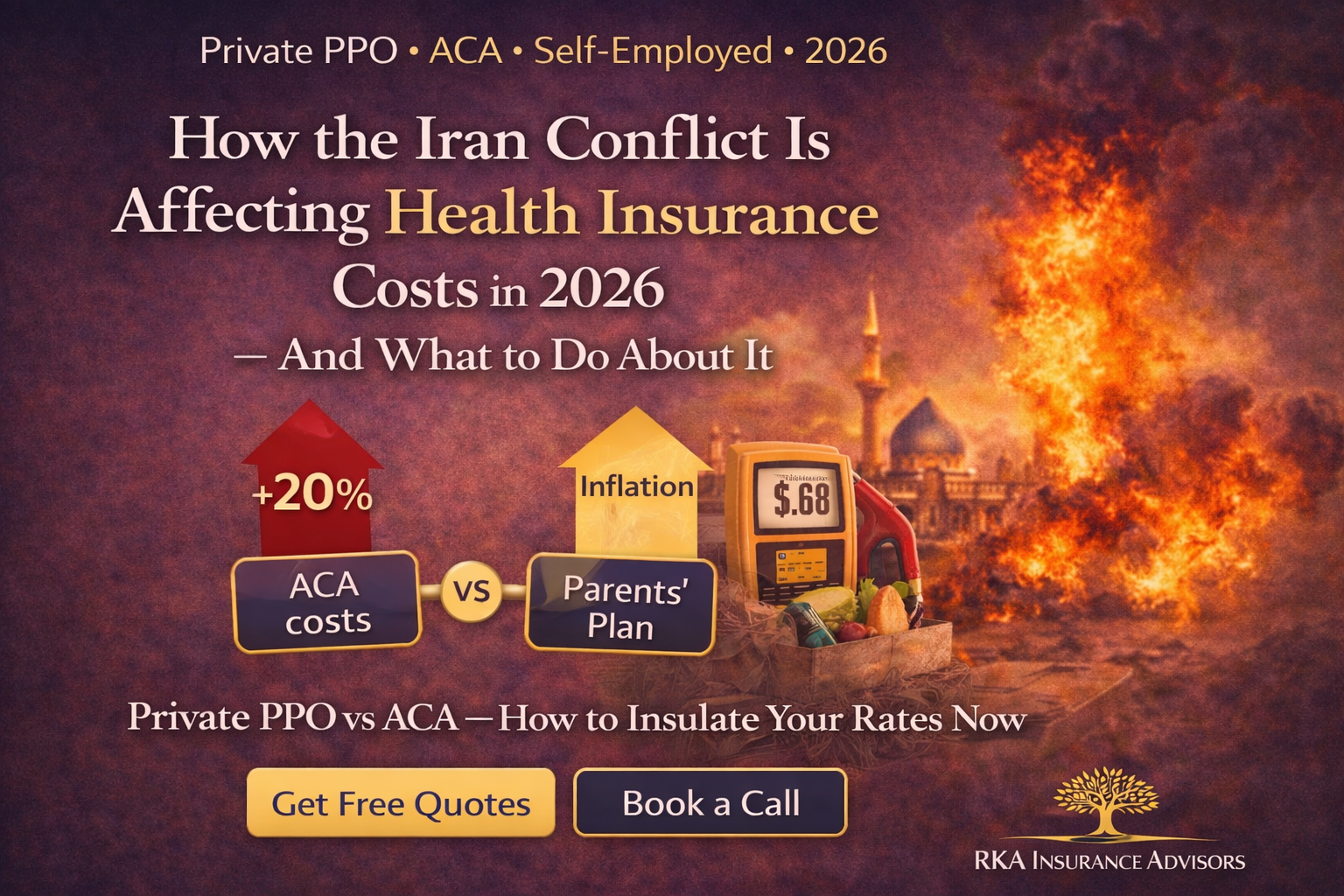
How War and Economic Uncertainty Affect Your Health Insurance in 2026
ACA premiums are already up 18-20% in 2026 — the largest increase since 2018. The Iran conflict is accelerating inflation across housing, gas, and groceries. Here's what that means for your health coverage and the one option that's insulated from all of it.
Private PPO • ACA • Self-Employed • 2026
How the Iran Conflict Is Affecting Health Insurance Costs in 2026 — And What to Do About It
The numbers before we even get to the war
Before the Iran conflict became a factor, the 2026 health insurance picture was already the worst in nearly a decade. Enhanced ACA subsidies that had been in place since 2021 expired at the end of 2025. The impact was immediate and severe.
(Peterson-KFF Health System Tracker)
(KFF Survey, March 2026)
(KFF Survey, March 2026)
That's the baseline. Now add the Iran conflict.
How the Iran conflict accelerates the problem
War doesn't directly change your health insurance premium. But it does drive inflation — and inflation drives health insurance costs through several channels that are already under pressure in 2026.
How conflict drives health costs up
- Oil price spikes → higher logistics and supply chain costs for medical supplies and pharmaceuticals
- Broader inflation → hospitals and providers raise prices to cover operating costs
- Drug manufacturing disruption → specialty medication costs increase
- Labor cost inflation → medical staffing gets more expensive
- Economic anxiety → delayed care followed by higher-acuity claims
What's already happened
- Gas prices up following Feb. 28 Iran conflict onset
- Grocery inflation accelerating in Q1 2026
- Insurers projecting 7–8% medical cost trend for 2026
- Specialty drug costs rising double digits
- ACA risk pool shrinking as healthy enrollees exit — driving remaining costs higher
ACA vs Private PPO — How each responds to economic uncertainty
- Premium set by government policy and insurer filings — already up 18–20%
- Subsidy dependency — if Congress changes policy, your cost changes
- Risk pool shrinking — fewer healthy enrollees means higher costs for those remaining
- Inflation passes through to premiums at renewal
- No control over what happens to your rate next year
- Enrollment windows — can't act outside of SEP or open enrollment
- Premium based on your health — not income, not politics
- No subsidy dependency — zero exposure to Congressional action
- Not part of the ACA risk pool — unaffected by pool deterioration
- Rate locked at underwriting — no surprise renewals mid-year
- Available any month — no enrollment window dependency
- Nationwide PPO network — works in any state, any economic environment
Who benefits most from switching right now
Self-employed & 1099
- Freelancers, consultants, contractors
- Above subsidy threshold — paying full ACA rate
- Health-based pricing often significantly lower
- Available any month — no waiting for enrollment
Small business owners
- No group plan — buying individually
- Current ACA rate jumped 18–20% at renewal
- Private PPO not tied to ACA rate filings
- Rate set at underwriting — predictable going forward
Real estate, gig & commission earners
- Variable income — ACA subsidy reconciliation creates tax risk
- Private PPO has zero income reporting requirement
- No subsidy clawback at tax time
- Premium stays consistent regardless of income year
We compare your current ACA cost against private PPO options for your health profile. Most healthy self-employed applicants are surprised how much the difference is. Free quotes, no obligation, no pressure.
What private PPO actually costs right now
For healthy applicants, private medically underwritten plans price based on age and health — not on whatever the ACA risk pool is doing or what Congress decided about subsidies. Current approximate ranges for healthy non-smokers in 2026:
Age 25–35
- $120–$240/month typical range
- $0 deductible plans available
- Nationwide PPO access
- Lowest rates in your lifetime
Age 35–50
- $220–$430/month typical range
- Multiple deductible options
- Often 30–50% less than current ACA full rate
- Rate locked at approval
vs ACA unsubsidized 2026
- Silver plan: $350–$550/month
- Gold plan: $450–$650/month
- Up 18–20% from 2025
- Further increases likely in 2027
*Private PPO ranges are illustrative estimates for healthy non-smokers. Actual premiums vary by age, state, health history, plan, and underwriting outcome. ACA estimates based on 2026 market data for unsubsidized enrollees.
Frequently Asked Questions
Does war directly affect my health insurance premium?
Not directly — wars don't trigger immediate premium changes. But armed conflict drives inflation through energy prices, supply chains, and labor costs. Those inflationary pressures flow into healthcare costs over time, which insurers factor into the following year's premium filings. ACA premiums were already elevated in 2026 before the Iran conflict. The conflict adds additional inflationary pressure on an already stressed system.
Will ACA premiums go up again in 2027?
Based on current trends — continuing inflation, a shrinking and sicker ACA risk pool, rising drug costs, and geopolitical uncertainty — further increases in 2027 are likely. Insurers are already seeing the spiral effect: as healthy people exit the ACA market, remaining costs rise for those who stay, which drives more healthy people out. Private PPO exits this cycle entirely because it's individually underwritten, not pool-based.
What if the subsidies come back?
Subsidy reinstatement would reduce ACA costs for those who qualify by income. But it wouldn't help anyone above the subsidy threshold — and it comes with a perpetual political risk that subsidies can be changed or removed again. Private PPO has no subsidy dependency in either direction. Your rate is based on your health at the time of underwriting, period.
Can I switch from ACA to private PPO mid-year?
Yes. Private medically underwritten plans are available any month of the year with no enrollment window. If you're approved, your coverage can start as soon as the following month. You'd cancel your ACA plan once the private plan is active — typically timing it for a clean month-to-month transition with no gap.
What if the conflict escalates — could that affect private PPO plans?
Private PPO plans are not war risk insurance — they cover domestic healthcare costs the same way in any geopolitical environment. Broader inflation could eventually affect private plan renewal rates, but private plans adjust individually at renewal rather than through the systemic ACA pool mechanism. And importantly, you lock in your rate at underwriting — it doesn't change mid-year regardless of what happens.
Who doesn't qualify for private PPO?
Private medically underwritten plans require a health questionnaire. Applicants with significant health history — active chronic conditions, recent hospitalizations, multiple ongoing medications — may not qualify. For those individuals, ACA marketplace coverage remains the right path. We'll tell you honestly which option makes sense for your situation before you apply for anything.
We're an independent broker licensed in 32 states. We compare your ACA cost against private PPO options based on your exact health profile and tell you honestly what makes sense. No pressure, no obligation.
Robert Adams * President & Licensed Agent * NPN 19540130 * Licensed in 32 states. Statistical data sourced from KFF Survey (March 2026), Peterson-KFF Health System Tracker (January 2026), Commonwealth Fund (September 2025), and CNBC (March 2026). Premium estimates are illustrative ranges and are not guaranteed. Actual premiums vary by age, state, tobacco status, plan selection, carrier, and underwriting outcome. Private medically underwritten plans are not ACA-compliant and are subject to medical underwriting — not all applicants qualify. This content is for informational purposes only and does not constitute insurance, financial, or legal advice.

What Happens to Your Health Insurance When You Sell Your Business?
Selling your business is one of the most significant health insurance events of your life. Your group plan ends. COBRA is expensive and temporary. ACA subsidy eligibility depends on your post-sale income. For healthy business owners, private medically underwritten PPO plans often provide the best coverage at the lowest cost.
Private PPO • Business Owners • Self-Employed
What Happens to Your Health Insurance When You Sell Your Business?
The health insurance detail most exit advisors skip
Most business owners who carry health coverage do so through a group plan tied to the business. The moment ownership transfers, that plan ends. In an asset sale — the most common structure for small and mid-size businesses — coverage almost always terminates on the last day of the month in which the deal closes.
Your exit attorney, CPA, and M&A advisor are focused on the transaction. Health insurance rarely comes up until after closing. The result: sellers find themselves scrambling for coverage in a 20–30 day window with few good options lined up.
There are three paths. Knowing them before you close makes all the difference.
Your three options compared
- Keeps your exact existing plan
- Same doctors, same network
- No health screening required
- Retroactive — elect within 60 days
- Full premium — yours + employer's share
- Plus 2% administrative fee
- Expires at 18 months
- $900–$2,000+/mo individual
- Guaranteed issue — no health screening
- Subsidies possible below 400% FPL
- Business sale triggers Special Enrollment
- Capital gains count as MAGI income
- Large exit may eliminate subsidies
- Often HMO/EPO — regional networks
- $700–$1,200+/mo above subsidy cliff
- Premium based on health — not income
- Nationwide PPO — no referrals required
- Deductible options from $0 and up
- Available any month — no enrollment window
- No income reconciliation at tax time
- Terms don't change if you get sick after approval
- Health questionnaire required
- Not available with significant health history
Why a business sale changes the ACA subsidy math
ACA premium subsidies are based on Modified Adjusted Gross Income (MAGI). A business sale typically generates a capital gain — and capital gains count as MAGI. A seven-figure exit in a single year can push your income well above the subsidy threshold, even if your ongoing post-sale income is modest.
Before assuming ACA subsidies are available, work with your CPA to model your post-sale taxable income by year. Installment sales and earnout structures can spread income across multiple years and change the subsidy picture significantly.
Who qualifies for a private medically underwritten plan
Likely to qualify
- No major chronic conditions
- No hospitalizations in past 2–3 years
- Minimal or no ongoing prescriptions
- No active or planned specialty care
- Non-smoker or quit 12+ months ago
May not qualify
- Type 1 or Type 2 diabetes
- History of cardiac events or heart disease
- Active cancer or recent remission
- Multiple ongoing specialty medications
- Autoimmune conditions (MS, lupus, RA)
If you don't qualify for private coverage, COBRA or ACA marketplace remain the right path. We compare all three options honestly and will tell you which makes sense for your situation.
The right time to plan this is before the deal closes
60–90 days before closing
- Get pre-screened for private PPO eligibility
- Model ACA subsidy eligibility with your CPA
- Check COBRA cost from your current plan documents
30 days before closing
- Apply for private coverage timed to coverage end date
- Underwriting typically takes 2–4 weeks
- 60-day COBRA window available as backstop
At and after closing
- Coverage ends last day of closing month
- 60-day COBRA election window begins
- Private plan active — no gap if timed correctly
We compare COBRA, ACA, and private PPO options side by side — and pre-screen private plan eligibility before you apply. No pressure, no obligation.
Frequently Asked Questions
Does my coverage end on closing day or end of month?
In most cases, coverage ends on the last day of the month in which the sale closes. If your deal closes April 10, you're typically covered through April 30. Confirm with your group plan administrator — terms vary by carrier.
Does my capital gain from the sale count as ACA income?
Yes. Capital gains count toward ACA Modified Adjusted Gross Income (MAGI). A large one-time gain from a business sale can push your income above the subsidy threshold for that year. Work with your CPA to model this before assuming subsidy eligibility.
Can I stay on my plan if the buyer keeps the business running?
In a stock sale where the buyer retains the business entity and employees, the group plan may continue under new ownership. In most asset sales, the plan terminates with the old entity. Confirm with your benefits administrator during due diligence.
How quickly can a private PPO go into effect?
Most private plans take 2–4 weeks from application to underwriting decision. Coverage typically starts on the first of the following month. Apply 30–45 days before your group coverage ends to ensure a clean transition with no gap.
What if I'm not sure about my health history?
We pre-screen applicants before submitting a formal application so you have a realistic picture of approval likelihood before anything goes on record. No pressure, no obligation.
What if I don't qualify for a private plan?
If private underwriting isn't available based on your health history, COBRA or ACA marketplace plans remain solid options. We give you an honest side-by-side cost comparison for all three scenarios.
COBRA cost, ACA subsidy estimate, and private PPO options — side by side, before the deal closes. Most healthy sellers are surprised at the difference.
Robert Adams * President & Licensed Agent * NPN 19540130 * Licensed in 32 states. Premium estimates are illustrative ranges and are not guaranteed. Actual premiums vary by age, state, tobacco status, plan selection, carrier, and underwriting outcome. Private medically underwritten plans are not ACA-compliant and are subject to medical underwriting — not all applicants qualify. COBRA timelines and costs vary by plan. Consult your benefits administrator and a licensed advisor for your specific situation. This content is for informational purposes only and does not constitute insurance, legal, tax, or financial advice.
Health Insurance for Self-Employed Floridians: What to Know in 2026
Florida has more solo incorporated businesses per capita than any other state. If you're self-employed and above the ACA subsidy threshold, you may be overpaying for coverage. Private medically underwritten plans often cost 30-50% less for healthy Floridians.
Private PPO • Florida • Self-Employed
Health Insurance for Self-Employed Floridians: What to Know in 2026
We'll compare private and marketplace options side by side — no obligation.
Why Florida Has a Health Insurance Problem Worth Talking About
Florida consistently ranks first in the nation for incorporated self-employed workers per capita. The combination of no state income tax, warm weather, and a business-friendly regulatory environment has attracted hundreds of thousands of freelancers, consultants, sole proprietors, and small business owners over the past decade — and that number keeps growing as remote work enables relocation from high-tax states like New York, California, and Illinois.
That's great for Florida's economy. But it creates a concentrated population of people who have to buy their own health insurance — and many of them are paying far more than they need to.
The ACA Subsidy Cliff: Who It Hits Hardest
The Affordable Care Act offers significant premium subsidies for households earning up to 400% of the federal poverty level (FPL). In 2026, that's roughly $62,000 for a single person and $127,000 for a family of four. Enhanced subsidies through recent legislation have expanded eligibility somewhat, but there's still a hard threshold beyond which you receive little or no federal assistance.
For self-employed Floridians whose income exceeds that threshold — or whose net income fluctuates year to year — full marketplace rates can be steep:
Single, Age 35
- Bronze ACA: $320–$420/mo
- Silver ACA: $430–$560/mo
- Gold ACA: $530–$680/mo
Unsubsidized. Full premium.
Single, Age 45
- Bronze ACA: $420–$560/mo
- Silver ACA: $560–$720/mo
- Gold ACA: $680–$860/mo
Unsubsidized. Full premium.
Couple, Ages 40/42
- Bronze ACA: $780–$980/mo
- Silver ACA: $1,000–$1,280/mo
- Gold ACA: $1,200–$1,500/mo
Unsubsidized. Full premium.
These are estimates based on 2026 Florida marketplace rates in major metro areas. Actual premiums vary by zip code, carrier, and plan. The point: if you're not receiving subsidies, marketplace coverage is expensive — and many self-employed Floridians have an alternative worth exploring.
The Alternative: Private Medically Underwritten Coverage
Outside the ACA marketplace, a separate market exists for private medically underwritten plans with a nationwide PPO network. These plans are not sold on healthcare.gov. They require a health questionnaire and, in some cases, a brief medical review. If you qualify, the savings can be significant.
Guaranteed Issue
- No health questions required
- Everyone pays the same rate by age/zip
- Subsidies available below income threshold
- Premiums high above subsidy cliff
- Limited networks in some FL counties
- Risk pool includes all health conditions
Medically Underwritten
- Health questionnaire required
- Lower premiums for healthy applicants
- Nationwide PPO network access
- Flexible plan designs and deductibles
- No open enrollment window required
- Not available if significant health history
For a healthy 40-year-old in Florida, a private medically underwritten plan with a nationwide PPO network starts at $266/month and typically runs $266–$350/month — compared to $420–$560/month for an unsubsidized ACA Silver plan. That's a savings of $900–$1,800/year for comparable coverage.
Who Qualifies in Florida
Eligibility is based on your health history, not your income. The underwriting process typically reviews the past 3–5 years of medical records and asks about conditions including but not limited to: diabetes, heart disease, cancer, autoimmune disorders, ongoing prescription medication use, and recent hospitalizations.
Likely to Qualify
- No major chronic conditions
- No recent hospitalizations (past 2 years)
- No ongoing specialty care
- Minimal or no prescription medications
- Non-smoker (or quit 12+ months ago)
- Healthy BMI range
May Not Qualify
- Type 1 or Type 2 diabetes
- Heart disease or prior cardiac events
- Active cancer treatment or recent history
- Multiple ongoing prescriptions
- Autoimmune conditions (lupus, MS, etc.)
- Recent surgery or planned procedures
If you don't qualify for a private plan, the ACA marketplace remains the right option — especially if subsidies are available. There's no one-size-fits-all answer, which is why it makes sense to compare both before enrolling.
Florida-Specific Considerations
A few things that make Florida's self-employed health insurance landscape distinct:
No State Income Tax Advantage
- Self-employed health insurance premiums are deductible federally
- No Florida state income tax to offset
- Premium savings go straight to your bottom line
- Lower monthly cost = more cash flow for the business
New Residents from High-Cost States
- Relocating from NY, CA, IL? Rates are lower here
- New to self-employment after a move? No COBRA required
- Can apply for private coverage any time of year
- No open enrollment window to wait for
We run quotes on both private and marketplace options so you can compare apples to apples before deciding.
What the Process Looks Like
If you're interested in a private medically underwritten plan, here's what to expect from start to finish:
Step 1 — Get Quotes
- Submit basic info and health snapshot
- Receive side-by-side comparison
- Private vs marketplace vs hybrid options
- No obligation, takes about 5 minutes
Step 2 — Review & Apply
- Choose a plan that fits your budget
- Complete the health questionnaire
- Underwriting review (typically 3–7 days)
- Approval, counteroffer, or decline issued
Step 3 — Coverage Starts
- Effective date typically 1st of following month
- ID cards issued within 1–2 weeks
- Access to full nationwide PPO network immediately
- No waiting for open enrollment
Frequently Asked Questions
Is a private medically underwritten plan legal in Florida?
Yes. Private medically underwritten plans are legal in Florida and in all states where RKA operates. They are not sold on the ACA marketplace and are not subject to ACA guaranteed-issue rules, but they are fully licensed and regulated products.
Can I deduct the premiums as a self-employed person?
In most cases, yes. Self-employed individuals can deduct 100% of health insurance premiums paid for themselves, their spouse, and dependents as an above-the-line deduction on federal taxes. Consult your CPA for your specific situation, as deductibility depends on your business structure and net profit.
What if I get sick after I enroll — can they cancel my coverage?
No. Once you are approved and enrolled, the carrier cannot cancel your coverage due to a new diagnosis or change in health. The underwriting only applies at the time of application. Renewal rates may change, but the plan cannot be rescinded for medical reasons after approval.
Do these plans cover specialists and hospitals in Florida?
Yes. Private medically underwritten plans through RKA use a nationwide PPO network with access to major hospital systems and specialists throughout Florida, including in Miami, Tampa, Orlando, Jacksonville, and other metro areas. You can verify specific providers before enrolling.
What if I don't qualify for a private plan?
If you don't qualify based on your health history, we'll show you the best available ACA marketplace options for your zip code and income level. If subsidies are available, we factor those in too. You leave with a clear picture either way — no pressure to buy anything.
I moved to Florida recently. Can I still apply?
Yes. There's no residency waiting period for a private medically underwritten plan. If you recently relocated to Florida from another state, you can apply immediately — no open enrollment window required. A recent move may also qualify you for a Special Enrollment Period on the ACA marketplace if you prefer that route.
RKA Insurance Advisors runs quotes on private medically underwritten plans and ACA options so you can compare both — free, no obligation.
Premium estimates are illustrative ranges based on 2026 Florida marketplace data and are not guaranteed. Actual premiums vary by age, zip code, tobacco status, plan selection, and carrier. Private medically underwritten plan availability and pricing are subject to underwriting approval. RKA Insurance Advisors LLC, NPN 19540130, licensed in 32 states. This content is for informational purposes only and does not constitute insurance advice.
Starting a New Business? Here's Your Health Insurance Game Plan
Starting a new business with unpredictable income? Private underwritten PPOs eliminate subsidy reconciliation hassles and may offer plans with deductibles as low as $0—often beating ACA high-deductible plans with healthier risk pools and supplemental coverage.
Starting a New Business? Here's Your Health Insurance Game Plan
Fast take: Left your job to start a business? Your health insurance strategy matters as much as your business plan. With unpredictable first-year income, private underwritten PPOs eliminate subsidy reconciliation hassles and may offer plans with deductibles as low as $0—often beating high-deductible ACA plans with better networks and lower total costs.
Just went full-time on your business?
We'll compare COBRA, ACA, and private PPO options—and verify your doctors stay covered while you build.
Get Free Quotes Book a CallYour coverage options when starting a business
COBRA (Bridge Option)
✓ Keep your old employer plan
✓ Same doctors and networks
✗ Usually most expensive
✗ Time-limited (18 months max)
ACA Marketplace
✓ May be cheapest with subsidies
✓ Loss of job = Special Enrollment
✗ Often HMO/EPO networks
✗ Income reconciliation at tax time
✗ High deductibles ($7,000-$9,000+)
Private Underwritten PPO
✓ May qualify for deductibles as low as $0
✓ Nationwide PPO access
✓ Year-round enrollment
✓ No income reporting
✓ Healthier risk pools
Why unpredictable income is a nightmare with ACA subsidies
The income estimation trap
When you enroll in ACA, you estimate your 2026 income in advance. First-year business? You're guessing.
✗ Estimate too low → subsidy payback at tax time
✗ Estimate too high → overpay premiums all year
✗ Business takes off mid-year? You owe thousands back
Private PPO eliminates the guessing game
Your premium is based on age, ZIP, and plan—not income.
✓ Make $50k or $500k? Premium stays the same
✓ No Form 8962 reconciliation at tax time
✓ Budget with confidence from day one
Why private underwritten PPOs beat high-deductible ACA plans
Many entrepreneurs think high-deductible Marketplace plans are their only affordable option. That's rarely true for healthy business owners.
ACA high-deductible plans
✗ $7,000-$9,000+ deductibles common
✗ You pay 100% until deductible is met
✗ Risk pool includes all applicants (healthy + unhealthy)
✗ Often HMO/EPO with referral requirements
✗ Premium jumps if income rises
Private underwritten PPOs
✓ May qualify for deductibles as low as $0
✓ Copays often start immediately (office visits, Rx)
✓ Risk pool = healthy small business owners/employees
✓ Nationwide PPO networks, no referrals
✓ Premium never changes with income
The risk pool advantage: Why private plans cost less for healthy entrepreneurs
ACA Marketplace risk pools
Guaranteed issue = everyone accepted regardless of health
Risk pool includes:
• Healthy applicants
• Chronic conditions
• High-cost ongoing treatments
Result: Higher premiums spread across everyone, including you
Private underwritten risk pools
Medical underwriting = healthier risk pool through association memberships
Risk pool includes:
• Healthy business owners
• Small business employees
• Self-employed professionals
Result: Lower premiums for healthy applicants, better benefits, lower deductibles
Supplemental coverage: Offsetting out-of-pocket costs
Even with low-deductible private PPOs, you can further reduce financial risk with supplemental coverage:
Hospital indemnity insurance
Pays cash benefit per day of hospitalization
✓ Use cash for deductibles, copays, or lost income
✓ Low monthly cost ($30-$80/month typical)
Accident insurance
Covers ER visits, urgent care, broken bones, imaging
✓ Pays lump sum or per-service benefits
✓ Complements your major medical plan
Critical illness insurance
Lump-sum payment if diagnosed with covered condition (heart attack, stroke, cancer)
✓ Use for medical bills, travel, mortgage—anything
✓ Peace of mind for catastrophic events
Strategy: Layer your protection
Private PPO with low deductible + hospital indemnity ($500/day) = near-zero financial risk
Total monthly cost often less than ACA high-deductible plan alone
Why entrepreneurs choose private PPO plans
No income reconciliation headaches
Your premium doesn't change when your business revenue fluctuates. No Form 8962, no tax-time surprises, no subsidy payback.
Travel-friendly nationwide networks
Client meetings in Austin? Conference in Denver? PPO access means you're covered wherever business takes you—no network restrictions.
Direct specialist access
No primary care referrals. No waiting weeks for authorization. See specialists when you need them without bureaucratic delays.
Lower total annual costs
Low-deductible PPO often costs less annually than $8,000 deductible ACA plan when you factor in total out-of-pocket exposure.
Common mistakes new business owners make
❌ Staying on COBRA too long
COBRA is expensive and time-limited. It's a bridge, not a long-term solution. Compare alternatives within 60 days.
❌ Underestimating income for subsidies
Business takes off? You'll owe subsidy money back at tax time. Estimate conservatively or skip subsidies entirely with private PPO.
❌ Accepting high deductibles as inevitable
ACA high-deductible plans aren't your only option. Private underwritten PPOs may offer plans with deductibles as low as $0 for healthy applicants.
❌ Not considering supplemental coverage
Hospital indemnity and accident insurance can eliminate remaining out-of-pocket exposure for less than $100/month.
Decision guide: Which option fits your business?
Choose ACA Marketplace if...
✓ Your first-year income will be very low (under $35k individual)
✓ You qualify for strong subsidies and cost-sharing reductions
✓ Your income is stable and predictable
✓ You're comfortable with high deductibles and HMO networks
✓ You don't mind annual tax reconciliation
Choose Private Underwritten PPO if...
✓ Your income is variable or growing (startup revenue unpredictable)
✓ You're healthy and pass medical underwriting
✓ You want lower deductibles and immediate copays
✓ You travel frequently for business
✓ You prefer nationwide PPO access with no referrals
✓ You want to avoid subsidy reconciliation at tax time
Your launch timeline: Health insurance edition
Before you leave your job
✓ Document your last day of employer coverage
✓ Get COBRA election notice
✓ List your current doctors and prescriptions
✓ Estimate your Year 1 business income range (low and high scenarios)
First 60 days after leaving
✓ Compare COBRA vs ACA vs private PPO costs and deductibles
✓ Verify provider networks for all options
✓ Get quotes for supplemental coverage (hospital indemnity, accident)
✓ Enroll in your long-term solution before Special Enrollment window closes
First year in business
✓ Track actual income monthly (if on ACA, update estimates)
✓ Keep records for self-employed health insurance tax deduction
✓ Set aside emergency fund for deductibles and out-of-pocket costs
✓ Review supplemental coverage needs as business stabilizes
Annual review
✓ Reassess coverage during Open Enrollment (or anytime with private PPO)
✓ Compare costs as your income stabilizes
✓ Verify doctors are still in-network
✓ Adjust deductible level based on actual business cash flow
How RKA helps entrepreneurs
Fast transition planning
We map your options before your last day of work—COBRA bridge strategies, Special Enrollment timing, and private PPO alternatives with accurate underwriting pre-screening.
Network verification
We confirm your doctors and hospitals are in-network across all options—ACA, private PPO, and supplemental plans—before you commit.
Total cost analysis
We model multiple income scenarios and compare: premiums + deductibles + expected usage + supplemental coverage = your true annual cost.
Supplemental layering strategy
We show you how hospital indemnity, accident, and critical illness coverage can eliminate remaining out-of-pocket exposure affordably.
Launching your business? Lock your health insurance first.
We'll compare COBRA, ACA, and private underwritten PPO options—verify your doctors—and layer supplemental coverage to eliminate financial risk.
Get Free Quotes Book a CallQuick FAQs
Why is private underwritten PPO cheaper than ACA high-deductible if I'm healthy?
Risk pool matters. ACA pools include everyone regardless of health, spreading costs across healthy and unhealthy. Private underwritten plans pool healthy small business owners, employees, and self-employed professionals through association memberships, resulting in lower premiums and better benefits.
What if my business income is unpredictable?
Private PPO eliminates the guessing game. Your premium is based on age and ZIP—not income. Make $50k or $500k, your premium stays the same. No subsidy reconciliation, no Form 8962, no tax-time surprises.
How does supplemental coverage work with my major medical plan?
Supplemental policies (hospital indemnity, accident, critical illness) pay cash benefits directly to you—use the money for deductibles, copays, lost income, or anything else. They stack on top of your major medical plan to eliminate financial risk.
For education only; consult a tax professional for deduction advice. Eligibility for private underwritten plans subject to medical underwriting. Benefits vary by carrier and state. Always review official plan documents.

Truckers Health Insurance 2026: Owner-Operators & CDL Drivers Guide | RKA
Owner-operators and OTR drivers are self-employed — no employer benefits, no W-2, no payroll-deducted insurance. For healthy CDL holders, private medically underwritten PPO plans deliver real major medical with nationwide network access — often well below unsubsidized ACA. Available year-round.
Private PPO • Trucking • Self-Employed
Health Insurance for Owner-Operator and OTR Truckers in 2026
The coverage gap most truckers don't realize they have
Company drivers get a benefits package — health, dental, vision, sometimes retirement. The moment you go owner-operator, every benefit becomes your problem. Fuel, insurance on the rig, maintenance, plates, ELD service — and somewhere on that list, often near the bottom, is real health coverage for you and your family.
The result is predictable. Most owner-operators carry coverage that's either too expensive (full unsubsidized ACA), too limited (occupational accident only), or non-existent (rolling the dice). Each has a better alternative for healthy drivers.
Your four options compared
- Group benefit programs through trucker associations
- Quality varies — some real major medical, some limited benefit
- No health questions for some plans
- Often have caps, exclusions, or limited PPO networks
- Premium increases driven by entire association pool
- Guaranteed issue — no health screening
- Subsidies available below ~$60K income (single, 2026)
- Best option if you qualify for subsidies
- Many plans HMO/EPO with state-limited networks
- Full unsubsidized rate above the income threshold
- Lower premiums upfront
- Useful as 60–90 day bridge between coverage
- Doesn't cover preexisting conditions
- Often excludes maternity, mental health, prescription
- Doesn't count as minimum essential coverage
- Off-exchange plans with nationwide PPO networks
- Real major medical with defined deductibles
- Available any month — no enrollment window
- Best rates for healthy CDL holders
- Health questionnaire required — not all applicants qualify
Why nationwide PPO matters more for truckers than almost anyone
If you run a regional lane in three states, an HMO might cover you. If you run TX–FL, I-10 coast-to-coast, or any true OTR schedule, regional networks are a problem waiting to happen.
Picture this: you slip getting out of the cab in a Pilot lot in New Mexico, fracture your wrist 1,800 miles from home. The local urgent care is in your network as far as Albuquerque is concerned — but on your HMO plan, it's out-of-state. You pay full price, then fight your insurer for partial reimbursement that may or may not come.
A nationwide PPO works the same in every state. Same network rules, same in-network rate, same coverage. For multi-state lane drivers, this is the actual point of having insurance.
Multi-state lanes
- Same network rules in any state
- No out-of-network surprises
- In-network rate from coast to coast
Telehealth from the cab
- 24/7 virtual visits included on most plans
- Sick on a 14-hour day? Talk to a doctor without leaving the truck
- Prescriptions sent to any pharmacy
ER coverage anywhere
- Emergency care covered at in-network rates
- No state-specific exclusions
- Specialist access without referrals
Why owner-operators are often a strong fit for medical underwriting
Medical underwriting means the carrier reviews your health history before approving coverage. Healthy applicants get the best rates — and the average active owner-operator is healthier than the general population for one specific reason: the DOT physical.
To hold a CDL, you pass a DOT medical exam (49 CFR 391.41) — typically every 24 months. That means your blood pressure, vision, hearing, BMI, and basic cardiovascular health are tracked and acceptable, or you don't have a CDL. Most active owner-operators are functionally pre-screened on baseline health, which is exactly what private underwriting looks for.
We compare ACA, private PPO, and association options for your specific age, state, and health profile — and tell you honestly which one makes sense. No pressure, no obligation.
Occupational Accident is not health insurance
Occupational accident coverage (OccAcc) is a workers-comp-style policy many owner-operators carry through their motor carrier or independently. It pays if you're hurt while working. It does not cover anything that happens off the truck — a heart attack at home, your kid's tonsils, your wife's pregnancy, your annual physical, the flu. None of that is OccAcc territory.
OccAcc and major medical are two different products. You probably need both — but using OccAcc as a substitute for health insurance is one of the most expensive mistakes owner-operators make. One non-occupational hospital stay can wipe out years of savings.
The self-employment health insurance deduction
Owner-operators filing Schedule C can typically deduct 100% of health insurance premiums paid for themselves, their spouse, and dependents — as an above-the-line deduction on Form 1040. That doesn't reduce self-employment tax, but it does reduce federal income tax dollar-for-dollar against your premium cost.
For a driver paying $500/month and netting $90,000, the deduction often saves $1,200–$1,800 a year in federal income tax. The premium net of deduction can be meaningfully lower than the headline number. Confirm with your CPA — premiums can't exceed your net Schedule C profit for the year.
Who qualifies — and who doesn't
Likely to qualify
- Active CDL with current DOT medical card
- No hospitalizations in past 2 years
- No major chronic conditions
- Non-smoker (or quit 12+ months ago)
- BMI within DOT-acceptable range
- No active or planned major surgery
May not qualify
- Type 1 or insulin-dependent Type 2 diabetes
- Active cancer treatment or recent remission
- Recent cardiac event (heart attack, bypass, stent)
- Active autoimmune disease (MS, lupus, severe RA)
- Multiple ongoing specialty medications
If your health history puts private underwriting out of reach, ACA marketplace is the right path — guaranteed issue, no health questions, subsidies available below ~$60K income for individuals. We compare both options honestly and tell you which makes sense for your specific situation.
What private PPO actually costs
Premium depends on your age, state, tobacco status, household size, and the specific plan you choose. There is no one-size-fits-all number — what matters is the comparison between unsubsidized ACA and private PPO for your situation.
For most healthy truckers, the math frequently favors private PPO once household income crosses the ACA subsidy threshold. Younger drivers often see the biggest gap — a healthy 25-year-old can sometimes find private PPO well under what an unsubsidized ACA Bronze plan costs, with a real PPO network instead of a regional HMO.
We run the side-by-side for free. Free quotes return real numbers for your age, state, and household — not estimates pulled out of thin air.
How the timing works for an owner-operator
Step 1 — Pre-screen
- 10-minute health questions
- Confirms likelihood of approval
- No formal application yet, no record
- No obligation
Step 2 — Quote & Compare
- Side-by-side: private PPO vs ACA
- For your age, state, health profile
- Verify your existing doctors in-network
- Pick the plan that fits
Step 3 — Apply & Activate
- Formal underwriting takes 7–14 days
- Coverage typically starts 1st of next month
- Apply 30–45 days before target start date
- ID cards within 1–2 weeks
Frequently Asked Questions
Can I keep coverage when I'm running multi-state lanes?
Yes. Private PPO plans use nationwide PPO networks (BCBS PPO, Aetna PPO, UnitedHealthcare Choice Plus, and similar). Same network rules and rates apply in any state — no in-state-only restrictions like most ACA HMO plans.
What's the difference between OOIDA's plans and private PPO?
OOIDA member benefit programs are association-sponsored — quality and structure varies by program and year. Some are real major medical, some are limited benefit programs that cap payouts. Private PPO plans are individually underwritten with defined deductibles and out-of-pocket maximums consistent with traditional health insurance. We can compare your OOIDA program against private PPO options if you want a side-by-side.
I'm currently on a short-term plan. Should I switch?
Probably yes, if you're healthy enough to qualify for private PPO. Short-term plans don't cover preexisting conditions, often exclude major categories like maternity and mental health, and don't count as minimum essential coverage. They're useful as a 60–90 day bridge — not as ongoing coverage. A private PPO is real major medical with stable terms.
What if I get sick after I'm enrolled in a private PPO?
Once your policy is issued, the carrier cannot cancel you for getting sick. Underwriting only applies at the time of application. Your renewal premium can change at the next annual renewal, but the policy itself doesn't get revoked because you developed a condition after enrollment.
Does this cover my spouse and kids?
Yes. Family plans are available, priced by age and health of each adult. Dependents under 18 don't go through medical underwriting on most plans. If a spouse has a significant health condition that would disqualify them, a split-family approach is possible — one spouse on private PPO, the other on ACA marketplace — and we'll tell you when that math works in your favor.
How does the self-employed health insurance deduction work for owner-operators?
If you have net Schedule C income, you can typically deduct 100% of health insurance premiums paid for yourself, your spouse, and dependents as an above-the-line deduction on Form 1040 — which reduces federal income tax (it doesn't reduce SE tax). Confirm with your CPA for your specific situation. Premiums can't exceed your net Schedule C profit for the year.
Is RKA licensed in my state?
RKA Insurance Advisors is licensed in 30 states: AL, CO, DE, FL, GA, IA, IL, IN, KY, KS, LA, MD, MI, MO, MS, MT, NC, NE, NV, OH, OK, SC, SD, TN, TX, UT, VA, WI, WV, WY. If your home state is on this list, we can quote and enroll you. NPN 19540130.
We help owner-operators and OTR drivers compare every option — ACA, private PPO, association, short-term. Free quotes, honest advice, no pressure.
Robert Adams * President & Licensed Agent * NPN 19540130 * Licensed in 30 states. Premium estimates are illustrative ranges based on 2026 market data and are not guaranteed. Actual premiums vary by age, state, tobacco status, plan selection, carrier, and underwriting outcome. Private medically underwritten plans are not ACA-compliant and are subject to medical underwriting — not all applicants qualify. Occupational accident insurance is a separate product from major medical health insurance and does not provide equivalent coverage. The self-employed health insurance deduction availability and amount depend on individual tax situations — consult your tax advisor. This content is for informational purposes only and does not constitute insurance, legal, tax, or financial advice.