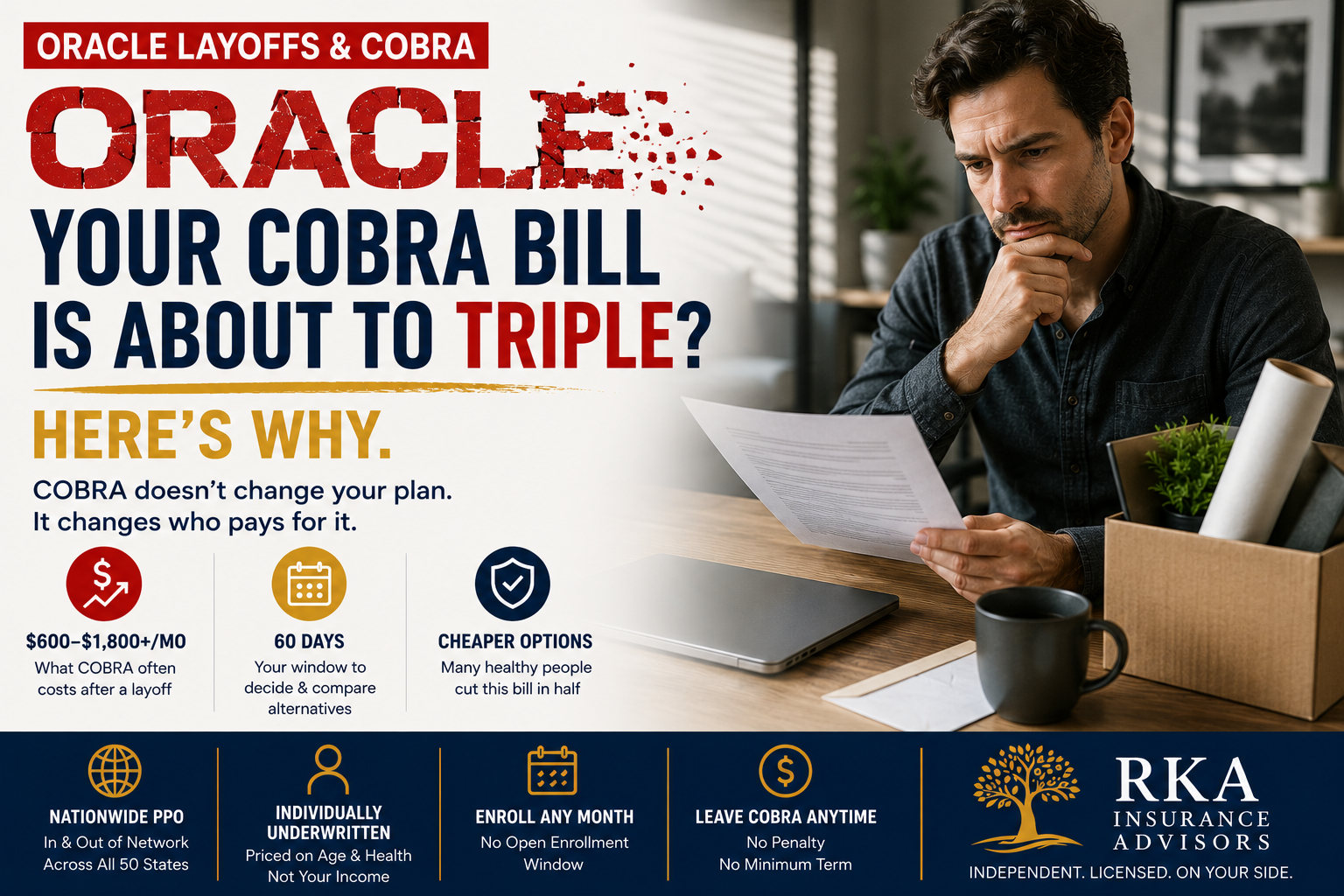
Oracle Layoffs & COBRA: What Your Coverage Will Cost and Cheaper Alternatives
Oracle cut roughly 21,000 roles over the past year. If you were one of them, the COBRA letter in your inbox is about to show you what your health plan actually costs. Here's how COBRA, ACA, and a nationwide private PPO compare —and how healthy people frequently cut the bill in half.
Layoffs & Coverage • COBRA • Private PPO
Oracle Layoffs & COBRA: What Your Coverage Will Cost and Cheaper Alternatives
Why the Oracle COBRA number is such a shock
While you were employed, Oracle carried most of your premium. You saw a modest payroll deduction and never saw the rest. Many Oracle employees have described the company covering only about half of the dependent cost even while employed — which means if you had a family on the plan, you were already paying more than most people do.
COBRA doesn't change your plan. It changes who pays for it. The coverage is identical — same doctors, same pharmacy, same network — but now 100% of the group premium is yours, plus the administrative fee. That's the entire reason the number looks nothing like what you're used to.
Your three real options after an Oracle layoff
COBRA
- Identical plan — zero disruption
- Same doctors and pharmacy
- No health questions
- Retroactive if elected within 60 days
- You pay the full premium — yours and Oracle's
- Plus up to 2% in admin fees
- Ends at 18 months
ACA Marketplace
- Guaranteed issue — no health screening
- Job loss opens a Special Enrollment Period
- Subsidies possible if this year's income drops
- Networks are often regional HMO/EPO
- Severance counts toward income — it can push you past the subsidy line
- Full price if your income stays high
Private PPO (underwritten)
- Priced on your health and age, not your income
- Nationwide PPO access — specialists without referrals
- Available any month — no enrollment window
- No subsidy reconciliation at tax time
- Frequently 30–50% below COBRA for healthy applicants
- Medical underwriting — not everyone qualifies
The severance trap nobody mentions
Your severance is income. If you're counting on an ACA subsidy to make a marketplace plan affordable, run the math on your full-year projected income — severance included. A large lump sum can push you over the subsidy threshold for the year, and the marketplace reconciles that at tax time on Form 8962. People get a subsidy all year, then owe it back. A private PPO doesn't have this problem at all: the premium is set by age and health, so it doesn't care what your severance was or when you land your next role.
How to use your 60-day window correctly
Do this first
- Apply for a private plan now — underwriting takes 2–4 weeks
- Don't elect COBRA on day one; you don't have to
- If approved, coverage starts the first of next month
- If underwriting runs long, elect COBRA retroactively as a backstop
If you already elected COBRA
- You can leave COBRA any month — no penalty, no minimum
- Private plans have no enrollment window
- Cancel COBRA once the new plan activates
- Time it to the first of the month and there's no gap
Plenty of people ride COBRA for the full 18 months without realizing they could have left at any point. If you're three or six months in and healthy, it's still worth running the comparison.
Laid off from Oracle? Get your real numbers in 5 minutes.
We'll put COBRA, ACA and a nationwide private PPO side by side for your exact situation — verify your doctors, check your prescriptions, and tell you straight which one wins. Free, no obligation.
Will you qualify for a private PPO?
Likely to qualify
- No major chronic conditions
- No hospitalizations in the last 2–3 years
- Few or no ongoing prescriptions
- No active or planned specialty care
- Non-smoker, or quit 12+ months ago
May not qualify
- Type 1 or Type 2 diabetes
- Cardiac history or active heart disease
- Active cancer or recent remission
- Multiple ongoing specialty medications
- Autoimmune conditions
If underwriting isn't a fit, that's a real answer and we'll say so — COBRA or the marketplace becomes the right path, and your layoff opens a Special Enrollment Period either way. We're an independent brokerage; the honest recommendation matters more to us than any single sale.
Related reading
- Amazon layoffs & COBRA: why it's too expensive and what to do instead
- Left your job? How to cut your COBRA bill in half
- Marketplace vs private PPO: an honest comparison
Frequently asked questions
How much does COBRA cost after an Oracle layoff?
It's whatever your Oracle plan actually costs, in full, plus up to a 2% administrative fee — not the payroll deduction you were used to seeing. Depending on your plan tier and how many people are on it, that commonly lands between roughly $600 and $1,800+ per month. Your COBRA election notice states your exact figure. If it looks high, that's not an error — it's the first time you're seeing the real price of the plan.
Does Oracle pay for any of my COBRA coverage?
Check your specific severance paperwork, because terms vary by package and by role. Some employers subsidize COBRA for a period; others don't. If yours doesn't include a COBRA subsidy, you're paying the full premium from day one — which is exactly when comparing alternatives is worth the twenty minutes.
How long do I have to decide?
60 days from the date you lost coverage, or from the date on your COBRA election notice, whichever is later. COBRA is retroactive within that window, so electing on day 55 still covers you from day one. Use the window — don't let it expire by default.
Can I leave COBRA later if I find something cheaper?
Yes. You can cancel COBRA at any time with no penalty and no minimum term. If you're approved for a private PPO or enroll in a marketplace plan, you cancel COBRA with the plan administrator and the new coverage takes over.
What if I get another job in a few months?
If your new employer offers group coverage, you enroll as a new hire and drop the private plan. Some people keep the private plan anyway if the new group plan is expensive or has a narrow network. Either way you're not locked in.
Will my doctors be covered?
We check your specific providers before you apply, not after. Nationwide PPO networks reach most physicians, specialists and hospital systems that accept PPO insurance — but we confirm yours by name so there are no surprises.
Compare COBRA vs private PPO with your actual numbers.
Most healthy people coming off a corporate plan are surprised how much comes off the monthly bill. We run the comparison and pre-screen your underwriting eligibility at no cost.
RKA Insurance Advisors is an independent insurance brokerage and is not affiliated with, endorsed by, or sponsored by Oracle Corporation. Oracle is a trademark of its respective owner and is referenced here solely for identification and news-commentary purposes. Workforce-reduction figures are as publicly reported. Severance and benefit terms vary by individual package — always review your own paperwork and plan documents.
Robert Adams * President & Licensed Agent * NPN 19540130 * Licensed in 30 states. Premium estimates are illustrative and based on general market data — actual premiums vary by age, state, health profile, and underwriting outcome. Private medically underwritten plans are not ACA-compliant and are subject to medical underwriting — not all applicants qualify. COBRA costs and timelines vary by employer plan. Consult your benefits administrator and a licensed advisor for your specific situation. This content is for informational purposes only and does not constitute insurance, legal, tax, or financial advice.

Retiring Before 65? How to Bridge the Medicare Gap Without Paying COBRA Rates
Medicare starts at 65. If you're retiring at 60-64, you need real coverage for 1-5 years. COBRA maxes at 18 months and is expensive.For healthy early retirees, private plans often cost 30-50% less than unsubsidized marketplace options.
Private PPO • Pre-Medicare • Early Retirement
Retiring Before 65? How to Bridge the Medicare Gap Without Paying COBRA Rates
The Medicare gap nobody plans for
Early retirement is increasingly common among higher-income professionals who built savings, sold a business, or simply chose to step back before 65. But Medicare doesn't start until age 65. That leaves a 1–5 year window where you need real health coverage but no longer have an employer providing it.
COBRA extends your employer plan for up to 18 months — but at full premium cost plus a 2% administrative fee. For a 62-year-old, COBRA can easily run $800–$1,500/month. For a couple, that climbs to $2,000–$3,500/month. And once COBRA expires, you may still have years left before Medicare kicks in.
Most early retirees default to the ACA marketplace. For those who qualify for subsidies, that works. But if your retirement income — from savings withdrawals, investment income, Social Security, or a pension — puts you above the subsidy threshold, you're paying full unsubsidized rates. For a 62-year-old, that's often $700–$1,100/month or more.
There's a third option most people don't know exists.
Your three options compared
- Keeps existing doctors and coverage
- No health screening required
- Can elect retroactively within 60 days
- Full premium — your share + employer's share
- Plus up to 2% administrative fee
- Expires at 18 months
- $800–$1,500+/mo individual
- Guaranteed issue — no health screening
- Subsidies available below 400% FPL
- Covers until Medicare at 65
- Full unsubsidized rates above income threshold
- $700–$1,100+/mo at 62 unsubsidized
- Often HMO/EPO with regional networks
- Premium based on your health — not age alone
- Healthy applicants pay significantly less
- Nationwide PPO — no referrals required
- $0 deductible options available
- Available any month — no enrollment window
- Covers until Medicare at 65
- $350–$700/mo for healthy 62-year-old*
*Illustrative range for a healthy non-smoker. Actual rates depend on age, health history, and location.
Why this works for healthy early retirees
Most people retiring early in good health are exactly who private medically underwritten plans are built for. No chronic conditions, no recent major procedures, generally healthy lifestyle. Underwriting rewards that profile with lower premiums — often 30–50% less than what the unsubsidized ACA marketplace charges for the same age bracket.
The trade-off is that these plans require medical qualification. You apply, answer health questions, and the carrier underwrites based on your history. If you have significant pre-existing conditions, ACA marketplace plans remain the right path — they cover everyone regardless of health history. We work with both and will tell you honestly which makes sense for your situation.
When to choose each option
COBRA or ACA may be better if...
- You have ongoing treatment in progress
- You're mid-year with a deductible nearly met
- You have a condition that affects private plan eligibility
- You qualify for meaningful ACA subsidies
Private medically underwritten may be better if...
- You're healthy with no active conditions
- Your income is above the ACA subsidy threshold
- You need coverage for more than 18 months
- You want nationwide PPO with no referrals
How to time your Medicare transition
Before coverage ends
- Apply 30–45 days before last day of employer coverage
- No enrollment window — private plans available any month
- Get pre-screened to confirm eligibility first
During the bridge years
- Annual renewable — no time limit
- COBRA can backstop if underwriting takes time
- Coverage terms don't change if you get sick after enrollment
At age 65
- 7-month Medicare enrollment window
- Enroll in Part A and Part B
- Add a Medicare Supplement policy
- Private plan ends when you switch
How RKA helps
What we do
- Compare COBRA, ACA, and private plan costs side by side
- Pre-screen your private plan eligibility
- Verify your doctors are in the new network
- Help you time the transition correctly
What you get
- An honest side-by-side cost comparison
- Coverage that doesn't expire before you hit 65
- No income reporting or reconciliation risk
- A licensed advisor — not a call center
We run the numbers for your specific situation. Most healthy early retirees are surprised at the difference. No pressure, no obligation.
Frequently Asked Questions
Can I keep my current doctors?
Yes. These plans use a nationwide PPO network. You can see any physician or specialist who accepts PPO insurance without a referral — which covers the vast majority of providers in the US.
Is a private underwritten plan cheaper than COBRA?
For healthy applicants, yes — frequently by a significant margin. COBRA requires you to pay the full group premium including your employer's share. Private plans price based on your individual health profile, not the group rate.
What if I get sick after I enroll?
Once your policy is issued, it renews annually. A health event after enrollment does not change your coverage terms or cancel your plan.
What if I have a pre-existing condition and don't qualify?
If you don't qualify for private underwriting, ACA marketplace plans provide guaranteed issue coverage regardless of health history. COBRA may also be the right choice if you have treatment in progress. We'll be straightforward about which path fits your situation.
What happens when I turn 65?
You transition to Medicare. Most people enroll in Medicare Part A and Part B at 65, then add a Medicare Supplement (Medigap) policy. Your private plan ends when you make that switch.
Is this available in my state?
RKA Insurance Advisors is licensed in 32 states. Plan availability varies by state and carrier. A brief call will confirm what's available in your location.
Robert Adams * President & Licensed Agent * NPN 19540130 * Licensed in 32 states. For educational purposes only. *Premium estimates vary significantly by age, state, health history, and plan. Speak to a licensed advisor for exact figures. Private medically underwritten plans are not ACA marketplace plans and are not subject to ACA guaranteed issue protections. Medical underwriting applies; not all applicants qualify.

COBRA Is Expensive. Here's the Private PPO Alternative
COBRA coverage after job loss can cost significantly more than you expect — you're now paying 100% of the premium with no employer subsidy. For healthy applicants, a private underwritten PPO is often a lower-cost alternative with no open enrollment restrictions.
Private PPO • COBRA Alternative • Self-Employed
COBRA Is Expensive. Here's the Private PPO Alternative
Why COBRA costs so much
When you're employed, your employer typically covers a significant portion of your health insurance premium — often 70–80% of the cost. You only see your small share in your paycheck. When you leave that job and elect COBRA, you suddenly become responsible for the entire premium — your share plus your employer's share — plus an administrative fee.
For individual coverage, COBRA costs can be a significant monthly expense. For family coverage, it can be considerably more. Most people are shocked by the amount when they see their COBRA election notice.
COBRA vs Private PPO
- Keeps your existing coverage and doctors
- No health screening required
- Retroactive — can elect after a gap
- You pay full employer + employee premium
- Plus up to 2% administrative fee
- Limited to 18 months in most cases
- Expensive for most healthy individuals
- Underwritten based on your health
- Healthy applicants often pay significantly less
- Nationwide PPO access — no referrals
- Lower deductible options — including $0 deductible plans
- Available any month — no enrollment window
- No time limit on coverage
When COBRA makes sense vs when to switch
COBRA may be better if...
- You have ongoing treatment in progress
- You're mid-year with a deductible nearly met
- You have a health condition that affects PPO eligibility
- You need continuity with specific doctors
Private PPO may be better if...
- You're healthy with no active conditions
- COBRA cost is a significant financial burden
- You want long-term coverage, not just 18 months
- You want nationwide PPO access going forward
How RKA helps
What we do
- Compare your COBRA cost vs private PPO options
- Pre-screen your PPO eligibility
- Verify your doctors are in the new network
- Help you time the transition correctly
What you get
- An honest side-by-side cost comparison
- Coverage that doesn't expire in 18 months
- No income reporting or reconciliation
- A licensed advisor — not a call center
We run the numbers for your specific situation. Most healthy applicants are surprised at the difference. No pressure, no obligation.
Frequently Asked Questions
Is private PPO cheaper than COBRA?
For healthy applicants, private PPO plans are frequently significantly less expensive than COBRA. COBRA requires you to pay the full group premium including the portion your employer was covering. Private PPO premiums are based on your individual health profile.
Can I switch from COBRA to a private PPO any time?
Yes. You can leave COBRA and switch to a private PPO at any time. Private PPO plans are available year-round with no enrollment window.
What if I have a health condition and can't get private PPO?
If you don't qualify for private underwriting, COBRA may be the right choice — especially if you have ongoing treatment or a deductible nearly met. ACA Special Enrollment may also apply if you've recently lost employer coverage.
How long does COBRA coverage last?
In most cases, COBRA coverage lasts 18 months. Some situations — such as disability — may extend it to 29 or 36 months. Private PPO plans have no such time limit.
Robert Adams * President & Licensed Agent * NPN 19540130 * Licensed in 32 states. For educational purposes only. *Premium estimates vary significantly by age, state, health history, and plan. Speak to a licensed advisor for exact figures.

Open Enrollment 2026: What You Need to Know
Premiums are rising again. 2026 Marketplace plans are pricier with higher deductibles and OOP limits. Here’s what’s driving it — and how to compare Marketplace vs Private PPO options before Open Enrollment.
Open Enrollment 2026: What You Need to Know
Important dates
Get Expert Guidance Today
We’ll verify your doctors and meds, compare Marketplace vs. Private PPO, and show clear costs—no pressure, just answers.
What’s changing for 2026?
- Medical inflation & utilization: Hospital and provider costs continue to ripple through next year’s premiums.
- Prescription drugs: High-cost specialty meds remain a driver; formularies and tiers can shift.
- Subsidy math: Income and household size determine savings. We’ll confirm your eligibility band before you choose.
- Networks: HMO vs PPO vs EPO—pick based on the doctors/hospitals you actually use, not just the premium.
How to choose the right plan (quick framework)
- Doctors & facilities first: We confirm in-network status and referral rules.
- Rx check: We price your actual meds across plans (tier, prior auth, step therapy, mail-order).
- True annual cost: Compare premium + expected usage (copays/coinsurance + deductible + max out-of-pocket).
- Access & travel: If you need multi-state flexibility or out-of-network options, consider PPO over HMO.
Quick FAQs
When should I enroll?
Enroll early. Dec 15 starts Jan 1 coverage; Jan 15 starts Feb 1 coverage.
Can private PPOs be cheaper than Marketplace?
Yes—especially for healthy households that don’t qualify for large subsidies. We’ll model both paths.
Can you confirm my doctors and hospitals?
Absolutely. We verify providers and prescriptions before we present options.
Bottom line
Open Enrollment 2026 is your chance to realign cost, access, and coverage. We’ll do the homework—net cost, doctors, medications, and network rules—so you can enroll with confidence.
Licensed in AL, CO, DE, FL, GA, IA, IL, IN, KY, KS, LA, MD, MI, MO, MS, MT, NC, NE, NV, OH, OK, SC, SD, TN, TX, UT, VA, WI, WV, WY