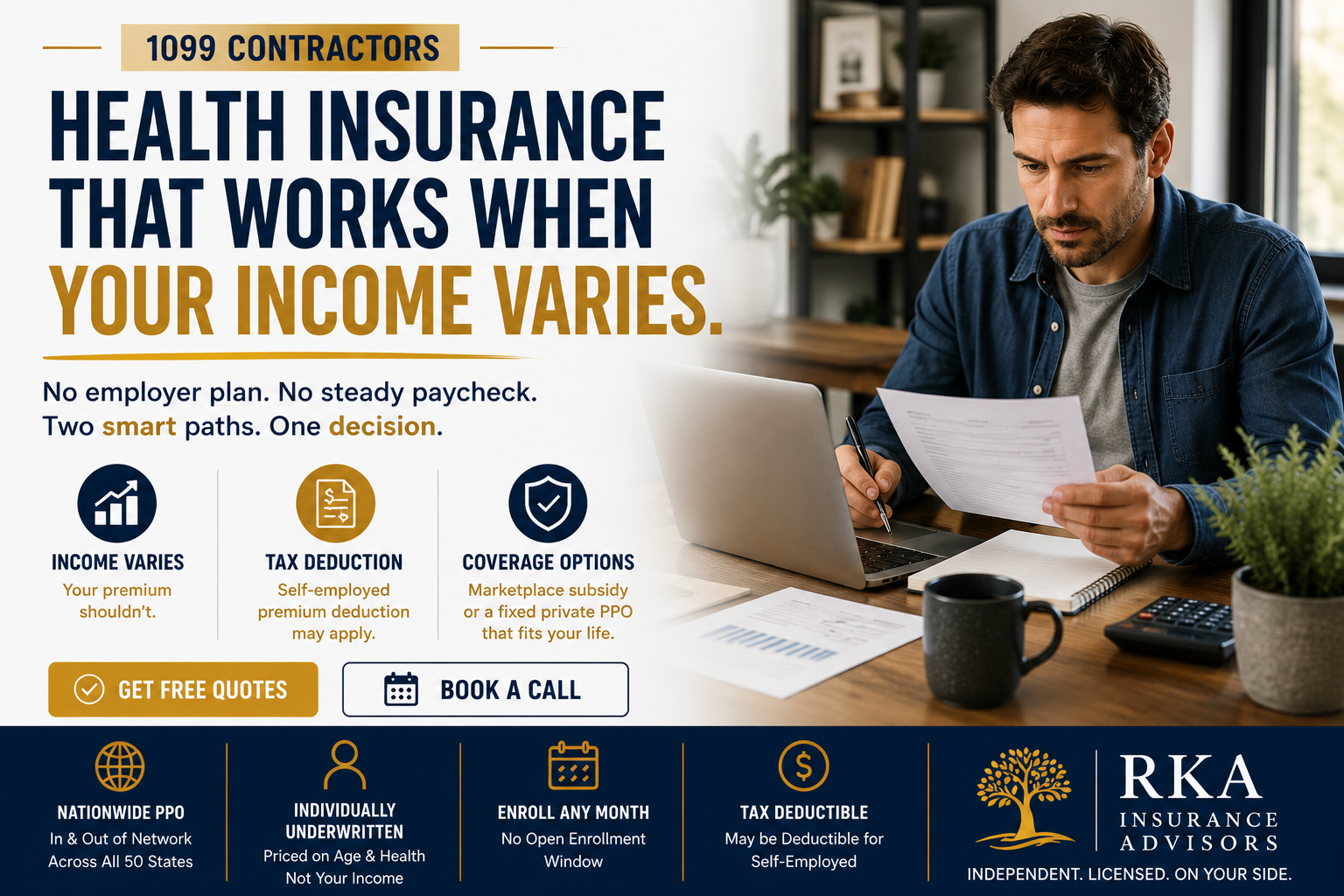
1099 Contractor Health Insurance: How to Get Covered When Your Income Varies
When you're 1099, there's no employer plan and no steady paycheck to size a premium against. That makes two things matter more than usual: estimating income for a subsidy you can't predict, and the self-employed premium deduction. Here's how contractors get covered.
Self-Employed • Private PPO • Individual Coverage
1099 Contractor Health Insurance: How to Get Covered When Your Income Varies
Why 1099 coverage is a different problem
A W-2 employee picks a plan once a year, has a fixed salary, and lets payroll deduct the premium. None of that is true for you. There's no employer splitting the cost, no HR portal, and — the part that trips people up — no predictable income to base a subsidy on. When your earnings swing month to month, the usual advice doesn't fit. The two questions below are the ones that actually decide your best move.
Question 1: Can you even predict your income?
Marketplace subsidies are based on your projected annual income. You estimate it when you enroll, the subsidy is paid in advance based on that estimate, and at tax time the IRS reconciles what you actually earned on Form 8962. For a salaried employee that's simple. For a contractor whose income depends on how many contracts close this year, it's a guess — and guessing wrong cuts both ways.
If you underestimate
- You collect a bigger subsidy during the year than you were owed
- You repay the difference at tax time — sometimes a large bill in April
- A single big contract late in the year can trigger it
If you overestimate
- You get a smaller subsidy during the year than you qualified for
- You get the difference back as a credit at tax time
- But you fronted more cash all year than you had to
The predictable alternative: a nationwide private PPO is priced on your age and health, not your income. The premium doesn't move when your income does, and there's nothing to reconcile at tax time. For a healthy contractor with variable or higher income, that predictability is often worth more than a subsidy you have to gamble on.
Question 2: Are you taking the self-employed deduction?
If you're self-employed and turn a profit, you may be able to deduct your health insurance premiums — for yourself, your spouse, and your dependents — on your federal return, whether you take the standard deduction or itemize. It's an "above-the-line" deduction, which is more valuable than most write-offs. It applies to private plans and unsubsidized marketplace plans, but not to the portion of a premium already covered by a subsidy.
This matters for the comparison: a private plan that looks more expensive on paper can be cheaper after the deduction than a partially-subsidized marketplace plan. The exact benefit depends on your tax situation, so confirm the specifics with your tax professional — but don't leave it out of the math.
Your two ways to get covered
ACA Marketplace
- Guaranteed issue — no health questions, no one is declined
- Subsidies possible if your projected income qualifies
- You must estimate income; the IRS reconciles it at tax time
- Enroll only during Open Enrollment or with a qualifying life event
- Most plans in many areas are regional HMO/EPO
Nationwide Private PPO
- Priced on health and age, not income — premium doesn't move
- Available any month, no enrollment window
- Nationwide PPO — see specialists anywhere, no referrals
- No subsidy, so nothing to reconcile at tax time
- Medically underwritten — you have to qualify
Not sure which fits your 1099 income? Let's run both.
We'll model a subsidized marketplace plan against a fixed private PPO for your actual situation — factor in the self-employed deduction, verify your doctors, and tell you straight which one wins. Free, no obligation.
Which path tends to win, honestly
Lean marketplace if…
- Your income is modest and reasonably predictable
- A subsidy makes the net premium clearly lower
- You have a health condition that underwriting might exclude
Lean private PPO if…
- You're healthy and above the subsidy line
- Your income swings and you'd rather not gamble on an estimate
- You want nationwide access and no reconciliation at tax time
This is the same honest fork we walk through with gig and rideshare workers — if you want the version focused on total cost and network freedom, see our gig workers and 1099 coverage guide.
Related reading
- Health insurance for gig workers and 1099 contractors
- Marketplace vs private PPO: an honest comparison
- Health insurance for the self-employed
Frequently asked questions
How do I estimate my income for a marketplace subsidy if I'm 1099?
You project your expected annual net income for the year and enter it when you enroll. The subsidy is paid in advance based on that number, then reconciled against your actual income on Form 8962 at tax time. Because contractor income is variable, build in a realistic buffer — underestimating means repaying subsidy in April. If your income is genuinely hard to predict, a private plan priced on health rather than income avoids the guesswork entirely.
Can I deduct my health insurance premiums as a 1099 contractor?
If you're self-employed and profitable, you generally can deduct premiums for yourself, your spouse, and your dependents as an above-the-line deduction — even without itemizing. It doesn't apply to any portion covered by a subsidy. It can make a private plan cheaper after taxes than it looks on paper. Confirm the specifics with your tax professional for your situation.
Can I get covered outside of Open Enrollment?
Private medically underwritten PPO plans are available year-round with no enrollment window — you can apply any month. Marketplace plans generally require Open Enrollment or a qualifying life event such as losing other coverage, moving, or marriage. That year-round availability is one reason contractors between contracts often look at the private path.
My income changes every month — does that affect a private plan?
No. A private plan's premium is set by your age and health at enrollment, not your income, so it doesn't move when your earnings do. That's the core appeal for contractors with variable income: a fixed cost you can budget around, and no year-end reconciliation. The tradeoff is that you have to qualify through medical underwriting.
I'm healthy and earn well — is the marketplace still worth checking?
Yes, always check both. If your income is above the subsidy line, an unsubsidized marketplace plan and a private PPO are both on the table, and the private PPO often wins on cost and network for a healthy applicant. But we compare them side by side rather than assume — occasionally a specific marketplace plan fits better, and we'll tell you when it does.
How does RKA help 1099 contractors?
We compare a subsidized marketplace plan against a fixed nationwide private PPO for your specific income and health, factor in the self-employed premium deduction, verify your doctors and prescriptions, and give you the honest call. We're independent and licensed in 30 states. NPN 19540130.
Get a fixed number you can actually budget around.
When your income isn't predictable, your health coverage can still be. We'll price both paths, factor the deduction, and pre-screen private eligibility — at no cost.
Robert Adams * President & Licensed Agent * NPN 19540130 * Licensed in 30 states. Premium estimates are illustrative and based on general market data — actual premiums vary by age, state, health profile, and underwriting outcome. Private medically underwritten plans are not ACA-compliant and are subject to medical underwriting — not all applicants qualify. Tax treatment depends on your individual circumstances — consult a qualified tax professional. This content is for informational purposes only and does not constitute insurance, legal, tax, or financial advice.

Getting Married? How to Compare Health Insurance Before You Merge Plans
Marriage is a qualifying life event — a 60-day window to optimize your coverage, not just merge it. For two working spouses, separate plans sometimes beat one combined plan on cost and network. Here's how to run the comparison before you default to "just join mine."
Private PPO • Families • Life Events
Getting Married? How to Compare Health Insurance Before You Merge Plans
The 60-day window most newlyweds don't use
Marriage is one of the life events that opens a Special Enrollment Period — a 60-day window during which you can change health coverage without waiting for Open Enrollment in the fall. Most couples treat that window as a formality: one spouse simply adds the other to their existing employer plan and moves on.
That's the missed opportunity. The window isn't just permission to merge — it's a chance to look at every option side by side, exactly once, before your choices lock until next year. Adding your spouse to your plan is one option. It is rarely the only one, and not always the cheapest.
Why "just join my plan" can cost more
When you were single, your employer likely paid a big share of your premium. Here's what changes the moment you add a spouse: employers typically subsidize the employee generously and the dependent far less — sometimes not at all. So the sticker price of adding your spouse to your plan can be dramatically higher than what you'd guess from your own paycheck deduction.
Meanwhile your spouse may have their own employer plan, their own marketplace option, or — if self-employed or higher-income — access to a private plan priced independently of either job. The only way to know which combination wins is to put the real numbers next to each other.
Your three real paths as a married couple
Merge onto one plan
- Simplest — one card, one deductible, one renewal
- Good when one plan is strong and cheap to add a spouse to
- Dependent premium is often lightly subsidized or not at all
- You inherit that plan's network — check both sets of doctors
Keep separate coverage
- Each spouse keeps the plan their employer subsidizes best
- Often wins when both employers pay well for the employee
- Each keeps their own doctors and network
- Two deductibles, two plans to manage
Nationwide private PPO
- Priced on health and age, not on either employer
- Nationwide PPO — see specialists anywhere, no referrals
- Strong fit if one spouse is self-employed or above the subsidy line
- Medically underwritten — not everyone qualifies
What to compare before you decide
Run the cost math
- Your premium alone vs your premium + spouse added
- What each employer actually pays toward a dependent
- Both deductibles and both out-of-pocket maximums
- Total annual cost, not just the monthly premium
Check the fit
- Are both of your doctors in the combined plan's network?
- Are both of your prescriptions covered, and at what tier?
- Does either of you travel or live across state lines?
- Is either spouse planning a procedure or a pregnancy soon?
The subsidy fork worth knowing: if your combined household income after marriage is modest, a marketplace plan with a subsidy may be the cheapest path — but marriage changes your household size and income, which can raise or lower that subsidy. If your combined income is higher, or one of you is self-employed, subsidies may phase out and a nationwide private PPO frequently pencils out better. We model both so you're choosing on real numbers, not a guess.
Just married? Compare all three paths in one sitting.
We'll put "merge onto one plan," "keep separate," and a nationwide private PPO side by side for your exact situation — verify both of your doctors, check both prescriptions, and tell you honestly which wins. Free, no obligation.
The self-employed spouse angle
If one of you runs a business or works 1099, marriage is a good moment to reexamine coverage entirely. A self-employed spouse often has no employer subsidy at all, which is exactly the situation where a medically underwritten nationwide PPO can beat both a marketplace plan and the cost of getting added to the other spouse's employer plan. There's also a tax angle: a self-employed spouse may be able to deduct health insurance premiums — worth raising with your tax professional as you compare.
Related reading
- Marketplace vs private PPO: an honest comparison
- Health insurance for the self-employed
- Is it cheaper to insure your family separately from your employer's plan?
Frequently asked questions
Does getting married let me change health insurance right away?
Yes. Marriage is a qualifying life event that opens a 60-day Special Enrollment Period. During that window you can add a spouse to an employer plan, enroll in a marketplace plan, or apply for a private plan — without waiting for fall Open Enrollment. Once the 60 days pass, most changes wait until the next Open Enrollment.
Is it cheaper to add my spouse to my plan or keep separate coverage?
It depends on what each employer pays toward a dependent. Employers usually subsidize the employee well and the spouse much less — sometimes nothing. If both of you have solid employer coverage, keeping separate plans often costs less than merging. If only one plan is strong, merging may win. The only way to know is to compare the real dependent premium against two separate premiums.
Will we both keep our doctors if we combine plans?
Only if both doctors are in the combined plan's network — which isn't guaranteed. Before you merge, check that both sets of providers and both prescriptions are covered. This is one of the most common surprises for newlyweds, and it's easy to verify before you commit.
Does marriage change our marketplace subsidy?
It can, in both directions. Marriage changes your household size and combined income, which are the two inputs that determine a marketplace subsidy. A couple that each qualified separately might qualify for more, less, or none once combined. If your combined income is above the subsidy line, a private plan priced on health rather than income may be the better value.
One of us is self-employed — does that change things?
Often, yes. A self-employed spouse usually has no employer subsidy, which makes a nationwide private PPO more competitive than getting added to the other spouse's employer plan or buying unsubsidized on the marketplace. There may also be a premium deduction available to the self-employed spouse — worth confirming with your tax professional.
How does RKA help newlyweds?
We compare all three paths — merging onto one plan, keeping separate coverage, and a nationwide private PPO — side by side for your specific situation. We verify both of your doctors and prescriptions, factor in what each employer actually pays, and tell you straight which option wins. We're independent and licensed in 30 states. NPN 19540130.
Compare your options while the window's open.
The 60-day marriage window is the one time all year you can change course freely. We'll run the full comparison at no cost and pre-screen private eligibility if that path fits.
Robert Adams * President & Licensed Agent * NPN 19540130 * Licensed in 30 states. Premium estimates are illustrative and based on general market data — actual premiums vary by age, state, health profile, and underwriting outcome. Private medically underwritten plans are not ACA-compliant and are subject to medical underwriting — not all applicants qualify. This content is for informational purposes only and does not constitute insurance, legal, tax, or financial advice.
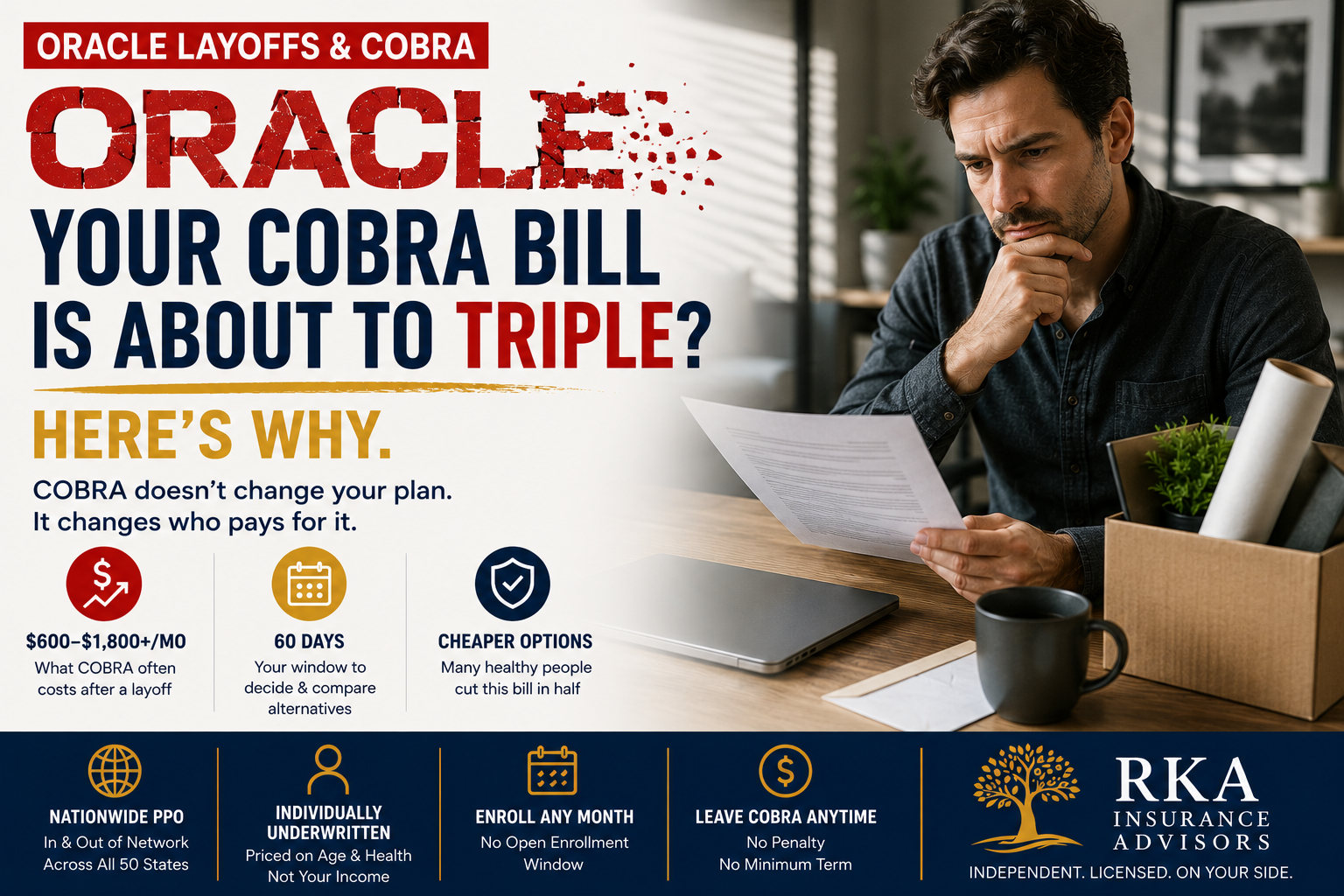
Oracle Layoffs & COBRA: What Your Coverage Will Cost and Cheaper Alternatives
Oracle cut roughly 21,000 roles over the past year. If you were one of them, the COBRA letter in your inbox is about to show you what your health plan actually costs. Here's how COBRA, ACA, and a nationwide private PPO compare —and how healthy people frequently cut the bill in half.
Layoffs & Coverage • COBRA • Private PPO
Oracle Layoffs & COBRA: What Your Coverage Will Cost and Cheaper Alternatives
Why the Oracle COBRA number is such a shock
While you were employed, Oracle carried most of your premium. You saw a modest payroll deduction and never saw the rest. Many Oracle employees have described the company covering only about half of the dependent cost even while employed — which means if you had a family on the plan, you were already paying more than most people do.
COBRA doesn't change your plan. It changes who pays for it. The coverage is identical — same doctors, same pharmacy, same network — but now 100% of the group premium is yours, plus the administrative fee. That's the entire reason the number looks nothing like what you're used to.
Your three real options after an Oracle layoff
COBRA
- Identical plan — zero disruption
- Same doctors and pharmacy
- No health questions
- Retroactive if elected within 60 days
- You pay the full premium — yours and Oracle's
- Plus up to 2% in admin fees
- Ends at 18 months
ACA Marketplace
- Guaranteed issue — no health screening
- Job loss opens a Special Enrollment Period
- Subsidies possible if this year's income drops
- Networks are often regional HMO/EPO
- Severance counts toward income — it can push you past the subsidy line
- Full price if your income stays high
Private PPO (underwritten)
- Priced on your health and age, not your income
- Nationwide PPO access — specialists without referrals
- Available any month — no enrollment window
- No subsidy reconciliation at tax time
- Frequently 30–50% below COBRA for healthy applicants
- Medical underwriting — not everyone qualifies
The severance trap nobody mentions
Your severance is income. If you're counting on an ACA subsidy to make a marketplace plan affordable, run the math on your full-year projected income — severance included. A large lump sum can push you over the subsidy threshold for the year, and the marketplace reconciles that at tax time on Form 8962. People get a subsidy all year, then owe it back. A private PPO doesn't have this problem at all: the premium is set by age and health, so it doesn't care what your severance was or when you land your next role.
How to use your 60-day window correctly
Do this first
- Apply for a private plan now — underwriting takes 2–4 weeks
- Don't elect COBRA on day one; you don't have to
- If approved, coverage starts the first of next month
- If underwriting runs long, elect COBRA retroactively as a backstop
If you already elected COBRA
- You can leave COBRA any month — no penalty, no minimum
- Private plans have no enrollment window
- Cancel COBRA once the new plan activates
- Time it to the first of the month and there's no gap
Plenty of people ride COBRA for the full 18 months without realizing they could have left at any point. If you're three or six months in and healthy, it's still worth running the comparison.
Laid off from Oracle? Get your real numbers in 5 minutes.
We'll put COBRA, ACA and a nationwide private PPO side by side for your exact situation — verify your doctors, check your prescriptions, and tell you straight which one wins. Free, no obligation.
Will you qualify for a private PPO?
Likely to qualify
- No major chronic conditions
- No hospitalizations in the last 2–3 years
- Few or no ongoing prescriptions
- No active or planned specialty care
- Non-smoker, or quit 12+ months ago
May not qualify
- Type 1 or Type 2 diabetes
- Cardiac history or active heart disease
- Active cancer or recent remission
- Multiple ongoing specialty medications
- Autoimmune conditions
If underwriting isn't a fit, that's a real answer and we'll say so — COBRA or the marketplace becomes the right path, and your layoff opens a Special Enrollment Period either way. We're an independent brokerage; the honest recommendation matters more to us than any single sale.
Related reading
- Amazon layoffs & COBRA: why it's too expensive and what to do instead
- Left your job? How to cut your COBRA bill in half
- Marketplace vs private PPO: an honest comparison
Frequently asked questions
How much does COBRA cost after an Oracle layoff?
It's whatever your Oracle plan actually costs, in full, plus up to a 2% administrative fee — not the payroll deduction you were used to seeing. Depending on your plan tier and how many people are on it, that commonly lands between roughly $600 and $1,800+ per month. Your COBRA election notice states your exact figure. If it looks high, that's not an error — it's the first time you're seeing the real price of the plan.
Does Oracle pay for any of my COBRA coverage?
Check your specific severance paperwork, because terms vary by package and by role. Some employers subsidize COBRA for a period; others don't. If yours doesn't include a COBRA subsidy, you're paying the full premium from day one — which is exactly when comparing alternatives is worth the twenty minutes.
How long do I have to decide?
60 days from the date you lost coverage, or from the date on your COBRA election notice, whichever is later. COBRA is retroactive within that window, so electing on day 55 still covers you from day one. Use the window — don't let it expire by default.
Can I leave COBRA later if I find something cheaper?
Yes. You can cancel COBRA at any time with no penalty and no minimum term. If you're approved for a private PPO or enroll in a marketplace plan, you cancel COBRA with the plan administrator and the new coverage takes over.
What if I get another job in a few months?
If your new employer offers group coverage, you enroll as a new hire and drop the private plan. Some people keep the private plan anyway if the new group plan is expensive or has a narrow network. Either way you're not locked in.
Will my doctors be covered?
We check your specific providers before you apply, not after. Nationwide PPO networks reach most physicians, specialists and hospital systems that accept PPO insurance — but we confirm yours by name so there are no surprises.
Compare COBRA vs private PPO with your actual numbers.
Most healthy people coming off a corporate plan are surprised how much comes off the monthly bill. We run the comparison and pre-screen your underwriting eligibility at no cost.
RKA Insurance Advisors is an independent insurance brokerage and is not affiliated with, endorsed by, or sponsored by Oracle Corporation. Oracle is a trademark of its respective owner and is referenced here solely for identification and news-commentary purposes. Workforce-reduction figures are as publicly reported. Severance and benefit terms vary by individual package — always review your own paperwork and plan documents.
Robert Adams * President & Licensed Agent * NPN 19540130 * Licensed in 30 states. Premium estimates are illustrative and based on general market data — actual premiums vary by age, state, health profile, and underwriting outcome. Private medically underwritten plans are not ACA-compliant and are subject to medical underwriting — not all applicants qualify. COBRA costs and timelines vary by employer plan. Consult your benefits administrator and a licensed advisor for your specific situation. This content is for informational purposes only and does not constitute insurance, legal, tax, or financial advice.
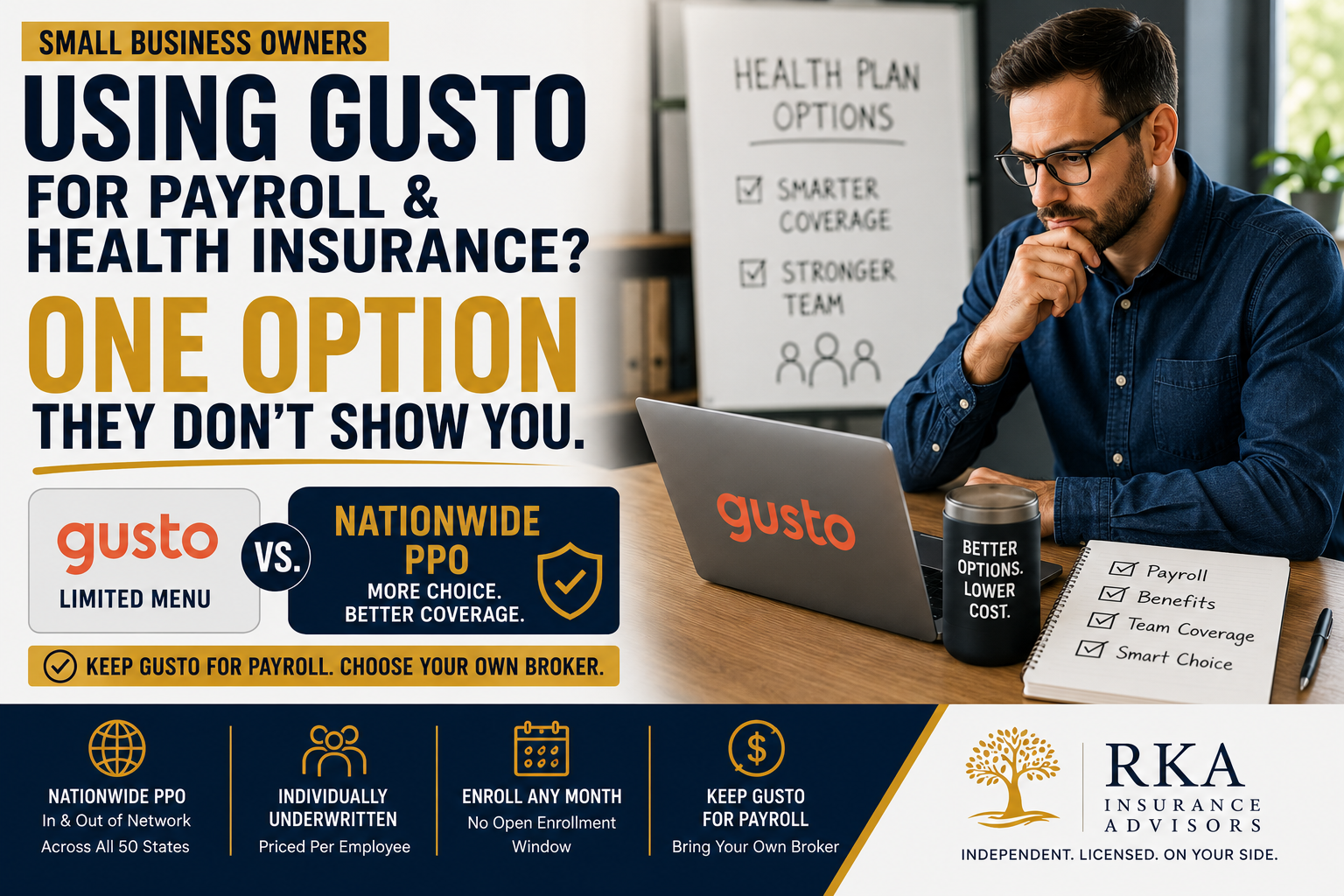
Using Gusto for Payroll and Health Insurance? One Option They Don't Show You
If you run payroll on Gusto, its health-insurance tab is Gusto's own in-house brokerage showing a limited menu of carriers — and it won't surface options outside that menu. This guide covers the one that often saves a healthy small team the most (an individually medically underwritten nationwide PPO, where each employee is underwritten into a broader, healthier pool), why standard small-group overprices a healthy team, how to keep Gusto for payroll while bringing your own broker, and when Gusto's built-in options still make sense.
Using Gusto for Payroll and Health Insurance? One Option They Don't Show You
What Gusto's benefits tab actually is
If you're weighing Gusto health insurance alternatives, start with what that benefits tab actually is. Gusto is excellent payroll software. The health-insurance section, though, is a brokerage — Gusto acts as your broker of record through its own licensed team and earns a commission when you buy through it. That's not a criticism; it's just important to understand what you're looking at. Like any single brokerage working off a software menu, it shows a limited set of carriers and plan types, and it generally won't dig into the underwriting factors driving your premium or surface structures outside its lineup. What you see in that tab is a slice of the market, not the whole market.
Why a healthy small team overpays on standard small-group
Traditional small-group coverage prices your business as its own small risk pool. A small pool can't absorb a single large claim — a heart attack, a cancer diagnosis, a serious injury — so carriers price for that risk, and rates climb to anticipate it. If your team is young and healthy, you're effectively subsidizing risk you don't carry.
The fix most software funnels won't show you: individually underwrite each employee and place them into a broader pooled program of other small employers. A larger, healthier pool can substantially reduce rates while keeping strong benefits — but it only happens if a broker actually structures it that way.
What a software benefits funnel shows
- A limited menu of carriers and standard plans
- Your small group priced as its own risk pool
- Little visibility into what's driving the premium
- Structures outside the lineup rarely appear
- Convenient, but a slice of the market
What an independent broker can show
- Options across the wider market, on and off the menu
- Individually-underwritten, broader-pool structures
- The trade-offs behind the price, in plain English
- A nationwide PPO built around how your team lives
- A person who handles claims and renewals with you
The option they don't show: an individually-underwritten nationwide PPO
For a healthy small business, the plan that often wins isn't on the standard menu: an individually medically underwritten nationwide PPO, priced per employee — so a healthier team is rated on its own merits, not lumped into a pool priced for worst-case claims. Dental and vision are included by default.
How it's structured
- Nationwide PPO network — in and out of network
- Each employee underwritten, placed into a broader healthy pool
- Priced per individual (age, ZIP, gender — income isn't a factor)
- Dental & vision included by default
- Enroll any month — not just at renewal
Who it fits — and who it doesn't
- Best for healthy teams that can clear underwriting
- Medically underwritten — not everyone qualifies
- Not designed for significant pre-existing conditions
- Pairs cleanly with Gusto payroll (see below)
Can You Keep Your Own Broker with Gusto?
This is the part owners miss: choosing your own broker doesn't mean giving up the payroll platform your team already uses. Gusto's broker integration lets you keep Gusto for payroll and name RKA as your broker of record. Enrollments and payroll deductions still sync automatically, new-hire onboarding still runs in Gusto, and you get an independent advisor who shops the wider market and handles claims and renewals with you. Gusto's own materials put broker integration at no extra cost on the Premium plan, or a small per-employee fee on lower tiers. Best of both: the software you like, the market access you didn't have.
See what the funnel didn't show your team
Send us your team's ages and a little detail, and we'll compare an individually-underwritten nationwide PPO against what you're seeing in Gusto — side by side, in plain numbers. Keep Gusto for payroll. No cost, no pressure.
When Gusto's built-in options still make sense
Being straight about this matters. An individually-underwritten PPO isn't right for every team. If you have employees with significant pre-existing conditions, a guaranteed-issue plan — which is what Gusto's funnel and the ACA market offer — is generally the better route, because underwritten coverage isn't guaranteed to everyone. If your team's incomes are modest, some employees may do better with a subsidized individual marketplace plan (an approach a QSEHRA or ICHRA can support). If you also cover family or are self-employed yourself, our family coverage guide goes deeper. The point isn't that the menu is bad — it's that it's incomplete. The right move is to compare the underwritten option against the guaranteed-issue one and choose with the full picture.
How to compare, in four steps
1. Know what your Gusto tab is quoting
Note the carriers, plan types, and total cost it's showing. That's your benchmark — a slice of the market, not all of it.
2. Get the underwritten option priced
Have a broker run an individually-underwritten nationwide PPO for your team so you can see per-employee pricing against the group quote.
3. Compare total cost and network
Look past premium to deductibles, out-of-pocket maximums, and whether the plan works nationwide, in and out of network.
4. Keep Gusto, add your broker
Whichever wins, use Gusto's broker integration so payroll deductions and onboarding stay automated — no platform switch.
Common questions from Gusto users
Does Gusto sell the insurance itself?
No — Gusto is payroll software, and its benefits section acts as a brokerage through its own licensed team. When you buy health insurance in Gusto, Gusto is your broker of record and earns a commission. It's a convenient path, but it shows a limited menu, not the whole market.
Can I keep Gusto for payroll but use my own broker?
Yes. Gusto's broker integration lets you name an independent broker of record while keeping payroll in Gusto. Enrollments and payroll deductions still sync, onboarding still runs in Gusto, and you get an advisor who shops the wider market. Gusto lists this at no extra cost on its Premium plan, or a small per-employee fee on lower tiers.
Why would an independent broker beat what I see in Gusto?
Because a broker isn't limited to one software menu. For a healthy small team, an individually-underwritten nationwide PPO — where each employee is underwritten into a broader, healthier pool — can price better than a standard small-group plan rated on your group alone. That structure usually doesn't appear in a software funnel.
Is the underwritten option right for everyone?
No. It's medically underwritten, so it's best for healthy teams and not designed for significant pre-existing conditions. If someone on your team has major health needs, a guaranteed-issue plan is generally the better route. That's exactly why comparing both matters.
What's the underwritten option you keep mentioning?
It's an individually medically underwritten nationwide PPO, priced per employee, with dental and vision typically included. Because it's underwritten and pooled more broadly, a healthy team is often rated more favorably than under standard small-group pricing. We verify your team's doctors before you commit.
Do I have to switch at my group's renewal?
Not necessarily. Individually-underwritten coverage enrolls year-round, so you're not locked to a renewal window. We'll tell you whether it makes sense to move now or wait, based on your current plan and timing.
Get the full market, not just the menu
One quick conversation and you'll see your team's real options — the underwritten nationwide PPO next to your Gusto quote — with doctors verified. Keep Gusto for payroll. Free, no pressure.
Robert Adams · President & Licensed Agent · NPN 19540130 · Licensed in 30 states. RKA Insurance Advisors is an independent brokerage and is not affiliated with, endorsed by, or sponsored by Gusto; "Gusto" is a trademark of its respective owner, referenced here for comparison and identification only. The private option referenced is an individually medically underwritten nationwide PPO plan. Premium and plan figures depend on age, ZIP, gender, plan design, and underwriting outcome, and pricing is per individual. Private medically underwritten plans are not ACA-compliant and are subject to medical underwriting; not all applicants qualify, and they are not designed for significant pre-existing conditions. Broker-integration availability and fees are set by Gusto and subject to change. This content is for informational purposes only and does not constitute insurance, legal, tax, or financial advice.
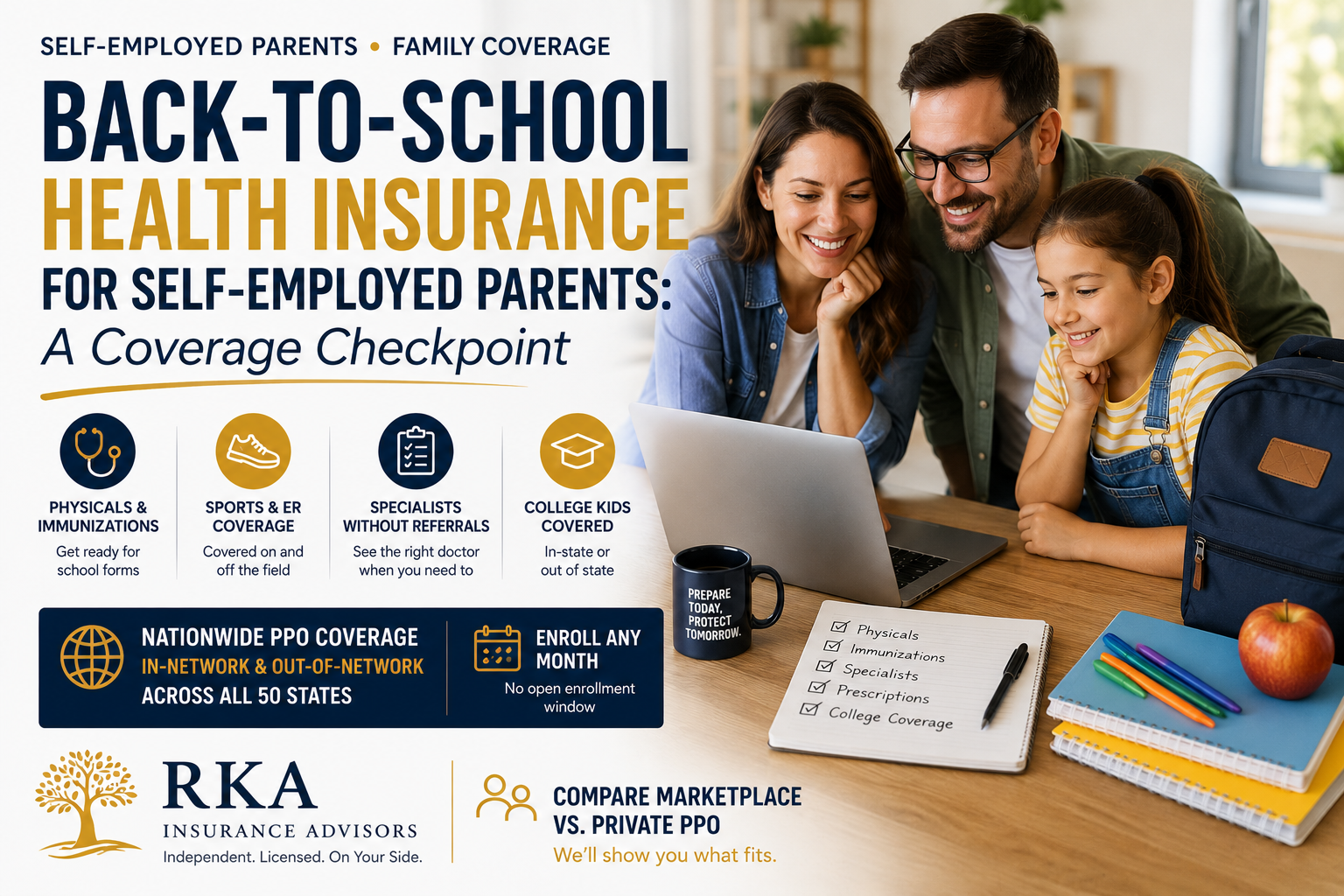
Back-to-School Health Insurance for Self-Employed Parents: A Coverage Checkpoint
Back-to-school season is a natural coverage checkpoint for self-employed parents — sports physicals, school forms, new prescriptions, and kids who may be aging off your plan. This guide covers the five things to confirm before September, why a nationwide PPO often fits families better than an in-state marketplace HMO for specialists and travel-sports injuries, when a marketplace subsidy is still the smarter family move, and a tax perk many self-employed parents miss.
Back-to-School Health Insurance for Self-Employed Parents: A Coverage Checkpoint
Why back-to-school is the right time to check your family's coverage
Summer ends and the paperwork begins: physical forms, immunization records, sports clearances, and a fresh round of "does our plan cover this?" It's also the season when kids actually use their coverage — checkups, urgent care, and the occasional trip to the ER. That makes late summer the natural checkpoint to make sure your family plan fits before you need it, not after. And because a private PPO enrolls year-round, you're not stuck waiting for open enrollment to fix a plan that no longer works.
The checklist: what to confirm before September
Physicals & immunizations
Confirm your plan's preventive-care coverage and that your pediatrician is in-network before the fall rush of forms and appointments.
Sports injuries & the ER
A broken wrist or a torn ligament means urgent care, imaging, and orthopedics — sometimes out of network. Check what your plan pays when it's not a scheduled visit.
Keep the pediatrician & specialists
Make sure the doctors your kids already see are covered — and whether you need a referral to reach a specialist.
Prescriptions
Recheck the drug list. Formularies change every year, and a medication that was covered can move tiers or drop off.
A kid aging off your plan
Children can stay on a parent's plan until 26. If one is turning 26 this year, plan their transition before there's a gap.
A college kid out of state
If a child is heading to school in another state, confirm they're actually covered there — many in-state plans aren't.
The network problem parents feel first
Cost matters, but for families the network is usually what bites first. Most ACA marketplace plans today are HMOs or EPOs built around one state or region. They often require referrals to see a specialist, and they typically pay nothing out of network outside of a true emergency. For a family, that shows up in very specific moments: a pediatric specialist across the state line, a travel-sports tournament three states away, a college freshman two time zones from home, or co-parenting across state lines.
Marketplace HMO / EPO
- Covers pre-existing conditions, guaranteed issue
- Subsidies if your household income qualifies
- Usually no out-of-network coverage (except emergencies)
- Network tied to your home state or region
- Referrals often required to see specialists
- Enroll only in open enrollment or with a qualifying life event
Private nationwide PPO (medically underwritten)
- One of the nation's largest PPO networks
- Works in and out of network across all 50 states
- No referrals needed to see a specialist
- Plan designs with deductibles as low as $0
- Enroll any month — no window
- Medically underwritten — best for healthy families, and not designed for significant pre-existing conditions
Same family, two plans: why the cheapest premium can cost more
Here's the trap in plain figures. Two family plans, same healthy household — and remember the premium is only the sticker price. What you actually pay is premium plus deductible, copays, and the out-of-pocket maximum, plus where the plan actually works:
Plan A — lower premium, higher exposure
- Lower monthly premium
- Family out-of-pocket max often $18,000+
- In-state HMO — no out-of-network coverage
- Referrals to reach pediatric specialists
- A single bad season can expose the full max
Plan B — nationwide PPO
- Modestly higher premium
- $0 deductible designs available
- Lower family out-of-pocket max
- In and out of network across all 50 states
- No referrals — see the specialist directly
Plan A can look cheaper every month right up until a kid breaks an arm at an away game or needs a specialist your HMO doesn't cover — then the low premium is beside the point. Paying a little more for Plan B often isn't spending more; it's buying thousands of dollars of protection and the freedom to get your kids care anywhere in the country. (Figures are illustrative — your actual numbers depend on ages, state, health, and plan design.)
See your real family options — free
Tell us your family's ages, health, doctors, and income, and we'll line up a marketplace plan against a nationwide PPO — total cost and network, side by side. No cost, no pressure.
When the marketplace still wins for families
A private PPO isn't automatically the answer, and being honest about that is the whole point. If your household income is modest, you may qualify for a marketplace subsidy, and in the lower-income cost-sharing reduction (CSR) range a Silver plan can come with sharply reduced deductibles, copays, and out-of-pocket maximums for the whole family. That can be a genuinely strong deal.
Even then, go in with eyes open: those plans are usually still in-state HMOs or EPOs, so the network limits and referral rules remain. And if a family member has significant pre-existing conditions, the marketplace is generally the better route, because a private PPO is medically underwritten and not everyone qualifies. The right move is to weigh your family's total cost against your need for network freedom. For a deeper side-by-side, see our Marketplace vs Private PPO breakdown.
A perk many self-employed parents miss: your premiums may be deductible
If you're self-employed and not eligible for coverage through a spouse's employer, the self-employed health insurance deduction may let you deduct your family's health, dental, and qualifying long-term-care premiums — which can meaningfully lower the true cost of a family plan. It's an above-the-line deduction, so you don't have to itemize. The rules depend on your business structure and net income, so confirm the details with your tax professional. (This is general information, not tax advice.)
How to decide, in four steps
1. Map how your family actually uses care
Which doctors do you want to keep? Do kids travel for sports or head out of state for school? Any regular prescriptions? This drives the network decision more than the premium does.
2. If income is modest, check the marketplace — including CSR
A subsidy, and especially a cost-sharing-reduction Silver plan, can lower your family's total cost substantially. Get that price as your benchmark.
3. Compare total exposure, not premium
Line up premium + deductible + copays + family out-of-pocket max across every option. The lowest monthly price is often not the lowest yearly cost.
4. Weigh network freedom
An in-state HMO vs a nationwide PPO that works in and out of network is a real difference for a family — decide what that's worth to you.
Common questions from self-employed parents
Why does back-to-school matter for my health insurance?
Because it's when your family actually uses coverage — physicals, forms, new prescriptions, urgent care, and sports injuries all cluster around the start of the school year. Checking now means you catch problems before you need care, not after. And since a private PPO enrolls any month, you can act on what you find right away.
My kids play sports — what coverage matters most?
Injuries rarely happen on a schedule, so look at urgent care, imaging, orthopedics, and the ER — and whether your plan pays out of network. Most marketplace HMOs cover little to nothing outside their home-state network except in a true emergency. A nationwide PPO covers your kids in and out of network across all 50 states, which matters for travel sports and away games.
One of my kids is heading to college out of state — will our plan cover them there?
Often not, if you have an in-state HMO or EPO — those typically only cover emergencies out of state. A nationwide PPO works across all 50 states, so a college student keeps full coverage away from home. It's one of the most common reasons families switch before fall.
My income varies — should I look at the marketplace or a private PPO?
If your household income is modest, check the marketplace first — you may qualify for a subsidy, and a cost-sharing-reduction Silver plan can carry low deductibles and out-of-pocket costs for the family. If you're healthy and above the subsidy range, a nationwide private PPO often wins on network and total cost. We price both so you can see the full comparison.
Can I deduct my family's health insurance premiums?
Many self-employed parents can, through the self-employed health insurance deduction, if you're not eligible for coverage through a spouse's employer plan. It can lower the real cost of a family plan meaningfully. The specifics depend on your business structure and income, so confirm with your tax professional — this isn't tax advice.
Do I have to wait for open enrollment to change our plan?
For a marketplace plan, generally yes — you need open enrollment or a qualifying life event. A private medically underwritten PPO enrolls any month of the year, so if your back-to-school check turns up a problem, you don't have to wait to fix it.
Get your family's coverage right before the school year starts
One quick conversation and you'll know your total cost and your network for every option — marketplace and private PPO — with your kids' doctors verified. Free, and no pressure.
Robert Adams · President & Licensed Agent · NPN 19540130 · Licensed in 30 states. Premium, deductible, and out-of-pocket figures are illustrative and vary by age, state, health profile, plan design, and underwriting outcome. Subsidy and cost-sharing-reduction eligibility depend on household income, size, and location. Private medically underwritten plans are not ACA-compliant and are subject to medical underwriting; not all applicants qualify, and they are not designed for significant pre-existing conditions. Tax information is general and not tax advice; consult your tax professional. This content is for informational purposes only and does not constitute insurance, legal, tax, or financial advice.
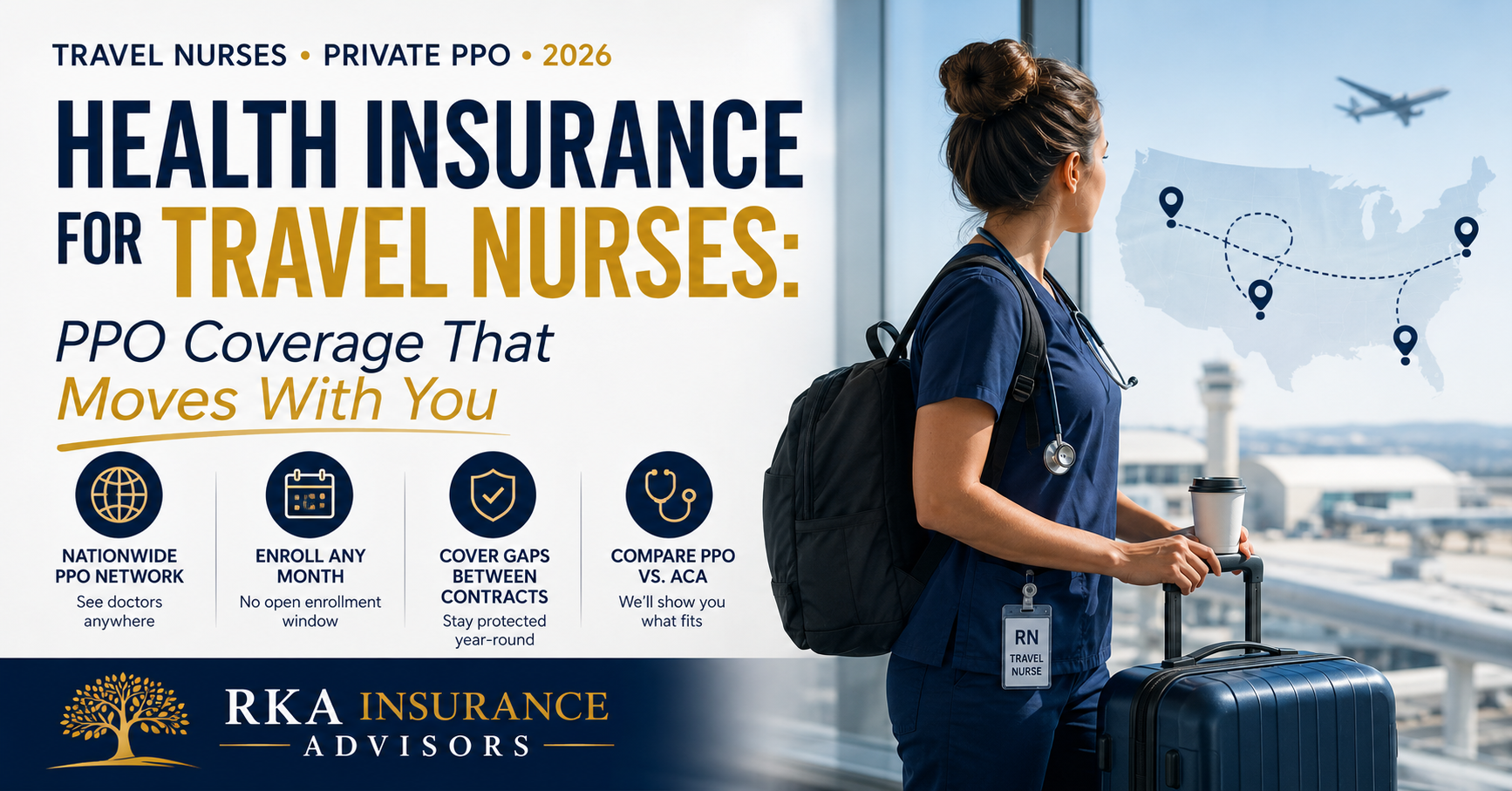
Health Insurance for Travel Nurses: PPO Coverage That Moves With You
Travel nurses change states every few months — most health plans don't keep up. Here's how nationwide private PPO coverage works for contract nurses, how to bridge gaps between assignments, and when the ACA marketplace still wins.
Health Insurance for Travel Nurses: Coverage That Moves With You
Why travel nurse coverage is its own problem
Most people pick a health plan once a year and keep the same doctors. A travel nurse's life doesn't work that way. You might start the year in Phoenix, take a summer contract in Seattle, and finish in Tampa — three states, three provider networks, and possibly a two-week gap between each assignment. The coverage questions that matter for you are different from the ones a typical employee ever thinks about:
Will it travel?
Does your plan's network actually cover providers in the next state you're assigned to — or only your "home" region?
What about the gap?
If a contract ends Friday and the next starts in three weeks, are you uninsured in between?
Can you enroll mid-year?
You rarely line up with a tidy open-enrollment window. Can you get covered the month you actually need it?
Your three real options
Agency / staffing plan
- Convenient, payroll-deducted
- Often ends the day your contract ends
- Coverage can lapse between assignments
- You lose it if you switch agencies
ACA marketplace
- Covers pre-existing conditions, no underwriting
- Subsidies if your income qualifies
- Network usually tied to one state — you may re-shop when you move
- Enroll only in OEP or with a qualifying life event
Private PPO (underwritten)
- One nationwide PPO network — travels with you
- Enroll any month, no window
- Fixed premium based on age/health, not income
- Health underwriting — best for healthy applicants
The gap between contracts is where nurses get burned
The single most common coverage mistake we see with contract nurses is assuming the agency plan carries them through downtime. Many don't. When the assignment ends, so does the plan — sometimes effective the last day worked. If you've got a two- or three-week break before the next contract, that's a window where one ER visit or accident is entirely out of pocket.
A nationwide private PPO sidesteps this because it isn't tied to any one assignment. It stays in force month to month regardless of where you're working — so the gap between contracts stops being a gap in coverage. You own the plan, not the agency.
When the marketplace still wins
We're an independent brokerage, so the honest answer matters more than the sale. A private PPO is not the right call for every travel nurse. Lean toward the ACA marketplace when:
Your income qualifies for subsidies
If a subsidy makes a marketplace plan dramatically cheaper, that often beats an unsubsidized private premium — even with a narrower network.
You have significant pre-existing conditions
Private plans are medically underwritten and can exclude or decline. The marketplace can't — it may be your broader-coverage path.
For a healthy, higher-earning contract nurse who's above the subsidy line and crossing state lines all year, the math more often tips toward a nationwide PPO. The only way to know your answer is to put real numbers side by side.
What to check before you pick any plan
- Network reach: confirm it covers providers in the states you're likely to be assigned, not just your home base.
- Effective date flexibility: can it start the first of next month, mid-contract, or after a gap?
- Telehealth: useful when you're new in a city and don't have a local doctor yet.
- Continuity: does it stay in force between assignments and when you change agencies?
- Your providers: if you have a specialist you fly back to see, verify they're covered before you enroll.
One plan that follows you state to state
We'll compare nationwide private PPO and marketplace options side by side — verify your providers, check effective dates around your contract schedule, and tell you straight which one wins for your situation. Free, no obligation.
Frequently asked questions
Will a private PPO cover me in every state I take a contract in?
Nationwide PPO networks access providers across the country, so the plan generally travels with you rather than resetting each time you move. Before you enroll we verify the network reaches the states and provider systems you're likely to work in, so there are no surprises on your next assignment.
What happens to my coverage between contracts?
That's the key advantage of owning your own plan. A private PPO stays in force month to month regardless of whether you're currently on assignment, so a break between contracts doesn't create a coverage gap. Agency plans, by contrast, often end when the contract does.
Can I enroll if it's not open enrollment?
Private underwritten PPO plans are available year-round with no enrollment window — you can apply between assignments or whenever your agency coverage ends. ACA marketplace plans generally require open enrollment or a qualifying life event such as losing other coverage.
I'm a 1099 / independent contract nurse. Does that change anything?
It often makes a private PPO more attractive, because you don't have an employer plan and your income may be above the subsidy threshold. Premiums are fixed by age and health rather than fluctuating with your income, which is helpful when contract pay varies through the year.
How does RKA help travel nurses specifically?
We compare marketplace and nationwide private PPO options side by side for your situation, verify your providers and the network's reach in the states you work, and match effective dates to your contract schedule so you're never caught in a gap. We're independent and licensed in 30 states. NPN 19540130.
Robert Adams · President & Licensed Agent · NPN 19540130 · Licensed in 30 states. Premium estimates are illustrative and based on general market data — actual premiums vary by age, state, health profile, and underwriting outcome. Private medically underwritten plans are not ACA-compliant and are subject to medical underwriting — not all applicants qualify. This content is for informational purposes only and does not constitute insurance, legal, tax, or financial advice.
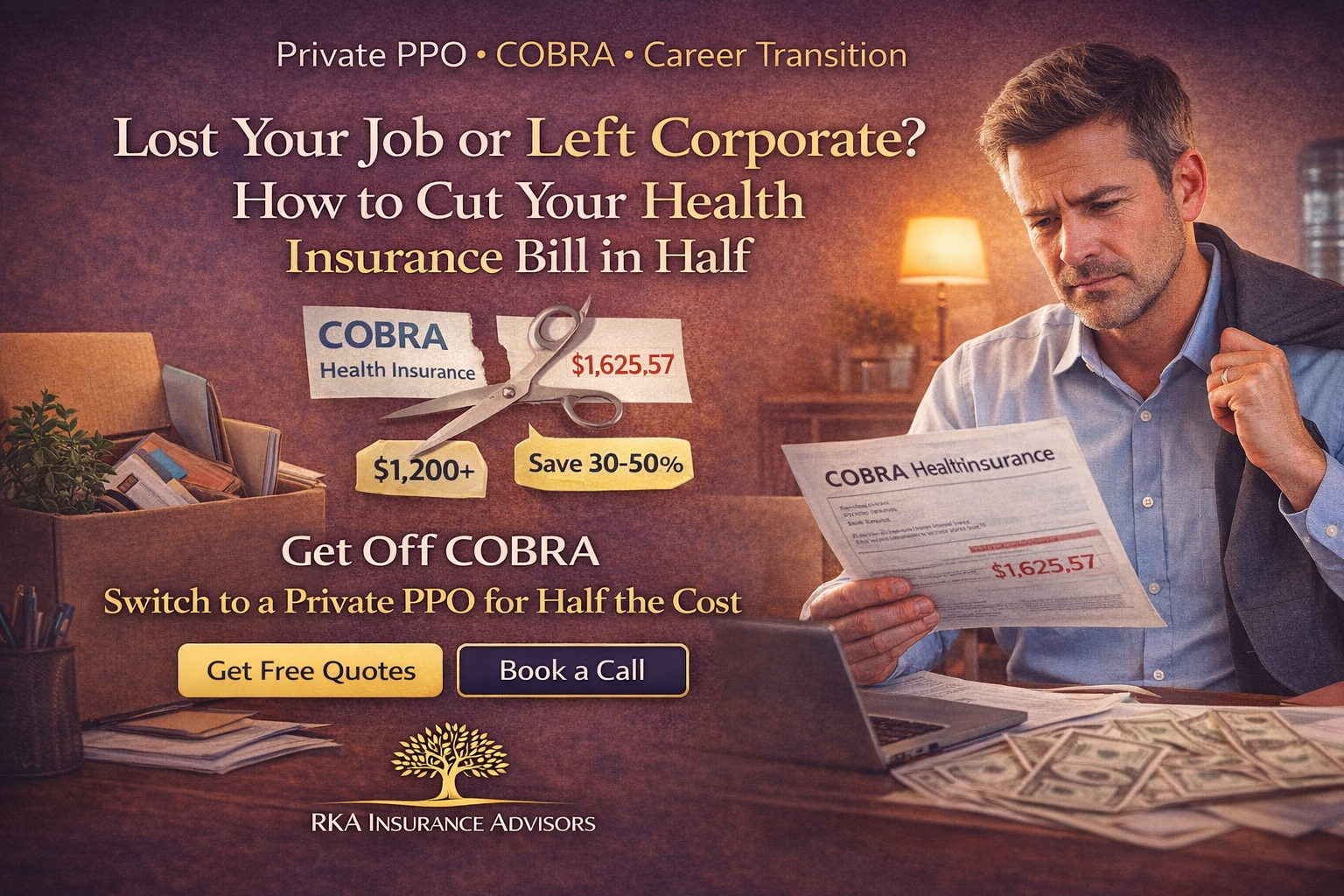
Lost Your Job or Left Corporate? How to Cut Your Health Insurance Bill in Half
Leaving a corporate job is one of the most common health insurance triggers. COBRA keeps your coverage but at full price — your share plus your employer's share. For healthy people, a private medically underwritten PPO often costs half as much with the same nationwide network. Here's how to make the switch.
Private PPO • COBRA • Career Transition
Lost Your Job or Left Corporate?
How to Cut Your Health Insurance Bill in Half
The COBRA surprise nobody prepares you for
When you leave a job, HR gives you a COBRA election notice. It's familiar, it's straightforward, and it keeps your exact same plan — same doctors, same pharmacy, same network. So most people elect it without comparing anything else.
Then the first bill arrives.
When you were employed, your employer was quietly covering 70–80% of your health insurance premium. That portion disappeared the moment you left. COBRA makes you whole on the coverage — but you now owe 100% of the group premium plus a 2% administrative fee. For a plan that cost you $180/month as an employee, COBRA might run $800/month or more.
Most people stay on COBRA because they assume it's the only option, or because they're worried about a gap in coverage. Neither is true.
What actually happens to your coverage when you leave
Your last day
- Group coverage ends — typically last day of the month
- COBRA election notice issued within 14 days
- 60-day window to elect COBRA begins
- COBRA is retroactive if you elect it within the window
Days 1–60
- You are technically uninsured — but COBRA can cover retroactively
- Best time to apply for a private plan
- Also qualifies for ACA Special Enrollment Period
- Private plan underwriting takes 2–4 weeks
After day 60
- COBRA election window closes permanently
- ACA Special Enrollment Period also closes
- Private PPO still available — no enrollment window
- Next ACA option: Open Enrollment (Nov–Jan)
COBRA vs your alternatives — side by side
- Exact same plan — no disruption
- Same doctors, same pharmacy
- No health screening
- Retroactive — elect within 60 days
- Full premium — yours + employer's share
- Plus 2% administrative fee
- Expires at 18 months
- $600–$1,800+/mo depending on plan
- Guaranteed issue — no health screening
- Job loss = Special Enrollment Period (60 days)
- Subsidies possible if income is lower this year
- Subsidy estimate based on projected annual income
- Often HMO/EPO — regional networks
- Full unsubsidized rate if income is high
- Premium based on your health — not income
- Nationwide PPO — see any specialist, no referrals
- Deductible options from $0 and up
- Available any month — no enrollment window
- No income reconciliation at tax time
- Frequently 30–50% less than COBRA for healthy people
- Health questionnaire required
What the cost difference actually looks like
The gap between COBRA and a private plan depends on your age, the quality of your former group plan, and your health profile. Here are typical ranges for healthy individuals in 2026:
Individual coverage — healthy, age 35
- COBRA (typical): $650–$900/mo
- ACA unsubsidized: $380–$520/mo
- Private PPO: $220–$320/mo
- Annual savings vs COBRA: $4,000–$8,000+
Individual coverage — healthy, age 50
- COBRA (typical): $900–$1,400/mo
- ACA unsubsidized: $550–$780/mo
- Private PPO: $380–$560/mo
- Annual savings vs COBRA: $6,000–$12,000+
*Estimates based on 2026 market data. Actual figures vary by state, plan, and underwriting outcome.
Who qualifies for a private medically underwritten plan
Likely to qualify
- No major chronic conditions
- No hospitalizations in the past 2–3 years
- Minimal or no ongoing prescription medications
- No active or planned specialty care
- Non-smoker or quit 12+ months ago
May not qualify
- Type 1 or Type 2 diabetes
- History of cardiac events or active heart disease
- Active cancer or recent remission
- Multiple ongoing specialty medications
- Autoimmune conditions (MS, lupus, RA)
If you don't qualify for private underwriting, COBRA or the ACA marketplace remain the right path. Job loss qualifies you for a Special Enrollment Period — we'll show you the best available ACA options for your situation and income level.
We compare COBRA cost, ACA options, and private PPO side by side for your specific situation — no pressure, no obligation.
What if you're already on COBRA — can you switch?
Yes. You can leave COBRA and switch to a private medically underwritten plan at any time. There is no enrollment window for private plans — they're available year-round. You simply apply, go through underwriting, and your new coverage starts on the first of the following month. Your COBRA coverage ends when your new plan begins.
People stay on COBRA for months — sometimes the full 18 months — without realizing they could have left at any point. If you've been on COBRA for 3, 6, or 12 months and you're healthy, it's worth getting a comparison now.
How to use the 60-day window correctly
If you just left a job
- Apply for private plan immediately — don't wait
- Underwriting takes 2–4 weeks
- If approved, new plan starts first of next month
- COBRA backstop available if underwriting extends past 60 days
- Don't elect COBRA until you know your underwriting result
If you're currently on COBRA
- Private plans available any month — no window needed
- Apply now, coverage starts next month
- Cancel COBRA when new plan activates
- Prorated COBRA premium refunded for unused days in some cases
- No gap in coverage if timed to first of month
Frequently Asked Questions
How long do I have to elect COBRA after leaving a job?
60 days from the date you lost coverage — or the date of your COBRA election notice, whichever is later. COBRA is retroactive, so if you elect it on day 59, your coverage is treated as continuous from the day you lost employer coverage. This gives you the full window to explore alternatives before committing.
Can I leave COBRA early if I find a better plan?
Yes. You can cancel COBRA at any time. There's no penalty and no minimum term. If you're approved for a private PPO or enroll in an ACA plan, you simply cancel COBRA with your plan administrator and your new coverage takes over.
What if I get a new job while on a private plan?
If your new employer offers group health insurance, you can enroll during their open enrollment or new-hire enrollment period. You'd cancel your private plan at that point. Some people keep their private plan if the employer's group coverage is expensive or has a limited network.
Does leaving a job qualify me for ACA Special Enrollment?
Yes. Losing employer-sponsored health coverage qualifies as a life event that triggers a 60-day Special Enrollment Period on the ACA Marketplace. If your income this year will be lower due to the job change, you may also qualify for subsidies you didn't have before. We model both scenarios.
What if I'm between jobs and my income is hard to estimate?
Private PPO premiums are not income-based — they're based on your age and health profile. This is actually an advantage during an income transition: your premium stays the same regardless of whether you find a new job quickly or take longer. No subsidy reconciliation, no income reporting required.
How do I know if my doctors are in the private PPO network?
We check network participation for your specific providers before you apply. Private plans use nationwide PPO networks — most physicians, specialists, and hospital systems that accept PPO insurance are in-network. We confirm before you commit to anything.
Most healthy people who left a job are surprised at how much they can save. We run the comparison and pre-screen underwriting eligibility at no cost.
Robert Adams * President & Licensed Agent * NPN 19540130 * Licensed in 32 states. Premium estimates are illustrative ranges based on 2026 market data and are not guaranteed. Actual premiums vary by age, state, tobacco status, plan selection, carrier, and underwriting outcome. Private medically underwritten plans are not ACA-compliant and are subject to medical underwriting — not all applicants qualify. COBRA costs and timelines vary by employer plan. Consult your benefits administrator and a licensed advisor for your specific situation. This content is for informational purposes only and does not constitute insurance or legal advice.

Health Insurance for Gig Workers and 1099 Contractors: How to Get Covered
Gig and 1099 work spans rideshare to six-figure consulting — and none of it comes with benefits. Here's how independent workers really compare coverage: why the monthly premium is only the sticker price, how deductibles, copays, and out-of-pocket maximums decide what you actually pay, and why a nationwide PPO's in- and out-of-network freedom often beats an in-state HMO or EPO — plus when a marketplace subsidy still makes sense.
Health Insurance for Gig Workers and 1099 Contractors: How to Get Covered
The premium is the sticker price — not the real cost
When you buy coverage, the monthly premium is simply what you pay for the product. It tells you almost nothing about what that product will actually cost you over a year, because a health plan has four separate cost levers, and premium is only one of them:
Premium
What you pay every month just to hold the plan — whether or not you ever use it.
Deductible
What you pay out of pocket before the plan starts sharing costs. Can be $0 on some plans, $9,000+ on others.
Copays & coinsurance
What you pay per visit, per prescription, or as a percentage — every time you get care.
Out-of-pocket maximum
The most you can pay in a bad year. This is the number that protects you when something serious happens.
A plan with a low premium and a high deductible isn't "cheap" — it's a bet that you won't need care. If that bet is wrong, you can end up paying far more than you would have on a plan that cost a little more each month. That's why the premium alone should never decide it.
Same person, two plans: run the real numbers
Here's the trap, in plain figures. Two plans for the same healthy person:
Plan A — low premium, high exposure
- $150 / month premium
- ~$9,200 deductible and out-of-pocket max
- In-state HMO/EPO network — no out-of-network coverage
- One serious event and you're exposed to the full $9,200
Plan B — slightly higher premium, far less exposure
- $200 / month premium
- $0 deductible
- ~$3,000 out-of-pocket max
- Nationwide PPO — in and out of network, anywhere in the U.S.
Plan B costs about $50 more a month — roughly $600 a year. But the moment you have a real claim, Plan A can expose you to $6,000+ more than Plan B, and Plan A only works inside your home state. Paying the extra $50 isn't spending more; for a lot of people it's buying thousands of dollars of protection and the freedom to see any doctor in the country. (Figures are illustrative — your actual numbers depend on age, state, health, and plan design.)
Where can you actually use it? HMO/EPO vs nationwide PPO
Cost is half the story. The other half is network — and this is where the two products really diverge. The majority of ACA marketplace plans today are HMOs or EPOs. Those plans are generally built around one state or one region, and they typically pay nothing if you go out of network (outside of emergencies). Travel, move between states, or want a specialist across the country, and you're on your own.
Marketplace HMO / EPO
- Covers pre-existing conditions, guaranteed issue
- Subsidies if your income qualifies (more on that below)
- Usually no out-of-network coverage at all
- Network tied to your resident state or region
- Out-of-pocket maximums often $9,000+
- Enroll only in open enrollment or with a qualifying life event
Private nationwide PPO (medically underwritten)
- One of the nation's largest PPO networks
- Works in and out of network, across all 50 states
- Plan designs with deductibles as low as $0
- Out-of-pocket max options as low as around $3,000
- Enroll any month — no window
- Medically underwritten — best for healthy applicants, and not designed for significant pre-existing conditions
Stop comparing premiums. Compare what you'll actually pay.
Tell us a little about your health, your income, and how you live, and we'll show you the total cost and the network for each option — side by side, in plain numbers. No cost, no pressure.
When the marketplace still makes sense
A private PPO isn't automatically the answer — it depends on your situation, and being honest about that is the whole point. If your gig income is modest, you may qualify for a marketplace subsidy, and in the lower-income cost-sharing reduction (CSR) range, a Silver plan can come with sharply reduced deductibles, copays, and out-of-pocket maximums. That can be a genuinely strong deal on cost.
Even then, run it with eyes open: those plans are still usually in-state HMOs or EPOs, so the network restrictions and lack of out-of-network coverage remain. And if you have significant pre-existing conditions, the marketplace is generally the better route, because a private PPO is medically underwritten and not everyone qualifies. The right move is to weigh your total cost against your need for network freedom. For a deeper side-by-side, see our Marketplace vs Private PPO breakdown.
How to actually decide, in four steps
1. Map how you actually use care
Do you travel or move? Want a specific hospital or specialist? Take regular prescriptions? This drives the network and out-of-pocket decision more than the premium does.
2. If your income is modest, check the marketplace — including CSR
A subsidy, and especially a cost-sharing-reduction Silver plan, can lower your total cost substantially. Get that price as your benchmark.
3. Compare total exposure, not premium
Line up premium + deductible + copays + out-of-pocket max across every option. The lowest monthly price is often not the lowest yearly cost.
4. Weigh network freedom
An in-state HMO/EPO vs a nationwide PPO that works in and out of network is a real quality-of-coverage difference — decide what that's worth to you.
Common questions from gig and 1099 workers
Isn't the plan with the lowest monthly premium the cheapest?
Not usually. The premium is only what you pay to hold the plan. A low-premium plan often carries a $9,000+ deductible and out-of-pocket max and no out-of-network coverage, so the first real claim can cost you far more than a plan that was a little more per month. Compare total exposure — premium plus deductible, copays, and out-of-pocket maximum — not the premium alone.
What's the real difference between a marketplace HMO/EPO and a private PPO?
Most marketplace plans are HMOs or EPOs built around one state, and they generally pay nothing out of network. A private nationwide PPO uses one of the country's largest networks and works in and out of network across all 50 states — useful if you travel, move, or want a specific doctor. Some private PPO designs also offer $0 deductibles and out-of-pocket maximums as low as around $3,000.
I drive rideshare or deliver part-time. What should I look at first?
If your total annual income is modest, check the marketplace first — you may qualify for a subsidy, and in the cost-sharing-reduction range a Silver plan can have low deductibles and out-of-pocket costs. Just know it's usually an in-state HMO/EPO. If you're healthy and want nationwide, in-and-out-of-network coverage with a low out-of-pocket max, we'll price a private PPO against it so you can see the full comparison.
My income is irregular. Does that affect my options?
A private PPO premium is based on your age and health, not your income, so it doesn't move month to month and there's no year-end income reconciliation. You can also enroll any month — no waiting for an open-enrollment window between gigs. Marketplace subsidies, by contrast, are tied to your estimated annual income.
How does RKA help gig and 1099 workers?
We compare the whole picture for you — total cost and network across a marketplace plan and a private PPO — verify your doctors are covered, and explain the trade-offs in plain English. There's no one-size-fits-all answer, which is exactly why a personalized comparison matters. We're licensed in 30 states, and it's free.
Get the full picture — free
One quick conversation and you'll know your total cost and your network for every option, not just the monthly price. That's how you actually get the right plan.
Robert Adams · President & Licensed Agent · NPN 19540130 · Licensed in 30 states. Premium, deductible, and out-of-pocket figures are illustrative and vary by age, state, health profile, plan design, and underwriting outcome. Subsidy and cost-sharing-reduction eligibility depend on household income, size, and location. Private medically underwritten plans are not ACA-compliant and are subject to medical underwriting; not all applicants qualify, and they are not designed for significant pre-existing conditions. This content is for informational purposes only and does not constitute insurance, legal, tax, or financial advice.
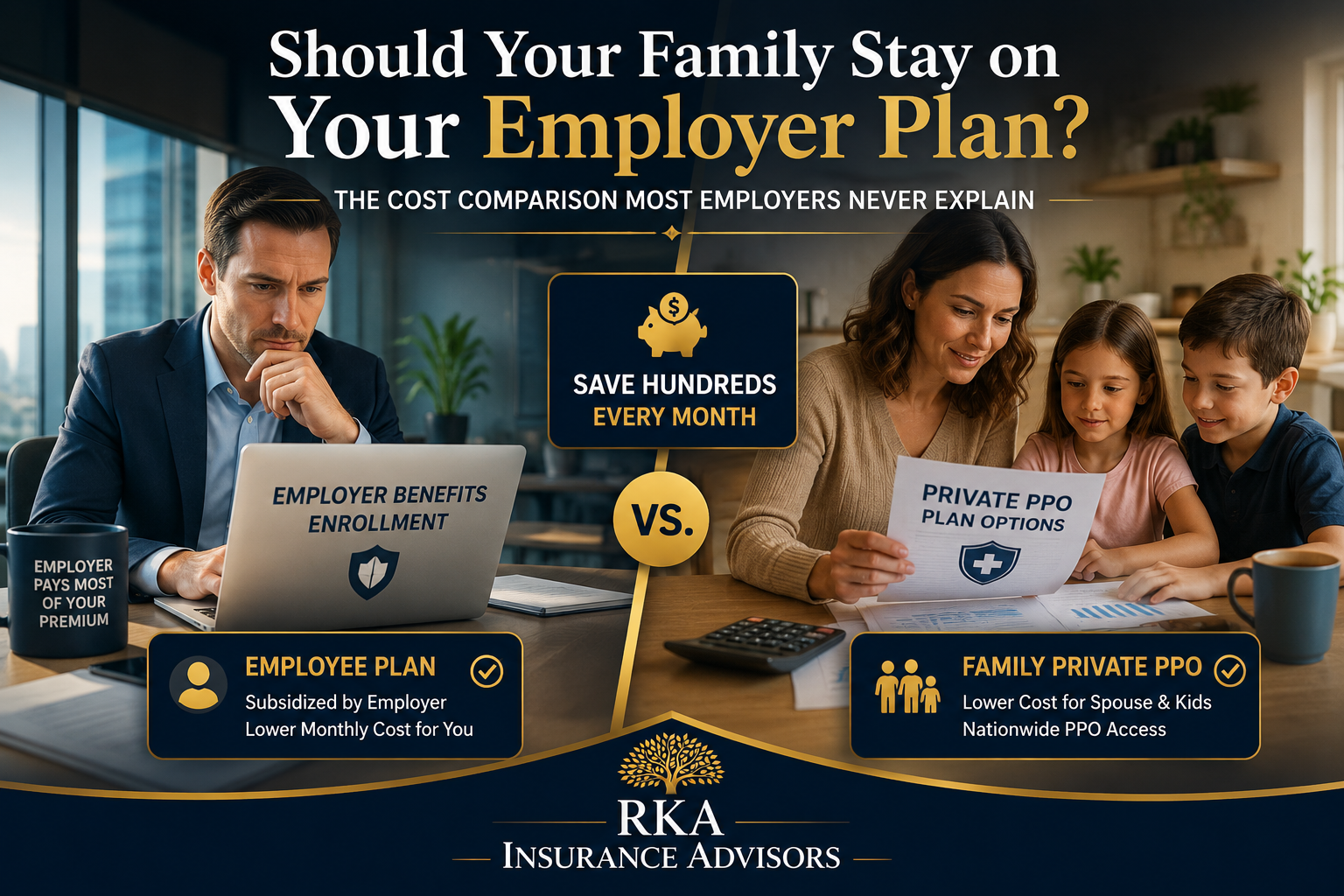
Is It Cheaper to Insure Your Family Separately From Your Employer's Plan?
Most employers heavily subsidize the employee's premium and contribute little or nothing toward a spouse or kids — so adding family to the group plan can cost hundreds a month. Here's the math nobody explains, and why "being on the same plan" matters less than you think.
Private PPO • Family Coverage
Is It Cheaper to Insure Your Family Separately From Your Employer’s Plan?
The health-insurance hack nobody talks about: what your employer really pays toward a spouse and kids — and how to pay less.
The number on your benefits sheet nobody reads
When open enrollment comes around, most people glance at the employee premium, see that it's affordable, and check the box to add their family. What they rarely do is look at how much of the family premium the employer is actually covering.
Here's the part nobody explains: employers tend to subsidize employee-only coverage — often paying somewhere between half and most of that premium — and then contribute little or nothing toward dependents. In practice, a real contribution toward a spouse or kids is rare; most people end up paying the full, unsubsidized rate to add their family. Some employers pay a flat dollar amount that barely moves when you add a spouse and kids; most pay a share of employee-only and nothing extra for family. The result is that the jump from "just me" to "me plus family" almost always lands on you — and how heavy that jump is depends entirely on your employer.
Illustrative ranges. Employer contributions vary by company — in practice a contribution toward dependents is rare. The number that decides this for you is on your own benefits sheet.
That gap is the whole game. You're not overpaying because the group plan is bad — you're overpaying because you're absorbing nearly the full cost of the people the employer doesn't subsidize.
The structure most families never consider
You don't have to put everyone on one plan. A common, completely legitimate approach for a healthy family:
You — stay on the employer plan
- Your premium is subsidized — keep it
- No change to your coverage or doctors
- Pre-tax payroll deduction stays intact
Spouse + kids — private PPO
- Priced on age and health, not the group's family rate
- Nationwide PPO network — keep your doctors, no referrals
- Available year-round — no enrollment window
- Medical underwriting — best for healthy dependents
Split the family, and you stop paying the group's unsubsidized family rate for the people the employer was never really covering. For a healthy spouse and children, a private PPO premium frequently comes in well below what the group plan charges to add them.
"But we want to be on the same plan"
This is the objection we hear most — and it's worth being honest about. A health plan is really two things: a network (which doctors and hospitals you can use) and a formulary (which medications are covered, and at what cost). "Same plan" feels meaningful, but if your providers and prescriptions are covered either way, the only real difference between being together on one plan and split across two is the price.
And that price difference is often hundreds of dollars a month. When you can see the actual savings side by side, "same plan" stops feeling like the priority it seemed to be.
This is exactly the part we handle for you: before anyone moves, we verify your spouse's and kids' doctors are in-network and their medications are covered on the new plan — so you're trading a higher bill for a lower one, not for a coverage surprise.
We'll compare keeping everyone on the group plan vs. splitting your spouse and kids onto a private PPO, verify their doctors and medications, and show you the real monthly difference. Free, no obligation.
When splitting the family makes sense — and when it doesn't
Worth comparing if…
- Your employer pays little or nothing toward dependents
- Your spouse and kids are generally healthy
- Adding family more than doubles your paycheck deduction
- You want nationwide access without referrals
Stay as-is if…
- Your employer actually subsidizes dependents too
- A family member has significant health history
- You qualify for meaningful marketplace subsidies as a family
- A key specialist isn't in the private PPO network
There's no one answer — it depends on your employer's contribution, your family's health, and your providers. The only way to know is to put the numbers next to each other.
Frequently Asked Questions
Is it allowed to keep myself on my employer plan and cover my family elsewhere?
Yes. You're not required to enroll your dependents in your employer's plan. You can keep your own employer coverage and cover your spouse and children separately on a private PPO or marketplace plan. It's a common arrangement, especially when an employer contributes little or nothing toward dependents.
How much can a family actually save doing this?
It varies by your employer's family contribution, your family's ages and health, and the plan you choose. For healthy families, the difference between the group family rate and a private PPO for a spouse and kids is often several hundred dollars a month. We run your specific numbers so you see the real figure, not an estimate.
Will my family keep their doctors?
That's the first thing we check. Private PPO plans use broad nationwide networks, so most physicians, specialists, and hospitals that accept PPO insurance are in-network — but we verify your family's specific providers and medications before anyone switches, so there are no surprises.
What if one of my kids or my spouse has a health condition?
Private plans are medically underwritten and may exclude or decline based on health history. If a dependent has significant conditions, keeping them on the group plan or using the ACA marketplace is often the better route. We'll tell you honestly which option fits each family member.
Could my family qualify for marketplace subsidies instead?
Possibly. If your employer's offer of family coverage is considered unaffordable under current rules, your spouse and children may qualify for subsidized marketplace coverage. We check that path alongside private PPO so you can compare all options on price and network.
We compare your group family rate against a private PPO for your spouse and kids, verify networks and medications, and lay out the real monthly difference. No cost, no pressure.
Robert Adams * President & Licensed Agent * NPN 19540130 * Licensed in 30 states. Premium figures and employer-contribution ranges in this article are illustrative examples, not guarantees, and vary widely by employer, plan, state, age, tobacco status, and underwriting outcome. Check your own benefits sheet for your employer's actual contribution. Private medically underwritten plans are not ACA-compliant and are subject to medical underwriting — not all applicants qualify. Marketplace subsidy eligibility depends on income and whether an employer's offer is deemed affordable. This content is for informational purposes only and does not constitute insurance, legal, tax, or financial advice. Review official plan documents and consult a licensed advisor for your situation.

Divorce and Health Insurance: What Happens to Your Coverage in 2026
Divorce ends the coverage you carried on a spouse's plan — usually within 30 days of the decree. For healthy, higher-income professionals who don' qualify for subsidies, a private medically underwritten PPO often costs far less than COBRA, with nationwide access and year-round enrollment.
Private PPO • Individual Coverage • Compare Plans
Divorce and Health Insurance: What Happens to Your Coverage in 2026
When exactly does your coverage end?
If you were the spouse carried on the other's employer or individual plan, divorce removes you as an eligible dependent. In most cases coverage ends on the last day of the month the divorce is finalized — though the exact date can be set by your decree or your plan administrator. Confirm it in writing so you know your real cutoff.
Your options after divorce
- Keeps the exact same plan, doctors, and network
- No health screening required
- Available for up to 36 months after divorce
- You pay the full premium — your share plus the employer's
- Often $500–$900+/month for one adult
- Most expensive route for a healthy person
- Best value if your employer covers 70%+ of premium
- Losing spousal coverage is a qualifying event to enroll
- Pre-existing conditions covered — no underwriting
- Only an option if your job offers benefits
- Enroll within your employer's election window (often 30 days)
- Guaranteed issue — covers any health history
- Losing coverage = 60-day Special Enrollment Period
- Subsidies possible only if income is below the threshold
- Higher earners pay the full unsubsidized rate
- Often HMO/EPO — regional networks
- Premium based on your health and age — not your income
- Nationwide PPO — see any participating doctor, no referrals
- $0 and low-deductible options available
- Available any month — no enrollment window
- For healthy applicants, often less than COBRA
- Health questionnaire required — not for every health history
Why a private PPO often fits higher-income professionals after divorce
If you're self-employed, a business owner, or simply earn above the subsidy threshold, the ACA marketplace charges you the full unsubsidized rate — and COBRA charges you the entire group premium. Neither is priced in your favor.
A private medically underwritten PPO is priced on your health and age instead of your income, so a healthy applicant frequently lands below both COBRA and unsubsidized ACA for comparable or broader coverage. And because it's a nationwide PPO with no referrals, it travels with you — useful if your work, your kids, or your post-divorce life now spans more than one state.
- Healthy, no major chronic conditions or ongoing specialty care
- Income above the ACA subsidy threshold (or variable self-employed income)
- Self-employed, business owner, or higher-earning professional
- Want nationwide coverage rather than a regional HMO/EPO network
Don't forget the kids
If your children were covered on the plan you're losing, they need a coverage plan too. Typically the parent providing coverage per the divorce decree enrolls them — through their own employer plan, the ACA marketplace, or a family private PPO. Coordinate this with your decree so there's no lapse and no duplication.
What coverage actually costs after divorce
Here's a realistic comparison for a healthy 45-year-old non-smoker with no major health history, in Florida or Texas — two of our most common markets:
COBRA (ex-spouse's plan)
- $500–$900+/mo for one adult
- Same plan and doctors
- Up to 36 months
- Full group premium + admin fee
- Most expensive for healthy people
ACA Marketplace (unsubsidized)
- Silver: $560–$720/mo
- Gold: $680–$860/mo
- Subsidies only below income threshold
- Often regional HMO/EPO networks
- Income reconciliation at tax time
Private Medically Underwritten PPO
- Often $300–$500/mo for a healthy 45-year-old
- Nationwide PPO — no referrals
- $0 deductible options available
- Not income-dependent — no reconciliation
- Available any month
*Estimates based on 2026 market data for healthy non-smokers in FL and TX. Actual figures vary by age, state, plan, health history, and underwriting outcome.
How to time the switch with no gap
30–45 days before coverage ends
- Confirm your exact coverage end date in writing
- Get pre-screened for private PPO eligibility
- Compare COBRA cost, ACA estimate, and private PPO side by side
At and after the decree
- 60-day special enrollment window opens when coverage ends
- COBRA can serve as a short backstop if underwriting is still processing
- Private plan effective the 1st of the following month — no gap if timed right
We compare COBRA, ACA, and private PPO for your exact situation — and pre-screen private eligibility before you apply. No pressure, no obligation.
Frequently Asked Questions
When does my coverage on my spouse's plan actually end?
In most cases it ends on the last day of the month the divorce is finalized, though your decree or plan administrator may set a different date. Confirm the exact cutoff in writing with the plan administrator so you can line up replacement coverage with no gap.
Is divorce a qualifying event for new coverage?
Yes. Losing coverage due to divorce triggers a 60-day Special Enrollment Period on the ACA marketplace, and it's also a qualifying event to join your own employer's plan (usually within about 30 days). Private medically underwritten PPO plans don't require a qualifying event at all — they're available any month.
How long can I keep COBRA after a divorce?
Divorce is a qualifying event that allows the former spouse to elect COBRA for up to 36 months. The trade-off is cost: you pay the full group premium plus a small administrative fee, which is why COBRA is often the most expensive option for a healthy person.
Will my income from the divorce affect ACA subsidies?
Possibly. ACA subsidies are based on Modified Adjusted Gross Income, and a settlement or change in income can move you above or below the threshold. Tax treatment of support payments depends on when your agreement was finalized. Work with your CPA on the numbers — and note that a private PPO is priced on health, not income, so it sidesteps this entirely.
What about coverage for my kids?
If your children were on the plan you're losing, the parent responsible for their coverage under the decree enrolls them — through an employer plan, the ACA marketplace, or a family private PPO. Coordinate it so there's no lapse and you're not paying for duplicate coverage.
What if I have a health condition and don't qualify for a private plan?
If private underwriting isn't available based on your health history, COBRA and the ACA marketplace remain solid options — the ACA is guaranteed issue regardless of health. We compare all three honestly and tell you which fits before you apply for anything.
Independent broker. We run COBRA, ACA, and private PPO side by side for your situation. Free quotes, honest advice, no pressure.
Robert Adams * President & Licensed Agent * NPN 19540130 * Licensed in 30 states. Premium estimates are illustrative ranges based on 2026 market data and are not guaranteed. Actual premiums vary by age, state, tobacco status, plan selection, carrier, and underwriting outcome. Private medically underwritten plans are not ACA-compliant and are subject to medical underwriting — not all applicants qualify. COBRA timelines and costs vary by plan; coverage end dates vary by decree and plan administrator. This content is for informational purposes only and does not constitute insurance, legal, tax, or financial advice — consult your attorney and CPA for your specific situation.

Summer Insurance Shock: Are Teachers Paying COBRA-Level Premiums?
Many teachers assume their "district health insurance" is a great deal — but family premiums often rival COBRA costs. For healthy families, moving dependents to a private PPO while keeping the teacher on the district plan can save $500–800/month
insurance Tips • Compare Plans • Private PPO
Summer Insurance Shock: Are Teachers Paying COBRA-Level Premiums?
The hidden cost of "district insurance"
Most teachers know their district contributes toward health insurance. What many don't realize is how that contribution is structured — and how little of it applies to family coverage.
According to the National Council on Teacher Quality (NCTQ), districts cover an average of 84% of employee-only premiums but only 64% of family premiums. The gap between those two numbers is where teachers get hit.
The result: a teacher paying $162/month for single coverage might pay $711/month or more for family coverage — a jump that rivals what they'd pay on COBRA.
Why family premiums are so high
Employee-only coverage
- District pays 80–90% of premium
- Teacher pays $100–200/month
- Feels like a "great benefit"
Family coverage
- District contribution doesn't scale proportionally
- Teacher picks up most of the dependent cost
- $600–900+/month is common
- Some districts exceed $1,000/month
In Texas specifically, the state contributes just $75/month toward employee coverage, plus a $150/month district minimum. That's $225/month total — for the teacher only. Family members? That's on you.
The split coverage strategy
Here's what some teachers are doing instead: keep the employee on the district plan (to capture the employer contribution), and move spouse and kids to a private medically underwritten PPO.
- Teacher stays on district plan — low cost, good coverage
- Dependents move to private PPO — often $400–600/month for spouse + kids
- Total family cost drops by $500–800/month in many cases
- Private plan has nationwide PPO network (UHC Choice Plus)
- No enrollment window — available any month
- Before: $780/month (district family plan)
- After — Teacher: $19/month (district employee-only)
- After — Spouse + 2 kids: $521/month (private PPO)
- New total: $540/month
- Savings: $240/month ($2,880/year)
Who this works for — and who it doesn't
Good candidates for split coverage
- Healthy spouse and children
- No major chronic conditions or ongoing specialty care
- Family members rarely use the healthcare system
- Current family premium exceeds $600/month
Not a fit if
- Spouse or child has significant health history
- Pre-existing conditions that require ongoing care
- Mental health or substance abuse treatment is needed
- You need guaranteed-issue coverage regardless of health
What private PPO coverage looks like
UnitedHealthcare Choice Plus PPO — Secure Advantage
- $0 day-to-day deductible — benefits start immediately
- 6 prepaid doctor visits per person/year
- $10 generic / $40 brand prescriptions
- Unlimited telehealth included
- $2,500–$10,000 deductible options for major medical
- 80/20 coinsurance up to max out-of-pocket
- Guaranteed renewable to age 65
What's not covered
- Inpatient mental health treatment
- Drug and alcohol rehabilitation
- Pre-existing conditions (underwriting required)
If these exclusions are a concern, district or ACA marketplace coverage may be the better path.
We'll compare your district family plan vs. employee-only + private PPO for dependents — and tell you honestly which path saves more.
How to know if this makes sense for you
Step 1 — Check your current family premium
- Look at your district benefits statement
- What are you actually paying for employee + dependents?
- Is your total above $600/month?
Step 2 — Get a private quote for dependents
- We'll run numbers for spouse and kids on a private PPO
- Based on their ages, ZIP code, and health profile
- Takes about 5 minutes
Step 3 — Compare total costs
- District employee-only + private PPO for dependents
- vs. district family plan
- The math tells you whether it's worth it
Step 4 — Pre-screen for underwriting
- Before applying, we check whether your family members are likely to qualify
- No surprises
- Honest assessment before you commit
Frequently Asked Questions
Does this work during the school year or only in summer?
Private PPO plans are available any month — no enrollment window. You can make the switch whenever your district's open enrollment allows you to drop dependents from the district plan.
What if my district requires me to cover my spouse?
Most districts don't require dependent coverage — it's optional. Check your benefits handbook or HR department. If coverage is truly required, this strategy won't work.
Can I add my kids back to the district plan later if needed?
Typically yes — during the next open enrollment period, or if you have a qualifying life event (job loss, birth, etc.). Confirm with your district's HR.
What if my spouse doesn't qualify for private coverage?
If underwriting isn't available for your spouse due to health history, they can stay on the district plan or explore ACA marketplace options. We compare all paths honestly.
Does this affect my pension or retirement benefits?
No. Your employment status and pension contributions are separate from which health plan your dependents use.
The bottom line
Not every teacher is overpaying for family coverage — but many are. If your district family premium is $600/month or more and your dependents are healthy, it's worth running the numbers on a split coverage strategy.
We'll compare your district family plan vs. employee-only + private PPO for dependents — and tell you honestly which makes sense.
Get a free comparison — your district plan vs. private PPO options for your family.
Robert Adams * President & Licensed Agent * NPN 19540130 * Licensed in 32 states. Premium estimates are illustrative and based on general market data — actual premiums vary by age, state, health profile, and underwriting outcome. Private medically underwritten plans are not ACA-compliant and are subject to medical underwriting — not all applicants qualify. District plan costs vary significantly by state and district. This content is for informational purposes only and does not constitute insurance, legal, tax, or financial advice.
How War and Economic Uncertainty Affect Your Health Insurance in 2026
ACA premiums are already up 18-20% in 2026 — the largest increase since 2018. The Iran conflict is accelerating inflation across housing, gas, and groceries. Here's what that means for your health coverage and the one option that's insulated from all of it.
Private PPO • ACA • Self-Employed • 2026
How the Iran Conflict Is Affecting Health Insurance Costs in 2026 — And What to Do About It
The numbers before we even get to the war
Before the Iran conflict became a factor, the 2026 health insurance picture was already the worst in nearly a decade. Enhanced ACA subsidies that had been in place since 2021 expired at the end of 2025. The impact was immediate and severe.
(Peterson-KFF Health System Tracker)
(KFF Survey, March 2026)
(KFF Survey, March 2026)
That's the baseline. Now add the Iran conflict.
How the Iran conflict accelerates the problem
War doesn't directly change your health insurance premium. But it does drive inflation — and inflation drives health insurance costs through several channels that are already under pressure in 2026.
How conflict drives health costs up
- Oil price spikes → higher logistics and supply chain costs for medical supplies and pharmaceuticals
- Broader inflation → hospitals and providers raise prices to cover operating costs
- Drug manufacturing disruption → specialty medication costs increase
- Labor cost inflation → medical staffing gets more expensive
- Economic anxiety → delayed care followed by higher-acuity claims
What's already happened
- Gas prices up following Feb. 28 Iran conflict onset
- Grocery inflation accelerating in Q1 2026
- Insurers projecting 7–8% medical cost trend for 2026
- Specialty drug costs rising double digits
- ACA risk pool shrinking as healthy enrollees exit — driving remaining costs higher
ACA vs Private PPO — How each responds to economic uncertainty
- Premium set by government policy and insurer filings — already up 18–20%
- Subsidy dependency — if Congress changes policy, your cost changes
- Risk pool shrinking — fewer healthy enrollees means higher costs for those remaining
- Inflation passes through to premiums at renewal
- No control over what happens to your rate next year
- Enrollment windows — can't act outside of SEP or open enrollment
- Premium based on your health — not income, not politics
- No subsidy dependency — zero exposure to Congressional action
- Not part of the ACA risk pool — unaffected by pool deterioration
- Rate locked at underwriting — no surprise renewals mid-year
- Available any month — no enrollment window dependency
- Nationwide PPO network — works in any state, any economic environment
Who benefits most from switching right now
Self-employed & 1099
- Freelancers, consultants, contractors
- Above subsidy threshold — paying full ACA rate
- Health-based pricing often significantly lower
- Available any month — no waiting for enrollment
Small business owners
- No group plan — buying individually
- Current ACA rate jumped 18–20% at renewal
- Private PPO not tied to ACA rate filings
- Rate set at underwriting — predictable going forward
Real estate, gig & commission earners
- Variable income — ACA subsidy reconciliation creates tax risk
- Private PPO has zero income reporting requirement
- No subsidy clawback at tax time
- Premium stays consistent regardless of income year
We compare your current ACA cost against private PPO options for your health profile. Most healthy self-employed applicants are surprised how much the difference is. Free quotes, no obligation, no pressure.
What private PPO actually costs right now
For healthy applicants, private medically underwritten plans price based on age and health — not on whatever the ACA risk pool is doing or what Congress decided about subsidies. Current approximate ranges for healthy non-smokers in 2026:
Age 25–35
- $120–$240/month typical range
- $0 deductible plans available
- Nationwide PPO access
- Lowest rates in your lifetime
Age 35–50
- $220–$430/month typical range
- Multiple deductible options
- Often 30–50% less than current ACA full rate
- Rate locked at approval
vs ACA unsubsidized 2026
- Silver plan: $350–$550/month
- Gold plan: $450–$650/month
- Up 18–20% from 2025
- Further increases likely in 2027
*Private PPO ranges are illustrative estimates for healthy non-smokers. Actual premiums vary by age, state, health history, plan, and underwriting outcome. ACA estimates based on 2026 market data for unsubsidized enrollees.
Frequently Asked Questions
Does war directly affect my health insurance premium?
Not directly — wars don't trigger immediate premium changes. But armed conflict drives inflation through energy prices, supply chains, and labor costs. Those inflationary pressures flow into healthcare costs over time, which insurers factor into the following year's premium filings. ACA premiums were already elevated in 2026 before the Iran conflict. The conflict adds additional inflationary pressure on an already stressed system.
Will ACA premiums go up again in 2027?
Based on current trends — continuing inflation, a shrinking and sicker ACA risk pool, rising drug costs, and geopolitical uncertainty — further increases in 2027 are likely. Insurers are already seeing the spiral effect: as healthy people exit the ACA market, remaining costs rise for those who stay, which drives more healthy people out. Private PPO exits this cycle entirely because it's individually underwritten, not pool-based.
What if the subsidies come back?
Subsidy reinstatement would reduce ACA costs for those who qualify by income. But it wouldn't help anyone above the subsidy threshold — and it comes with a perpetual political risk that subsidies can be changed or removed again. Private PPO has no subsidy dependency in either direction. Your rate is based on your health at the time of underwriting, period.
Can I switch from ACA to private PPO mid-year?
Yes. Private medically underwritten plans are available any month of the year with no enrollment window. If you're approved, your coverage can start as soon as the following month. You'd cancel your ACA plan once the private plan is active — typically timing it for a clean month-to-month transition with no gap.
What if the conflict escalates — could that affect private PPO plans?
Private PPO plans are not war risk insurance — they cover domestic healthcare costs the same way in any geopolitical environment. Broader inflation could eventually affect private plan renewal rates, but private plans adjust individually at renewal rather than through the systemic ACA pool mechanism. And importantly, you lock in your rate at underwriting — it doesn't change mid-year regardless of what happens.
Who doesn't qualify for private PPO?
Private medically underwritten plans require a health questionnaire. Applicants with significant health history — active chronic conditions, recent hospitalizations, multiple ongoing medications — may not qualify. For those individuals, ACA marketplace coverage remains the right path. We'll tell you honestly which option makes sense for your situation before you apply for anything.
We're an independent broker licensed in 32 states. We compare your ACA cost against private PPO options based on your exact health profile and tell you honestly what makes sense. No pressure, no obligation.
Robert Adams * President & Licensed Agent * NPN 19540130 * Licensed in 32 states. Statistical data sourced from KFF Survey (March 2026), Peterson-KFF Health System Tracker (January 2026), Commonwealth Fund (September 2025), and CNBC (March 2026). Premium estimates are illustrative ranges and are not guaranteed. Actual premiums vary by age, state, tobacco status, plan selection, carrier, and underwriting outcome. Private medically underwritten plans are not ACA-compliant and are subject to medical underwriting — not all applicants qualify. This content is for informational purposes only and does not constitute insurance, financial, or legal advice.

Just Graduated? Here's What Happens to Your Health Insurance
Graduating college is one of the most common reasons young adults lose health coverage. Your student plan ends. Your parents' plan has a clock. For healthy grads, private PPO plans often cost under $150/month. Here's the full breakdown.
Private PPO • Young Adults • Individual Coverage
Just Graduated? Here's What Happens to Your Health Insurance in 2026
When exactly does your coverage end?
It depends on which type of coverage you currently have. These are the three most common situations for new graduates:
On a student health plan
- Coverage ends at graduation — not at 26
- Most plans end last day of graduation month or semester
- Check your plan documents for exact cutoff date
- This is separate from the under-26 rule
On a parent's employer plan
- You can stay on until your 26th birthday
- Graduation doesn't trigger removal
- Coverage ends on your birthday or end of birth month
- After 26 — 60-day window to get your own plan
Uninsured in college
- Now is the time to fix it
- Especially important starting gig or freelance work
- Private PPO available any month — no enrollment window
- Healthy young adults get the best available rates
Your four options after graduation
- Valid until your 26th birthday regardless of graduation
- Best option while you figure out next steps
- No action needed — coverage continues automatically
- Ends at 26 no matter what — have a plan ready
- Best option if employer covers 70%+ of premium
- Losing student coverage = qualifying enrollment event
- You have 30 days from coverage loss to elect
- 30–90 day waiting period before coverage starts
- Only available with a full-time job that offers benefits
- Losing student plan = Special Enrollment Period (60 days)
- Guaranteed issue — no health screening
- Subsidies available if income under ~$58K (single, 2026)
- Often HMO or EPO — regional networks
- Higher deductibles on lower-premium plans
- Full unsubsidized rate if income is above threshold
- Healthy 22–24 year olds qualify for the lowest rates available
- Often starts under $150-$220/month for healthy new grads
- Nationwide PPO — see any doctor, no referrals
- $0 deductible options available
- Available any month — no enrollment window
- Health questionnaire required — not for all conditions
What does coverage actually cost for a new grad?
Here's a realistic cost comparison for a healthy 23-year-old, non-smoker, no major health history — in Florida or Texas, two of our most common markets for this age group:
ACA Marketplace (unsubsidized)
- Bronze: $200–$280/mo
- Silver: $280–$380/mo
- Gold: $360–$480/mo
- High deductibles on Bronze/Silver
- Regional HMO or EPO networks
ACA Marketplace (with subsidies)
- Income under ~$58K: subsidies apply
- Bronze can be $0–$100/mo with subsidies
- Check Healthcare.gov for your exact figure
- Best option if income qualifies
- Still regional network in most cases
Private Medically Underwritten PPO
- As low as $100–$220/mo for healthy 22–24 year olds
- Nationwide PPO — no referrals
- $0 deductible plan options available
- Best rates you'll see in your lifetime
- Not income-dependent — no reconciliation
*Estimates based on 2026 market data for healthy non-smokers. Actual figures vary by age, state, plan, and underwriting outcome.
What to do based on your situation
Starting a full-time job with benefits
- Losing student plan = qualifying event — enroll within 30 days
- If employer covers 70%+ — take the plan
- If employer contribution is low — compare private PPO first
- Bridge the waiting period with a short-term plan if needed
- We'll run the comparison for your exact situation
Freelance, gig work, or self-employed
- No employer plan — you're on your own for coverage
- If income is under ~$58K — check ACA subsidies first
- If healthy and income is higher — private PPO is usually best
- Apply 30–45 days before coverage ends for clean transition
- Private PPO available any month — no enrollment window
Why your graduation year is the best time to lock in a private plan
Age is one of the primary pricing factors in private health insurance. A 22-year-old in good health gets the lowest premiums they'll see for decades. Rates increase with every year — and health history accumulates over time.
If you're healthy now, getting a private PPO at graduation locks in a lower rate than you'll be able to get at 30, 35, or 40. Many people who get a private plan at this stage keep it for years because the premium stays relatively low and the nationwide PPO access works for their lifestyle.
We're an independent broker licensed in 32 states. We compare ACA, private PPO, and short-term options for your exact situation and tell you honestly which one makes sense. No pressure, no obligation.
Frequently Asked Questions
Does my student health plan end the day I graduate?
It varies by school and carrier. Most student plans end on the last day of the graduation month or the last day of the spring semester — not on the day of the ceremony. Check your school's student health plan documents or call the student health center directly for your exact termination date.
If I'm under 26, can I stay on my parents' plan after graduation?
Yes — if you're currently on a parent's employer-sponsored plan, graduation doesn't remove you. You can stay until your 26th birthday regardless of graduation, employment status, or whether you live at home. After 26, you have a 60-day special enrollment window to get your own coverage.
What if I have a pre-existing condition?
ACA marketplace plans are guaranteed issue and cover pre-existing conditions without health screening. If you have a significant health history, the ACA marketplace is likely the right path. Private medically underwritten plans may not be available depending on the condition. We'll tell you honestly which option fits your situation before you apply for anything.
How much does health insurance cost at 22–24 years old?
For a healthy 22–24 year old, private PPO plans typically run $100–$220/month depending on state, plan, and deductible. ACA marketplace plans can be $0–$150/month with subsidies for lower incomes, or $200–$380/month without subsidies. The exact number depends on your specific situation and state.
What happens if I just don't get coverage?
There's no federal penalty for being uninsured. But a single ER visit without coverage can easily cost $3,000–$15,000+. A broken bone, appendicitis, or a car accident while uninsured can set you back financially for years. At $100–$150/month, insurance costs less than most people spend on subscriptions — and the risk of going without is real.
Is private PPO available in my state?
RKA Insurance Advisors is licensed in 32 states. Plan availability varies by state and carrier. A quick call or quote request will confirm what's available where you live and what you'd likely qualify for based on your health profile.
We help new graduates navigate all coverage options — ACA, private PPO, short-term, and employer plans. Free quotes, honest advice, no pressure.
Robert Adams * President & Licensed Agent * NPN 19540130 * Licensed in 32 states. Premium estimates are illustrative ranges based on 2026 market data and are not guaranteed. Actual premiums vary by age, state, tobacco status, plan selection, carrier, and underwriting outcome. Private medically underwritten plans are not ACA-compliant and are subject to medical underwriting — not all applicants qualify. This content is for informational purposes only and does not constitute insurance or legal advice.

Turning 26 and Getting Kicked Off Your Parents' Insurance? Here's What to Do
Turning 26 is the most common reason young adults lose health insurance. You have options — ACA marketplace, employer coverage if you have it, or a private medically underwritten PPO if you're healthy. Here's what to do before your birthday and after, with no gaps in coverage.
Private PPO • Young Adults • Individual Coverage
Turning 26 and Getting Kicked Off Your Parents' Insurance?
Here's What to Do
When exactly does your parents' coverage end?
The exact cutoff depends on the type of plan your parents have:
Employer-sponsored group plan
- Coverage ends on your 26th birthday
- Some plans extend to the last day of the birth month
- Check with your parent's HR department for the exact date
- COBRA is available for up to 36 months after aging off
Individual or marketplace plan
- Coverage typically ends on the last day of the birth month
- Varies by carrier — confirm with the insurer directly
- Loss of coverage triggers a Special Enrollment Period
- 60-day window to enroll in new coverage begins
Your four options at 26
- Best option if your employer covers 70–80% of premium
- Aging off parents' plan = qualifying event for enrollment
- You have 30 days from coverage loss to enroll
- Pre-existing conditions covered — no underwriting
- Only available if your employer offers coverage
- Can be expensive if employer contribution is low
- Keep exact same plan — same doctors, same network
- Up to 36 months of continuation coverage
- No health screening required
- Full premium — you pay 100% of the group rate
- Often $300–$600+/mo for individual coverage
- Most expensive option for healthy young adults
- Guaranteed issue — no health screening
- Aging off plan = Special Enrollment Period (60 days)
- Subsidies available if income is below 400% FPL
- Bronze plans can be low-cost with subsidies
- Often HMO/EPO — regional networks
- Full unsubsidized rate if income is moderate or high
- Higher deductibles on lower-premium plans
- Healthy 26-year-olds get the best rates in this market
- Can start under $150/month for healthy individuals
- Nationwide PPO — no referrals, see any specialist
- Low and $0 deductible options available
- Available any month — no enrollment window
- No income reporting or subsidy reconciliation
- Health questionnaire required
What does coverage actually cost at 26?
Here's a realistic cost comparison for a healthy 26-year-old with no major health history, living in Florida or Texas (two of the most common states for our clients at this age):
ACA Marketplace (unsubsidized)
- Bronze: $200–$280/mo
- Silver: $280–$380/mo
- Gold: $360–$480/mo
- High deductibles on lower tiers
- Regional network — often HMO
COBRA (parents' group plan)
- Typically $350–$600/mo
- Full group premium + 2% admin fee
- Same plan — same doctors
- Best for active care or conditions
- Most expensive for healthy people
Private Medically Underwritten
- As low as $130–$260/mo for healthy 26-year-olds
- Nationwide PPO — no referrals
- $0 deductible options available
- Lowest cost for healthy young adults
- Best time in your life to lock this in
*Estimates based on 2026 market data for healthy non-smokers in FL and TX. Actual figures vary by state, plan, and underwriting outcome.
Why 26 is actually the best time to get a private plan
Age is one of the biggest factors in private plan pricing. A 26-year-old in good health gets the lowest premiums they'll likely ever see in the private insurance market. The longer you wait, the more you'll pay — both because you get older and because health histories accumulate over time.
If you're healthy now, this is the window to lock in the best possible rate. Many people who get a private plan at 26 keep it for years because their premium stays relatively low and their coverage is comprehensive.
We compare employer, ACA, and private PPO options for your specific situation — and tell you honestly which one makes the most sense. No pressure, no obligation.
What to do based on your situation
You have a job with benefits
- Aging off parents' plan = qualifying event to enroll
- You have 30 days from coverage loss to elect employer coverage
- If employer covers 70%+ of premium — take it
- If employer contribution is low, compare private PPO first
- We'll run the comparison so you can decide
You're self-employed, freelance, or between jobs
- No employer plan available — private PPO is usually best option
- If income is low — check ACA subsidy eligibility first
- Private plan available any month, no enrollment window
- Apply 30–45 days before your birthday for seamless transition
- No gap in coverage if timed correctly
Frequently Asked Questions
Does my coverage really end on my exact birthday?
It depends on the plan. Employer-sponsored group plans typically end on the 26th birthday itself. Some individual and marketplace plans end on the last day of the birth month. Check with your parent's plan administrator or insurer at least 60 days before your birthday so you know your exact cutoff date.
What if I have a pre-existing condition?
ACA marketplace plans are guaranteed issue — they cover pre-existing conditions without health screening. Private medically underwritten plans may not be available depending on the condition. If you have a significant health history, ACA marketplace is likely the right path. We'll tell you honestly which option fits your situation.
Can I stay on my parents' plan if I'm still in college?
Being a student doesn't extend coverage beyond 26 under federal law. However, many colleges and universities offer student health plans that may be worth comparing — particularly if you're on campus. We can help you weigh all options including student plans, ACA, and private PPO.
What if I miss the 60-day window?
If you miss the Special Enrollment Period triggered by losing parental coverage, you'd need to wait for Open Enrollment (November–January) to enroll in an ACA marketplace plan. However, private medically underwritten plans are available year-round with no enrollment window. You can apply and get coverage started within 2–4 weeks any time of year.
Is a private plan available in my state?
RKA Insurance Advisors is licensed in 32 states. Plan availability varies by state and carrier. A quick call or quote request will confirm what's available where you live.
My parents want to know their options too — can you help them?
Yes. If your parents are losing a dependent from their plan, their premium may decrease and it may be a good time for them to review their own coverage as well. We work with individuals and families across all life stages.
We help young adults navigate coverage options at 26 — whether you have a job, just graduated, or are figuring it out. Free quotes, honest advice.
Robert Adams * President & Licensed Agent * NPN 19540130 * Licensed in 32 states. Premium estimates are illustrative ranges based on 2026 market data and are not guaranteed. Actual premiums vary by age, state, tobacco status, plan selection, carrier, and underwriting outcome. Private medically underwritten plans are not ACA-compliant and are subject to medical underwriting — not all applicants qualify. Coverage termination dates vary by plan — confirm with your parent's plan administrator. This content is for informational purposes only and does not constitute insurance or legal advice.

What Happens to Your Health Insurance When You Sell Your Business?
Selling your business is one of the most significant health insurance events of your life. Your group plan ends. COBRA is expensive and temporary. ACA subsidy eligibility depends on your post-sale income. For healthy business owners, private medically underwritten PPO plans often provide the best coverage at the lowest cost.
Private PPO • Business Owners • Self-Employed
What Happens to Your Health Insurance When You Sell Your Business?
The health insurance detail most exit advisors skip
Most business owners who carry health coverage do so through a group plan tied to the business. The moment ownership transfers, that plan ends. In an asset sale — the most common structure for small and mid-size businesses — coverage almost always terminates on the last day of the month in which the deal closes.
Your exit attorney, CPA, and M&A advisor are focused on the transaction. Health insurance rarely comes up until after closing. The result: sellers find themselves scrambling for coverage in a 20–30 day window with few good options lined up.
There are three paths. Knowing them before you close makes all the difference.
Your three options compared
- Keeps your exact existing plan
- Same doctors, same network
- No health screening required
- Retroactive — elect within 60 days
- Full premium — yours + employer's share
- Plus 2% administrative fee
- Expires at 18 months
- $900–$2,000+/mo individual
- Guaranteed issue — no health screening
- Subsidies possible below 400% FPL
- Business sale triggers Special Enrollment
- Capital gains count as MAGI income
- Large exit may eliminate subsidies
- Often HMO/EPO — regional networks
- $700–$1,200+/mo above subsidy cliff
- Premium based on health — not income
- Nationwide PPO — no referrals required
- Deductible options from $0 and up
- Available any month — no enrollment window
- No income reconciliation at tax time
- Terms don't change if you get sick after approval
- Health questionnaire required
- Not available with significant health history
Why a business sale changes the ACA subsidy math
ACA premium subsidies are based on Modified Adjusted Gross Income (MAGI). A business sale typically generates a capital gain — and capital gains count as MAGI. A seven-figure exit in a single year can push your income well above the subsidy threshold, even if your ongoing post-sale income is modest.
Before assuming ACA subsidies are available, work with your CPA to model your post-sale taxable income by year. Installment sales and earnout structures can spread income across multiple years and change the subsidy picture significantly.
Who qualifies for a private medically underwritten plan
Likely to qualify
- No major chronic conditions
- No hospitalizations in past 2–3 years
- Minimal or no ongoing prescriptions
- No active or planned specialty care
- Non-smoker or quit 12+ months ago
May not qualify
- Type 1 or Type 2 diabetes
- History of cardiac events or heart disease
- Active cancer or recent remission
- Multiple ongoing specialty medications
- Autoimmune conditions (MS, lupus, RA)
If you don't qualify for private coverage, COBRA or ACA marketplace remain the right path. We compare all three options honestly and will tell you which makes sense for your situation.
The right time to plan this is before the deal closes
60–90 days before closing
- Get pre-screened for private PPO eligibility
- Model ACA subsidy eligibility with your CPA
- Check COBRA cost from your current plan documents
30 days before closing
- Apply for private coverage timed to coverage end date
- Underwriting typically takes 2–4 weeks
- 60-day COBRA window available as backstop
At and after closing
- Coverage ends last day of closing month
- 60-day COBRA election window begins
- Private plan active — no gap if timed correctly
We compare COBRA, ACA, and private PPO options side by side — and pre-screen private plan eligibility before you apply. No pressure, no obligation.
Frequently Asked Questions
Does my coverage end on closing day or end of month?
In most cases, coverage ends on the last day of the month in which the sale closes. If your deal closes April 10, you're typically covered through April 30. Confirm with your group plan administrator — terms vary by carrier.
Does my capital gain from the sale count as ACA income?
Yes. Capital gains count toward ACA Modified Adjusted Gross Income (MAGI). A large one-time gain from a business sale can push your income above the subsidy threshold for that year. Work with your CPA to model this before assuming subsidy eligibility.
Can I stay on my plan if the buyer keeps the business running?
In a stock sale where the buyer retains the business entity and employees, the group plan may continue under new ownership. In most asset sales, the plan terminates with the old entity. Confirm with your benefits administrator during due diligence.
How quickly can a private PPO go into effect?
Most private plans take 2–4 weeks from application to underwriting decision. Coverage typically starts on the first of the following month. Apply 30–45 days before your group coverage ends to ensure a clean transition with no gap.
What if I'm not sure about my health history?
We pre-screen applicants before submitting a formal application so you have a realistic picture of approval likelihood before anything goes on record. No pressure, no obligation.
What if I don't qualify for a private plan?
If private underwriting isn't available based on your health history, COBRA or ACA marketplace plans remain solid options. We give you an honest side-by-side cost comparison for all three scenarios.
COBRA cost, ACA subsidy estimate, and private PPO options — side by side, before the deal closes. Most healthy sellers are surprised at the difference.
Robert Adams * President & Licensed Agent * NPN 19540130 * Licensed in 32 states. Premium estimates are illustrative ranges and are not guaranteed. Actual premiums vary by age, state, tobacco status, plan selection, carrier, and underwriting outcome. Private medically underwritten plans are not ACA-compliant and are subject to medical underwriting — not all applicants qualify. COBRA timelines and costs vary by plan. Consult your benefits administrator and a licensed advisor for your specific situation. This content is for informational purposes only and does not constitute insurance, legal, tax, or financial advice.
Health Insurance for Self-Employed Floridians: What to Know in 2026
Florida has more solo incorporated businesses per capita than any other state. If you're self-employed and above the ACA subsidy threshold, you may be overpaying for coverage. Private medically underwritten plans often cost 30-50% less for healthy Floridians.
Private PPO • Florida • Self-Employed
Health Insurance for Self-Employed Floridians: What to Know in 2026
We'll compare private and marketplace options side by side — no obligation.
Why Florida Has a Health Insurance Problem Worth Talking About
Florida consistently ranks first in the nation for incorporated self-employed workers per capita. The combination of no state income tax, warm weather, and a business-friendly regulatory environment has attracted hundreds of thousands of freelancers, consultants, sole proprietors, and small business owners over the past decade — and that number keeps growing as remote work enables relocation from high-tax states like New York, California, and Illinois.
That's great for Florida's economy. But it creates a concentrated population of people who have to buy their own health insurance — and many of them are paying far more than they need to.
The ACA Subsidy Cliff: Who It Hits Hardest
The Affordable Care Act offers significant premium subsidies for households earning up to 400% of the federal poverty level (FPL). In 2026, that's roughly $62,000 for a single person and $127,000 for a family of four. Enhanced subsidies through recent legislation have expanded eligibility somewhat, but there's still a hard threshold beyond which you receive little or no federal assistance.
For self-employed Floridians whose income exceeds that threshold — or whose net income fluctuates year to year — full marketplace rates can be steep:
Single, Age 35
- Bronze ACA: $320–$420/mo
- Silver ACA: $430–$560/mo
- Gold ACA: $530–$680/mo
Unsubsidized. Full premium.
Single, Age 45
- Bronze ACA: $420–$560/mo
- Silver ACA: $560–$720/mo
- Gold ACA: $680–$860/mo
Unsubsidized. Full premium.
Couple, Ages 40/42
- Bronze ACA: $780–$980/mo
- Silver ACA: $1,000–$1,280/mo
- Gold ACA: $1,200–$1,500/mo
Unsubsidized. Full premium.
These are estimates based on 2026 Florida marketplace rates in major metro areas. Actual premiums vary by zip code, carrier, and plan. The point: if you're not receiving subsidies, marketplace coverage is expensive — and many self-employed Floridians have an alternative worth exploring.
The Alternative: Private Medically Underwritten Coverage
Outside the ACA marketplace, a separate market exists for private medically underwritten plans with a nationwide PPO network. These plans are not sold on healthcare.gov. They require a health questionnaire and, in some cases, a brief medical review. If you qualify, the savings can be significant.
Guaranteed Issue
- No health questions required
- Everyone pays the same rate by age/zip
- Subsidies available below income threshold
- Premiums high above subsidy cliff
- Limited networks in some FL counties
- Risk pool includes all health conditions
Medically Underwritten
- Health questionnaire required
- Lower premiums for healthy applicants
- Nationwide PPO network access
- Flexible plan designs and deductibles
- No open enrollment window required
- Not available if significant health history
For a healthy 40-year-old in Florida, a private medically underwritten plan with a nationwide PPO network starts at $266/month and typically runs $266–$350/month — compared to $420–$560/month for an unsubsidized ACA Silver plan. That's a savings of $900–$1,800/year for comparable coverage.
Who Qualifies in Florida
Eligibility is based on your health history, not your income. The underwriting process typically reviews the past 3–5 years of medical records and asks about conditions including but not limited to: diabetes, heart disease, cancer, autoimmune disorders, ongoing prescription medication use, and recent hospitalizations.
Likely to Qualify
- No major chronic conditions
- No recent hospitalizations (past 2 years)
- No ongoing specialty care
- Minimal or no prescription medications
- Non-smoker (or quit 12+ months ago)
- Healthy BMI range
May Not Qualify
- Type 1 or Type 2 diabetes
- Heart disease or prior cardiac events
- Active cancer treatment or recent history
- Multiple ongoing prescriptions
- Autoimmune conditions (lupus, MS, etc.)
- Recent surgery or planned procedures
If you don't qualify for a private plan, the ACA marketplace remains the right option — especially if subsidies are available. There's no one-size-fits-all answer, which is why it makes sense to compare both before enrolling.
Florida-Specific Considerations
A few things that make Florida's self-employed health insurance landscape distinct:
No State Income Tax Advantage
- Self-employed health insurance premiums are deductible federally
- No Florida state income tax to offset
- Premium savings go straight to your bottom line
- Lower monthly cost = more cash flow for the business
New Residents from High-Cost States
- Relocating from NY, CA, IL? Rates are lower here
- New to self-employment after a move? No COBRA required
- Can apply for private coverage any time of year
- No open enrollment window to wait for
We run quotes on both private and marketplace options so you can compare apples to apples before deciding.
What the Process Looks Like
If you're interested in a private medically underwritten plan, here's what to expect from start to finish:
Step 1 — Get Quotes
- Submit basic info and health snapshot
- Receive side-by-side comparison
- Private vs marketplace vs hybrid options
- No obligation, takes about 5 minutes
Step 2 — Review & Apply
- Choose a plan that fits your budget
- Complete the health questionnaire
- Underwriting review (typically 3–7 days)
- Approval, counteroffer, or decline issued
Step 3 — Coverage Starts
- Effective date typically 1st of following month
- ID cards issued within 1–2 weeks
- Access to full nationwide PPO network immediately
- No waiting for open enrollment
Frequently Asked Questions
Is a private medically underwritten plan legal in Florida?
Yes. Private medically underwritten plans are legal in Florida and in all states where RKA operates. They are not sold on the ACA marketplace and are not subject to ACA guaranteed-issue rules, but they are fully licensed and regulated products.
Can I deduct the premiums as a self-employed person?
In most cases, yes. Self-employed individuals can deduct 100% of health insurance premiums paid for themselves, their spouse, and dependents as an above-the-line deduction on federal taxes. Consult your CPA for your specific situation, as deductibility depends on your business structure and net profit.
What if I get sick after I enroll — can they cancel my coverage?
No. Once you are approved and enrolled, the carrier cannot cancel your coverage due to a new diagnosis or change in health. The underwriting only applies at the time of application. Renewal rates may change, but the plan cannot be rescinded for medical reasons after approval.
Do these plans cover specialists and hospitals in Florida?
Yes. Private medically underwritten plans through RKA use a nationwide PPO network with access to major hospital systems and specialists throughout Florida, including in Miami, Tampa, Orlando, Jacksonville, and other metro areas. You can verify specific providers before enrolling.
What if I don't qualify for a private plan?
If you don't qualify based on your health history, we'll show you the best available ACA marketplace options for your zip code and income level. If subsidies are available, we factor those in too. You leave with a clear picture either way — no pressure to buy anything.
I moved to Florida recently. Can I still apply?
Yes. There's no residency waiting period for a private medically underwritten plan. If you recently relocated to Florida from another state, you can apply immediately — no open enrollment window required. A recent move may also qualify you for a Special Enrollment Period on the ACA marketplace if you prefer that route.
RKA Insurance Advisors runs quotes on private medically underwritten plans and ACA options so you can compare both — free, no obligation.
Premium estimates are illustrative ranges based on 2026 Florida marketplace data and are not guaranteed. Actual premiums vary by age, zip code, tobacco status, plan selection, and carrier. Private medically underwritten plan availability and pricing are subject to underwriting approval. RKA Insurance Advisors LLC, NPN 19540130, licensed in 32 states. This content is for informational purposes only and does not constitute insurance advice.

Retiring Before 65? How to Bridge the Medicare Gap Without Paying COBRA Rates
Medicare starts at 65. If you're retiring at 60-64, you need real coverage for 1-5 years. COBRA maxes at 18 months and is expensive.For healthy early retirees, private plans often cost 30-50% less than unsubsidized marketplace options.
Private PPO • Pre-Medicare • Early Retirement
Retiring Before 65? How to Bridge the Medicare Gap Without Paying COBRA Rates
The Medicare gap nobody plans for
Early retirement is increasingly common among higher-income professionals who built savings, sold a business, or simply chose to step back before 65. But Medicare doesn't start until age 65. That leaves a 1–5 year window where you need real health coverage but no longer have an employer providing it.
COBRA extends your employer plan for up to 18 months — but at full premium cost plus a 2% administrative fee. For a 62-year-old, COBRA can easily run $800–$1,500/month. For a couple, that climbs to $2,000–$3,500/month. And once COBRA expires, you may still have years left before Medicare kicks in.
Most early retirees default to the ACA marketplace. For those who qualify for subsidies, that works. But if your retirement income — from savings withdrawals, investment income, Social Security, or a pension — puts you above the subsidy threshold, you're paying full unsubsidized rates. For a 62-year-old, that's often $700–$1,100/month or more.
There's a third option most people don't know exists.
Your three options compared
- Keeps existing doctors and coverage
- No health screening required
- Can elect retroactively within 60 days
- Full premium — your share + employer's share
- Plus up to 2% administrative fee
- Expires at 18 months
- $800–$1,500+/mo individual
- Guaranteed issue — no health screening
- Subsidies available below 400% FPL
- Covers until Medicare at 65
- Full unsubsidized rates above income threshold
- $700–$1,100+/mo at 62 unsubsidized
- Often HMO/EPO with regional networks
- Premium based on your health — not age alone
- Healthy applicants pay significantly less
- Nationwide PPO — no referrals required
- $0 deductible options available
- Available any month — no enrollment window
- Covers until Medicare at 65
- $350–$700/mo for healthy 62-year-old*
*Illustrative range for a healthy non-smoker. Actual rates depend on age, health history, and location.
Why this works for healthy early retirees
Most people retiring early in good health are exactly who private medically underwritten plans are built for. No chronic conditions, no recent major procedures, generally healthy lifestyle. Underwriting rewards that profile with lower premiums — often 30–50% less than what the unsubsidized ACA marketplace charges for the same age bracket.
The trade-off is that these plans require medical qualification. You apply, answer health questions, and the carrier underwrites based on your history. If you have significant pre-existing conditions, ACA marketplace plans remain the right path — they cover everyone regardless of health history. We work with both and will tell you honestly which makes sense for your situation.
When to choose each option
COBRA or ACA may be better if...
- You have ongoing treatment in progress
- You're mid-year with a deductible nearly met
- You have a condition that affects private plan eligibility
- You qualify for meaningful ACA subsidies
Private medically underwritten may be better if...
- You're healthy with no active conditions
- Your income is above the ACA subsidy threshold
- You need coverage for more than 18 months
- You want nationwide PPO with no referrals
How to time your Medicare transition
Before coverage ends
- Apply 30–45 days before last day of employer coverage
- No enrollment window — private plans available any month
- Get pre-screened to confirm eligibility first
During the bridge years
- Annual renewable — no time limit
- COBRA can backstop if underwriting takes time
- Coverage terms don't change if you get sick after enrollment
At age 65
- 7-month Medicare enrollment window
- Enroll in Part A and Part B
- Add a Medicare Supplement policy
- Private plan ends when you switch
How RKA helps
What we do
- Compare COBRA, ACA, and private plan costs side by side
- Pre-screen your private plan eligibility
- Verify your doctors are in the new network
- Help you time the transition correctly
What you get
- An honest side-by-side cost comparison
- Coverage that doesn't expire before you hit 65
- No income reporting or reconciliation risk
- A licensed advisor — not a call center
We run the numbers for your specific situation. Most healthy early retirees are surprised at the difference. No pressure, no obligation.
Frequently Asked Questions
Can I keep my current doctors?
Yes. These plans use a nationwide PPO network. You can see any physician or specialist who accepts PPO insurance without a referral — which covers the vast majority of providers in the US.
Is a private underwritten plan cheaper than COBRA?
For healthy applicants, yes — frequently by a significant margin. COBRA requires you to pay the full group premium including your employer's share. Private plans price based on your individual health profile, not the group rate.
What if I get sick after I enroll?
Once your policy is issued, it renews annually. A health event after enrollment does not change your coverage terms or cancel your plan.
What if I have a pre-existing condition and don't qualify?
If you don't qualify for private underwriting, ACA marketplace plans provide guaranteed issue coverage regardless of health history. COBRA may also be the right choice if you have treatment in progress. We'll be straightforward about which path fits your situation.
What happens when I turn 65?
You transition to Medicare. Most people enroll in Medicare Part A and Part B at 65, then add a Medicare Supplement (Medigap) policy. Your private plan ends when you make that switch.
Is this available in my state?
RKA Insurance Advisors is licensed in 32 states. Plan availability varies by state and carrier. A brief call will confirm what's available in your location.
Robert Adams * President & Licensed Agent * NPN 19540130 * Licensed in 32 states. For educational purposes only. *Premium estimates vary significantly by age, state, health history, and plan. Speak to a licensed advisor for exact figures. Private medically underwritten plans are not ACA marketplace plans and are not subject to ACA guaranteed issue protections. Medical underwriting applies; not all applicants qualify.

Health Insurance for Self-Employed Texans: Why Private PPO Makes Sense in 2026
Texas has more uninsured self-employed residents than almost any other state — not because options don't exist, but because most people don't know about private underwritten PPO plans available year-round outside the Marketplace.
Texas • Private PPO • Self-Employed • 2026
Health Insurance for Self-Employed Texans:
Why Private PPO Makes Sense in 2026
The Texas health insurance landscape for self-employed professionals
Texas is the largest state by number of self-employed workers. From independent contractors in Houston's energy sector to real estate agents in Dallas-Fort Worth to consultants in Austin's tech corridor — Texas has millions of professionals navigating health insurance on their own.
Texas also has one of the highest full-price ACA premiums in the country for those above the subsidy threshold. The state's large geography and diverse carrier participation create both challenges and opportunities in the private insurance market.
ACA vs Private PPO for Texas self-employed professionals
- Subsidies if income under 400% FPL
- Guaranteed issue — no health screening
- Among highest unsubsidized rates nationally
- Often HMO/EPO — regional networks
- Income reconciliation at tax time
- Open enrollment window only
- Premium based on health — not income
- Strong private market in Texas
- Nationwide PPO access — no referrals
- Lower deductible options — including $0
- Available year-round — no window
- No income reconciliation at tax time
Texas regions we cover
Houston metro
- Energy, healthcare, finance professionals
- Strong private carrier options
- We work throughout the Houston area
Dallas-Fort Worth
- Real estate, consulting, tech professionals
- Competitive private PPO rates
- Multiple carrier options
Austin + San Antonio
- Tech, creative, self-employed professionals
- Growing private market options
- We cover all of Texas
We compare ACA vs private PPO for self-employed Texans based on your exact situation. Free quotes, no obligation.
Frequently Asked Questions
Why are health insurance premiums so high in Texas?
Texas has a large uninsured population and high healthcare costs in major metro areas. Without ACA subsidies, full-price premiums reflect the broader risk pool — making private underwritten coverage a significant advantage for healthy applicants.
Is private PPO available throughout Texas?
Yes. Private medically underwritten PPO plans with nationwide network access are available across Texas. We're licensed in Texas and work with professionals in all major metros and rural areas.
What if I travel between Texas and other states for work?
A nationwide PPO is ideal for Texans who travel for work. You have in-network access anywhere in the country without needing referrals or prior authorization for most services.
Robert Adams * President & Licensed Agent * NPN 19540130 * Licensed in 32 states. For educational purposes only. *Premium estimates vary significantly by age, state, health history, and plan. Speak to a licensed advisor for exact figures.

Health Insurance for Real Estate Agents and Realtors in 2026
Real estate agents are self-employed 1099 contractors — no group plan, no employer subsidy. In 2026, private underwritten PPO plans often beat unsubsidized ACA rates for Realtors earning above the subsidy threshold. Here's how to compare your options.
Private PPO • Real Estate • Self-Employed
Health Insurance for Real Estate Agents and Realtors in 2026
The four health insurance challenges Realtors face
Why the standard options don't work well for agents
- No employer-sponsored coverage through the brokerage
- Commission income varies month to month
- A strong year pushes you past the subsidy threshold
- ACA subsidies disappear above 400% FPL
What agents actually need
- Coverage that doesn't depend on income estimates
- No reconciliation risk at tax time
- Nationwide PPO — clients and showings anywhere
- Available year-round — not just during open enrollment
ACA vs Private PPO for Realtors
- Guaranteed issue
- Subsidies under 400% FPL
- Commission spike = subsidy payback
- Often HMO/EPO — regional networks
- Open enrollment window only
- Full price if income is strong
- Premium based on health — not commission income
- No income reporting or reconciliation
- Nationwide PPO — see doctors anywhere
- Lower deductible options — including $0 deductible plans
- Available any month — no enrollment window
- Consistent premium regardless of sales year
Why nationwide PPO matters for Realtors
Many ACA Marketplace plans are HMO or EPO structures with regional networks. If you're showing homes in multiple counties, working with out-of-area clients, or traveling for your business, a regional network can leave you with limited in-network options when you need care.
Private PPO plans provide access to nationwide PPO networks with no referrals required. You can see any in-network specialist directly, across state lines if needed, without pre-authorization for most services.
How income variability affects your health insurance
Slow year
- May qualify for ACA subsidies
- Private PPO still available
- We compare both options
Strong year
- Above 400% FPL = no subsidies
- Private PPO premium unchanged
- No reconciliation payback
Variable year
- ACA income risk mid-year
- Private PPO = fixed premium
- No surprises at tax time
We specialize in health insurance for self-employed professionals. We'll compare your options and find what actually makes sense for your situation.
Frequently Asked Questions
Do real estate agents get health insurance through their brokerage?
Most real estate agents are independent contractors, not employees. Brokerages typically do not provide health insurance. Agents are responsible for their own coverage.
Can I deduct health insurance as a real estate agent?
Self-employed individuals — including real estate agents operating as independent contractors — may be able to deduct health insurance premiums. Consult a tax advisor for guidance specific to your situation.
What if my commission income varies significantly year to year?
This is one of the strongest reasons to consider private PPO over ACA. With private PPO, your premium is fixed regardless of what you earn. With ACA, a strong year can trigger subsidy reconciliation payback at tax time.
Are private PPO plans available in all states?
Plan availability varies by state. RKA is licensed in 32 states. We'll confirm what's available in your state and give you a side-by-side comparison of your best options.
Robert Adams * President & Licensed Agent * NPN 19540130 * Licensed in 32 states. For educational purposes only. *Premium estimates vary significantly by age, state, health history, and plan. Speak to a licensed advisor for exact figures.

ACA Subsidy Cliff 2026: What Self-Employed Earners Above $60K Need to Know
Enhanced ACA subsidies expired December 31, 2025. If you earn above $60,240, you now pay the full unsubsidized Marketplace premium. Here's what changed — and what self-employed professionals in good health can do about it.
Private PPO * ACA 2026 * Self-Employed
ACA Subsidy Cliff 2026: What Self-Employed Earners Above $60K Need to Know
What changed in 2026
Before (2021-2025)
- Enhanced credits capped premiums at 8.5% of income
- Subsidies available at any income level
- Higher earners still got meaningful help
Now (2026)
- Subsidies cut off at $60,240 (individual)
- Above that - 100% full unsubsidized rate
- Full-price Silver plans average $600-$900/mo*
- Deductibles typically $4,000-$8,000
Marketplace vs Private PPO
- Guaranteed issue - no health screening
- Subsidies if income under $60,240
- Often HMO/EPO - referrals common
- Open enrollment window only
- Income reconciliation at tax time
- Full price if above subsidy threshold
- Health underwriting required
- Premiums based on health - not income
- Nationwide PPO access - no referrals
- Available any month - no enrollment window
- No subsidy reconciliation at tax time
- Can cost significantly less for healthy applicants*
Who Private PPO works best for
Income above $60K
- No subsidies available anyway
- Private PPO often cheaper
Variable income
- No mid-year reconciliation risk
- Fixed premium regardless of earnings
Missed open enrollment
- No qualifying event needed
- Coverage can start within days
How RKA helps
What we do
- Confirm your exact subsidy eligibility
- Verify your doctors in both ACA and PPO networks
- Project total annual cost - premium + deductible
- Pre-screen PPO eligibility before you apply
What you get
- Side-by-side ACA vs PPO comparison
- No surprises at application or tax time
- Coverage that fits your income and health
- A licensed advisor - not a call center
We verify your doctors, check your prescriptions, and compare ACA vs private PPO with real numbers. No pressure, no obligation.
Frequently Asked Questions
What is the ACA subsidy cliff in 2026?
The income point where premium tax credits phase out entirely - $60,240 for individuals in 2026. Earn $1 above that and you pay the full unsubsidized rate.
Are private PPO plans available if I missed open enrollment?
Yes. Private medically underwritten PPO plans are available year-round. No qualifying life event required.
How much could I save with a private PPO?
It depends on your age, state, and health history. For healthy applicants above the subsidy threshold, savings can be significant. We run the exact comparison for your situation at no cost.
What does medically underwritten mean?
The insurer reviews your health history before approving coverage. We pre-screen your eligibility so you know where you stand before submitting a full application.
Robert Adams * President & Licensed Agent * NPN 19540130 * Licensed in 30 states. For educational purposes only. *Premium estimates based on publicly available 2026 rate data and vary significantly by age, state, and plan. Speak to a licensed advisor for exact figures.