Travel Nurses, Private PPO, Tennessee Robert Adams Travel Nurses, Private PPO, Tennessee Robert Adams

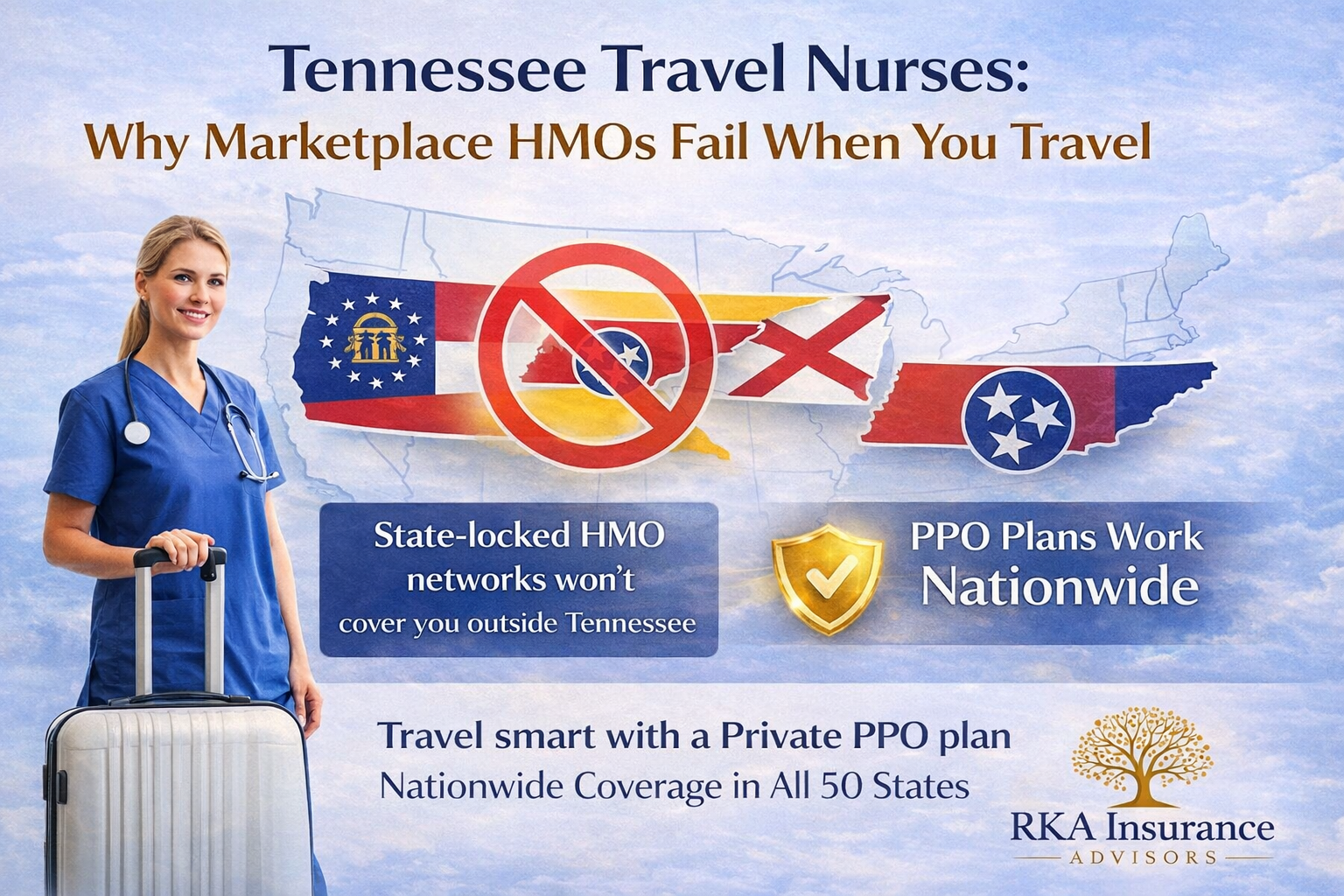
Tennessee Travel Nurses: Why Marketplace HMOs Fail When You Travel

Tennessee travel nurses: Your HMO stops at state borders. Get Private PPO plans with nationwide coverage that actually work when you travel for assignments.

Tennessee Travel Nurses: Why Marketplace HMOs Fail When You Travel

Fast take: HMO networks stop at state borders—your Tennessee HMO won't cover you in Georgia, Alabama, or any other state. Marketplace plans are designed for people who stay in one place, not travel nurses. Private PPO plans give you nationwide networks that work in all 50 states, often at lower rates than marketplace plans because of healthier risk pools.

Need Private PPO coverage that works nationwide?

We'll verify your doctors are in-network, compare marketplace vs private PPO options, and enroll you quickly.

Get Free Quotes Book a Call

The Problem: HMOs Are State-Locked

When you buy health insurance on Healthcare.gov in Tennessee, you're getting an HMO network built for Tennessee residents. The insurance carrier contracts with Tennessee hospitals and doctors. Those contracts don't extend to Georgia, Alabama, Kentucky, Virginia, North Carolina, South Carolina, Mississippi, or Missouri.

If you need care outside Tennessee, your HMO will only cover:

  • True emergencies — and the insurance company decides what counts as an emergency after the fact
  • Nothing else — routine care, urgent care, prescriptions, specialists are all out-of-pocket

You're traveling to Nashville, Knoxville, Memphis, and Chattanooga for assignments. But your assignments also take you to Atlanta, Birmingham, Charlotte, and Huntsville. Your marketplace HMO leaves you uncovered the moment you cross a border.

Real Example: $8,400 Emergency Room Bill

Sarah, a travel nurse from Nashville, took a 13-week contract in Birmingham, Alabama. Week 3, she developed severe abdominal pain and went to the ER. Appendicitis. Emergency surgery.

Her Tennessee marketplace HMO initially denied the claim. After appeals, they covered the surgery but not the ER physician, anesthesiologist, or follow-up care. Her out-of-pocket bill: $8,400.

A Private PPO plan would have covered the entire visit at in-network rates in Alabama.

Why Travel Nurses Need Private PPO Plans

Private PPO (Preferred Provider Organization) plans are off-exchange health insurance options available only through licensed agents. They're medically underwritten, which means you apply based on your health history instead of getting guaranteed acceptance like marketplace plans.

Why medical underwriting actually saves you money: Because Private PPO plans screen for health risks, they attract healthier applicants. This creates a lower-risk pool, which means lower premiums for everyone who qualifies. If you're healthy enough to pass a hospital's employment health screening, you'll likely qualify—and save money compared to marketplace plans.

Key Advantages for Travel Nurses

✓ Nationwide networks — Coverage works in all 50 states

✓ No referrals — See specialists directly

✓ Year-round enrollment — Apply any time

✓ Broader doctor access — Larger provider networks

✓ Lower premiums — Healthier risk pool = better rates

✓ Travel nurse-friendly — Designed for cross-state work

Who Qualifies

✓ Working full-time (healthy enough for hospital screenings)

✓ Generally younger, healthier professionals

✓ Many pre-existing conditions acceptable

✓ May be rated up for significant conditions

✓ Marketplace still available if declined

Private PPO vs Marketplace: The Real Cost Difference

Most travel nurses earning $80,000+ per year don't qualify for marketplace premium tax credits. Without subsidies, Private PPO plans are often more affordable than marketplace plans—and give you nationwide coverage.

Why Private PPO costs less (without subsidies): Medical underwriting creates a healthier risk pool. Marketplace plans must accept everyone regardless of health status, which raises premiums for all enrollees. Private PPO plans screen applicants, resulting in lower claims and lower premiums for those who qualify.

If you're earning above subsidy thresholds and you're healthy, Private PPO typically saves you money while giving you better coverage across state lines.

What About Premium Tax Credits?

If you qualify for marketplace subsidies (generally under $60,000/year for a single person), the subsidized marketplace plan will almost always be cheaper than Private PPO. However, you'll still be stuck with an HMO that doesn't work across state lines. Additionally, likely a higher deducitble and certaintly a higher out of pocket max.

Run the numbers with us:

  • Compare your actual after-subsidy marketplace cost
  • Compare Private PPO rates for your age and health profile
  • Factor in the cost of one out-of-network ER visit, the plans deducitble and max out of pocket. ($5,000-$10,000)

How to Get Private PPO Quotes in Tennessee

Private PPO plans aren't listed on Healthcare.gov. You need to work with a licensed health insurance agent who has access to off-exchange carriers.

Application Process

1. Complete health pre qualifying questionnaire w a licensed advsior (10-15 minutes)

2. Licensed advisor submits to application

3. Complete verification call w carrier (15-20 min)

4. Receive eligibilty determination within 48 hours on avgerage

5. Coverage starts on scheduled effective date

What We Verify

✓ Your current doctors are in-network

✓ Prescriptions are covered

✓ Tennessee hospitals included

✓ Out-of-state coverage confirmed

✓ Total annual cost comparison

Ready to Compare Private PPO Plans?

Get side-by-side quotes from top carriers. We verify your doctors are in-network and explain all your options—marketplace and private.

Get Free Quotes Book a Call

Frequently Asked Questions

Can I keep my Tennessee doctors with a Private PPO?

Yes. Private PPO plans include large nationwide networks. We verify your current doctors are in-network before you enroll. Most major hospital systems in Tennessee (Vanderbilt, HCA, UT Medical Center) are in-network with top PPO carriers.

What if I have a pre-existing condition?

It depends on the condition. Controlled conditions, high blood pressure, hypothroidism or past surgeries are often acceptable. Active cancer, recent heart attack, or uncontrolled chronic conditions may result in declination or higher rates.

Can I cancel my Private PPO if I get a staff position with benefits?

Yes. Private PPO plans are month-to-month. You can cancel any time with 30 days notice. No penalties or fees.

Do Private PPO plans cover prescriptions?

Yes. Most Private PPO plans include prescription coverage with tiered copays. We verify your current medications are covered before enrollment.

What's the difference between Private PPO and travel nurse agencies' health plans?

Agency contracts are typically 13 weeks, meaning any accumilation to deductible is lost after that contract, your coverage is tied to your agency and leaves you shopping coverage every 13 week.

Related Articles

HMO vs PPO vs EPO vs POS: Which Network Fits Your Needs?

Confused by network types? Learn the differences and why PPOs work best for travel nurses.

Truckers Health Insurance Guide

Another profession that crosses state lines? See how truckers get nationwide PPO coverage.

Licensed in Tennessee and 31 other states. NPN 19540130. For education only; coverage and availability vary by carrier and state.

Read More

Traveler-Friendly Health Insurance: Stay Covered Wherever You Go

Traveler-friendly health insurance with nationwide PPO access. Get urgent care & ER coverage on the road. Compare options & enroll fast with RKA.

Traveler‑Friendly Health Insurance: Stay Covered Wherever You Go | RKA Insurance Advisors

Travel Health Coverage

Traveler‑Friendly Health Insurance: Stay Covered Wherever You Go

Updated Aug 28, 2025 • Originally published Feb 29, 2025 • By

Whether you’re on the road for work, chasing weekend getaways, or planning a cross‑country move, having reliable coverage that travels with you matters. Traveler‑friendly plans—often built on nationwide PPO networks—help you access urgent care, ERs, and a broad set of in‑network doctors across the U.S.

Tip: Before you go, add your plan ID card to your phone wallet and bookmark your carrier’s provider search. If you’re unsure about a facility, text or call us and we’ll verify network status for you.

Why traveler‑friendly health insurance?

If you spend time outside your home area, a PPO gives you flexibility without referrals and, on many plans, nationwide in‑network access. That can mean lower bills and faster check‑in when you need care away from home.

Key features frequent travelers value

1) Nationwide provider access

Tap into large, national networks so you can see in‑network providers in most cities and states, from urgent care to specialists.

2) Emergency & urgent care coverage on the road

Emergencies don’t wait. With the right plan, ER and urgent care visits while traveling are covered per your policy terms, with predictable cost sharing.

3) Help coordinating care

We’ll confirm network participation, estimate costs, and schedule appointments for you—so you focus on the trip, not the paperwork.

4) Options for international travel

Going abroad? Pair your domestic plan with short‑term travel medical for overseas emergencies and evacuation benefits.

How RKA Insurance Advisors helps

  • Plan matching: We compare traveler‑friendly PPO options across carriers in the 30+ states where we’re licensed.
  • Concierge verification: Message us a clinic name, and we’ll check network status and expected costs before you go.
  • Fast enrollment: Same‑day enrollments available in many cases; options exist year‑round depending on your situation.

Want proof you’re in good hands? See our Google reviews and learn about our services.

Traveler FAQs

Does PPO health insurance cover me while traveling out of state?
Yes. With a PPO network, members typically have nationwide access to participating providers for urgent care, ERs, and many outpatient services. Benefits depend on the plan; verify provider participation and any out‑of‑network cost sharing before you go.
Do I need separate travel medical insurance for international trips?
U.S. plans often have limited or no coverage abroad. For international travel, a short‑term travel medical policy can cover emergencies and evacuation. We’ll help you compare options.
What’s better for travelers: PPO or HMO?
PPOs offer broader, often nationwide networks and don’t usually require referrals—ideal for frequent travelers. HMOs tend to be regional and referral‑based; out‑of‑area care is typically emergency‑only.
How do I check if a provider is in‑network while traveling?
Use the carrier’s provider lookup or call member services. Or text/call us—we’ll verify and estimate costs.
Can I get short‑term coverage just for a trip?
Yes—short‑term medical or travel medical may fit. We’ll review dates, destinations, and needs to recommend the right fit.
Robert Adams • President & Licensed Agent • NPN 19540130
Licensed in AL, CO, DE, FL, GA, IA, IL, IN, KY, KS, LA, MD, MI, MO, MS, MT, NC, NE, NV, OH, OK, SC, SD, TN, TX, UT, VA, WI, WV, WY
Read More

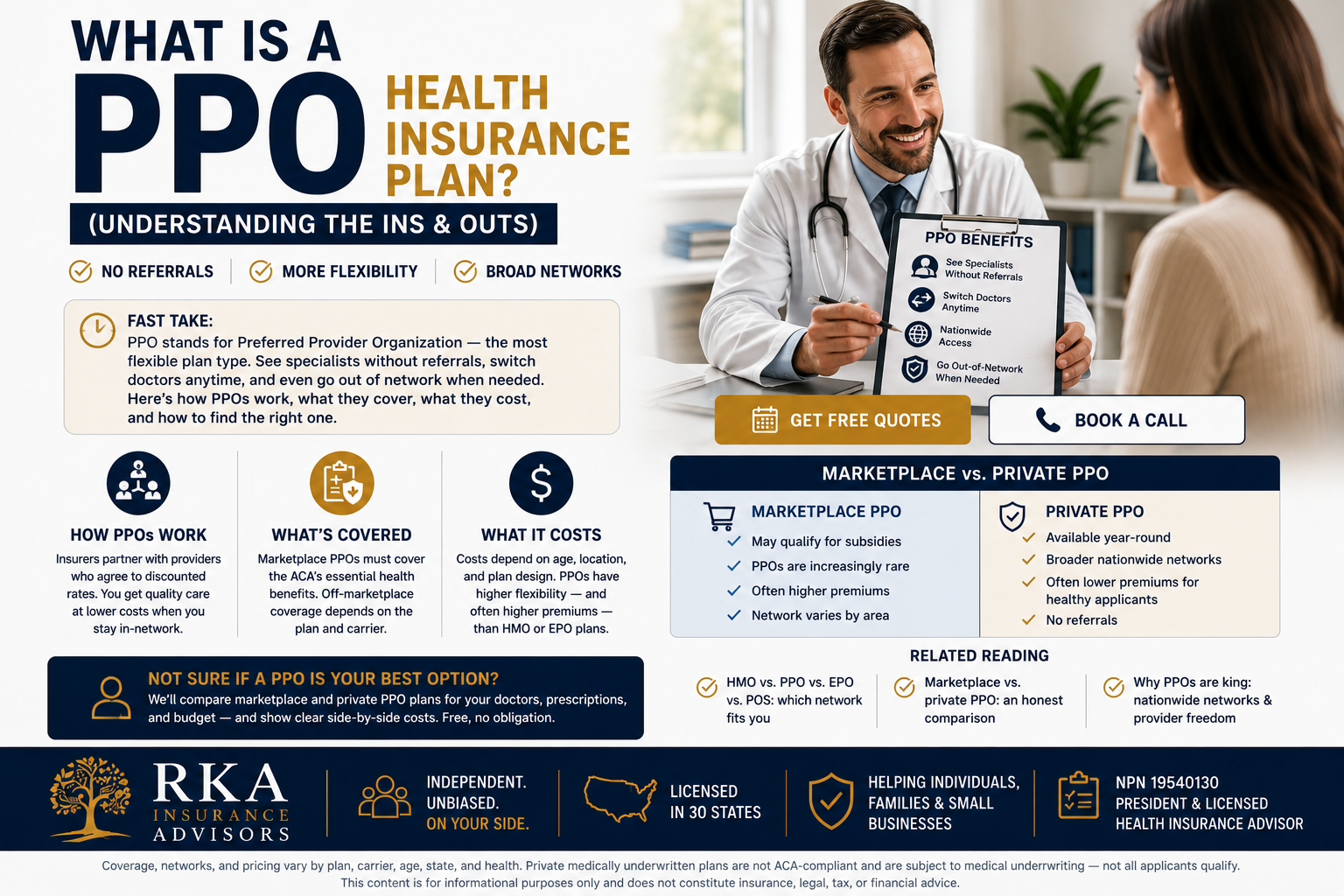
What Is A PPO Health Insurance Plan?

PPO plans explained in plain English — how they work, why there are no referrals, the out-of-network flexibility, what they cost, and how marketplace and private PPO options compare.

PPO • Health Insurance Basics

What Is a PPO Health Insurance Plan? (Understanding the Ins & Outs)

Fast take: PPO stands for Preferred Provider Organization — the most flexible and popular plan type. No primary care doctor required, no referrals to see specialists, and you can even go out of network if you need to. Here’s how PPOs work, what they cover, what they cost, and how to find the right one.

What a PPO is — and how it works

A PPO contracts with a network of doctors, hospitals, and facilities that agree to charge set rates for their services. Stay in-network and you get significant savings versus going outside it. The reason it works is simple: insurers bring the members, providers bring the care, and both agree on a discounted rate up front — a win for the carrier, the provider, and, most importantly, you.

The feature people love most is flexibility. Unlike an HMO, a PPO doesn’t make you pick a primary care physician, and you don’t need a referral to see a specialist.

What’s covered

  • Marketplace PPOs must cover the ACA’s essential health benefits
  • Off-marketplace coverage depends on the specific plan and carrier
  • Most PPOs offer broad coverage thanks to large provider networks

How much does a PPO cost?

Cost comes down to a few things: your age, how many people are covered, your ZIP code, and the plan’s network size, copays, deductible, and out-of-pocket maximum. One catch on the marketplace: true PPOs are increasingly hard to find there, and when they exist they’re often pricier than HMO or EPO options.

Off the marketplace, private PPOs are available in most areas. Some are short-term plans that are technically PPOs but provide limited benefits — always talk to a licensed advisor before enrolling in one. Others are medically underwritten: because the risk pool is healthier, the carrier can often offer lower rates, real PPO networks, and stronger benefits for people with a smaller claims history.

Marketplace vs. private PPO: if you qualify for a subsidy, a marketplace plan may win — but true PPO networks are getting rare there. If you’re healthy or above the subsidy line, a medically underwritten private PPO often delivers a broader network for less. The only way to know is to compare both for your situation.

Where to start your search

The best place to start is right here. We take an educational approach and review all the options available in your area — marketplace and private — so you can see the full picture. It’s worth a conversation even if you just want a second opinion on your current plan.

Not sure if a PPO is your best option?

We’ll compare PPO options — marketplace and private — for your doctors, prescriptions, and budget, and show clear side-by-side costs. Free, no obligation.

Get Free Quotes Book a Call

Related reading

Frequently asked questions

Do I need a referral with a PPO?

No. PPOs let you see specialists directly, without a referral from a primary care doctor — one of the main reasons people choose them.

Can I use out-of-network doctors with a PPO?

Yes, though you’ll usually pay more than in-network. The flexibility to go out of network when you need to is a core PPO benefit.

Are PPOs available on the marketplace?

Fewer than there used to be, and they’re often more expensive than HMO or EPO plans there. Many true PPOs are found off-marketplace as private plans — worth comparing both.

Is a private PPO cheaper than a marketplace plan?

For a healthy household above the subsidy line, a medically underwritten private PPO is frequently less expensive with a broader network. If you qualify for a subsidy, a marketplace plan may win. Compare both to be sure.

Short-term plans are not ACA-compliant and provide limited benefits — always review the details with a licensed advisor before enrolling.

Robert Adams · President & Licensed Agent · NPN 19540130 · Licensed in 30 states. Coverage, networks, and pricing vary by plan, carrier, age, state, and health. Private medically underwritten plans are not ACA-compliant and are subject to medical underwriting — not all applicants qualify. This content is for informational purposes only and does not constitute insurance, legal, tax, or financial advice.

PPO • Preferred Provider Organization • health insurance basics • private PPO • HMO vs PPO • provider networks

RKA Insurance Advisors

Robert Adams
https://www.RKAInsuranceAdvisors.com

Read More
Education, Open Enrollment Robert Adams Education, Open Enrollment Robert Adams

Open Enrollment & Your Plan Options

Open enrollment explained — metal tiers, networks, subsidies, and the private options most brokers skip.

Open Enrollment • Basics

Open Enrollment & Your Plan Options, Explained

📅 Looking for this year's exact dates? See our 2027 Open Enrollment Dates guide →
Fast take: Open enrollment is the once-a-year window to sign up for or change health coverage. It opens November 1 and runs into mid-January in most states — enroll by December 15 for a January 1 start. But the Marketplace isn't your only option: the right plan depends on your income, health, lifestyle, and work. Here's how the choices actually compare.

Open enrollment is the period each year when you can sign up for health insurance or change your current coverage. In most states it opens November 1 and runs through mid-January for individual and family plans. Enroll by December 15 and coverage typically starts January 1; enroll after that (through the deadline) and coverage usually starts February 1. Some states run their own window on different dates — check with one of our benefit specialists for your state, or see the current-year guide linked above.

Marketplace metal tiers

  • Bronze — lowest monthly cost, but higher deductibles and more out-of-pocket expense.
  • Silver — middle-of-the-road; balances coverage and cost (and unlocks extra savings if you qualify).
  • Gold — higher premium, stronger cost-sharing, lower deductibles and out-of-pocket exposure.
  • Platinum — rare and only in a few counties; highest premium, lowest deductibles.

Networks: why the type matters

Most Marketplace options are HMO or EPO networks — limited to a local service area, covering you outside it only for emergencies. PPO networks are available in select areas and offer nationwide access to providers without referrals. If you travel, split time between states, or want freedom to see specialists directly, network type matters as much as price.

Subsidies (premium tax credits)

If your income falls between 100% and 400% of the federal poverty level, you may qualify for a premium tax credit that lowers your Marketplace cost — sometimes dramatically. The exact income cutoffs change each year, and earning over the top of the range means you pay full price (the "subsidy cliff"). We calculate your current-year subsidy and show your true net cost. More on the subsidy cliff →

Options beyond the Marketplace

Our specialty — private nationwide PPO. If subsidies aren't available to you (or you want a broader network), a private, medically-underwritten PPO often delivers lower out-of-pocket costs and lower deductibles than the Marketplace, with coast-to-coast provider access and no referrals. Some options are guaranteed renewable to age 65. It's the option only a limited number of agents offer — and where we shine. (Underwriting required — you'll need to be relatively healthy to qualify.)

Other options we can compare

  • Short-term medical — often the most affordable; coverage for roughly 30 days up to (with some insurers) 12 months. More limited than major medical.
  • Fixed indemnity — supplemental coverage that pays set cash benefits toward specific costs; a layer of protection on top of a plan, not a replacement.
  • Healthcare sharing — members share medical costs via a monthly share amount; not insurance, with its own rules and limits.

Don't assume your current plan is still the best

Before you renew, talk to a benefits specialist — we'll compare Marketplace and private options, verify your doctors, and make sure you're not overpaying.

Get Free Quotes Book a Call

Frequently asked questions

When exactly can I enroll?

Open enrollment opens November 1 and runs into mid-January in most states; some state marketplaces differ. See the current-year guide for exact dates, or ask us about your state.

Is the Marketplace my only choice?

No. Depending on your income and health, a private nationwide PPO or a supplemental option may be a better fit. We compare all of them for you.

How do I know I'm not overpaying?

We price your real annual cost — premium, deductible, copays, and out-of-pocket max — across every option and verify your doctors before you enroll.

For education only; eligibility, benefits, and availability vary by carrier and state. Always review official plan documents. Private plans are medically underwritten — not all applicants qualify. RKA Insurance Advisors is an independent, licensed health insurance brokerage (NPN 19540130). We do not offer Medicare. Call (561) 806-9913.

Read More