COBRA vs Marketplace vs Private PPO: What to Do Right After You Lose Employer Coverage
Quick guide to COBRA vs Marketplace vs Private PPO—costs, networks, and when each wins. We’ll verify your doctors and show clear prices.
COBRA vs Marketplace vs Private PPO: What to Do Right After You Lose Employer Coverage
Laid off, new job, or between jobs? Here’s the fast, practical guide—costs, networks, deadlines, and how to decide in minutes. We’ll verify your doctors and show clear costs.
- Same network/benefits you already know.
- Usually most expensive (you pay full premium + 2%).
- Time-limited (18 months); retroactive if elected on time.
- Good when in treatment and changing plans is risky.
- May be cheapest if your income qualifies for credits.
- Many plans are HMO/EPO; referrals are common.
- Mid-year move allowed due to loss of coverage.
- Credits reconcile at tax time—under-reporting income can create payback.
- Nationwide PPO when eligible; keep specialists/hospitals.
- Typically no referrals; fewer hoops.
- Advance premium tax credits do not apply to Private PPOs.
- Pricing = age, ZIP, benefits, and network.
- Great when you travel or want doctor choice.
What tends to cost more—and why
Why COBRA is often pricey
- You pay the entire employer premium + 2% admin fee.
- Large-group plan designs can carry higher OOP maxes.
- No income-based help.
How non-Marketplace Private PPO prices
- Based on age, ZIP, network size, and benefits.
- Good fits: provider choice, travel, specialist access, fewer referrals.
- We verify your doctors before you switch.
How to decide in minutes
Pick COBRA if…
- You’re mid-treatment and can’t risk network changes.
- You can stomach short-term higher premiums.
- You need exactly the same plan and doctors right now.
Pick Private PPO if…
- You want nationwide PPO and typically no referrals.
- You travel, use specialists, or dislike gatekeepers.
- Credits don’t help you—or you prefer not to use them.
Want the best post-employer fit in your ZIP?
We’ll verify your doctors and meds, compare COBRA vs Marketplace vs Private PPO, and show clear costs. No pressure—just answers.
FAQ
How long do I have to elect COBRA?
Can I switch from COBRA to other coverage later?
Do Private PPOs use ACA tax credits?
How do I know if my doctors are covered?
How do we start?
This overview is educational, not tax or legal advice. Availability varies by state and carrier. Eligibility and enrollment subject to plan terms.
Losing employer coverage creates options most people don't know about. Our licensed advisors compare COBRA, marketplace plans, and private PPO alternatives to find the best fit for your situation. Compare your options now.
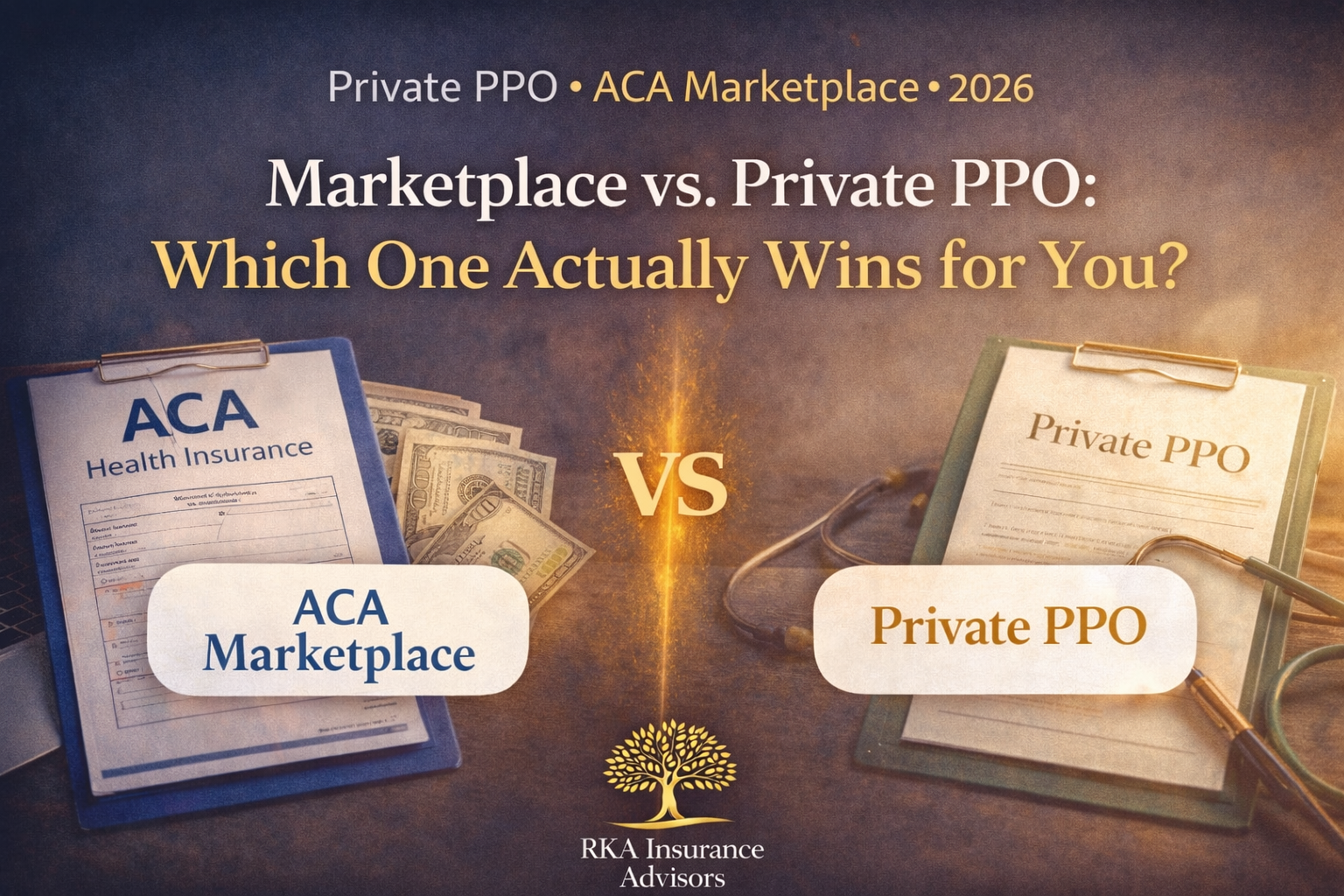
Marketplace vs Private PPO 2026 | Which Wins for You?
ACA Marketplace plans can be the right call if your income qualifies for subsidies. But if you earn above the subsidy threshold or want broader doctor access with no referral requirements, a private underwritten PPO often wins on cost, flexibility, and nationwide coverage.
Private PPO • ACA Marketplace • 2026
Marketplace vs. Private PPO:
Which One Actually Wins for You?
The core difference in one sentence
Marketplace (ACA) plans are priced based on your income and regulated by the government. Private PPO plans are priced based on your health and issued by private carriers outside the exchange.
That one difference drives everything else — cost, network, enrollment windows, and who qualifies for what.
Side-by-side comparison
- Premium tied to your income
- Subsidies available below 400% of the Federal Poverty Level (FPL)
- Open enrollment window (or qualifying life event required)
- Pre-existing conditions covered — no underwriting
- Network can be narrow depending on plan and region
- Referrals may be required on HMO-type plans
- Deductibles can be significant on unsubsidized plans
- Premium based on age and health — not income
- No subsidies — but often lower premiums for healthy applicants
- Available year-round — no enrollment window
- Medical underwriting required — health history reviewed
- Nationwide PPO network — see any PPO doctor, no referrals
- No referral requirements
- Qualify for lower deductible options, including $0 deductible plans
When the Marketplace wins
The ACA Marketplace is genuinely the better option in certain situations. It wins when:
- Your income qualifies for subsidies. Below 400% of the Federal Poverty Level (FPL), subsidies can make Marketplace plans extremely affordable — sometimes as low as $0/month. If you qualify, it's hard for a private plan to compete on price.
- You have pre-existing conditions. Marketplace plans cannot deny coverage or charge more based on health history. Private underwritten plans can decline applicants or exclude conditions — so if you have significant health history, the Marketplace may be your only path to full coverage.
- You're between jobs short-term. If you need a bridge for 30–60 days and qualify for a Special Enrollment Period, a Marketplace plan can be fast and straightforward.
When a private PPO wins
Private PPO plans tend to outperform the Marketplace when:
- Your income is above the subsidy threshold. Once you're above 400% FPL, Marketplace premiums are unsubsidized and can be steep. For a healthy individual in this bracket, a private PPO often comes in significantly lower.
- You need coverage outside open enrollment. Private PPO plans are available year-round — no qualifying life event required. If you missed open enrollment or just went self-employed mid-year, a private plan is often the only option.
- You want nationwide access. Private PPO networks typically cover you anywhere in the country with no referral requirements — important for frequent travelers, remote workers, and anyone who splits time between states.
- You're self-employed with variable income. ACA plans reprice if your income changes — under or overestimate and you pay the difference at tax time. Private PPOs have fixed premiums not tied to income.
The honest answer
There is no universally better option. The right plan depends on your income, health history, where you live, and whether you're in an open enrollment window. The only way to know which wins for you is to compare both with actual numbers.
That's exactly what we do — side-by-side, with real quotes, from a licensed advisor. Free, no obligation.
What about doctor networks?
This is where private PPO plans have a consistent advantage. Marketplace networks — especially at the Silver tier — vary significantly by state and county. In some markets they're broad; in others, major hospital systems are excluded entirely.
Private PPO plans access major nationwide carrier networks. If you have a doctor, specialist, or hospital you want to keep, we verify coverage on both options before you enroll — not after.
How RKA helps
RKA Insurance Advisors is an independent brokerage licensed in 32 states. We're not captive to any single carrier — we compare Marketplace plans and private PPO options side by side and help you pick what actually fits your situation.
- Free quote — no obligation
- We verify your doctors on both options before you commit
- We explain subsidy eligibility clearly — if you qualify, we'll tell you
- Available year-round, not just during open enrollment
See which option wins for you
We'll compare Marketplace and private PPO side by side — free, no pressure, no obligation.
Frequently Asked Questions
Can I switch from Marketplace to a private PPO anytime?
Yes — private PPO plans are available year-round with no enrollment window. You can apply and get covered in as little as a few days depending on the carrier. Cancelling your Marketplace plan mid-year may affect any advance premium tax credits received, so review your tax situation before switching.
Does a private PPO cover pre-existing conditions?
Private underwritten plans review your health history at application. Some conditions may be excluded or result in a higher premium. If you have significant pre-existing conditions, a Marketplace plan may provide broader coverage. We'll be upfront about what each option covers for your specific situation.
What does "above the subsidy threshold" mean?
ACA subsidies phase out at 400% of the Federal Poverty Level (FPL). Above that income level, you pay the full unsubsidized Marketplace premium. For many self-employed professionals and small business owners in this bracket, private PPO premiums compare favorably — often significantly so.
Can I keep my current doctors on a private PPO?
Most likely yes — private PPO networks are broad and access major hospital systems and specialist groups nationwide. We verify your specific providers on any plan before you enroll so there are no surprises.
Is RKA an ACA broker or private PPO broker?
Both. We're an independent brokerage — we're not incentivized toward either option. We compare what's available for your situation and present the numbers clearly. NPN: 19540130. Licensed in 32 states.
Educational purposes only. Plan availability, premiums, and benefits vary by state, county, and individual health profile. Review official plan documents before enrolling. RKA Insurance Advisors, NPN 19540130, licensed in 32 states.
Why Health Insurance Matters in 2026: Protection & Costs
Staying uninsured is risky. A single ER visit or surgery can create years of debt. The right health plan protects your health, your family, and your wallet by covering everyday care and unexpected emergencies.
Why Health Insurance Matters
Staying uninsured is risky. A single ER visit, surgery, or specialty medication can create years of debt. The right health plan protects your health, your family, and your wallet—before and after something serious happens.
Think of health insurance as a financial safety system: it keeps everyday care affordable, caps your worst-case bills in a bad year, and gives your family more stability when life changes unexpectedly.
Everyday care that stays affordable
- Helps with sick visits, labs, imaging, and prescriptions.
- Uses copays or in-network discounts instead of full price.
- Makes preventive care easier to keep up with.
Protection from “worst-case” bills
- Turns unpredictable hospital bills into capped costs.
- Uses deductibles and out-of-pocket maximums to limit damage.
- Helps you avoid long-term medical debt after an emergency.
Financial stability for your family
- Reduces the chance a surprise bill blows up your savings.
- Helps protect your credit and long-term goals.
- Gives you more control over how you budget for health care.
What tends to cost more—and why
Staying uninsured
- You pay full retail cost for ER visits, imaging, and surgery.
- Hospitals can bill tens of thousands of dollars for a single event.
- No out-of-pocket maximum to cap how bad a year can get.
Having the wrong-fit plan
- Too-high deductible or out-of-pocket max for your budget.
- Networks that don’t include your main doctors or hospitals.
- Drug coverage that doesn’t line up with your medications.
How to decide in minutes
Stay the course if…
- Your current plan is affordable and covers your doctors and meds.
- You’ve already met your deductible and have upcoming care.
- You understand your out-of-pocket max and it fits your savings.
Review options with RKA if…
- Your premiums jumped or you’re worried about 2026 increases.
- You’re not sure if ACA Marketplace or private PPO fits better.
- You want someone to verify doctors, hospitals, and medications for you.
Our role is to remove the guesswork. We map out what you actually use—doctors, prescriptions, budget—and then show how different plan types handle those needs.
Want a plan that actually fits your life?
We’ll verify your doctors and prescriptions, compare ACA Marketplace and private PPO options in your ZIP, and show clear costs—no pressure, just answers.
FAQ
Do I really need health insurance if I’m young and healthy?
Yes. Insurance is designed for the unexpected—accidents, new diagnoses, or sudden surgeries. When you’re healthy, you still benefit from low-cost preventive care and protection if something changes.
What’s the biggest risk of going without coverage?
One major event—such as an ER visit, imaging, or a short hospital stay—can create bills that take years to pay off. Without a plan, there’s no out-of-pocket maximum to cap how bad the year can get.
How do ACA Marketplace plans and private PPOs fit into this?
Marketplace plans use income-based credits and standardized benefits. Private PPOs can offer $0 deductibles, nationwide networks, and different pricing for healthy households. We compare both side-by-side so you’re not guessing.
What does it cost to work with RKA Insurance Advisors?
There is no extra cost to you. We’re paid by the carriers, so you get expert guidance and support with the same or better pricing than going direct—plus help during enrollment and if issues pop up later.
This overview is educational, not tax or legal advice. Availability and eligibility vary by state and carrier. Benefits, networks, and pricing are subject to change. Always review official plan documents before enrolling.