Health Insurance for Self-Employed Floridians: What to Know in 2026
Florida has more solo incorporated businesses per capita than any other state. If you're self-employed and above the ACA subsidy threshold, you may be overpaying for coverage. Private medically underwritten plans often cost 30-50% less for healthy Floridians.
Private PPO • Florida • Self-Employed
Health Insurance for Self-Employed Floridians: What to Know in 2026
Why Florida has a health insurance problem worth talking about
Florida consistently ranks first in the nation for incorporated self-employed workers per capita. No state income tax, warm weather, and a business-friendly climate have pulled in hundreds of thousands of freelancers, consultants, sole proprietors, and small business owners over the past decade — and that number keeps growing as remote work lets people relocate from high-tax states like New York, California, and Illinois.
That's great for Florida's economy. But it creates a concentrated population of people who have to buy their own health insurance — and many of them are paying far more than they need to.
The ACA subsidy cliff: who it hits hardest
The Affordable Care Act offers significant premium subsidies for households earning up to 400% of the federal poverty level. In 2026, that's roughly $62,000 for a single person and $127,000 for a family of four. There's still a hard threshold beyond which you receive little or no federal help. For self-employed Floridians whose income tops that line — or whose net income swings year to year — full marketplace rates get steep:
Single, age 35
Bronze ACA: $320–$420/mo
Silver ACA: $430–$560/mo
Gold ACA: $530–$680/mo
Unsubsidized. Full premium.
Single, age 45
Bronze ACA: $420–$560/mo
Silver ACA: $560–$720/mo
Gold ACA: $680–$860/mo
Unsubsidized. Full premium.
Couple, ages 40/42
Bronze ACA: $780–$980/mo
Silver ACA: $1,000–$1,280/mo
Gold ACA: $1,200–$1,500/mo
Unsubsidized. Full premium.
These are estimates based on 2026 Florida marketplace rates in major metro areas; actual premiums vary by zip code, carrier, and plan. The point: if you're not getting subsidies, marketplace coverage is expensive — and many self-employed Floridians have an alternative worth exploring.
The alternative: private medically-underwritten coverage
Outside the ACA marketplace, a separate market exists for private, medically-underwritten plans with a nationwide PPO network. These aren't sold on HealthCare.gov. They require a health questionnaire and, in some cases, a brief medical review. If you qualify, the savings can be significant.
ACA marketplace — guaranteed issue
- No health questions required
- Subsidies available below the income threshold
- Everyone pays the same rate by age/zip
- Premiums high above the subsidy cliff
- Networks are narrower in some FL counties
Private underwritten plan — medically underwritten
- Lower premiums for healthy applicants
- Nationwide PPO network access
- Flexible plan designs and deductibles
- No open enrollment window — apply any time
- Not available if you have significant health history
Who qualifies in Florida
Eligibility is based on your health history, not your income. Underwriting typically reviews the past 3–5 years of medical records and asks about conditions including diabetes, heart disease, cancer, autoimmune disorders, ongoing prescription use, and recent hospitalizations.
Likely to qualify
- No major chronic conditions
- No recent hospitalizations (past 2 years)
- No ongoing specialty care
- Minimal or no prescription medications
- Non-smoker (or quit 12+ months ago)
- Healthy BMI range
May not qualify
- Type 1 or Type 2 diabetes
- Heart disease or prior cardiac events
- Active cancer treatment or recent history
- Multiple ongoing prescriptions
- Autoimmune conditions (lupus, MS, etc.)
- Recent surgery or a planned procedure
If you don't qualify for a private plan, the ACA marketplace is the right option — especially if subsidies are available. There's no one-size-fits-all answer, which is exactly why it makes sense to compare both before you enroll.
Florida-specific considerations
No state income tax advantage
- Self-employed premiums are deductible federally
- No Florida state income tax to offset
- Premium savings go straight to your bottom line
- Lower monthly cost = more cash flow for the business
New residents from high-cost states
- Relocating from NY, CA, IL? Rates are lower here
- New to self-employment after a move? No COBRA required
- Can apply for private coverage any time of year
- No open enrollment window to wait for
Find out what you'd pay in Florida
We run quotes on both private and marketplace options so you can compare apples to apples before deciding — free, no obligation.
Get Free Quotes Talk to an AdvisorWhat the process looks like
- Step 1 — Get quotes. Submit basic info and a health snapshot, get a side-by-side comparison of private vs. marketplace vs. hybrid options. No obligation, about 5 minutes.
- Step 2 — Review & apply. Choose a plan that fits your budget, complete the health questionnaire, and go through underwriting (typically 3–7 days). You get an approval, counteroffer, or decline.
- Step 3 — Coverage starts. Effective date is typically the 1st of the following month, ID cards arrive within 1–2 weeks, and you have full nationwide PPO access immediately — no waiting for open enrollment.
Frequently asked questions
Is a private medically-underwritten plan legal in Florida?
Yes. These are fully legal private plans sold outside the ACA marketplace. They're not ACA-compliant coverage, so they work best for healthy applicants who clear underwriting — but there's nothing improper about them.
Can I deduct the premiums as a self-employed person?
In most cases yes — self-employed health insurance premiums are generally deductible on your federal return. Confirm your specifics with your tax professional.
What if I get sick after I enroll — can they cancel my coverage?
No. Once you're approved and covered, a new condition that develops afterward can't be used to cancel the plan. Underwriting happens at application, not after a claim.
Do these plans cover specialists and hospitals in Florida?
Yes — they use a nationwide PPO network with broad access to Florida doctors, specialists, and hospitals, with no referrals needed. We confirm your specific providers before you enroll.
What if I don't qualify for a private plan?
Then the ACA marketplace is your path, and if subsidies apply it may be the cheaper one. We quote both, so you're never left without an option.
I moved to Florida recently. Can I still apply?
Yes. Private plans can be applied for any time of year — no open enrollment window and no COBRA required after a move.
Self-employed in Florida? Compare both sides first.
We run quotes on private medically-underwritten plans and ACA options so you can compare both — free, no obligation.
Get Free Quotes Book an Appointment
Robert Adams
President & Licensed Agent, RKA Insurance Advisors · NPN 19540130 · (561) 806-9913
Premium estimates are illustrative ranges based on 2026 Florida marketplace data and are not guaranteed. Actual premiums vary by age, zip code, tobacco status, plan selection, and carrier. Private medically-underwritten plan availability and pricing are subject to underwriting approval; private plans are not ACA-compliant and do not count as minimum essential coverage. RKA Insurance Advisors LLC, NPN 19540130. This content is for informational purposes only and does not constitute insurance, legal, tax, or financial advice.
Extended Open Enrollment 2026: Final Days Before January 15 Deadline | RKA
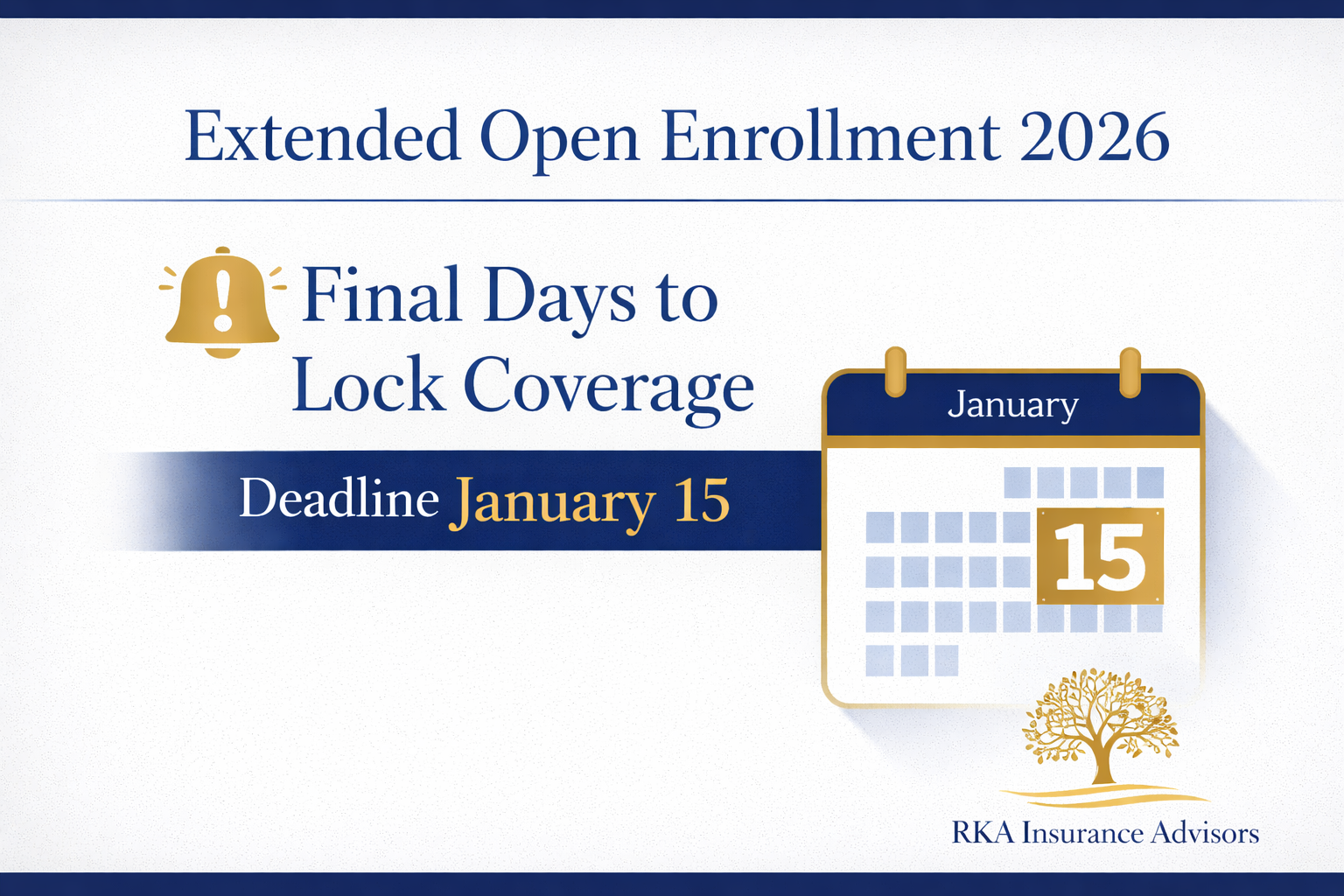
Open Enrollment 2026 closes January 15. Enroll by Dec 15 for Jan 1 coverage, or by Jan 15 for Feb 1 coverage. Don't auto-renew into higher 2026 rates—compare ACA Marketplace plans vs private PPOs and verify your doctors are covered.
Open Enrollment
Extended Open Enrollment: Final Days to Lock Coverage — January 15 Deadline
Key dates to remember
What to do before the deadline
- 1. Verify your providers. Marketplace networks can be narrow — HMO/EPO-heavy with referral requirements. Private PPOs often offer broader access. We confirm your doctors are in-network before you enroll.
- 2. Compare total annual cost. Don't just look at premiums — factor deductibles, copays, coinsurance, and out-of-pocket maximums against your expected usage.
- 3. Check subsidy eligibility. Income-based tax credits can dramatically lower Marketplace premiums. We'll estimate your subsidy and show net cost.
- 4. Consider private PPO alternatives. If you don't qualify for subsidies or want nationwide PPO access, a private, medically-underwritten PPO may offer lower total cost and fewer restrictions.
How to decide in minutes
Pick an HMO or POS if…
- You want lower premiums and are comfortable staying in a local network
- You prefer one doctor coordinating care and providing referrals
- You rarely travel or need specialists outside your area
Pick a PPO or EPO if…
- You want to see specialists without referrals and value a larger network
- You travel often or need doctors across multiple states
- You'll pay a bit more to avoid network restrictions and referrals
How RKA helps with last-minute enrollment
- Fast comparisons — ACA vs. PPO side-by-side with your providers
- Network verification — we confirm your doctors before you commit
- Clean enrollment — we hit the deadline and set your correct effective date
Lock your coverage before January 15
We'll verify your doctors and prescriptions, compare ACA vs. PPO, and show clear costs — no pressure, just answers.
Get Free Quotes Book a CallQuick FAQs
What if I miss the January 15 deadline?
You'll need a Qualifying Life Event for a Special Enrollment Period, or you'll wait until next Open Enrollment. Private PPOs may still be available year-round if you're eligible.
Can I change plans if I already enrolled?
During Open Enrollment you can switch plans. After January 15, changes require a Special Enrollment Period.
Will my current plan auto-renew?
Usually yes — but you may pay more. Many insurers raised rates significantly, so review before auto-renewal hits.
Missing the deadline doesn't mean you're out of options. Our licensed advisors help you explore Marketplace plans, private PPO options, and special enrollment opportunities year-round. Get coverage options now.
For education only; eligibility and benefits vary by carrier and state. Always review official plan documents. RKA Insurance Advisors is an independent, licensed health insurance brokerage (NPN 19540130). We do not offer Medicare. Call (561) 806-9913.

Preparing for Open Enrollment 2026: Key Steps Every Consumer Should Know
Open enrollment runs Nov 1 to mid-January. Key deadlines, cost trends, and how to compare Marketplace vs. private PPO — so you don't overpay.Open Enrollment • Get Ready
Preparing for Open Enrollment: Dates, Deadlines & Smart Moves
Why costs keep climbing
- Medical inflation — hospital, physician, and facility prices keep outpacing wages
- Prescription trend — specialty drugs (including GLP-1s) are widening spend
- Higher utilization — delayed care is catching up and pushing claims higher
- Plan-design shifts — deductibles, copays, and contributions get adjusted
What to compare during Open Enrollment
Marketplace (Government)
- Premium tax credits available if your income qualifies
- HMO/EPO networks common; referrals often required
- County-based networks — choices vary by ZIP
- Available during Open Enrollment or a qualifying life event
Private PPO (Licensed Access)
- Broad PPO access, referrals typically not required
- Medically underwritten — can be lower-cost for healthy households
- Often better for travel, provider choice, and specialist access
- Available year-round (subject to eligibility)
Key enrollment timing
State-based exchanges may run different dates — ask us to confirm your state's exact deadlines, or check the current-year guide linked above.
How RKA helps — no pressure, just answers
- Side-by-side comparisons — Marketplace vs. private PPO, matched to your doctors and prescriptions
- Network & Rx checks — we confirm providers and drug tiers up front to prevent surprises
- Year-round support — we stay with you for renewals, plan changes, and claims questions
Want a side-by-side Marketplace vs. private PPO analysis?
We'll verify networks and medications, compare plans in your ZIP, and show clear costs — no pressure, just answers.
Get Free Quotes Book a CallQuick FAQs
Is the employer plan always best?
Not always. If spousal or child premiums are high, moving them to a Marketplace or private PPO plan can cut total household cost while keeping access. We model both paths.
Can you verify our doctors and hospitals first?
Yes — we confirm providers and prescriptions up front so you avoid out-of-network surprises or drug-tier shocks later.
Can we switch mid-year?
Generally only with a qualifying life event. Otherwise Open Enrollment is your main window — though a private PPO may offer year-round access if you're eligible.
Educational use only; benefits and eligibility vary by employer, carrier, and state. Always review official plan documents. Private plans are medically underwritten — not all applicants qualify. RKA Insurance Advisors is an independent, licensed health insurance brokerage (NPN 19540130). We do not offer Medicare. Call (561) 806-9913.
How does the Inflation Reduction Act affect your Health Coverage?
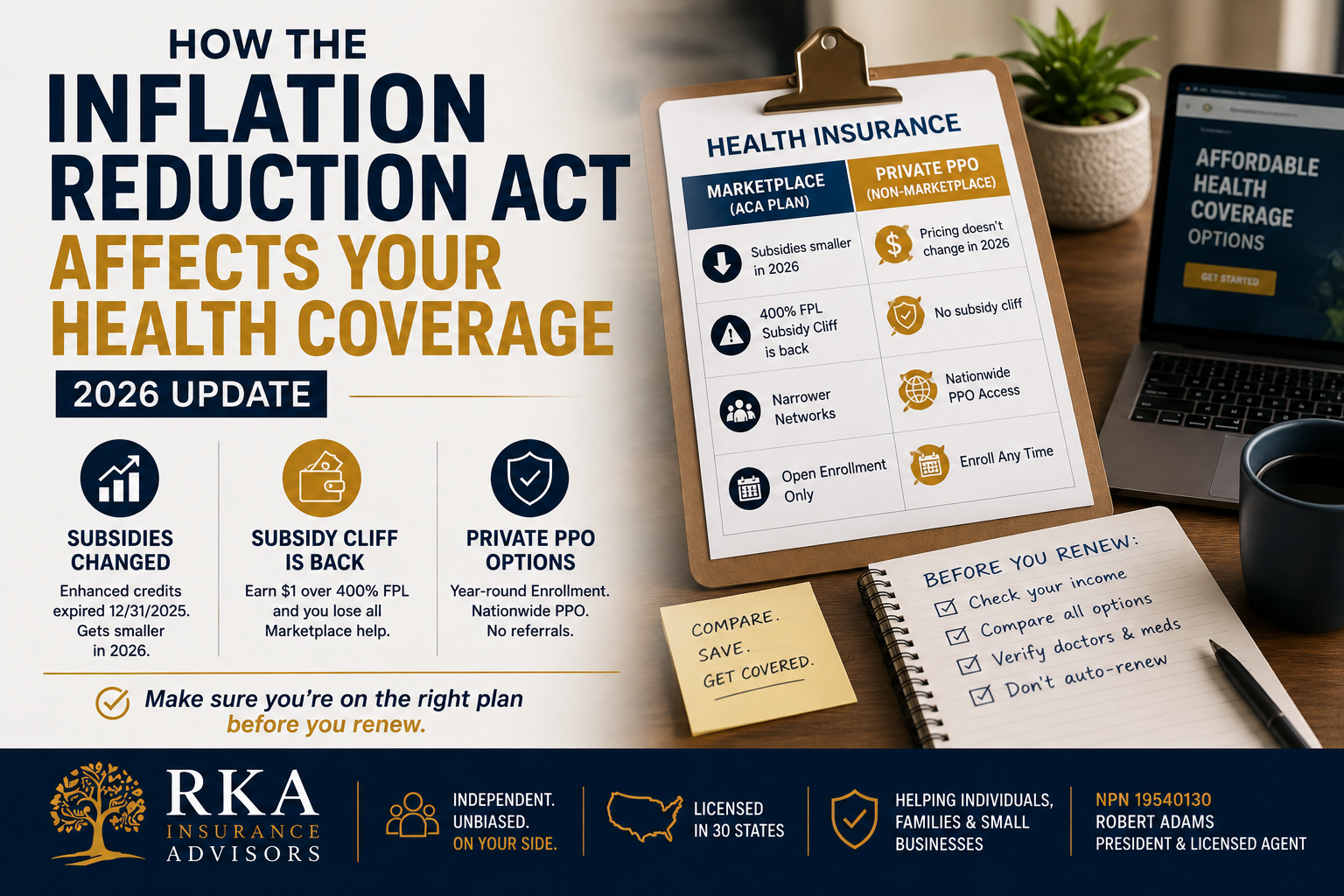
The Inflation Reduction Act's enhanced ACA subsidies expired at the end of 2025 and the 2026 subsidy cliff is back. Here's what changed, the income cutoffs, and where a private PPO now beats the marketplace.
Private PPO • Marketplace • 2026 Changes
How the Inflation Reduction Act Affects Your Health Coverage (2026 Update)
What changed for 2026
The IRA’s larger subsidies were always temporary. They ran from 2021 through 2025, and Congress did not extend them. When 2026 Open Enrollment opened, the enhanced credits were gone — and for millions of people the price to keep the same plan jumped sharply.
The cliff cutoff scales with household size — roughly $84,600 for a couple and $128,600 for a family of four in 2026. Cross it by a dollar and your Marketplace subsidy drops to zero.
Marketplace vs. Private PPO in 2026
Marketplace (ACA) Plans
- Still a strong fit if your income is under the cliff and you qualify for a subsidy
- Guaranteed issue — no health questions
- Above 400% of poverty, you now pay the full unsubsidized premium
- Networks are often narrower (HMO/EPO) with referrals
Private PPO (Non-Marketplace)
- Never used IRA subsidies — nothing about its pricing changed in 2026
- Priced on age and health, not income — often cheaper over the cliff
- Nationwide PPO access, no referrals, enroll any month
- Medically underwritten — not everyone qualifies
What to compare before you renew
Run the cost math
- Your realistic 2026 income vs. the cliff cutoff for your family size
- Full-price Marketplace premium vs. a private PPO quote
- Deductibles and out-of-pocket maximums, not just the premium
- Total annual cost across the whole year
Check the fit
- Are your doctors in each plan’s network?
- Are your prescriptions covered, and at what tier?
- Do you travel or live across state lines?
- Any planned procedure or pregnancy this year?
Not sure which side of the cliff you’re on?
We’ll put full-price Marketplace and a nationwide private PPO side by side for your exact situation — verify your doctors, check your prescriptions, and tell you honestly which wins. Free, no obligation.
Get Free Quotes Book a CallThe self-employed angle
If you run a business or work 1099, the expired subsidies hit harder — you’re buying your own coverage with no employer help, and you’re more likely to be over the cliff. That’s exactly the situation where a medically underwritten nationwide PPO can beat full-price Marketplace, priced on your health instead of your income. There’s also a tax angle: self-employed people can often deduct their premiums — worth raising with your tax professional as you compare.
Related reading
Frequently asked questions
Did the Inflation Reduction Act’s subsidies go away?
The larger enhanced credits that ran from 2021 through 2025 expired December 31, 2025. The original ACA subsidies still exist, but at smaller pre-2021 levels — and the 400% income cliff is back for 2026.
I earn just over the cliff — what are my options?
Above 400% of the federal poverty level you get no Marketplace subsidy in 2026, so you pay the full premium. For a healthy household, a medically underwritten private PPO is often less expensive with a broader nationwide network. It’s worth comparing both before you decide.
Why did my premium jump so much for 2026?
When the enhanced subsidies expired, the amount of help you receive shrank, so the net premium you pay rose — on average about 114% for subsidized enrollees to keep the same plan.
Do I still need to report income changes?
Yes. If you use Marketplace coverage, keep your income and household details updated so your subsidy stays accurate — with the cliff back in 2026, being off can mean a large bill at tax time.
Subsidy amounts, cliff cutoffs, and premiums vary by household and can change; the figures here reflect 2026 rules at the time of writing.
Robert Adams · President & Licensed Agent · NPN 19540130 · Licensed in 30 states. Premium and subsidy figures are illustrative and based on general market data — actual amounts vary by age, state, income, and health. Private medically underwritten plans are not ACA-compliant and are subject to medical underwriting — not all applicants qualify. This content is for informational purposes only and does not constitute insurance, legal, tax, or financial advice.

Robert Adams
https://www.RKAInsuranceAdvisors.com