
Health Insurance for Travel Nurses: PPO Coverage That Moves With You
Travel nurses change states every few months — most health plans don't keep up. Here's how nationwide private PPO coverage works for contract nurses, how to bridge gaps between assignments, and when the ACA marketplace still wins.
Health Insurance for Travel Nurses: Coverage That Moves With You
Why travel nurse coverage is its own problem
Most people pick a health plan once a year and keep the same doctors. A travel nurse's life doesn't work that way. You might start the year in Phoenix, take a summer contract in Seattle, and finish in Tampa — three states, three provider networks, and possibly a two-week gap between each assignment. The coverage questions that matter for you are different from the ones a typical employee ever thinks about:
Will it travel?
Does your plan's network actually cover providers in the next state you're assigned to — or only your "home" region?
What about the gap?
If a contract ends Friday and the next starts in three weeks, are you uninsured in between?
Can you enroll mid-year?
You rarely line up with a tidy open-enrollment window. Can you get covered the month you actually need it?
Your three real options
Agency / staffing plan
- Convenient, payroll-deducted
- Often ends the day your contract ends
- Coverage can lapse between assignments
- You lose it if you switch agencies
ACA marketplace
- Covers pre-existing conditions, no underwriting
- Subsidies if your income qualifies
- Network usually tied to one state — you may re-shop when you move
- Enroll only in OEP or with a qualifying life event
Private PPO (underwritten)
- One nationwide PPO network — travels with you
- Enroll any month, no window
- Fixed premium based on age/health, not income
- Health underwriting — best for healthy applicants
The gap between contracts is where nurses get burned
The single most common coverage mistake we see with contract nurses is assuming the agency plan carries them through downtime. Many don't. When the assignment ends, so does the plan — sometimes effective the last day worked. If you've got a two- or three-week break before the next contract, that's a window where one ER visit or accident is entirely out of pocket.
A nationwide private PPO sidesteps this because it isn't tied to any one assignment. It stays in force month to month regardless of where you're working — so the gap between contracts stops being a gap in coverage. You own the plan, not the agency.
When the marketplace still wins
We're an independent brokerage, so the honest answer matters more than the sale. A private PPO is not the right call for every travel nurse. Lean toward the ACA marketplace when:
Your income qualifies for subsidies
If a subsidy makes a marketplace plan dramatically cheaper, that often beats an unsubsidized private premium — even with a narrower network.
You have significant pre-existing conditions
Private plans are medically underwritten and can exclude or decline. The marketplace can't — it may be your broader-coverage path.
For a healthy, higher-earning contract nurse who's above the subsidy line and crossing state lines all year, the math more often tips toward a nationwide PPO. The only way to know your answer is to put real numbers side by side.
What to check before you pick any plan
- Network reach: confirm it covers providers in the states you're likely to be assigned, not just your home base.
- Effective date flexibility: can it start the first of next month, mid-contract, or after a gap?
- Telehealth: useful when you're new in a city and don't have a local doctor yet.
- Continuity: does it stay in force between assignments and when you change agencies?
- Your providers: if you have a specialist you fly back to see, verify they're covered before you enroll.
One plan that follows you state to state
We'll compare nationwide private PPO and marketplace options side by side — verify your providers, check effective dates around your contract schedule, and tell you straight which one wins for your situation. Free, no obligation.
Frequently asked questions
Will a private PPO cover me in every state I take a contract in?
Nationwide PPO networks access providers across the country, so the plan generally travels with you rather than resetting each time you move. Before you enroll we verify the network reaches the states and provider systems you're likely to work in, so there are no surprises on your next assignment.
What happens to my coverage between contracts?
That's the key advantage of owning your own plan. A private PPO stays in force month to month regardless of whether you're currently on assignment, so a break between contracts doesn't create a coverage gap. Agency plans, by contrast, often end when the contract does.
Can I enroll if it's not open enrollment?
Private underwritten PPO plans are available year-round with no enrollment window — you can apply between assignments or whenever your agency coverage ends. ACA marketplace plans generally require open enrollment or a qualifying life event such as losing other coverage.
I'm a 1099 / independent contract nurse. Does that change anything?
It often makes a private PPO more attractive, because you don't have an employer plan and your income may be above the subsidy threshold. Premiums are fixed by age and health rather than fluctuating with your income, which is helpful when contract pay varies through the year.
How does RKA help travel nurses specifically?
We compare marketplace and nationwide private PPO options side by side for your situation, verify your providers and the network's reach in the states you work, and match effective dates to your contract schedule so you're never caught in a gap. We're independent and licensed in 30 states. NPN 19540130.
Robert Adams · President & Licensed Agent · NPN 19540130 · Licensed in 30 states. Premium estimates are illustrative and based on general market data — actual premiums vary by age, state, health profile, and underwriting outcome. Private medically underwritten plans are not ACA-compliant and are subject to medical underwriting — not all applicants qualify. This content is for informational purposes only and does not constitute insurance, legal, tax, or financial advice.

New to Texas? Health Insurance—Fast Guide (Marketplace vs Private PPO)
Texas health insurance, made simple: Marketplace credits vs Private PPO, how networks differ, start dates, and what to verify first. We’ll check your doctors and show clear costs.
New to Texas? Health Insurance—Fast Guide (Marketplace vs Private PPO)
Just moved to TX? Here’s how coverage works, what proof you’ll need, and how to keep your doctors. We’ll verify providers and show clear costs—no pressure.
- Can be cheapest if your income qualifies for credits.
- Many plans are HMO/EPO; referrals are common.
- Options vary by county/ZIP.
- Move = special enrollment (time-limited). Credits reconcile at tax time.
- Nationwide PPO access when eligible; keep key doctors/hospitals.
- Typically no referrals; fewer hoops for specialists.
- Pricing isn’t tied to ACA income credits.
- Good for travel, provider choice, and specialist access.
What to do first (takes 5 minutes)
1) Gather quick proof
- New TX address (lease, closing docs, utility, USPS change).
- Prior coverage details if switching.
2) List providers & meds
- Doctors, specialists, hospitals you want to keep.
- Current prescriptions (name + dosage).
3) Decide priorities
- Lowest premium vs. broad network.
- Referrals OK or prefer no referrals?
- Travel out of state?
What drives cost in Texas
Marketplace
- Income & household size (for tax credits).
- Plan level & network (HMO/EPO common).
- County—options can change across county lines.
Private PPO
- Age, ZIP, benefit level, and network size.
- No ACA credits; premiums are straightforward.
- Great when keeping providers is the priority.
Simple decision guide
Choose Marketplace if…
- Your income qualifies for strong credits.
- You’re OK with HMO/EPO rules & referrals.
- Lowest premium is the top priority.
Choose Private PPO if…
- You want broad, often nationwide PPO access.
- You prefer no referrals to see specialists.
- Keeping specific doctors/hospitals matters most.
New to Texas? Let’s lock the best fit in your ZIP.
We’ll verify your doctors and meds, compare Marketplace vs Private PPO, and show clear costs. No pressure—just answers.
FAQ for recent Texas moves
Do I get a special enrollment window when I move to Texas?
What proof of my move do I need?
When will coverage start?
Can I keep my current doctors?
What if I’m coming from COBRA?
This overview is educational, not tax or legal advice. Availability and rules vary by carrier and county. Eligibility and enrollment subject to plan terms.

New to Florida? Health Insurance—Fast Guide (Marketplace vs Private PPO)
Fast guide for Floridians who just moved—how coverage works, proof to have ready, and how to keep your doctors. We compare Marketplace vs Private PPO and show clear costs.
New to Florida? Health Insurance—Fast Guide (Marketplace vs Private PPO)
Just moved to FL? Here’s how coverage works, what proof you’ll need, and how to keep your doctors. We’ll verify providers and show clear costs—no pressure.
- Can be cheapest if your income qualifies for credits.
- Many plans are HMO/EPO; referrals are common.
- County-based options; networks vary by ZIP.
- Move = special enrollment (time-limited). Credits reconcile at tax time.
- Nationwide PPO access when eligible; keep key doctors/hospitals.
- Typically no referrals; fewer hoops for specialists.
- Pricing isn’t tied to ACA income credits.
- Good for travel, provider choice, and specialist access.
What to do first (takes 5 minutes)
1) Gather quick proof
- New FL address (lease, closing docs, utility, USPS change).
- Prior coverage details if switching.
2) List providers & meds
- Doctors, specialists, hospitals you want to keep.
- Current prescriptions (name + dosage).
3) Decide priorities
- Lowest premium vs. broad network.
- Referrals OK or prefer no referrals?
- Travel out of state?
What drives cost in Florida
Marketplace
- Income & household size (for tax credits).
- Plan level & network (HMO/EPO common).
- County—options can change across county lines.
Private PPO
- Age, ZIP, benefit level, and network size.
- No ACA credits; premiums are straightforward.
- Great when keeping providers is the priority.
Simple decision guide
Choose Marketplace if…
- Your income qualifies for strong credits.
- You’re OK with HMO/EPO rules & referrals.
- Lowest premium is the top priority.
Choose Private PPO if…
- You want broad, often nationwide PPO access.
- You prefer no referrals to see specialists.
- Keeping specific doctors/hospitals matters most.
New to Florida? Let’s lock the best fit in your ZIP.
We’ll verify your doctors and meds, compare Marketplace vs Private PPO, and show clear costs. No pressure—just answers.
FAQ for recent Florida moves
Do I get a special enrollment window when I move to Florida?
What proof of my move do I need?
When will coverage start?
Can I keep my current doctors?
What if I’m coming from COBRA?
This overview is educational, not tax or legal advice. Availability and rules vary by carrier and county. Eligibility and enrollment subject to plan terms.
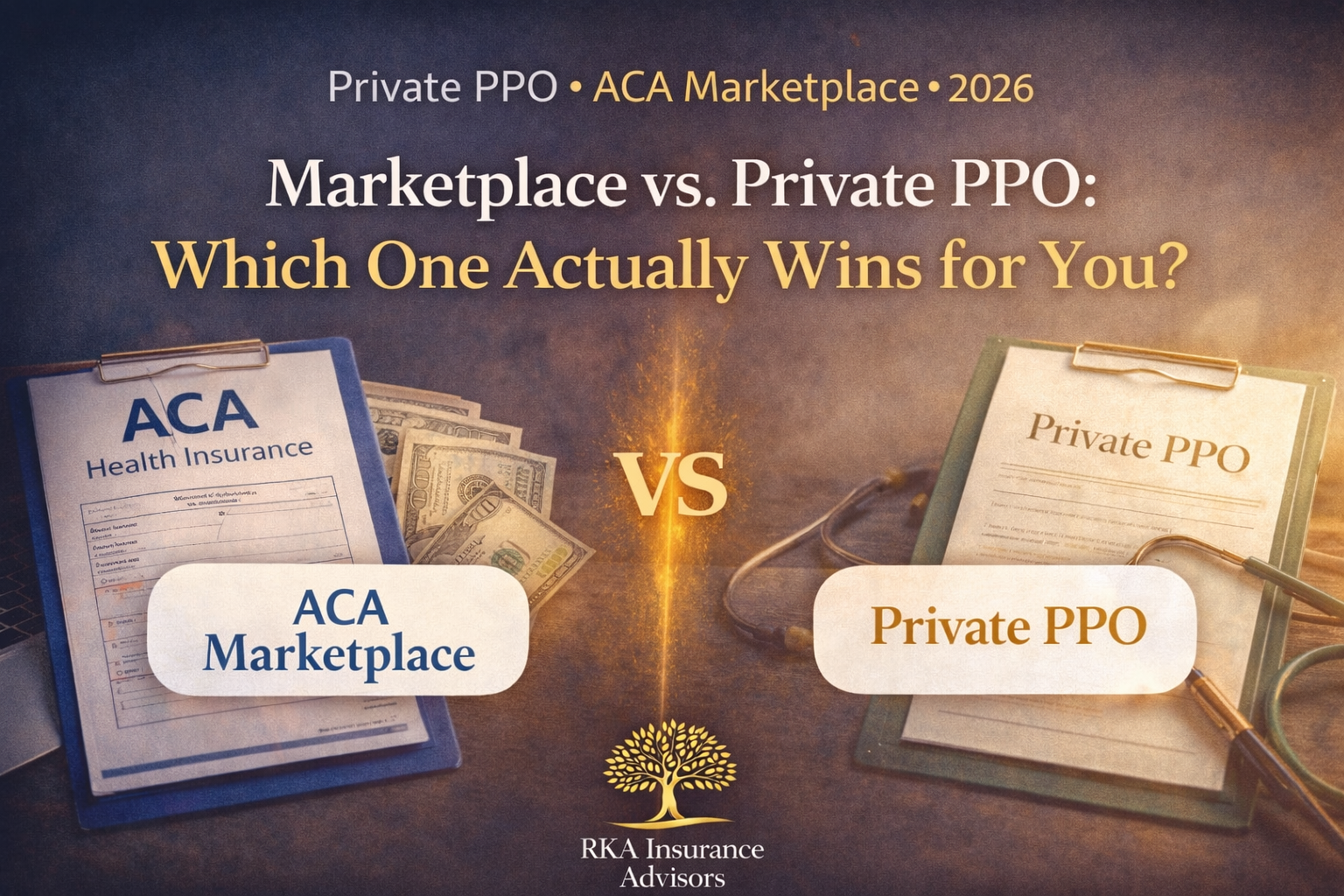
Marketplace vs Private PPO 2026 | Which Wins for You?
ACA Marketplace plans can be the right call if your income qualifies for subsidies. But if you earn above the subsidy threshold or want broader doctor access with no referral requirements, a private underwritten PPO often wins on cost, flexibility, and nationwide coverage.
Private PPO • ACA Marketplace • 2026
Marketplace vs. Private PPO:
Which One Actually Wins for You?
The core difference in one sentence
Marketplace (ACA) plans are priced based on your income and regulated by the government. Private PPO plans are priced based on your health and issued by private carriers outside the exchange.
That one difference drives everything else — cost, network, enrollment windows, and who qualifies for what.
Side-by-side comparison
- Premium tied to your income
- Subsidies available below 400% of the Federal Poverty Level (FPL)
- Open enrollment window (or qualifying life event required)
- Pre-existing conditions covered — no underwriting
- Network can be narrow depending on plan and region
- Referrals may be required on HMO-type plans
- Deductibles can be significant on unsubsidized plans
- Premium based on age and health — not income
- No subsidies — but often lower premiums for healthy applicants
- Available year-round — no enrollment window
- Medical underwriting required — health history reviewed
- Nationwide PPO network — see any PPO doctor, no referrals
- No referral requirements
- Qualify for lower deductible options, including $0 deductible plans
When the Marketplace wins
The ACA Marketplace is genuinely the better option in certain situations. It wins when:
- Your income qualifies for subsidies. Below 400% of the Federal Poverty Level (FPL), subsidies can make Marketplace plans extremely affordable — sometimes as low as $0/month. If you qualify, it's hard for a private plan to compete on price.
- You have pre-existing conditions. Marketplace plans cannot deny coverage or charge more based on health history. Private underwritten plans can decline applicants or exclude conditions — so if you have significant health history, the Marketplace may be your only path to full coverage.
- You're between jobs short-term. If you need a bridge for 30–60 days and qualify for a Special Enrollment Period, a Marketplace plan can be fast and straightforward.
When a private PPO wins
Private PPO plans tend to outperform the Marketplace when:
- Your income is above the subsidy threshold. Once you're above 400% FPL, Marketplace premiums are unsubsidized and can be steep. For a healthy individual in this bracket, a private PPO often comes in significantly lower.
- You need coverage outside open enrollment. Private PPO plans are available year-round — no qualifying life event required. If you missed open enrollment or just went self-employed mid-year, a private plan is often the only option.
- You want nationwide access. Private PPO networks typically cover you anywhere in the country with no referral requirements — important for frequent travelers, remote workers, and anyone who splits time between states.
- You're self-employed with variable income. ACA plans reprice if your income changes — under or overestimate and you pay the difference at tax time. Private PPOs have fixed premiums not tied to income.
The honest answer
There is no universally better option. The right plan depends on your income, health history, where you live, and whether you're in an open enrollment window. The only way to know which wins for you is to compare both with actual numbers.
That's exactly what we do — side-by-side, with real quotes, from a licensed advisor. Free, no obligation.
What about doctor networks?
This is where private PPO plans have a consistent advantage. Marketplace networks — especially at the Silver tier — vary significantly by state and county. In some markets they're broad; in others, major hospital systems are excluded entirely.
Private PPO plans access major nationwide carrier networks. If you have a doctor, specialist, or hospital you want to keep, we verify coverage on both options before you enroll — not after.
How RKA helps
RKA Insurance Advisors is an independent brokerage licensed in 32 states. We're not captive to any single carrier — we compare Marketplace plans and private PPO options side by side and help you pick what actually fits your situation.
- Free quote — no obligation
- We verify your doctors on both options before you commit
- We explain subsidy eligibility clearly — if you qualify, we'll tell you
- Available year-round, not just during open enrollment
See which option wins for you
We'll compare Marketplace and private PPO side by side — free, no pressure, no obligation.
Frequently Asked Questions
Can I switch from Marketplace to a private PPO anytime?
Yes — private PPO plans are available year-round with no enrollment window. You can apply and get covered in as little as a few days depending on the carrier. Cancelling your Marketplace plan mid-year may affect any advance premium tax credits received, so review your tax situation before switching.
Does a private PPO cover pre-existing conditions?
Private underwritten plans review your health history at application. Some conditions may be excluded or result in a higher premium. If you have significant pre-existing conditions, a Marketplace plan may provide broader coverage. We'll be upfront about what each option covers for your specific situation.
What does "above the subsidy threshold" mean?
ACA subsidies phase out at 400% of the Federal Poverty Level (FPL). Above that income level, you pay the full unsubsidized Marketplace premium. For many self-employed professionals and small business owners in this bracket, private PPO premiums compare favorably — often significantly so.
Can I keep my current doctors on a private PPO?
Most likely yes — private PPO networks are broad and access major hospital systems and specialist groups nationwide. We verify your specific providers on any plan before you enroll so there are no surprises.
Is RKA an ACA broker or private PPO broker?
Both. We're an independent brokerage — we're not incentivized toward either option. We compare what's available for your situation and present the numbers clearly. NPN: 19540130. Licensed in 32 states.
Educational purposes only. Plan availability, premiums, and benefits vary by state, county, and individual health profile. Review official plan documents before enrolling. RKA Insurance Advisors, NPN 19540130, licensed in 32 states.