Private PPO • Trucking • Self-Employed
Health Insurance for Owner-Operator and OTR Truckers in 2026
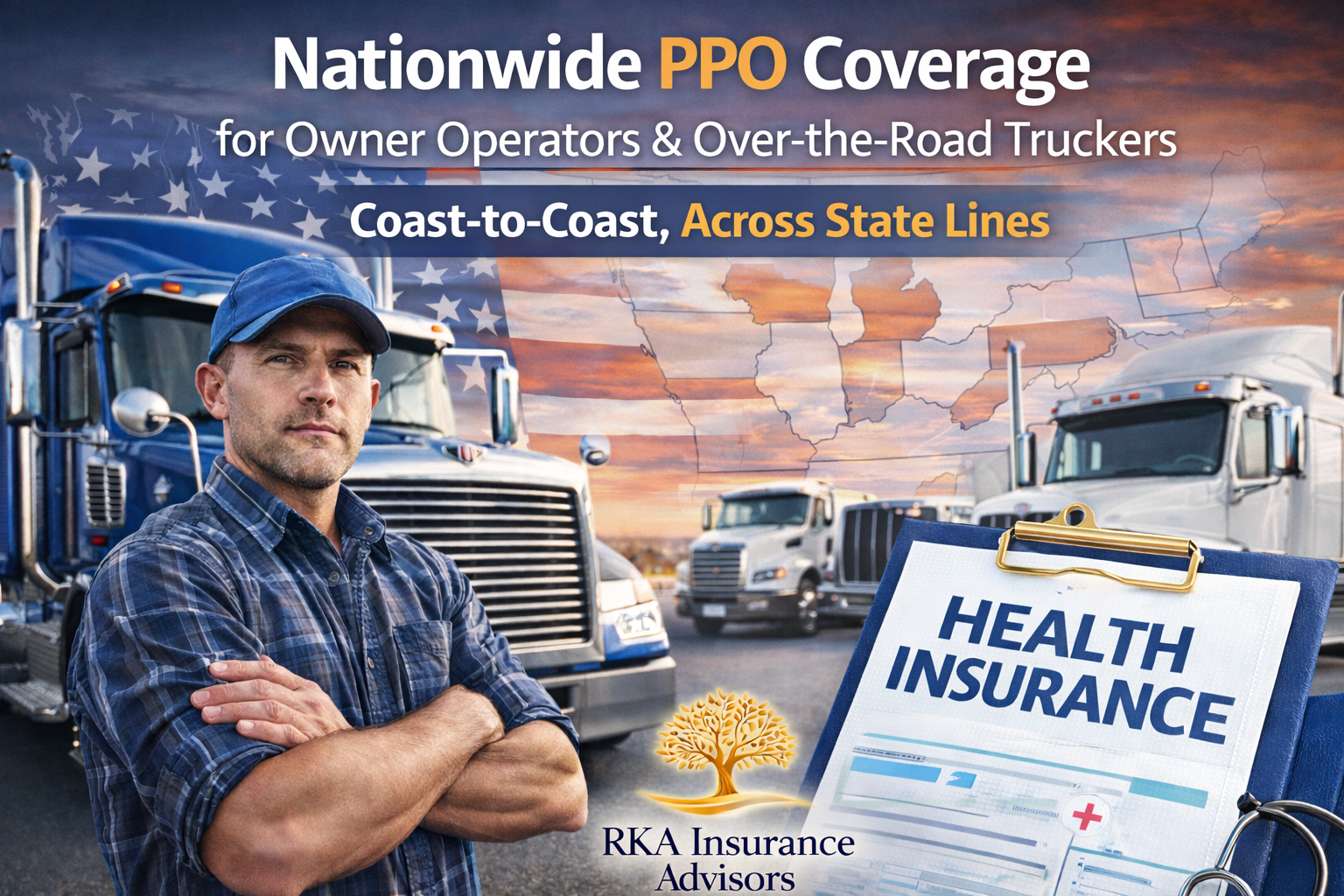
Fast take: Owner-operator truckers and OTR drivers are self-employed — no employer benefits, no W-2, no payroll-deducted insurance. Most rely on association programs, occupational accident coverage, or short-term plans that don't cover real major medical events. Whether you're a 22-year-old who just got your CDL and bought your first rig or a 55-year-old veteran owner-op, private medically underwritten PPO plans offer real coverage with nationwide network access for healthy drivers — often well below unsubsidized ACA pricing. Available year-round, no enrollment window required.
The coverage gap most truckers don't realize they have
Company drivers get a benefits package — health, dental, vision, sometimes retirement. The moment you go owner-operator, every benefit becomes your problem. Fuel, insurance on the rig, maintenance, plates, ELD service — and somewhere on that list, often near the bottom, is real health coverage for you and your family.
The result is predictable. Most owner-operators carry coverage that's either too expensive (full unsubsidized ACA), too limited (occupational accident only), or non-existent (rolling the dice). Each has a better alternative for healthy drivers.
Your four options compared
OOIDA / Association Plans
- Group benefit programs through trucker associations
- Quality varies — some real major medical, some limited benefit
- No health questions for some plans
- Often have caps, exclusions, or limited PPO networks
- Premium increases driven by entire association pool
ACA Marketplace
- Guaranteed issue — no health screening
- Subsidies available below ~$60K income (single, 2026)
- Best option if you qualify for subsidies
- Many plans HMO/EPO with state-limited networks
- Full unsubsidized rate above the income threshold
Short-Term Medical
- Lower premiums upfront
- Useful as 60–90 day bridge between coverage
- Doesn't cover preexisting conditions
- Often excludes maternity, mental health, prescription
- Doesn't count as minimum essential coverage
Private Medically Underwritten PPO
- Off-exchange plans with nationwide PPO networks
- Real major medical with defined deductibles
- Available any month — no enrollment window
- Best rates for healthy CDL holders
- Health questionnaire required — not all applicants qualify
Why nationwide PPO matters more for truckers than almost anyone
If you run a regional lane in three states, an HMO might cover you. If you run TX–FL, I-10 coast-to-coast, or any true OTR schedule, regional networks are a problem waiting to happen.
Picture this: you slip getting out of the cab in a Pilot lot in New Mexico, fracture your wrist 1,800 miles from home. The local urgent care is in your network as far as Albuquerque is concerned — but on your HMO plan, it's out-of-state. You pay full price, then fight your insurer for partial reimbursement that may or may not come.
A nationwide PPO works the same in every state. Same network rules, same in-network rate, same coverage. For multi-state lane drivers, this is the actual point of having insurance.
Multi-state lanes
- Same network rules in any state
- No out-of-network surprises
- In-network rate from coast to coast
Telehealth from the cab
- 24/7 virtual visits included on most plans
- Sick on a 14-hour day? Talk to a doctor without leaving the truck
- Prescriptions sent to any pharmacy
ER coverage anywhere
- Emergency care covered at in-network rates
- No state-specific exclusions
- Specialist access without referrals
Why owner-operators are often a strong fit for medical underwriting
Medical underwriting means the carrier reviews your health history before approving coverage. Healthy applicants get the best rates — and the average active owner-operator is healthier than the general population for one specific reason: the DOT physical.
To hold a CDL, you pass a DOT medical exam (49 CFR 391.41) — typically every 24 months. That means your blood pressure, vision, hearing, BMI, and basic cardiovascular health are tracked and acceptable, or you don't have a CDL. Most active owner-operators are functionally pre-screened on baseline health, which is exactly what private underwriting looks for.
Active CDL? Get your options in 5 minutes.
We compare ACA, private PPO, and association options for your specific age, state, and health profile — and tell you honestly which one makes sense. No pressure, no obligation.
Occupational Accident is not health insurance
Occupational accident coverage (OccAcc) is a workers-comp-style policy many owner-operators carry through their motor carrier or independently. It pays if you're hurt while working. It does not cover anything that happens off the truck — a heart attack at home, your kid's tonsils, your wife's pregnancy, your annual physical, the flu. None of that is OccAcc territory.
OccAcc and major medical are two different products. You probably need both — but using OccAcc as a substitute for health insurance is one of the most expensive mistakes owner-operators make. One non-occupational hospital stay can wipe out years of savings.
Common mistake: Many owner-ops carry OccAcc through their motor carrier and assume it functions as health insurance. It doesn't. OccAcc covers on-the-job injuries only. A heart attack at home, your child's surgery, a routine illness — none of it is covered. You need real major medical alongside OccAcc, not instead of it.
The self-employment health insurance deduction
Owner-operators filing Schedule C can typically deduct 100% of health insurance premiums paid for themselves, their spouse, and dependents — as an above-the-line deduction on Form 1040. That doesn't reduce self-employment tax, but it does reduce federal income tax dollar-for-dollar against your premium cost.
For a driver paying $500/month and netting $90,000, the deduction often saves $1,200–$1,800 a year in federal income tax. The premium net of deduction can be meaningfully lower than the headline number. Confirm with your CPA — premiums can't exceed your net Schedule C profit for the year.
Who qualifies — and who doesn't
Likely to qualify
- Active CDL with current DOT medical card
- No hospitalizations in past 2 years
- No major chronic conditions
- Non-smoker (or quit 12+ months ago)
- BMI within DOT-acceptable range
- No active or planned major surgery
May not qualify
- Type 1 or insulin-dependent Type 2 diabetes
- Active cancer treatment or recent remission
- Recent cardiac event (heart attack, bypass, stent)
- Active autoimmune disease (MS, lupus, severe RA)
- Multiple ongoing specialty medications
If your health history puts private underwriting out of reach, ACA marketplace is the right path — guaranteed issue, no health questions, subsidies available below ~$60K income for individuals. We compare both options honestly and tell you which makes sense for your specific situation.
What private PPO actually costs
Premium depends on your age, state, tobacco status, household size, and the specific plan you choose. There is no one-size-fits-all number — what matters is the comparison between unsubsidized ACA and private PPO for your situation.
For most healthy truckers, the math frequently favors private PPO once household income crosses the ACA subsidy threshold. Younger drivers often see the biggest gap — a healthy 25-year-old can sometimes find private PPO well under what an unsubsidized ACA Bronze plan costs, with a real PPO network instead of a regional HMO.
We run the side-by-side for free. Free quotes return real numbers for your age, state, and household — not estimates pulled out of thin air.
How the timing works for an owner-operator
Step 1 — Pre-screen
- 10-minute health questions
- Confirms likelihood of approval
- No formal application yet, no record
- No obligation
Step 2 — Quote & Compare
- Side-by-side: private PPO vs ACA
- For your age, state, health profile
- Verify your existing doctors in-network
- Pick the plan that fits
Step 3 — Apply & Activate
- Formal underwriting takes 7–14 days
- Coverage typically starts 1st of next month
- Apply 30–45 days before target start date
- ID cards within 1–2 weeks
Frequently Asked Questions
Can I keep coverage when I'm running multi-state lanes?
Yes. Private PPO plans use nationwide PPO networks (BCBS PPO, Aetna PPO, UnitedHealthcare Choice Plus, and similar). Same network rules and rates apply in any state — no in-state-only restrictions like most ACA HMO plans.
What's the difference between OOIDA's plans and private PPO?
OOIDA member benefit programs are association-sponsored — quality and structure varies by program and year. Some are real major medical, some are limited benefit programs that cap payouts. Private PPO plans are individually underwritten with defined deductibles and out-of-pocket maximums consistent with traditional health insurance. We can compare your OOIDA program against private PPO options if you want a side-by-side.
I'm currently on a short-term plan. Should I switch?
Probably yes, if you're healthy enough to qualify for private PPO. Short-term plans don't cover preexisting conditions, often exclude major categories like maternity and mental health, and don't count as minimum essential coverage. They're useful as a 60–90 day bridge — not as ongoing coverage. A private PPO is real major medical with stable terms.
What if I get sick after I'm enrolled in a private PPO?
Once your policy is issued, the carrier cannot cancel you for getting sick. Underwriting only applies at the time of application. Your renewal premium can change at the next annual renewal, but the policy itself doesn't get revoked because you developed a condition after enrollment.
Does this cover my spouse and kids?
Yes. Family plans are available, priced by age and health of each adult. Dependents under 18 don't go through medical underwriting on most plans. If a spouse has a significant health condition that would disqualify them, a split-family approach is possible — one spouse on private PPO, the other on ACA marketplace — and we'll tell you when that math works in your favor.
How does the self-employed health insurance deduction work for owner-operators?
If you have net Schedule C income, you can typically deduct 100% of health insurance premiums paid for yourself, your spouse, and dependents as an above-the-line deduction on Form 1040 — which reduces federal income tax (it doesn't reduce SE tax). Confirm with your CPA for your specific situation. Premiums can't exceed your net Schedule C profit for the year.
Is RKA licensed in my state?
RKA Insurance Advisors is licensed in 30 states: AL, CO, DE, FL, GA, IA, IL, IN, KY, KS, LA, MD, MI, MO, MS, MT, NC, NE, NV, OH, OK, SC, SD, TN, TX, UT, VA, WI, WV, WY. If your home state is on this list, we can quote and enroll you. NPN 19540130.
Don't roll the dice another mile without real coverage.
We help owner-operators and OTR drivers compare every option — ACA, private PPO, association, short-term. Free quotes, honest advice, no pressure.