
Health Insurance for Gig Workers and 1099 Contractors: How to Get Covered
Gig and 1099 work spans rideshare to six-figure consulting — and none of it comes with benefits. Here's how independent workers really compare coverage: why the monthly premium is only the sticker price, how deductibles, copays, and out-of-pocket maximums decide what you actually pay, and why a nationwide PPO's in- and out-of-network freedom often beats an in-state HMO or EPO — plus when a marketplace subsidy still makes sense.
Health Insurance for Gig Workers and 1099 Contractors: How to Get Covered
The premium is the sticker price — not the real cost
When you buy coverage, the monthly premium is simply what you pay for the product. It tells you almost nothing about what that product will actually cost you over a year, because a health plan has four separate cost levers, and premium is only one of them:
Premium
What you pay every month just to hold the plan — whether or not you ever use it.
Deductible
What you pay out of pocket before the plan starts sharing costs. Can be $0 on some plans, $9,000+ on others.
Copays & coinsurance
What you pay per visit, per prescription, or as a percentage — every time you get care.
Out-of-pocket maximum
The most you can pay in a bad year. This is the number that protects you when something serious happens.
A plan with a low premium and a high deductible isn't "cheap" — it's a bet that you won't need care. If that bet is wrong, you can end up paying far more than you would have on a plan that cost a little more each month. That's why the premium alone should never decide it.
Same person, two plans: run the real numbers
Here's the trap, in plain figures. Two plans for the same healthy person:
Plan A — low premium, high exposure
- $150 / month premium
- ~$9,200 deductible and out-of-pocket max
- In-state HMO/EPO network — no out-of-network coverage
- One serious event and you're exposed to the full $9,200
Plan B — slightly higher premium, far less exposure
- $200 / month premium
- $0 deductible
- ~$3,000 out-of-pocket max
- Nationwide PPO — in and out of network, anywhere in the U.S.
Plan B costs about $50 more a month — roughly $600 a year. But the moment you have a real claim, Plan A can expose you to $6,000+ more than Plan B, and Plan A only works inside your home state. Paying the extra $50 isn't spending more; for a lot of people it's buying thousands of dollars of protection and the freedom to see any doctor in the country. (Figures are illustrative — your actual numbers depend on age, state, health, and plan design.)
Where can you actually use it? HMO/EPO vs nationwide PPO
Cost is half the story. The other half is network — and this is where the two products really diverge. The majority of ACA marketplace plans today are HMOs or EPOs. Those plans are generally built around one state or one region, and they typically pay nothing if you go out of network (outside of emergencies). Travel, move between states, or want a specialist across the country, and you're on your own.
Marketplace HMO / EPO
- Covers pre-existing conditions, guaranteed issue
- Subsidies if your income qualifies (more on that below)
- Usually no out-of-network coverage at all
- Network tied to your resident state or region
- Out-of-pocket maximums often $9,000+
- Enroll only in open enrollment or with a qualifying life event
Private nationwide PPO (medically underwritten)
- One of the nation's largest PPO networks
- Works in and out of network, across all 50 states
- Plan designs with deductibles as low as $0
- Out-of-pocket max options as low as around $3,000
- Enroll any month — no window
- Medically underwritten — best for healthy applicants, and not designed for significant pre-existing conditions
Stop comparing premiums. Compare what you'll actually pay.
Tell us a little about your health, your income, and how you live, and we'll show you the total cost and the network for each option — side by side, in plain numbers. No cost, no pressure.
When the marketplace still makes sense
A private PPO isn't automatically the answer — it depends on your situation, and being honest about that is the whole point. If your gig income is modest, you may qualify for a marketplace subsidy, and in the lower-income cost-sharing reduction (CSR) range, a Silver plan can come with sharply reduced deductibles, copays, and out-of-pocket maximums. That can be a genuinely strong deal on cost.
Even then, run it with eyes open: those plans are still usually in-state HMOs or EPOs, so the network restrictions and lack of out-of-network coverage remain. And if you have significant pre-existing conditions, the marketplace is generally the better route, because a private PPO is medically underwritten and not everyone qualifies. The right move is to weigh your total cost against your need for network freedom. For a deeper side-by-side, see our Marketplace vs Private PPO breakdown.
How to actually decide, in four steps
1. Map how you actually use care
Do you travel or move? Want a specific hospital or specialist? Take regular prescriptions? This drives the network and out-of-pocket decision more than the premium does.
2. If your income is modest, check the marketplace — including CSR
A subsidy, and especially a cost-sharing-reduction Silver plan, can lower your total cost substantially. Get that price as your benchmark.
3. Compare total exposure, not premium
Line up premium + deductible + copays + out-of-pocket max across every option. The lowest monthly price is often not the lowest yearly cost.
4. Weigh network freedom
An in-state HMO/EPO vs a nationwide PPO that works in and out of network is a real quality-of-coverage difference — decide what that's worth to you.
Common questions from gig and 1099 workers
Isn't the plan with the lowest monthly premium the cheapest?
Not usually. The premium is only what you pay to hold the plan. A low-premium plan often carries a $9,000+ deductible and out-of-pocket max and no out-of-network coverage, so the first real claim can cost you far more than a plan that was a little more per month. Compare total exposure — premium plus deductible, copays, and out-of-pocket maximum — not the premium alone.
What's the real difference between a marketplace HMO/EPO and a private PPO?
Most marketplace plans are HMOs or EPOs built around one state, and they generally pay nothing out of network. A private nationwide PPO uses one of the country's largest networks and works in and out of network across all 50 states — useful if you travel, move, or want a specific doctor. Some private PPO designs also offer $0 deductibles and out-of-pocket maximums as low as around $3,000.
I drive rideshare or deliver part-time. What should I look at first?
If your total annual income is modest, check the marketplace first — you may qualify for a subsidy, and in the cost-sharing-reduction range a Silver plan can have low deductibles and out-of-pocket costs. Just know it's usually an in-state HMO/EPO. If you're healthy and want nationwide, in-and-out-of-network coverage with a low out-of-pocket max, we'll price a private PPO against it so you can see the full comparison.
My income is irregular. Does that affect my options?
A private PPO premium is based on your age and health, not your income, so it doesn't move month to month and there's no year-end income reconciliation. You can also enroll any month — no waiting for an open-enrollment window between gigs. Marketplace subsidies, by contrast, are tied to your estimated annual income.
How does RKA help gig and 1099 workers?
We compare the whole picture for you — total cost and network across a marketplace plan and a private PPO — verify your doctors are covered, and explain the trade-offs in plain English. There's no one-size-fits-all answer, which is exactly why a personalized comparison matters. We're licensed in 30 states, and it's free.
Get the full picture — free
One quick conversation and you'll know your total cost and your network for every option, not just the monthly price. That's how you actually get the right plan.
Robert Adams · President & Licensed Agent · NPN 19540130 · Licensed in 30 states. Premium, deductible, and out-of-pocket figures are illustrative and vary by age, state, health profile, plan design, and underwriting outcome. Subsidy and cost-sharing-reduction eligibility depend on household income, size, and location. Private medically underwritten plans are not ACA-compliant and are subject to medical underwriting; not all applicants qualify, and they are not designed for significant pre-existing conditions. This content is for informational purposes only and does not constitute insurance, legal, tax, or financial advice.
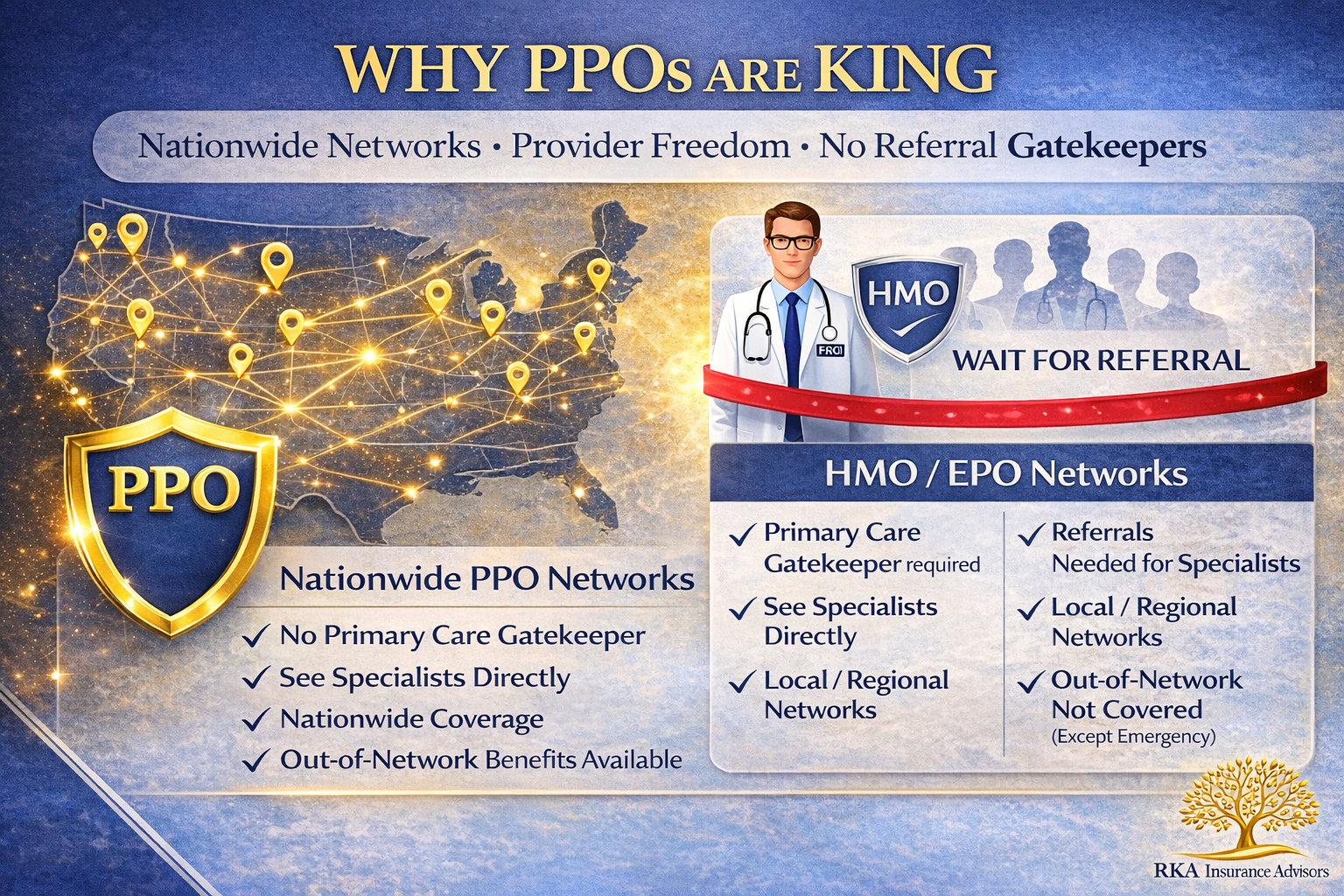
Why PPOs Are King: The Case for Nationwide Networks and Provider Freedom
Why PPOs beat HMOs for self-employed professionals, business owners, and frequent travelers: nationwide networks, no primary care gatekeepers, direct specialist access, and fewer authorization delays.
Why PPOs Are King: The Case for Nationwide Networks and Provider Freedom
Fast take: If you're self-employed, travel for work, or value direct access to specialists without referral red tape, PPO networks offer unmatched flexibility. No primary care gatekeepers, no waiting weeks for authorization, and coverage that works wherever you are—not just in your home county.
Tired of narrow HMO networks and referral requirements?
We'll show you nationwide PPO options and verify your doctors are covered—no restrictions, no runarounds.
Get Free Quotes Book a CallWhat makes PPO networks different
HMO/EPO (Most Marketplace plans)
✗ Primary care doctor required (PCP)
✗ Referrals needed for specialists
✗ Limited to local network only
✗ Out-of-network = not covered (except emergencies)
✗ Authorization delays common
PPO (Preferred Provider Organization)
✓ No primary care gatekeeper required
✓ See specialists directly—no referrals
✓ Nationwide network coverage
✓ Out-of-network benefits available
✓ Fewer authorization requirements
Who benefits most from PPO networks
Business owners & entrepreneurs
✓ Client meetings across multiple states
✓ Need care wherever business takes you
✓ Can't afford delays waiting for referrals
✓ Want specialist access without bureaucracy
Frequent travelers
✓ Snowbirds splitting time between states
✓ Digital nomads working remotely
✓ Families with second homes
✓ Need consistent coverage anywhere
People with specific provider needs
✓ Established relationship with specialist
✓ Prefer specific hospitals or facilities
✓ Need access to top-tier medical centers
✓ Don't want to change doctors
High-income households
✓ Don't qualify for meaningful ACA subsidies
✓ Paying full price either way
✓ Want maximum flexibility and choice
✓ Prefer premium networks and providers
Real-world scenarios where PPOs win
Scenario 1: The entrepreneur in pain
HMO path: Back pain → see PCP first → wait for referral → wait for specialist appointment → weeks of delays
PPO path: Back pain → call orthopedist directly → appointment this week → faster treatment
Scenario 2: The traveling consultant
HMO path: Urgent care needed in Dallas → not in network → pay full cost out-of-pocket → file claim, hope for reimbursement
PPO path: Urgent care in Dallas → nationwide network → normal copay → done
Scenario 3: The specialist relationship
HMO path: Your cardiologist isn't in network → forced to switch doctors → rebuild relationship from scratch
PPO path: Your cardiologist is in nationwide PPO → keep your doctor → continuity of care
Scenario 4: The imaging authorization
HMO path: Doctor orders MRI → need authorization → wait 5-7 business days → delay diagnosis
PPO path: Doctor orders MRI → schedule immediately → faster diagnosis and treatment
The hidden costs of HMO restrictions
Many people choose HMOs to save on monthly premiums, but the total cost equation includes more than just what you pay each month:
Time costs
✗ Waiting for PCP appointments before specialist referrals
✗ Authorization delays (5-7 days common for imaging/procedures)
✗ Extended treatment timelines due to referral requirements
✗ Lost productivity from delayed care
Out-of-pocket surprise costs
✗ Traveling for work? Out-of-network urgent care = full cost
✗ Emergency room in another state = potential balance billing
✗ Preferred specialist not in network = start over with new doctor
✗ Lab work at non-contracted facility = surprise bills
PPO networks for self-employed professionals
If you're self-employed, your health insurance needs are different from W-2 employees:
You can't afford downtime
No paid sick leave. Every day you're delayed waiting for referrals or authorizations is lost income. PPOs let you see specialists immediately and get treatment faster.
Your work location varies
Client sites, conferences, remote work from different states—you need coverage that travels with you, not just in your home county.
You control your own schedule
Don't waste time scheduling PCP visits just to get a referral. See the specialist directly and get back to work.
You're paying full freight anyway
If you don't qualify for subsidies, you're paying full price for ACA plans. PPO premiums are often comparable with far better access.
Common PPO myths debunked
❌ Myth: PPOs are always more expensive
Reality: For healthy applicants who don't qualify for subsidies, private underwritten PPOs often cost less than unsubsidized ACA plans—with better networks and lower deductibles.
❌ Myth: You don't need nationwide coverage
Reality: Even if you rarely travel, emergencies happen. Car accident on vacation? Family emergency out of state? Nationwide PPO coverage eliminates surprise bills.
❌ Myth: Referrals aren't a big deal
Reality: Referral requirements add 1-3 weeks to every specialist visit. For time-sensitive issues or busy professionals, this delay is costly.
❌ Myth: All PPOs are the same
Reality: PPO network size varies dramatically. We verify your specific doctors are in-network before you enroll—not all "nationwide" PPOs include every provider.
When to choose PPO over HMO/EPO
Choose PPO if...
✓ You're self-employed or own a business
✓ You travel frequently for work or personal reasons
✓ You have established relationships with specialists
✓ You don't qualify for meaningful ACA subsidies
✓ You value direct access without referral delays
✓ Time is money and you can't afford bureaucratic delays
HMO/EPO might work if...
✓ You qualify for strong ACA subsidies
✓ All your doctors are in a local HMO network
✓ You rarely travel and don't need out-of-area care
✓ You're comfortable with PCP gatekeeping
✓ You don't mind waiting for referrals and authorizations
✓ Lowest monthly premium is your only priority
How RKA finds the right PPO for you
Doctor verification first
We check your specific doctors, specialists, and hospitals against actual PPO networks—not just "find-a-doc" directories that are often outdated.
Multi-state coverage mapping
Travel between Florida and New York? We verify both locations have strong network coverage before you commit.
Total cost comparison
We model premiums + deductibles + expected usage for HMO vs PPO options—sometimes PPO costs less when you factor in out-of-network exposure.
Private vs Marketplace PPO options
Marketplace has limited PPO options. We compare against private underwritten PPOs that may offer better networks and lower deductibles.
Ready for nationwide PPO freedom?
We'll verify your doctors, compare PPO options, and show you total costs—no referral requirements, no network restrictions.
Get Free Quotes Book a CallQuick FAQs
Are PPOs available on the ACA Marketplace?
Some states offer limited PPO options on the Marketplace, but many areas only have HMO/EPO plans. Private underwritten PPOs (off-exchange) often offer broader networks and better benefits for healthy applicants.
Do PPOs really cost that much more than HMOs?
For subsidized plans, yes. But if you don't qualify for subsidies, private PPO premiums are often comparable to unsubsidized HMO/EPO plans—with far better access and lower deductibles.
What does "nationwide PPO" actually mean?
Network coverage in all 50 states (or most states). Specific provider availability varies—we verify your doctors are included, not just that the network exists in your state.
Can I switch from HMO to PPO mid-year?
ACA plans can only switch during Open Enrollment (or with a qualifying event). Private PPOs are available year-round if you qualify for underwriting.
For education only; network access and benefits vary by carrier and state. Always verify providers before enrollment. Eligibility for private underwritten plans subject to medical underwriting.
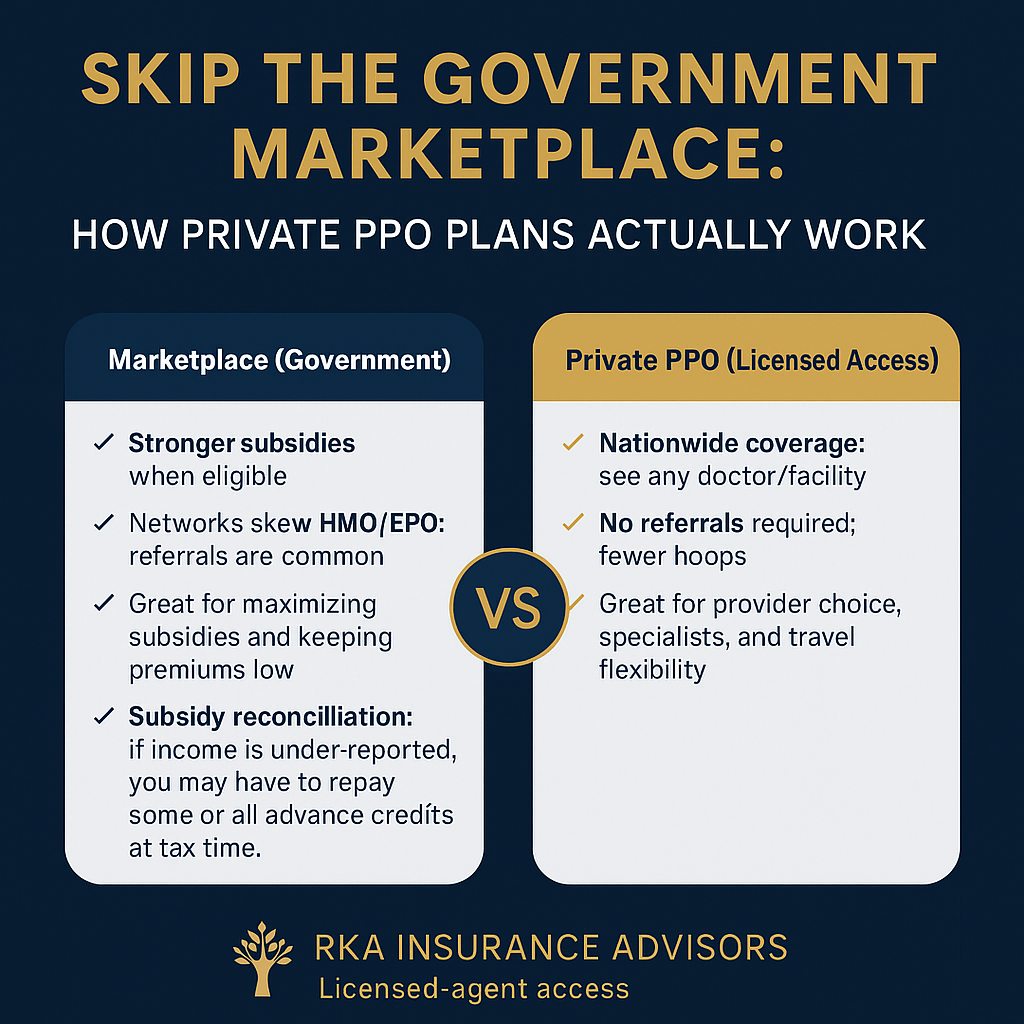
Skip the Government Marketplace: How Private PPO Plans Actually Work
Fast guide to non-Marketplace Private PPOs—how they bill, who they fit, and what to verify first. We’ll confirm your doctors, compare options, and show clear costs.
Skip the Government Marketplace: How Private PPO Plans Actually Work
Prefer private, licensed-access coverage? Here’s the fast, practical guide—what it is, how it bills, and how to check if it fits your doctors, travel, and budget.
Why some people skip the Marketplace
- Keep specific doctors/hospitals. Many Marketplace options are HMO/EPO with referrals.
- Travel flexibility. Want nationwide, not just local networks.
- Fewer gatekeepers. Prefer no referrals for specialists or imaging.
- Income too high for meaningful subsidies—or you don’t want tax-credit involvement.
- If your income qualifies, Marketplace can be the cheapest route.
- Credits reconcile on your tax return; under-reporting income can create payback.
- Private PPOs skip subsidies entirely—pricing is based on age, ZIP, benefits, and network.
How Private PPO actually works
- Nationwide PPO access in eligible networks—keep your specialists and preferred hospitals.
- No referrals for specialists (typical), fewer hoops to schedule care.
- Enroll through a licensed agent; options vary by state and carrier.
- Premiums aren’t tied to ACA income credits.
- Your exact doctors and facilities are in-network (we check for you).
- Copays vs coinsurance on high-ticket items (imaging, outpatient surgery).
- Prescription tiers and any prior-auth on key meds.
- Out-of-pocket maximum is a number you can live with.
What drives price (non-subsidized)
The big levers
- Age rating for adults; kids usually add less than another adult.
- ZIP/county + network breadth.
- Deductibles, coinsurance, copays, and the out-of-pocket max.
Ways to keep it efficient
- Don’t overbuy—match benefits to how you actually use care.
- Choose networks that include your real providers (not just brand names).
- Use generics when clinically appropriate; we’ll check formulary tiers.
Who typically chooses Private PPO
Strong fit
- Self-employed/1099 families who want broad doctor choice.
- Frequent travelers or multi-state households.
- People who dislike referral bottlenecks.
Maybe not a fit
- Households whose main goal is max subsidies and the lowest possible premium.
- Anyone who does not have specific providers to keep and rarely needs out-of-area care.
Want the best non-Marketplace fit in your ZIP?
We’ll verify your doctors and meds, compare PPO options, and show clear costs. No pressure—just answers.
FAQ
Are Private PPOs the same as Marketplace plans?
Do Private PPOs need referrals?
Will I owe taxes if I’m not using subsidies?
How do I know if my doctor is covered?
How do we start?
This overview is educational, not tax or legal advice. Plan availability and rules vary by state and carrier. Eligibility and enrollment subject to underwriting/plan terms where applicable.

Telemedicine Benefits: Save Time, Cut Costs, and Skip the Waiting Room | RKA Insurance Advisors
See a clinician by phone or video—often at $0 copay. When telemedicine works best, what’s covered, and how to get plans with $0 virtual visits.
Health Guides • Updated • Written by Robert Adams
Telemedicine Benefits: Faster Care, Lower Cost, Less Hassle
Fast take:
Telemedicine lets you meet with board-certified clinicians by phone or video, usually in minutes. It’s great for common issues, refills, and follow-ups—often at $0 copay on many plans. You save time, avoid waiting rooms, and cut costs without sacrificing quality.
- • See a clinician from home, work, or travel—no waiting room.
- • Perfect for minor illnesses, refills, and quick follow-ups.
- • Visits typically run ~15 minutes.
- • Fewer germ exposures vs. urgent care/ER waiting areas.
- • Helpful for immunocompromised, pregnant, and elderly.
- • Triage contagious symptoms before in-person care.
- • Family, internal, and pediatrics: easy follow-ups and check-ins.
- • Manage hypertension, diabetes, asthma, mental health, more.
- • Many platforms offer 24/7 access.
- • Many plans cover telehealth at $0 or low copay.
- • Cash-pay telehealth is typically cheaper than in-office rates.
- • Using telehealth for non-emergencies avoids costly ER bills.
Good uses vs. go in-person
Use telemedicine for
- Cold/flu, sore throat, sinus/ear issues
- Minor skin rashes, pink eye
- Medication refills & follow-ups
- Mild GI upset
Go in-person for
- Chest pain, severe shortness of breath
- Serious injury, heavy bleeding
- Neurologic symptoms (stroke signs)
- Anything emergent → ER
Want $0-copay telehealth on your plan?
We’ll verify your network, show real costs, and compare Marketplace vs. Private PPO options for your ZIP.
Quick FAQs
Is telemedicine covered?
Many plans cover telehealth at 100% for non-emergency visits. We’ll confirm your exact copay and vendors.
Can telehealth prescribe meds?
Yes—for appropriate conditions. Controlled substances typically require in-person evaluation per state rules.
Does telehealth replace my PCP?
No. It complements primary care and urgent care for quick, non-emergency needs.
Robert Adams
RKA Insurance Advisors • Private & Marketplace Health Coverage • 561-806-9913 • robert@rkainsuranceadvisors.com