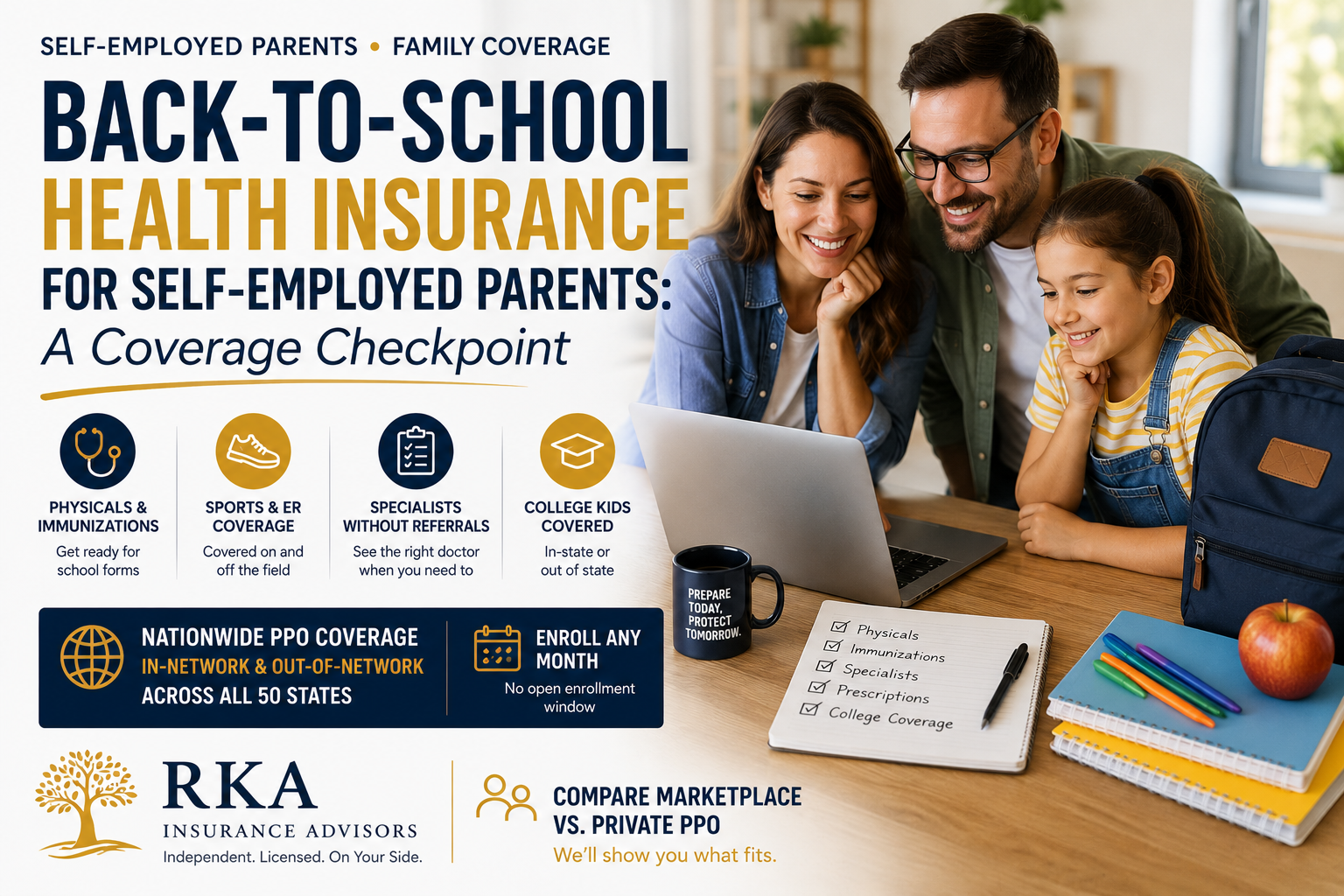
Back-to-School Health Insurance for Self-Employed Parents: A Coverage Checkpoint
Back-to-school season is a natural coverage checkpoint for self-employed parents — sports physicals, school forms, new prescriptions, and kids who may be aging off your plan. This guide covers the five things to confirm before September, why a nationwide PPO often fits families better than an in-state marketplace HMO for specialists and travel-sports injuries, when a marketplace subsidy is still the smarter family move, and a tax perk many self-employed parents miss.
Back-to-School Health Insurance for Self-Employed Parents: A Coverage Checkpoint
Why back-to-school is the right time to check your family's coverage
Summer ends and the paperwork begins: physical forms, immunization records, sports clearances, and a fresh round of "does our plan cover this?" It's also the season when kids actually use their coverage — checkups, urgent care, and the occasional trip to the ER. That makes late summer the natural checkpoint to make sure your family plan fits before you need it, not after. And because a private PPO enrolls year-round, you're not stuck waiting for open enrollment to fix a plan that no longer works.
The checklist: what to confirm before September
Physicals & immunizations
Confirm your plan's preventive-care coverage and that your pediatrician is in-network before the fall rush of forms and appointments.
Sports injuries & the ER
A broken wrist or a torn ligament means urgent care, imaging, and orthopedics — sometimes out of network. Check what your plan pays when it's not a scheduled visit.
Keep the pediatrician & specialists
Make sure the doctors your kids already see are covered — and whether you need a referral to reach a specialist.
Prescriptions
Recheck the drug list. Formularies change every year, and a medication that was covered can move tiers or drop off.
A kid aging off your plan
Children can stay on a parent's plan until 26. If one is turning 26 this year, plan their transition before there's a gap.
A college kid out of state
If a child is heading to school in another state, confirm they're actually covered there — many in-state plans aren't.
The network problem parents feel first
Cost matters, but for families the network is usually what bites first. Most ACA marketplace plans today are HMOs or EPOs built around one state or region. They often require referrals to see a specialist, and they typically pay nothing out of network outside of a true emergency. For a family, that shows up in very specific moments: a pediatric specialist across the state line, a travel-sports tournament three states away, a college freshman two time zones from home, or co-parenting across state lines.
Marketplace HMO / EPO
- Covers pre-existing conditions, guaranteed issue
- Subsidies if your household income qualifies
- Usually no out-of-network coverage (except emergencies)
- Network tied to your home state or region
- Referrals often required to see specialists
- Enroll only in open enrollment or with a qualifying life event
Private nationwide PPO (medically underwritten)
- One of the nation's largest PPO networks
- Works in and out of network across all 50 states
- No referrals needed to see a specialist
- Plan designs with deductibles as low as $0
- Enroll any month — no window
- Medically underwritten — best for healthy families, and not designed for significant pre-existing conditions
Same family, two plans: why the cheapest premium can cost more
Here's the trap in plain figures. Two family plans, same healthy household — and remember the premium is only the sticker price. What you actually pay is premium plus deductible, copays, and the out-of-pocket maximum, plus where the plan actually works:
Plan A — lower premium, higher exposure
- Lower monthly premium
- Family out-of-pocket max often $18,000+
- In-state HMO — no out-of-network coverage
- Referrals to reach pediatric specialists
- A single bad season can expose the full max
Plan B — nationwide PPO
- Modestly higher premium
- $0 deductible designs available
- Lower family out-of-pocket max
- In and out of network across all 50 states
- No referrals — see the specialist directly
Plan A can look cheaper every month right up until a kid breaks an arm at an away game or needs a specialist your HMO doesn't cover — then the low premium is beside the point. Paying a little more for Plan B often isn't spending more; it's buying thousands of dollars of protection and the freedom to get your kids care anywhere in the country. (Figures are illustrative — your actual numbers depend on ages, state, health, and plan design.)
See your real family options — free
Tell us your family's ages, health, doctors, and income, and we'll line up a marketplace plan against a nationwide PPO — total cost and network, side by side. No cost, no pressure.
When the marketplace still wins for families
A private PPO isn't automatically the answer, and being honest about that is the whole point. If your household income is modest, you may qualify for a marketplace subsidy, and in the lower-income cost-sharing reduction (CSR) range a Silver plan can come with sharply reduced deductibles, copays, and out-of-pocket maximums for the whole family. That can be a genuinely strong deal.
Even then, go in with eyes open: those plans are usually still in-state HMOs or EPOs, so the network limits and referral rules remain. And if a family member has significant pre-existing conditions, the marketplace is generally the better route, because a private PPO is medically underwritten and not everyone qualifies. The right move is to weigh your family's total cost against your need for network freedom. For a deeper side-by-side, see our Marketplace vs Private PPO breakdown.
A perk many self-employed parents miss: your premiums may be deductible
If you're self-employed and not eligible for coverage through a spouse's employer, the self-employed health insurance deduction may let you deduct your family's health, dental, and qualifying long-term-care premiums — which can meaningfully lower the true cost of a family plan. It's an above-the-line deduction, so you don't have to itemize. The rules depend on your business structure and net income, so confirm the details with your tax professional. (This is general information, not tax advice.)
How to decide, in four steps
1. Map how your family actually uses care
Which doctors do you want to keep? Do kids travel for sports or head out of state for school? Any regular prescriptions? This drives the network decision more than the premium does.
2. If income is modest, check the marketplace — including CSR
A subsidy, and especially a cost-sharing-reduction Silver plan, can lower your family's total cost substantially. Get that price as your benchmark.
3. Compare total exposure, not premium
Line up premium + deductible + copays + family out-of-pocket max across every option. The lowest monthly price is often not the lowest yearly cost.
4. Weigh network freedom
An in-state HMO vs a nationwide PPO that works in and out of network is a real difference for a family — decide what that's worth to you.
Common questions from self-employed parents
Why does back-to-school matter for my health insurance?
Because it's when your family actually uses coverage — physicals, forms, new prescriptions, urgent care, and sports injuries all cluster around the start of the school year. Checking now means you catch problems before you need care, not after. And since a private PPO enrolls any month, you can act on what you find right away.
My kids play sports — what coverage matters most?
Injuries rarely happen on a schedule, so look at urgent care, imaging, orthopedics, and the ER — and whether your plan pays out of network. Most marketplace HMOs cover little to nothing outside their home-state network except in a true emergency. A nationwide PPO covers your kids in and out of network across all 50 states, which matters for travel sports and away games.
One of my kids is heading to college out of state — will our plan cover them there?
Often not, if you have an in-state HMO or EPO — those typically only cover emergencies out of state. A nationwide PPO works across all 50 states, so a college student keeps full coverage away from home. It's one of the most common reasons families switch before fall.
My income varies — should I look at the marketplace or a private PPO?
If your household income is modest, check the marketplace first — you may qualify for a subsidy, and a cost-sharing-reduction Silver plan can carry low deductibles and out-of-pocket costs for the family. If you're healthy and above the subsidy range, a nationwide private PPO often wins on network and total cost. We price both so you can see the full comparison.
Can I deduct my family's health insurance premiums?
Many self-employed parents can, through the self-employed health insurance deduction, if you're not eligible for coverage through a spouse's employer plan. It can lower the real cost of a family plan meaningfully. The specifics depend on your business structure and income, so confirm with your tax professional — this isn't tax advice.
Do I have to wait for open enrollment to change our plan?
For a marketplace plan, generally yes — you need open enrollment or a qualifying life event. A private medically underwritten PPO enrolls any month of the year, so if your back-to-school check turns up a problem, you don't have to wait to fix it.
Get your family's coverage right before the school year starts
One quick conversation and you'll know your total cost and your network for every option — marketplace and private PPO — with your kids' doctors verified. Free, and no pressure.
Robert Adams · President & Licensed Agent · NPN 19540130 · Licensed in 30 states. Premium, deductible, and out-of-pocket figures are illustrative and vary by age, state, health profile, plan design, and underwriting outcome. Subsidy and cost-sharing-reduction eligibility depend on household income, size, and location. Private medically underwritten plans are not ACA-compliant and are subject to medical underwriting; not all applicants qualify, and they are not designed for significant pre-existing conditions. Tax information is general and not tax advice; consult your tax professional. This content is for informational purposes only and does not constitute insurance, legal, tax, or financial advice.