
CareSource Leaving Indiana 2027
CareSource is leaving Indiana's marketplace for 2027 — ~60,000 members need a new plan. Your options, and how to keep your subsidy.
Indiana • 2027 Coverage Change
CareSource Is Leaving Indiana's Marketplace for 2027
What this means for you
This is a carrier exit, not the end of your coverage. Your CareSource plan pays claims normally through December 31, 2026. For 2027 you'll choose a new plan during open enrollment (opens November 1, 2026). If you don't pick one, the marketplace may auto-enroll you in a similar plan — but that's rarely the best value, and it can change your doctors, drugs, and subsidy. Choosing on purpose beats being defaulted.
Your options for 2027
Private nationwide PPO — the upgrade
- A premium plan with a broad nationwide network and no referrals
- Offered by only a limited number of agents — we're one
- Many people happily pay a little more for better coverage and the freedom to see any doctor
- Enroll year-round, not just during open enrollment
- Medically underwritten — we'll confirm you qualify
A new marketplace plan — keep your subsidy
- Your subsidy moves with you — many people pay little or nothing
- Guaranteed issue: no health questions, covers pre-existing conditions and maternity
- We match you to an Indiana plan that keeps your doctors and prescriptions where possible
- A solid base you can strengthen with the add-ons below
What to do now
- 1. Don't wait to be auto-moved — the default plan is rarely your best option.
- 2. Check your subsidy — a job or income change can raise or lower it for 2027.
- 3. Confirm your doctors and prescriptions are covered before you pick a plan.
- 4. Enroll by December 15, 2026 for coverage starting January 1.
Losing CareSource in Indiana? Let's find your best 2027 plan.
Free call with a licensed advisor — we compare your Indiana marketplace options (and a private PPO if it fits), keep your subsidy, and check your doctors. No cost to you.
Get Free Quotes Book a CallFrequently asked questions
Is my CareSource plan ending right now?
No. Your CareSource coverage stays active through December 31, 2026. It simply won't be available to renew for 2027, so you'll choose a new plan during open enrollment (November 1, 2026 onward).
Will I lose my subsidy?
No — if you qualify for a premium subsidy, it moves with you to whatever new plan you choose. Your subsidy amount depends on your 2027 income, which we'll check with you.
Cigna is leaving Indiana too — does that affect me?
Both CareSource and Cigna are exiting Indiana's marketplace for 2027. If you have either, you're switching carriers. If you're a Cigna member, see our Indiana Cigna page below. Either way, we help you compare what's left.
Do I have to use the marketplace, or is there another option?
You've got choices. A new marketplace plan keeps your subsidy, or you can step up to a private nationwide PPO for a broader network — an option only a limited number of agents offer, and one plenty of people choose even when a subsidized plan is available. We can also add dental, vision, and supplemental coverage to any plan. We'll build the right mix for you.
Related guides
RKA Insurance Advisors is an independent, licensed health insurance brokerage (NPN 19540130). Carrier participation and plan availability for 2027 are based on public filings and announcements and are subject to change; confirm current options before enrolling. We compare ACA marketplace plans and private, medically-underwritten nationwide PPO plans, plus supplemental, dental, and vision coverage. Private plans are not ACA-compliant and are subject to medical underwriting (not all applicants qualify); marketplace plans remain available to everyone during open enrollment. We help you compare all options to fit your health and budget. We do not offer Medicare. Call (561) 806-9913.

Baylor Scott & White Leaving Texas 2027
Baylor Scott & White is leaving Texas' marketplace for 2027 — ~100,000 members need a new plan. Your options, explained.
Texas • 2027 Coverage Change
Baylor Scott & White Is Leaving Texas' Marketplace for 2027
What this means for you
This is a carrier exit, not the end of your coverage. Your Baylor Scott & White plan pays claims normally through December 31, 2026. For 2027 you'll pick a new plan during open enrollment (opens November 1, 2026). If you don't choose, the marketplace may auto-enroll you in a similar plan — but that's rarely the best value, and it can change your doctors, drugs, and subsidy. Choosing on purpose beats being defaulted.
Your options for 2027
Private nationwide PPO — the upgrade
- A premium plan with a broad nationwide network and no referrals
- Offered by only a limited number of agents — we're one
- Many Texans happily pay a bit more for better coverage and freedom to see any doctor
- Enroll year-round, not just during open enrollment
- Medically underwritten — we'll confirm you qualify
A new marketplace plan — keep your subsidy
- Your subsidy moves with you — many people pay little or nothing
- Guaranteed issue: no health questions, covers pre-existing conditions and maternity
- New Texas options are entering — including UnitedHealthcare-Sanitas, expanding in Texas for 2027
- A solid base you can strengthen with the add-ons below
Self-employed or 1099 in Texas? This matters more for you
Texas has one of the largest self-employed and 1099 workforces in the country, and those are exactly the households that feel a carrier exit and a 14% rate increase the hardest — especially anyone earning above the subsidy line. That's where comparing a private nationwide PPO against the marketplace can save you the most. We do that comparison for free.
What to do now
- 1. Don't wait to be auto-moved — the default plan is rarely your best option.
- 2. Check your subsidy — a job or income change can raise or lower it for 2027.
- 3. Confirm your doctors and prescriptions are covered before you pick a plan.
- 4. Enroll by December 15, 2026 for coverage starting January 1.
Losing Baylor Scott & White in Texas? Let's find your best 2027 plan.
Free call with a licensed advisor — we compare your Texas marketplace options (and a private PPO if it fits), keep your subsidy, and check your doctors. No cost to you.
Get Free Quotes Book a CallFrequently asked questions
Is my Baylor Scott & White plan ending right now?
No. Your coverage stays active through December 31, 2026. It simply won't be available to renew for 2027, so you'll choose a new plan during open enrollment (November 1, 2026 onward).
Will I lose my subsidy?
No — if you qualify for a premium subsidy, it moves with you to whatever new plan you choose. Your amount depends on your 2027 income, which we'll check with you.
Cigna is leaving Texas too — does that affect me?
Both Baylor Scott & White and Cigna are exiting Texas' marketplace for 2027. If you have either, you're switching carriers. Cigna members can see our Texas Cigna page below.
Do I have to use the marketplace, or is there another option?
You've got choices. A new marketplace plan keeps your subsidy, or you can step up to a private nationwide PPO for a broader network — plus dental, vision, and supplemental coverage on any plan. We'll build the right mix for you.
Related guides
RKA Insurance Advisors is an independent, licensed health insurance brokerage (NPN 19540130) and is not affiliated with or endorsed by Baylor Scott & White, Cigna, or UnitedHealthcare. Carrier participation and plan availability for 2027 are based on public filings and announcements and are subject to change; confirm current options before enrolling. We compare ACA marketplace and private, medically-underwritten nationwide PPO plans, plus supplemental, dental, and vision coverage. Private plans are not ACA-compliant and are subject to medical underwriting — not all applicants qualify. We do not offer Medicare. Not insurance, legal, tax, or financial advice. Call (561) 806-9913.
2027 Open Enrollment Dates
2027 open enrollment opens Nov 1 — the key dates, the subsidy cliff, and how to compare marketplace vs. private nationwide PPO.
2027 Open Enrollment
2027 Open Enrollment: New Dates, Higher Costs & What Changed
The 2027 dates (and the confusion, cleared up)
What's solid
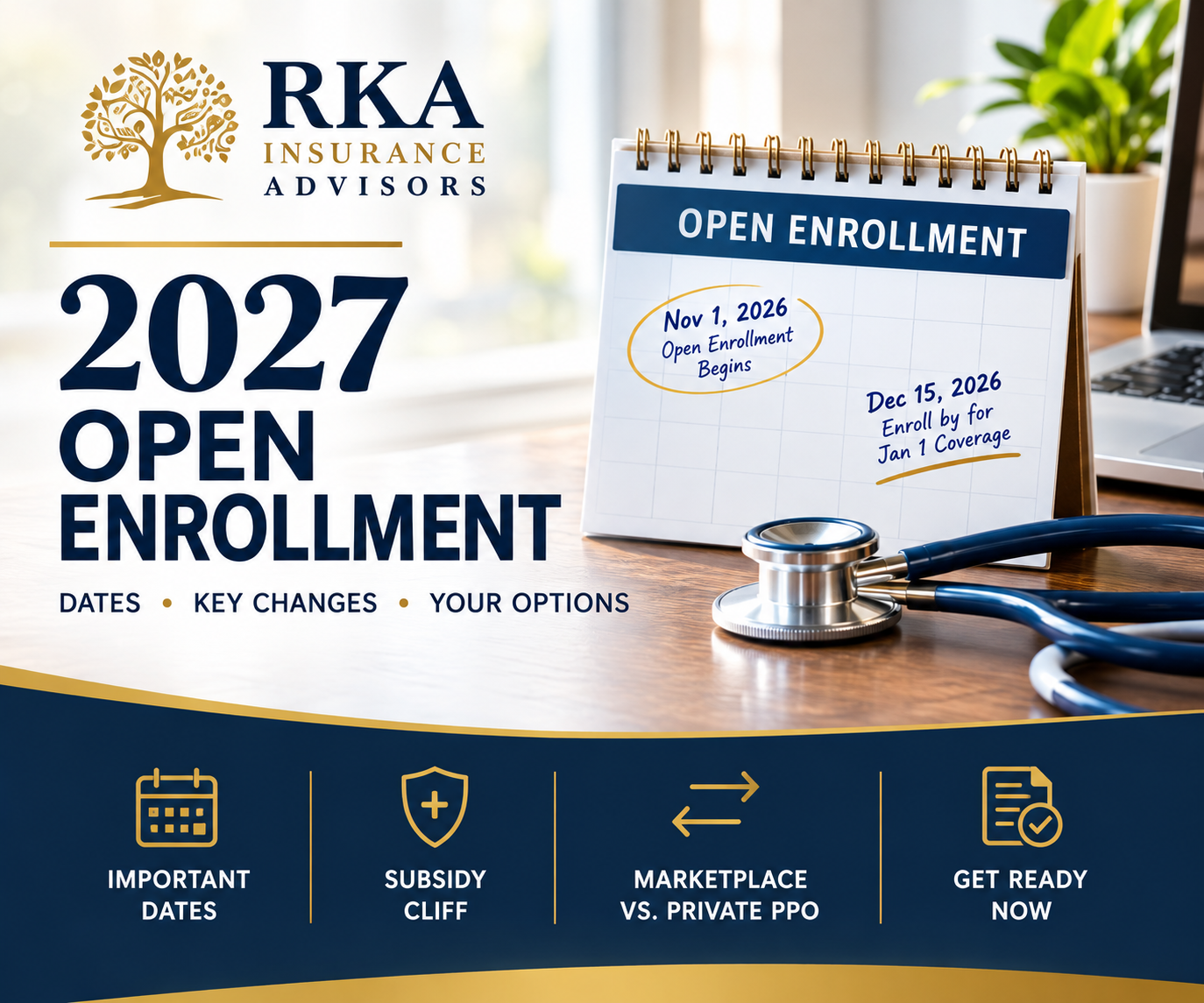
- Nov 1, 2026 — open enrollment opens
- Dec 15, 2026 — enroll by this date for coverage starting January 1 (true in every state)
- Miss Dec 15 and your start date is typically pushed to Feb 1 where a later window still applies
What's in flux
- A federal rule tried to end 2027 open enrollment on Dec 15 — but a court vacated it in June 2026
- So most states are expected to keep the Jan 15, 2027 end date, but it varies by state and could shift
- Bottom line: don't gamble on the late window — target Dec 15
What changed for 2027
The enhanced subsidies that lowered premiums from 2021–2025 expired at the end of 2025. For 2027 that means higher net premiums for many, and the return of the subsidy cliff: earn a dollar over 400% of the federal poverty level and you lose all marketplace subsidy. If your income is above that line, the marketplace charges full retail — which is exactly where a private plan often wins.
Your two ways to enroll for 2027
Private nationwide PPO
- Offered by only a limited number of agents — we're one
- Priced on your health, not income — often cheaper if you're healthy or above the cliff
- Broad nationwide network, no referrals, enroll year-round
- Medically underwritten — not everyone qualifies
A marketplace (ACA) plan
- Best if your income qualifies you for a subsidy
- Guaranteed issue — no health questions; covers maternity and pre-existing conditions
- Enroll during the open enrollment window above
- Networks often narrower (HMO/EPO), with referrals
What to do now
- 1. Check your income against the cliff for your family size — it decides whether the marketplace or a private PPO wins.
- 2. Compare both — full-price marketplace vs. a private nationwide PPO, on premium, network, and total cost.
- 3. Confirm your doctors and prescriptions are covered before you enroll.
- 4. Enroll by December 15 for January 1 coverage — don't rely on the later window.
Get your 2027 plan sorted before Dec 15
We compare private nationwide PPO plans and marketplace options — matched to your income, doctors, and budget — at no cost to you.
Get Free Quotes Book a CallFrequently asked questions
When does 2027 open enrollment start and end?
It opens November 1, 2026. The deadline to enroll for January 1 coverage is December 15, 2026 in every state. A rule that would have ended enrollment on December 15 was vacated in court, so most states are expected to run through January 15, 2027 — but this varies by state and can change, so target December 15 to be safe.
What is the subsidy cliff for 2027?
With the enhanced subsidies expired, if your household income is above 400% of the federal poverty level you get no marketplace subsidy in 2027 — you pay the full premium. For healthy households over the cliff, a private nationwide PPO is often the cheaper option.
Is the marketplace my only choice?
No. Besides a marketplace plan, we offer private, medically-underwritten nationwide PPO plans that only a limited number of agents can access — often cheaper and broader for healthy or higher-income households. We compare both.
What if I miss the deadline?
You may qualify for a Special Enrollment Period after a life event (job loss, marriage, a move, a new baby). And private PPO plans enroll year-round, so you're not locked out until next fall.
Related guides
This article is for general educational purposes and is not a substitute for personalized advice. Open enrollment dates and rules vary by state and are subject to change and ongoing litigation; confirm the current dates for your state before enrolling. RKA Insurance Advisors is an independent, licensed health insurance brokerage (NPN 19540130) that compares ACA marketplace and private, medically-underwritten nationwide PPO plans. Private plans are not ACA-compliant and are subject to medical underwriting — not all applicants qualify. We do not offer Medicare. Not insurance, legal, tax, or financial advice. Call (561) 806-9913.
Cigna Leaving ACA Marketplace 2027
Cigna is leaving the ACA marketplace in 2027 — who's affected, key dates, and how to replace your plan without losing coverage.
Coverage Alert • ACA Marketplace
Cigna Is Leaving the ACA Marketplace in 2027: What Members Need to Know
What's happening
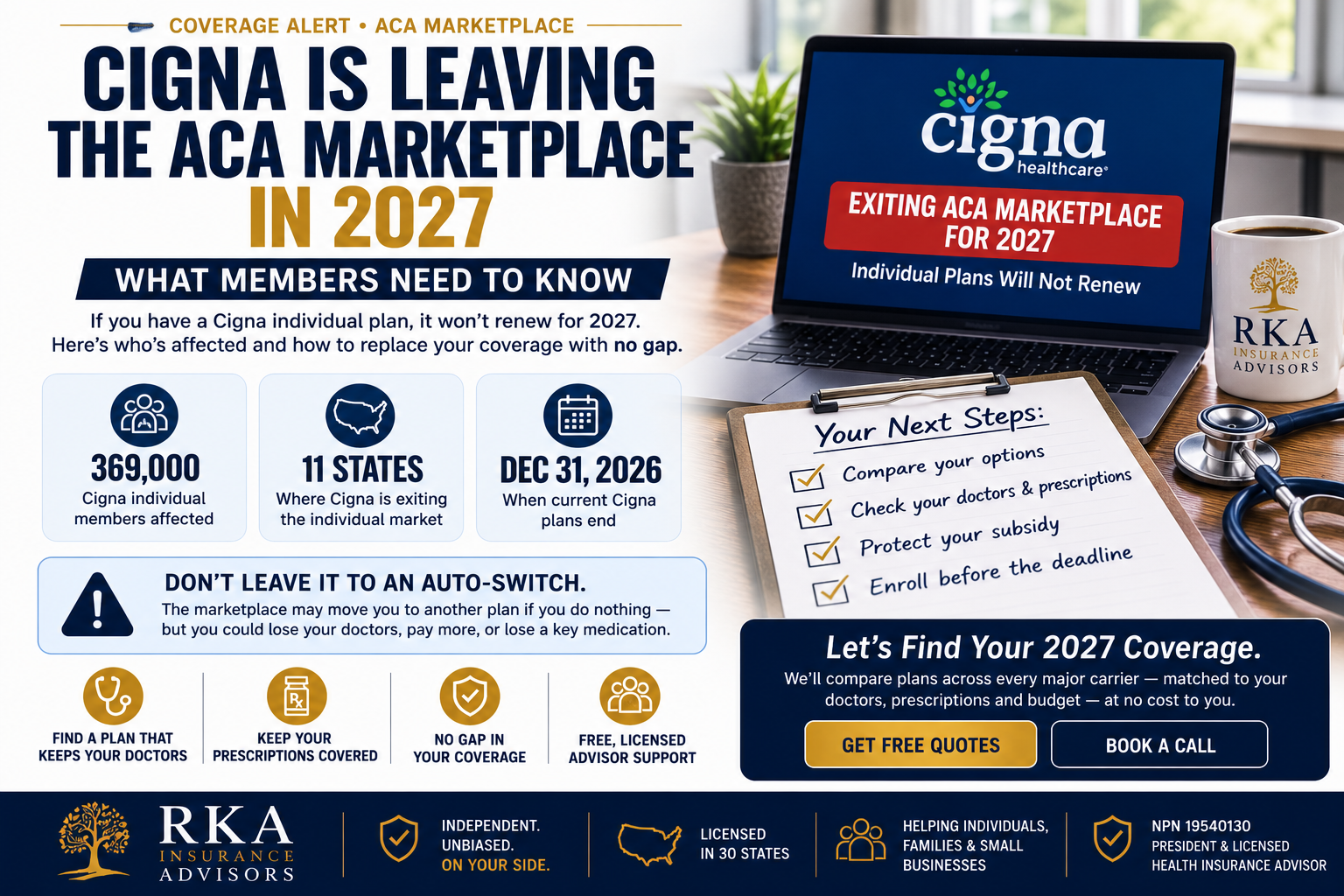
Cigna announced in April 2026 that it is leaving the individual ACA market to focus on its larger business lines. The result: Cigna individual and family plans will not be sold or renewed for 2027. This affects both on-exchange plans (through HealthCare.gov or your state's marketplace) and off-exchange Cigna individual plans. Employer group and Medicare products are not affected.
Your two ways to replace it
Private nationwide PPO
- Offered by only a limited number of agents — we're one
- Priced on your health, not your income — often cheaper if you're healthy or above the subsidy line
- Broad nationwide PPO network, no referrals, enroll year-round
- Medically underwritten — not everyone qualifies
A new marketplace (ACA) plan
- Best if your income qualifies you for a subsidy
- Guaranteed issue — no health questions
- Any subsidy you get today carries to the new plan
- Networks are often narrower (HMO/EPO), with referrals
What you should do now
- 1. Don't wait for the auto-switch. Choose your own 2027 coverage during open enrollment.
- 2. Compare both. Weigh a private nationwide PPO against a new marketplace plan — premium, network, and total cost.
- 3. Match it to your doctors and prescriptions. Confirm your providers are covered before you enroll.
- 4. Enroll before the deadline so your new coverage starts January 1 with no gap.
Key dates for 2027 coverage
Deadlines that matter
- Dec 31, 2026 — your current Cigna plan ends
- Nov 1, 2026 – Jan 15, 2027 — open enrollment (marketplace)
- Dec 15, 2026 — enroll by this date for Jan 1 coverage (no gap)
Good to know
- Private nationwide PPO plans enroll year-round — not tied to open enrollment
- Every marketplace plan is guaranteed-issue — no denial for pre-existing conditions
- Many of the same doctors are in other carriers' networks
Find your state
Cigna is exiting the ACA marketplace in 11 states. Choose yours for the details and next steps:
Losing your Cigna plan? See the option most brokers can't show you.
We compare private nationwide PPO plans and marketplace options — matched to your doctors, prescriptions, and budget — at no cost to you.
Get Free Quotes Book a CallFrequently asked questions
Is a new marketplace plan my only option?
No — and this is the part most people never hear. Besides a new marketplace (ACA) plan, you can replace a Cigna plan with a private, medically-underwritten nationwide PPO, which only a limited number of agents offer. It's priced on your health, uses a broad national network, and is often cheaper if you're healthy or above the subsidy line. We compare both.
What's the difference between marketplace and private PPO?
Marketplace plans are subsidized (if you qualify), guaranteed-issue, and often narrower networks. Private nationwide PPO plans are priced on your health, use broad networks with no referrals, and enroll year-round — but are medically underwritten, so not everyone qualifies. Most brokers only offer the marketplace side; we do both.
When does my Cigna plan end?
December 31, 2026. It will not renew into a Cigna plan for 2027.
Will I lose my doctors or my subsidy?
Not necessarily. Many of the same doctors are in other carriers' networks, and any marketplace subsidy carries to a new marketplace plan. A private PPO uses a broad national network. The key is comparing both before you enroll.
Does it cost anything to work with an advisor?
No. A licensed independent advisor is paid by the carriers, so there's no fee to you for help comparing private PPO and marketplace plans and enrolling.

Robert Adams
President & Licensed Agent, RKA Insurance Advisors · NPN 19540130 · (561) 806-9913
This article is for general educational purposes and is not a substitute for personalized advice. Plan availability, pricing, and enrollment dates vary by state; confirm details for your situation before enrolling. RKA Insurance Advisors is an independent, licensed health insurance brokerage specializing in private, medically-underwritten nationwide PPO plans in addition to ACA marketplace coverage. Private plans are not ACA-compliant and are subject to medical underwriting — not all applicants qualify. We do not offer Medicare. This content does not constitute insurance, legal, tax, or financial advice.

TrumpRx Launches: What This New Prescription Drug Website Means for Your Health Coverage | RKA
President Trump launched TrumpRx.gov—a direct-to-consumer website offering discounted prescription drugs including Ozempic, Wegovy, and Zepbound. Discounts apply to cash-paying patients only and do NOT work with insurance. Here's who benefits, how it affects your coverage decisions, and what it doesn't cover.
TrumpRx Launches: What This New Prescription Drug Website Means for Your Health Coverage
Fast take: President Trump launched TrumpRx.gov on February 5, 2026—a direct-to-consumer website offering discounted prescription drugs at "most favored nation" prices. The discounts apply to cash-paying patients only and do not work with insurance. Here's what you need to know and how it affects your coverage decisions.
Not sure if TrumpRx or insurance is the better deal for your prescriptions?
We'll compare your total costs—premiums, deductibles, and Rx—across ACA Marketplace plans, private PPOs, and cash-pay options like TrumpRx.
Get Free Quotes Book a CallWhat is TrumpRx?
TrumpRx.gov is a new government website that connects patients directly to pharmaceutical companies offering discounted prescription drugs. It launched with 43 brand-name medications from five manufacturers: AstraZeneca, Eli Lilly, EMD Serono, Novo Nordisk, and Pfizer. More drugs from 16 total participating manufacturers are expected to be added.
The site doesn't sell drugs directly. Instead, it provides coupons you can print or download to your phone and present at your pharmacy, or it directs you to manufacturer websites like LillyDirect or NovoCare to complete your purchase.
Key drugs and new prices
Weight Loss / Diabetes
Ozempic: $1,028 → $350/month
Wegovy (injectable): $1,349 → as low as $199/month
Wegovy (pill): $1,349 → as low as $149/month
Zepbound: $1,088 → as low as $299/month
Fertility Medications
Gonal-F: as low as $168/pen
Cetrotide: $316 → $22.50
Ovidrel: $251 → $84
Potential savings: $2,000+ per fertility cycle
Respiratory
Bevespi Aerosphere (COPD): $458 → $51
Airsupra (asthma): $504 → $201
Other Medications
Eucrisa (dermatitis): $792 → $158
Insulin Lispro: as low as $25/month
Duavee (menopause): $202 → $30
Who benefits most from TrumpRx?
TrumpRx may help if you...
✓ Are uninsured and pay cash for prescriptions
✓ Need GLP-1 drugs (Ozempic, Wegovy, Zepbound) not covered by your insurance
✓ Pay for fertility treatments out-of-pocket
✓ Have high-deductible plans and haven't met your deductible
✓ Take brand-name drugs with no generic alternative
TrumpRx probably won't help if you...
✗ Have insurance with reasonable copays
✗ Take generic medications (9 in 10 prescriptions are generics)
✗ Have already met your deductible for the year
✗ Want purchases to count toward your out-of-pocket max
✗ Need drugs not listed on the platform
⚠️ Important: TrumpRx Does NOT Work With Insurance
TrumpRx discounts are for cash-paying patients only. If you use TrumpRx:
✗ You cannot use your insurance
✗ Purchases do NOT count toward your deductible
✗ Purchases do NOT count toward your out-of-pocket maximum
For many people with insurance, using your plan's pharmacy benefit will cost less over the course of the year.
How TrumpRx affects your health insurance decision
TrumpRx doesn't replace health insurance—it's a prescription discount program. But it does change the math for some people when comparing coverage options:
If you need GLP-1 drugs
Weight loss medications like Wegovy and Zepbound are often excluded from insurance plans. TrumpRx pricing ($149-$350/month) may now make these accessible without needing a plan that covers them—which expands your insurance options.
If you're comparing high-deductible vs. low-deductible plans
A high-deductible plan with lower premiums + TrumpRx for specific brand-name drugs might cost less annually than a low-deductible plan. We can model both scenarios for you.
If you're self-employed with variable income
For some self-employed individuals, a catastrophic or high-deductible plan + cash-pay options like TrumpRx + an HSA may provide better value than a comprehensive plan with high premiums.
If you're uninsured
TrumpRx helps with specific brand-name drugs, but it's not a substitute for major medical coverage. You still need insurance for hospitalizations, surgeries, preventive care, and most prescriptions.
What TrumpRx does NOT cover
✗ Generic medications (90% of all prescriptions)
✗ Doctor visits and preventive care
✗ Hospitalizations and surgeries
✗ Emergency room visits
✗ Lab work and imaging
✗ Most brand-name drugs (only 43 currently listed)
The bottom line
TrumpRx is a useful tool for specific situations—especially for uninsured patients or those needing expensive brand-name drugs not covered by their insurance. But for most people with health coverage, your insurance pharmacy benefit will still be the better deal over the course of the year.
The real question is: How does this fit into your total healthcare cost picture? That depends on your income, health status, prescription needs, and which plans are available in your state.
Need help comparing your total costs?
We'll model premiums + deductibles + prescriptions across ACA plans, private PPOs, and cash-pay options to find what actually costs you less.
Get Free Quotes Book a CallQuick FAQs
Can I use TrumpRx with my insurance?
No. TrumpRx discounts are only for cash-paying patients. If you use TrumpRx, you cannot bill your insurance for that purchase, and it won't count toward your deductible or out-of-pocket maximum.
Is TrumpRx cheaper than my insurance copay?
It depends on your plan. For many people with insurance, copays are lower than TrumpRx prices—especially after meeting your deductible. Compare both options before deciding.
Does TrumpRx replace health insurance?
No. TrumpRx only covers 43 specific brand-name drugs. You still need health insurance for doctor visits, hospitalizations, preventive care, generic medications, and most prescriptions.
How do I use TrumpRx?
Visit TrumpRx.gov, find your medication, and either print a coupon to take to your pharmacy or complete your order through the manufacturer's website (like LillyDirect or NovoCare).
What about generic drugs?
TrumpRx only offers brand-name drugs. For generics (which account for 90% of prescriptions), sites like Mark Cuban's Cost Plus Drugs or your insurance pharmacy benefit are typically better options.
For education only; pricing and availability subject to change. Always compare options before purchasing medications. This is not medical advice—consult your healthcare provider about treatment decisions.
How does the Inflation Reduction Act affect your Health Coverage?
The Inflation Reduction Act's enhanced ACA subsidies expired at the end of 2025 and the 2026 subsidy cliff is back. Here's what changed, the income cutoffs, and where a private PPO now beats the marketplace.
Private PPO • Marketplace • 2026 Changes
How the Inflation Reduction Act Affects Your Health Coverage (2026 Update)
What changed for 2026
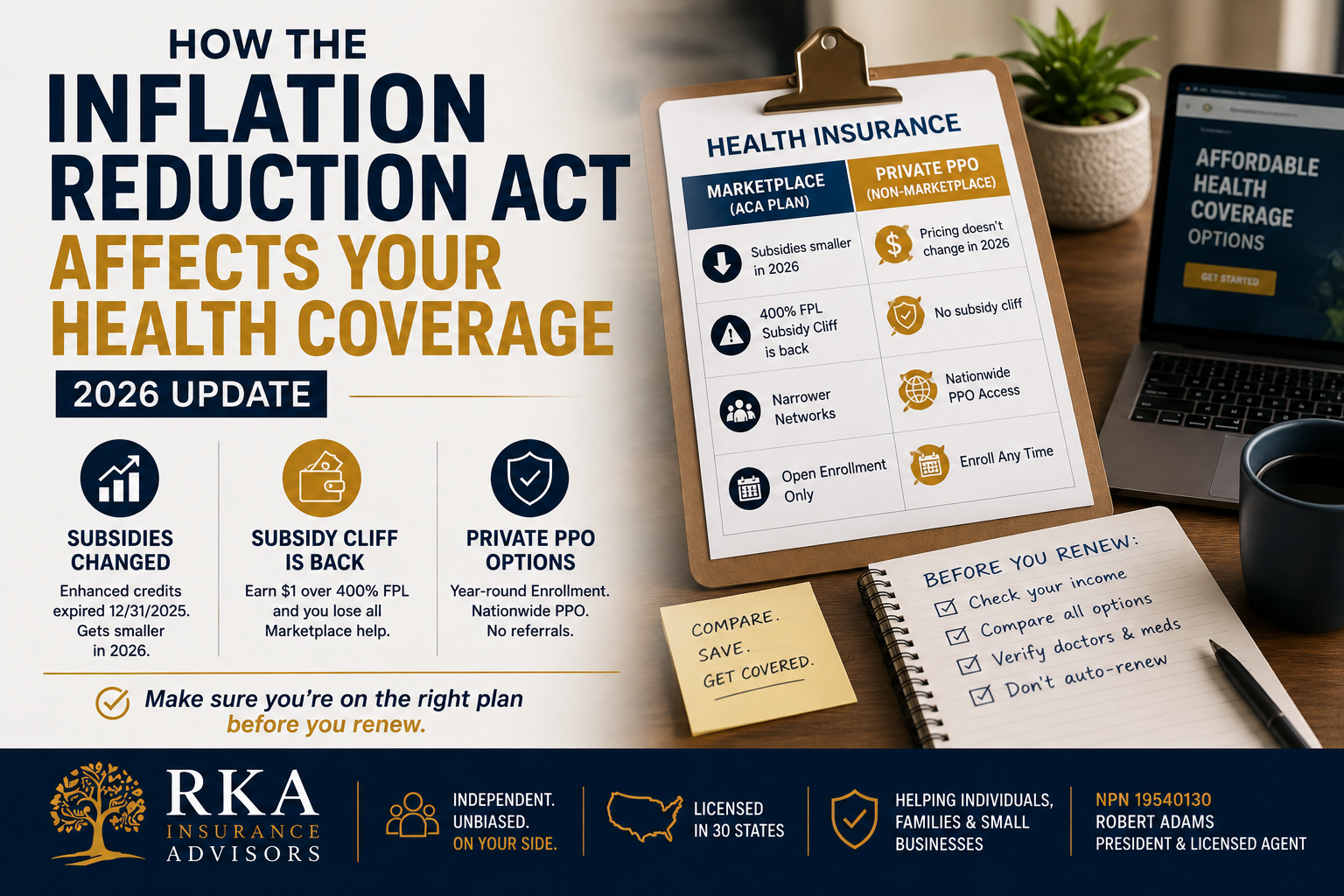
The IRA’s larger subsidies were always temporary. They ran from 2021 through 2025, and Congress did not extend them. When 2026 Open Enrollment opened, the enhanced credits were gone — and for millions of people the price to keep the same plan jumped sharply.
The cliff cutoff scales with household size — roughly $84,600 for a couple and $128,600 for a family of four in 2026. Cross it by a dollar and your Marketplace subsidy drops to zero.
Marketplace vs. Private PPO in 2026
Marketplace (ACA) Plans
- Still a strong fit if your income is under the cliff and you qualify for a subsidy
- Guaranteed issue — no health questions
- Above 400% of poverty, you now pay the full unsubsidized premium
- Networks are often narrower (HMO/EPO) with referrals
Private PPO (Non-Marketplace)
- Never used IRA subsidies — nothing about its pricing changed in 2026
- Priced on age and health, not income — often cheaper over the cliff
- Nationwide PPO access, no referrals, enroll any month
- Medically underwritten — not everyone qualifies
What to compare before you renew
Run the cost math
- Your realistic 2026 income vs. the cliff cutoff for your family size
- Full-price Marketplace premium vs. a private PPO quote
- Deductibles and out-of-pocket maximums, not just the premium
- Total annual cost across the whole year
Check the fit
- Are your doctors in each plan’s network?
- Are your prescriptions covered, and at what tier?
- Do you travel or live across state lines?
- Any planned procedure or pregnancy this year?
Not sure which side of the cliff you’re on?
We’ll put full-price Marketplace and a nationwide private PPO side by side for your exact situation — verify your doctors, check your prescriptions, and tell you honestly which wins. Free, no obligation.
Get Free Quotes Book a CallThe self-employed angle
If you run a business or work 1099, the expired subsidies hit harder — you’re buying your own coverage with no employer help, and you’re more likely to be over the cliff. That’s exactly the situation where a medically underwritten nationwide PPO can beat full-price Marketplace, priced on your health instead of your income. There’s also a tax angle: self-employed people can often deduct their premiums — worth raising with your tax professional as you compare.
Related reading
Frequently asked questions
Did the Inflation Reduction Act’s subsidies go away?
The larger enhanced credits that ran from 2021 through 2025 expired December 31, 2025. The original ACA subsidies still exist, but at smaller pre-2021 levels — and the 400% income cliff is back for 2026.
I earn just over the cliff — what are my options?
Above 400% of the federal poverty level you get no Marketplace subsidy in 2026, so you pay the full premium. For a healthy household, a medically underwritten private PPO is often less expensive with a broader nationwide network. It’s worth comparing both before you decide.
Why did my premium jump so much for 2026?
When the enhanced subsidies expired, the amount of help you receive shrank, so the net premium you pay rose — on average about 114% for subsidized enrollees to keep the same plan.
Do I still need to report income changes?
Yes. If you use Marketplace coverage, keep your income and household details updated so your subsidy stays accurate — with the cliff back in 2026, being off can mean a large bill at tax time.
Subsidy amounts, cliff cutoffs, and premiums vary by household and can change; the figures here reflect 2026 rules at the time of writing.
Robert Adams · President & Licensed Agent · NPN 19540130 · Licensed in 30 states. Premium and subsidy figures are illustrative and based on general market data — actual amounts vary by age, state, income, and health. Private medically underwritten plans are not ACA-compliant and are subject to medical underwriting — not all applicants qualify. This content is for informational purposes only and does not constitute insurance, legal, tax, or financial advice.

Robert Adams
https://www.RKAInsuranceAdvisors.com