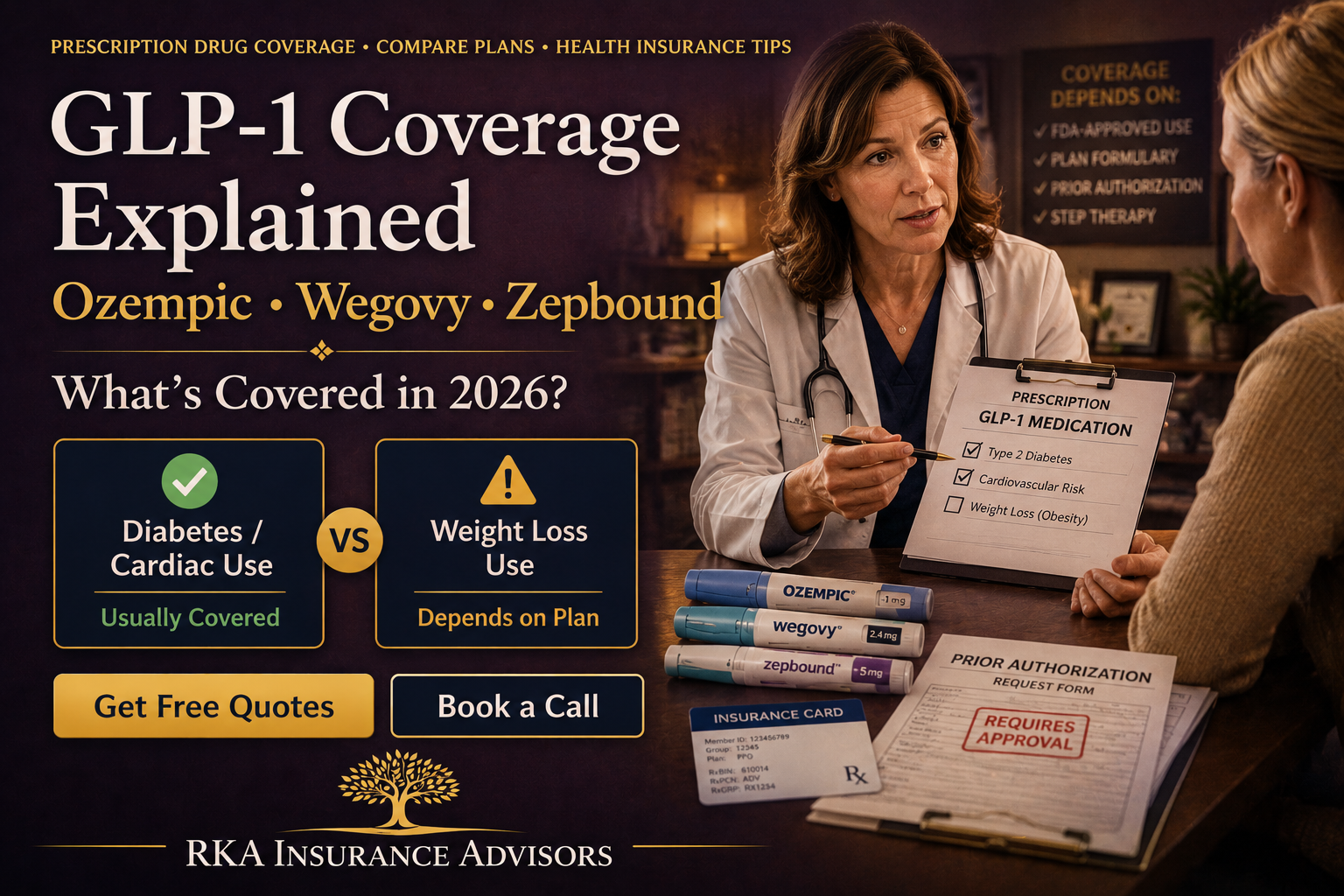
GLP-1 Coverage Explained: Ozempic, Wegovy & Zepbound in 2026
Whether a plan covers a GLP-1 usually comes down to what it's prescribed for. Diabetes use is commonly covered; weight-loss coverage in 2026 is limited, shrinking, and almost always tied to prior authorization. Here's how each coverage path works — and what to check before you enroll.
Prescription Drug Coverage • Compare Plans • Health Insurance Tips
GLP-1 Coverage Explained: Ozempic, Wegovy & Zepbound in 2026
First, what counts as a "GLP-1"?
GLP-1 receptor agonists mimic a hormone that helps regulate blood sugar and appetite. The brand names get used interchangeably in the headlines, but the FDA approvals behind them are different — and that difference drives whether your plan pays.
Approved for type 2 diabetes
- Ozempic (semaglutide)
- Mounjaro (tirzepatide)
- Rybelsus (oral semaglutide)
- Trulicity, Victoza
Approved for chronic weight management
- Wegovy (semaglutide)
- Zepbound (tirzepatide)
- Saxenda (liraglutide)
The 2026 coverage picture, by plan type
| Coverage path | For diabetes / cardiac use | For weight loss alone |
|---|---|---|
| ACA Marketplace plans | Commonly covered, often with restrictions | Rarely covered — and declining |
| Employer plans | Commonly covered | Only if the employer buys a weight-management rider |
| Private PPO plans | Varies by formulary — verify the drug list | Often excluded or on a high specialty tier |
| Medicare Part D | Covered for approved non-weight uses | Limited — see the GLP-1 Bridge note below |
Why weight-loss coverage keeps shrinking
At roughly $1,000+ per month at list price, GLP-1s have become one of the fastest-growing line items in pharmacy budgets — and insurers have pointed to them as a factor pushing 2026 marketplace premiums higher. The result: many carriers have narrowed weight-loss coverage to diabetes-only, added prior authorization, or dropped it entirely for individual and small-group members effective January 2026.
What this means for you
- A plan covering Ozempic for diabetes may not cover Wegovy for weight loss.
- Even "covered" weight-loss prescriptions usually need prior authorization first.
- Coverage can change at renewal — what's on the formulary this year may shift next year.
If a plan does cover it: how approval usually works
When a plan includes weight-loss GLP-1s, approval criteria tend to mirror the FDA prescribing guidelines:
Typical approval requirements
- BMI of 30+, or 27+ with a weight-related condition (high blood pressure, prediabetes, high cholesterol)
- A documented diagnosis with the correct code from your provider
- A prior authorization request submitted by your prescriber
- In some plans, step therapy — trying a lower-cost option first
Good to know
- Prior authorization can take up to 10 business days
- Ask your prescriber's office to submit it the day the script is written
- Denials can be appealed — and appeals succeed more often than people expect
If your plan excludes it: lower-cost paths
A coverage denial isn't a dead end. Several manufacturer and pharmacy programs exist for people paying out of pocket:
Manufacturer direct
- NovoCare (Wegovy): injection from about $199/month for new patients, then higher; Wegovy pill from about $149/month
- LillyDirect (Zepbound): from about $299/month depending on dose
Pharmacy savings
- GoodRx and similar tools for semaglutide and tirzepatide pricing
- Commercial-insurance copay cards
- Manufacturer cards exclude government plans (Medicare/Medicaid)
A new Medicare GLP-1 Bridge program begins July 1, 2026, giving eligible Part D beneficiaries access to certain weight-loss GLP-1s for a $50 monthly copay through the end of 2027, with prior authorization and clinical criteria required. This applies to Medicare members specifically — separate from the under-65 coverage this guide focuses on.
What to check before you enroll in any plan
- Pull the plan's drug formulary and search the exact brand you take
- Review the Summary of Benefits and Coverage (SBC) — every plan must provide one
- Confirm the tier and whether prior authorization or step therapy applies
- Check whether coverage is tied to a diabetes diagnosis or includes weight management
Where we come in
- We'll run this formulary check with you before you commit to a plan
- Compare your options side by side across carriers
- No surprises at the pharmacy counter
- Free, and no obligation
We'll review the drug lists with you and compare your options side by side — at no cost.
Frequently Asked Questions
Is Ozempic covered by health insurance?
Ozempic is FDA-approved for type 2 diabetes (and cardiovascular risk reduction in certain adults with diabetes), so it's commonly covered when prescribed for those uses — often with prior authorization. It is not FDA-approved as a weight-loss drug, so plans generally won't cover it for weight loss alone.
Why would my plan cover Ozempic but not Wegovy?
They share the same active ingredient (semaglutide) but have different FDA approvals. Ozempic is approved for diabetes; Wegovy is approved for weight management. Formularies follow the approved use, so a plan can include one and exclude the other.
Do ACA Marketplace plans cover GLP-1s for weight loss?
Rarely in 2026. Industry analyses found only about 26 of roughly 300 marketplace carriers cover GLP-1s for obesity, concentrated in nine states, and coverage has been declining. Plans that do cover them typically require prior authorization or quantity limits. Always check the specific plan's formulary.
What if my prescription is denied?
Denials can often be appealed, and appeals succeed more often than people expect — many simply never file one. You can also use manufacturer direct programs and pharmacy savings tools while you sort out coverage. Your prescriber's office handles the prior authorization and appeal paperwork.
Can a private PPO plan get me GLP-1 coverage?
It depends entirely on the individual plan's formulary. Private PPO drug lists vary, and weight-loss GLP-1s are often excluded or placed on a high specialty tier. The reliable move is to verify the exact medication on the formulary before you enroll — which is something we can do with you directly.
We're an independent broker. We'll check the formulary, compare carriers, and tell you honestly what each plan covers for your situation. No pressure, no obligation.
Robert Adams * President & Licensed Agent * NPN 19540130 * Licensed in 30 states. This content is for informational purposes only and does not constitute insurance, medical, legal, tax, or financial advice. Prescription coverage, formularies, prior-authorization rules, and manufacturer program pricing vary by plan, state, and date and change frequently — verify details against your plan's current formulary and Summary of Benefits and Coverage, and consult your healthcare provider about any medication. Private medically underwritten plans are not ACA-compliant and are subject to medical underwriting — not all applicants qualify.

TrumpRx Launches: What This New Prescription Drug Website Means for Your Health Coverage | RKA
President Trump launched TrumpRx.gov—a direct-to-consumer website offering discounted prescription drugs including Ozempic, Wegovy, and Zepbound. Discounts apply to cash-paying patients only and do NOT work with insurance. Here's who benefits, how it affects your coverage decisions, and what it doesn't cover.
TrumpRx Launches: What This New Prescription Drug Website Means for Your Health Coverage
Fast take: President Trump launched TrumpRx.gov on February 5, 2026—a direct-to-consumer website offering discounted prescription drugs at "most favored nation" prices. The discounts apply to cash-paying patients only and do not work with insurance. Here's what you need to know and how it affects your coverage decisions.
Not sure if TrumpRx or insurance is the better deal for your prescriptions?
We'll compare your total costs—premiums, deductibles, and Rx—across ACA Marketplace plans, private PPOs, and cash-pay options like TrumpRx.
Get Free Quotes Book a CallWhat is TrumpRx?
TrumpRx.gov is a new government website that connects patients directly to pharmaceutical companies offering discounted prescription drugs. It launched with 43 brand-name medications from five manufacturers: AstraZeneca, Eli Lilly, EMD Serono, Novo Nordisk, and Pfizer. More drugs from 16 total participating manufacturers are expected to be added.
The site doesn't sell drugs directly. Instead, it provides coupons you can print or download to your phone and present at your pharmacy, or it directs you to manufacturer websites like LillyDirect or NovoCare to complete your purchase.
Key drugs and new prices
Weight Loss / Diabetes
Ozempic: $1,028 → $350/month
Wegovy (injectable): $1,349 → as low as $199/month
Wegovy (pill): $1,349 → as low as $149/month
Zepbound: $1,088 → as low as $299/month
Fertility Medications
Gonal-F: as low as $168/pen
Cetrotide: $316 → $22.50
Ovidrel: $251 → $84
Potential savings: $2,000+ per fertility cycle
Respiratory
Bevespi Aerosphere (COPD): $458 → $51
Airsupra (asthma): $504 → $201
Other Medications
Eucrisa (dermatitis): $792 → $158
Insulin Lispro: as low as $25/month
Duavee (menopause): $202 → $30
Who benefits most from TrumpRx?
TrumpRx may help if you...
✓ Are uninsured and pay cash for prescriptions
✓ Need GLP-1 drugs (Ozempic, Wegovy, Zepbound) not covered by your insurance
✓ Pay for fertility treatments out-of-pocket
✓ Have high-deductible plans and haven't met your deductible
✓ Take brand-name drugs with no generic alternative
TrumpRx probably won't help if you...
✗ Have insurance with reasonable copays
✗ Take generic medications (9 in 10 prescriptions are generics)
✗ Have already met your deductible for the year
✗ Want purchases to count toward your out-of-pocket max
✗ Need drugs not listed on the platform
⚠️ Important: TrumpRx Does NOT Work With Insurance
TrumpRx discounts are for cash-paying patients only. If you use TrumpRx:
✗ You cannot use your insurance
✗ Purchases do NOT count toward your deductible
✗ Purchases do NOT count toward your out-of-pocket maximum
For many people with insurance, using your plan's pharmacy benefit will cost less over the course of the year.
How TrumpRx affects your health insurance decision
TrumpRx doesn't replace health insurance—it's a prescription discount program. But it does change the math for some people when comparing coverage options:
If you need GLP-1 drugs
Weight loss medications like Wegovy and Zepbound are often excluded from insurance plans. TrumpRx pricing ($149-$350/month) may now make these accessible without needing a plan that covers them—which expands your insurance options.
If you're comparing high-deductible vs. low-deductible plans
A high-deductible plan with lower premiums + TrumpRx for specific brand-name drugs might cost less annually than a low-deductible plan. We can model both scenarios for you.
If you're self-employed with variable income
For some self-employed individuals, a catastrophic or high-deductible plan + cash-pay options like TrumpRx + an HSA may provide better value than a comprehensive plan with high premiums.
If you're uninsured
TrumpRx helps with specific brand-name drugs, but it's not a substitute for major medical coverage. You still need insurance for hospitalizations, surgeries, preventive care, and most prescriptions.
What TrumpRx does NOT cover
✗ Generic medications (90% of all prescriptions)
✗ Doctor visits and preventive care
✗ Hospitalizations and surgeries
✗ Emergency room visits
✗ Lab work and imaging
✗ Most brand-name drugs (only 43 currently listed)
The bottom line
TrumpRx is a useful tool for specific situations—especially for uninsured patients or those needing expensive brand-name drugs not covered by their insurance. But for most people with health coverage, your insurance pharmacy benefit will still be the better deal over the course of the year.
The real question is: How does this fit into your total healthcare cost picture? That depends on your income, health status, prescription needs, and which plans are available in your state.
Need help comparing your total costs?
We'll model premiums + deductibles + prescriptions across ACA plans, private PPOs, and cash-pay options to find what actually costs you less.
Get Free Quotes Book a CallQuick FAQs
Can I use TrumpRx with my insurance?
No. TrumpRx discounts are only for cash-paying patients. If you use TrumpRx, you cannot bill your insurance for that purchase, and it won't count toward your deductible or out-of-pocket maximum.
Is TrumpRx cheaper than my insurance copay?
It depends on your plan. For many people with insurance, copays are lower than TrumpRx prices—especially after meeting your deductible. Compare both options before deciding.
Does TrumpRx replace health insurance?
No. TrumpRx only covers 43 specific brand-name drugs. You still need health insurance for doctor visits, hospitalizations, preventive care, generic medications, and most prescriptions.
How do I use TrumpRx?
Visit TrumpRx.gov, find your medication, and either print a coupon to take to your pharmacy or complete your order through the manufacturer's website (like LillyDirect or NovoCare).
What about generic drugs?
TrumpRx only offers brand-name drugs. For generics (which account for 90% of prescriptions), sites like Mark Cuban's Cost Plus Drugs or your insurance pharmacy benefit are typically better options.
For education only; pricing and availability subject to change. Always compare options before purchasing medications. This is not medical advice—consult your healthcare provider about treatment decisions.