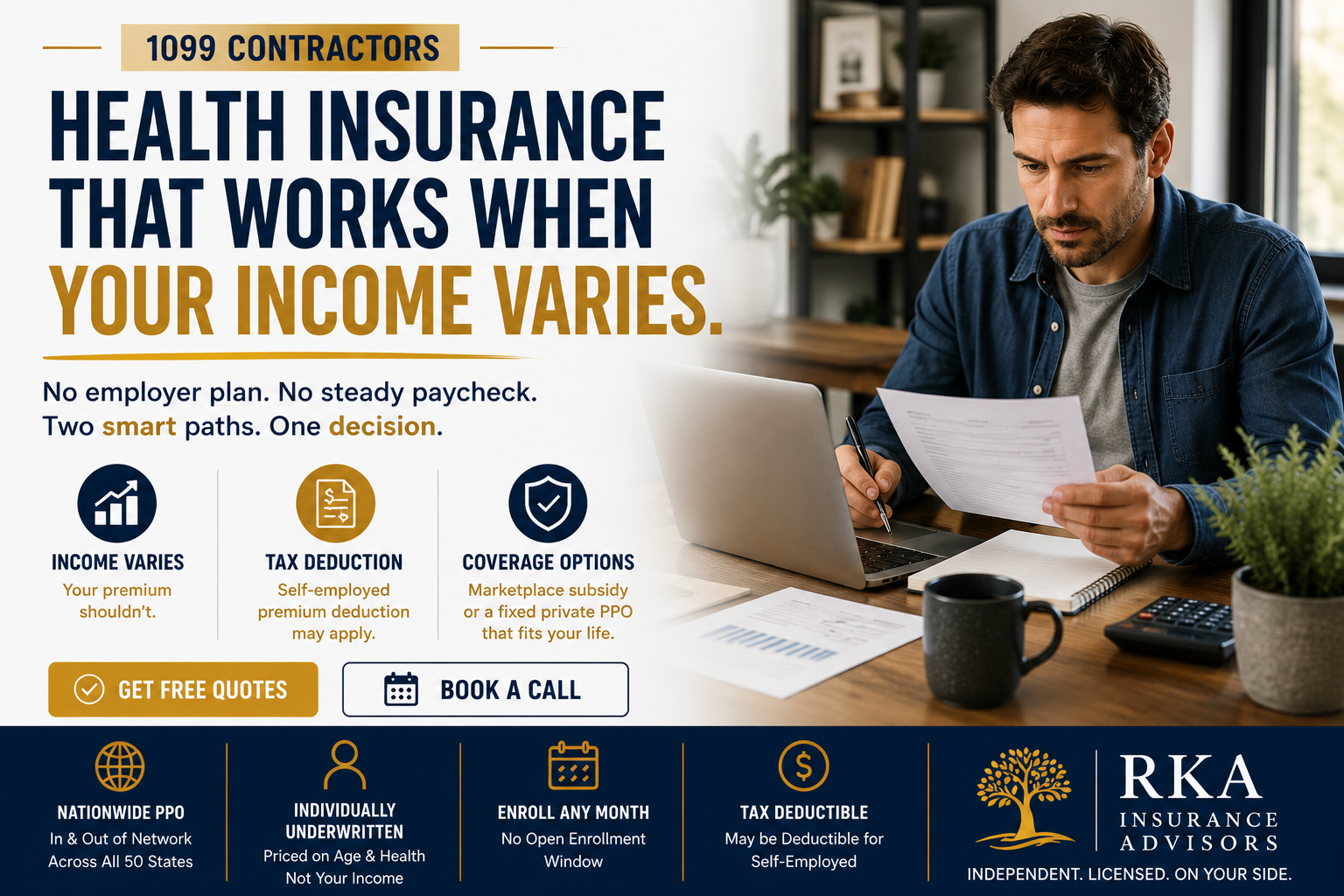
1099 Contractor Health Insurance: How to Get Covered When Your Income Varies
When you're 1099, there's no employer plan and no steady paycheck to size a premium against. That makes two things matter more than usual: estimating income for a subsidy you can't predict, and the self-employed premium deduction. Here's how contractors get covered.
Self-Employed • Private PPO • Individual Coverage
1099 Contractor Health Insurance: How to Get Covered When Your Income Varies
Why 1099 coverage is a different problem
A W-2 employee picks a plan once a year, has a fixed salary, and lets payroll deduct the premium. None of that is true for you. There's no employer splitting the cost, no HR portal, and — the part that trips people up — no predictable income to base a subsidy on. When your earnings swing month to month, the usual advice doesn't fit. The two questions below are the ones that actually decide your best move.
Question 1: Can you even predict your income?
Marketplace subsidies are based on your projected annual income. You estimate it when you enroll, the subsidy is paid in advance based on that estimate, and at tax time the IRS reconciles what you actually earned on Form 8962. For a salaried employee that's simple. For a contractor whose income depends on how many contracts close this year, it's a guess — and guessing wrong cuts both ways.
If you underestimate
- You collect a bigger subsidy during the year than you were owed
- You repay the difference at tax time — sometimes a large bill in April
- A single big contract late in the year can trigger it
If you overestimate
- You get a smaller subsidy during the year than you qualified for
- You get the difference back as a credit at tax time
- But you fronted more cash all year than you had to
The predictable alternative: a nationwide private PPO is priced on your age and health, not your income. The premium doesn't move when your income does, and there's nothing to reconcile at tax time. For a healthy contractor with variable or higher income, that predictability is often worth more than a subsidy you have to gamble on.
Question 2: Are you taking the self-employed deduction?
If you're self-employed and turn a profit, you may be able to deduct your health insurance premiums — for yourself, your spouse, and your dependents — on your federal return, whether you take the standard deduction or itemize. It's an "above-the-line" deduction, which is more valuable than most write-offs. It applies to private plans and unsubsidized marketplace plans, but not to the portion of a premium already covered by a subsidy.
This matters for the comparison: a private plan that looks more expensive on paper can be cheaper after the deduction than a partially-subsidized marketplace plan. The exact benefit depends on your tax situation, so confirm the specifics with your tax professional — but don't leave it out of the math.
Your two ways to get covered
ACA Marketplace
- Guaranteed issue — no health questions, no one is declined
- Subsidies possible if your projected income qualifies
- You must estimate income; the IRS reconciles it at tax time
- Enroll only during Open Enrollment or with a qualifying life event
- Most plans in many areas are regional HMO/EPO
Nationwide Private PPO
- Priced on health and age, not income — premium doesn't move
- Available any month, no enrollment window
- Nationwide PPO — see specialists anywhere, no referrals
- No subsidy, so nothing to reconcile at tax time
- Medically underwritten — you have to qualify
Not sure which fits your 1099 income? Let's run both.
We'll model a subsidized marketplace plan against a fixed private PPO for your actual situation — factor in the self-employed deduction, verify your doctors, and tell you straight which one wins. Free, no obligation.
Which path tends to win, honestly
Lean marketplace if…
- Your income is modest and reasonably predictable
- A subsidy makes the net premium clearly lower
- You have a health condition that underwriting might exclude
Lean private PPO if…
- You're healthy and above the subsidy line
- Your income swings and you'd rather not gamble on an estimate
- You want nationwide access and no reconciliation at tax time
This is the same honest fork we walk through with gig and rideshare workers — if you want the version focused on total cost and network freedom, see our gig workers and 1099 coverage guide.
Related reading
- Health insurance for gig workers and 1099 contractors
- Marketplace vs private PPO: an honest comparison
- Health insurance for the self-employed
Frequently asked questions
How do I estimate my income for a marketplace subsidy if I'm 1099?
You project your expected annual net income for the year and enter it when you enroll. The subsidy is paid in advance based on that number, then reconciled against your actual income on Form 8962 at tax time. Because contractor income is variable, build in a realistic buffer — underestimating means repaying subsidy in April. If your income is genuinely hard to predict, a private plan priced on health rather than income avoids the guesswork entirely.
Can I deduct my health insurance premiums as a 1099 contractor?
If you're self-employed and profitable, you generally can deduct premiums for yourself, your spouse, and your dependents as an above-the-line deduction — even without itemizing. It doesn't apply to any portion covered by a subsidy. It can make a private plan cheaper after taxes than it looks on paper. Confirm the specifics with your tax professional for your situation.
Can I get covered outside of Open Enrollment?
Private medically underwritten PPO plans are available year-round with no enrollment window — you can apply any month. Marketplace plans generally require Open Enrollment or a qualifying life event such as losing other coverage, moving, or marriage. That year-round availability is one reason contractors between contracts often look at the private path.
My income changes every month — does that affect a private plan?
No. A private plan's premium is set by your age and health at enrollment, not your income, so it doesn't move when your earnings do. That's the core appeal for contractors with variable income: a fixed cost you can budget around, and no year-end reconciliation. The tradeoff is that you have to qualify through medical underwriting.
I'm healthy and earn well — is the marketplace still worth checking?
Yes, always check both. If your income is above the subsidy line, an unsubsidized marketplace plan and a private PPO are both on the table, and the private PPO often wins on cost and network for a healthy applicant. But we compare them side by side rather than assume — occasionally a specific marketplace plan fits better, and we'll tell you when it does.
How does RKA help 1099 contractors?
We compare a subsidized marketplace plan against a fixed nationwide private PPO for your specific income and health, factor in the self-employed premium deduction, verify your doctors and prescriptions, and give you the honest call. We're independent and licensed in 30 states. NPN 19540130.
Get a fixed number you can actually budget around.
When your income isn't predictable, your health coverage can still be. We'll price both paths, factor the deduction, and pre-screen private eligibility — at no cost.
Robert Adams * President & Licensed Agent * NPN 19540130 * Licensed in 30 states. Premium estimates are illustrative and based on general market data — actual premiums vary by age, state, health profile, and underwriting outcome. Private medically underwritten plans are not ACA-compliant and are subject to medical underwriting — not all applicants qualify. Tax treatment depends on your individual circumstances — consult a qualified tax professional. This content is for informational purposes only and does not constitute insurance, legal, tax, or financial advice.

Getting Married? How to Compare Health Insurance Before You Merge Plans
Marriage is a qualifying life event — a 60-day window to optimize your coverage, not just merge it. For two working spouses, separate plans sometimes beat one combined plan on cost and network. Here's how to run the comparison before you default to "just join mine."
Private PPO • Families • Life Events
Getting Married? How to Compare Health Insurance Before You Merge Plans
The 60-day window most newlyweds don't use
Marriage is one of the life events that opens a Special Enrollment Period — a 60-day window during which you can change health coverage without waiting for Open Enrollment in the fall. Most couples treat that window as a formality: one spouse simply adds the other to their existing employer plan and moves on.
That's the missed opportunity. The window isn't just permission to merge — it's a chance to look at every option side by side, exactly once, before your choices lock until next year. Adding your spouse to your plan is one option. It is rarely the only one, and not always the cheapest.
Why "just join my plan" can cost more
When you were single, your employer likely paid a big share of your premium. Here's what changes the moment you add a spouse: employers typically subsidize the employee generously and the dependent far less — sometimes not at all. So the sticker price of adding your spouse to your plan can be dramatically higher than what you'd guess from your own paycheck deduction.
Meanwhile your spouse may have their own employer plan, their own marketplace option, or — if self-employed or higher-income — access to a private plan priced independently of either job. The only way to know which combination wins is to put the real numbers next to each other.
Your three real paths as a married couple
Merge onto one plan
- Simplest — one card, one deductible, one renewal
- Good when one plan is strong and cheap to add a spouse to
- Dependent premium is often lightly subsidized or not at all
- You inherit that plan's network — check both sets of doctors
Keep separate coverage
- Each spouse keeps the plan their employer subsidizes best
- Often wins when both employers pay well for the employee
- Each keeps their own doctors and network
- Two deductibles, two plans to manage
Nationwide private PPO
- Priced on health and age, not on either employer
- Nationwide PPO — see specialists anywhere, no referrals
- Strong fit if one spouse is self-employed or above the subsidy line
- Medically underwritten — not everyone qualifies
What to compare before you decide
Run the cost math
- Your premium alone vs your premium + spouse added
- What each employer actually pays toward a dependent
- Both deductibles and both out-of-pocket maximums
- Total annual cost, not just the monthly premium
Check the fit
- Are both of your doctors in the combined plan's network?
- Are both of your prescriptions covered, and at what tier?
- Does either of you travel or live across state lines?
- Is either spouse planning a procedure or a pregnancy soon?
The subsidy fork worth knowing: if your combined household income after marriage is modest, a marketplace plan with a subsidy may be the cheapest path — but marriage changes your household size and income, which can raise or lower that subsidy. If your combined income is higher, or one of you is self-employed, subsidies may phase out and a nationwide private PPO frequently pencils out better. We model both so you're choosing on real numbers, not a guess.
Just married? Compare all three paths in one sitting.
We'll put "merge onto one plan," "keep separate," and a nationwide private PPO side by side for your exact situation — verify both of your doctors, check both prescriptions, and tell you honestly which wins. Free, no obligation.
The self-employed spouse angle
If one of you runs a business or works 1099, marriage is a good moment to reexamine coverage entirely. A self-employed spouse often has no employer subsidy at all, which is exactly the situation where a medically underwritten nationwide PPO can beat both a marketplace plan and the cost of getting added to the other spouse's employer plan. There's also a tax angle: a self-employed spouse may be able to deduct health insurance premiums — worth raising with your tax professional as you compare.
Related reading
- Marketplace vs private PPO: an honest comparison
- Health insurance for the self-employed
- Is it cheaper to insure your family separately from your employer's plan?
Frequently asked questions
Does getting married let me change health insurance right away?
Yes. Marriage is a qualifying life event that opens a 60-day Special Enrollment Period. During that window you can add a spouse to an employer plan, enroll in a marketplace plan, or apply for a private plan — without waiting for fall Open Enrollment. Once the 60 days pass, most changes wait until the next Open Enrollment.
Is it cheaper to add my spouse to my plan or keep separate coverage?
It depends on what each employer pays toward a dependent. Employers usually subsidize the employee well and the spouse much less — sometimes nothing. If both of you have solid employer coverage, keeping separate plans often costs less than merging. If only one plan is strong, merging may win. The only way to know is to compare the real dependent premium against two separate premiums.
Will we both keep our doctors if we combine plans?
Only if both doctors are in the combined plan's network — which isn't guaranteed. Before you merge, check that both sets of providers and both prescriptions are covered. This is one of the most common surprises for newlyweds, and it's easy to verify before you commit.
Does marriage change our marketplace subsidy?
It can, in both directions. Marriage changes your household size and combined income, which are the two inputs that determine a marketplace subsidy. A couple that each qualified separately might qualify for more, less, or none once combined. If your combined income is above the subsidy line, a private plan priced on health rather than income may be the better value.
One of us is self-employed — does that change things?
Often, yes. A self-employed spouse usually has no employer subsidy, which makes a nationwide private PPO more competitive than getting added to the other spouse's employer plan or buying unsubsidized on the marketplace. There may also be a premium deduction available to the self-employed spouse — worth confirming with your tax professional.
How does RKA help newlyweds?
We compare all three paths — merging onto one plan, keeping separate coverage, and a nationwide private PPO — side by side for your specific situation. We verify both of your doctors and prescriptions, factor in what each employer actually pays, and tell you straight which option wins. We're independent and licensed in 30 states. NPN 19540130.
Compare your options while the window's open.
The 60-day marriage window is the one time all year you can change course freely. We'll run the full comparison at no cost and pre-screen private eligibility if that path fits.
Robert Adams * President & Licensed Agent * NPN 19540130 * Licensed in 30 states. Premium estimates are illustrative and based on general market data — actual premiums vary by age, state, health profile, and underwriting outcome. Private medically underwritten plans are not ACA-compliant and are subject to medical underwriting — not all applicants qualify. This content is for informational purposes only and does not constitute insurance, legal, tax, or financial advice.
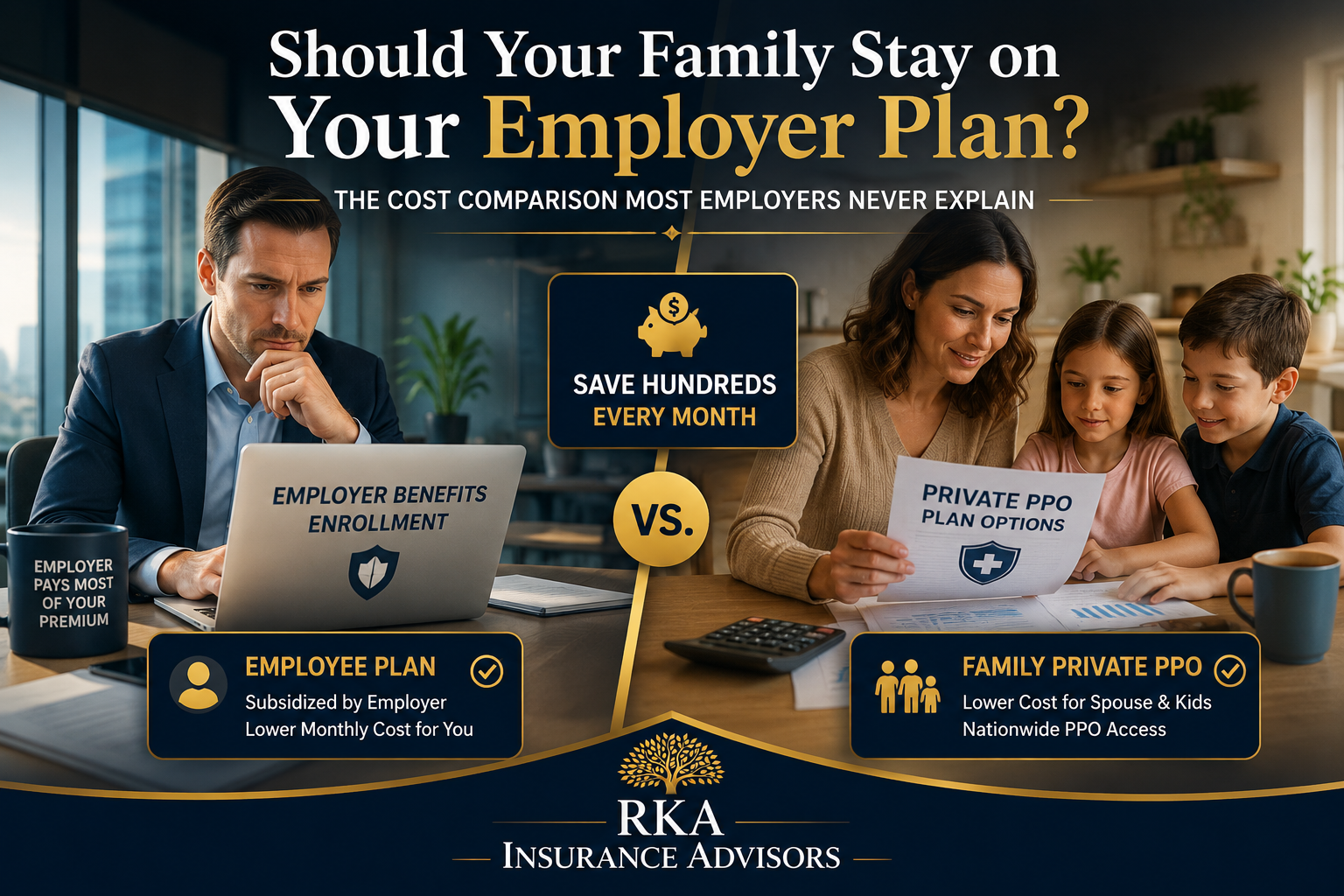
Is It Cheaper to Insure Your Family Separately From Your Employer's Plan?
Most employers heavily subsidize the employee's premium and contribute little or nothing toward a spouse or kids — so adding family to the group plan can cost hundreds a month. Here's the math nobody explains, and why "being on the same plan" matters less than you think.
Private PPO • Family Coverage
Is It Cheaper to Insure Your Family Separately From Your Employer’s Plan?
The health-insurance hack nobody talks about: what your employer really pays toward a spouse and kids — and how to pay less.
The number on your benefits sheet nobody reads
When open enrollment comes around, most people glance at the employee premium, see that it's affordable, and check the box to add their family. What they rarely do is look at how much of the family premium the employer is actually covering.
Here's the part nobody explains: employers tend to subsidize employee-only coverage — often paying somewhere between half and most of that premium — and then contribute little or nothing toward dependents. In practice, a real contribution toward a spouse or kids is rare; most people end up paying the full, unsubsidized rate to add their family. Some employers pay a flat dollar amount that barely moves when you add a spouse and kids; most pay a share of employee-only and nothing extra for family. The result is that the jump from "just me" to "me plus family" almost always lands on you — and how heavy that jump is depends entirely on your employer.
Illustrative ranges. Employer contributions vary by company — in practice a contribution toward dependents is rare. The number that decides this for you is on your own benefits sheet.
That gap is the whole game. You're not overpaying because the group plan is bad — you're overpaying because you're absorbing nearly the full cost of the people the employer doesn't subsidize.
The structure most families never consider
You don't have to put everyone on one plan. A common, completely legitimate approach for a healthy family:
You — stay on the employer plan
- Your premium is subsidized — keep it
- No change to your coverage or doctors
- Pre-tax payroll deduction stays intact
Spouse + kids — private PPO
- Priced on age and health, not the group's family rate
- Nationwide PPO network — keep your doctors, no referrals
- Available year-round — no enrollment window
- Medical underwriting — best for healthy dependents
Split the family, and you stop paying the group's unsubsidized family rate for the people the employer was never really covering. For a healthy spouse and children, a private PPO premium frequently comes in well below what the group plan charges to add them.
"But we want to be on the same plan"
This is the objection we hear most — and it's worth being honest about. A health plan is really two things: a network (which doctors and hospitals you can use) and a formulary (which medications are covered, and at what cost). "Same plan" feels meaningful, but if your providers and prescriptions are covered either way, the only real difference between being together on one plan and split across two is the price.
And that price difference is often hundreds of dollars a month. When you can see the actual savings side by side, "same plan" stops feeling like the priority it seemed to be.
This is exactly the part we handle for you: before anyone moves, we verify your spouse's and kids' doctors are in-network and their medications are covered on the new plan — so you're trading a higher bill for a lower one, not for a coverage surprise.
We'll compare keeping everyone on the group plan vs. splitting your spouse and kids onto a private PPO, verify their doctors and medications, and show you the real monthly difference. Free, no obligation.
When splitting the family makes sense — and when it doesn't
Worth comparing if…
- Your employer pays little or nothing toward dependents
- Your spouse and kids are generally healthy
- Adding family more than doubles your paycheck deduction
- You want nationwide access without referrals
Stay as-is if…
- Your employer actually subsidizes dependents too
- A family member has significant health history
- You qualify for meaningful marketplace subsidies as a family
- A key specialist isn't in the private PPO network
There's no one answer — it depends on your employer's contribution, your family's health, and your providers. The only way to know is to put the numbers next to each other.
Frequently Asked Questions
Is it allowed to keep myself on my employer plan and cover my family elsewhere?
Yes. You're not required to enroll your dependents in your employer's plan. You can keep your own employer coverage and cover your spouse and children separately on a private PPO or marketplace plan. It's a common arrangement, especially when an employer contributes little or nothing toward dependents.
How much can a family actually save doing this?
It varies by your employer's family contribution, your family's ages and health, and the plan you choose. For healthy families, the difference between the group family rate and a private PPO for a spouse and kids is often several hundred dollars a month. We run your specific numbers so you see the real figure, not an estimate.
Will my family keep their doctors?
That's the first thing we check. Private PPO plans use broad nationwide networks, so most physicians, specialists, and hospitals that accept PPO insurance are in-network — but we verify your family's specific providers and medications before anyone switches, so there are no surprises.
What if one of my kids or my spouse has a health condition?
Private plans are medically underwritten and may exclude or decline based on health history. If a dependent has significant conditions, keeping them on the group plan or using the ACA marketplace is often the better route. We'll tell you honestly which option fits each family member.
Could my family qualify for marketplace subsidies instead?
Possibly. If your employer's offer of family coverage is considered unaffordable under current rules, your spouse and children may qualify for subsidized marketplace coverage. We check that path alongside private PPO so you can compare all options on price and network.
We compare your group family rate against a private PPO for your spouse and kids, verify networks and medications, and lay out the real monthly difference. No cost, no pressure.
Robert Adams * President & Licensed Agent * NPN 19540130 * Licensed in 30 states. Premium figures and employer-contribution ranges in this article are illustrative examples, not guarantees, and vary widely by employer, plan, state, age, tobacco status, and underwriting outcome. Check your own benefits sheet for your employer's actual contribution. Private medically underwritten plans are not ACA-compliant and are subject to medical underwriting — not all applicants qualify. Marketplace subsidy eligibility depends on income and whether an employer's offer is deemed affordable. This content is for informational purposes only and does not constitute insurance, legal, tax, or financial advice. Review official plan documents and consult a licensed advisor for your situation.

Divorce and Health Insurance: What Happens to Your Coverage in 2026
Divorce ends the coverage you carried on a spouse's plan — usually within 30 days of the decree. For healthy, higher-income professionals who don' qualify for subsidies, a private medically underwritten PPO often costs far less than COBRA, with nationwide access and year-round enrollment.
Private PPO • Individual Coverage • Compare Plans
Divorce and Health Insurance: What Happens to Your Coverage in 2026
When exactly does your coverage end?
If you were the spouse carried on the other's employer or individual plan, divorce removes you as an eligible dependent. In most cases coverage ends on the last day of the month the divorce is finalized — though the exact date can be set by your decree or your plan administrator. Confirm it in writing so you know your real cutoff.
Your options after divorce
- Keeps the exact same plan, doctors, and network
- No health screening required
- Available for up to 36 months after divorce
- You pay the full premium — your share plus the employer's
- Often $500–$900+/month for one adult
- Most expensive route for a healthy person
- Best value if your employer covers 70%+ of premium
- Losing spousal coverage is a qualifying event to enroll
- Pre-existing conditions covered — no underwriting
- Only an option if your job offers benefits
- Enroll within your employer's election window (often 30 days)
- Guaranteed issue — covers any health history
- Losing coverage = 60-day Special Enrollment Period
- Subsidies possible only if income is below the threshold
- Higher earners pay the full unsubsidized rate
- Often HMO/EPO — regional networks
- Premium based on your health and age — not your income
- Nationwide PPO — see any participating doctor, no referrals
- $0 and low-deductible options available
- Available any month — no enrollment window
- For healthy applicants, often less than COBRA
- Health questionnaire required — not for every health history
Why a private PPO often fits higher-income professionals after divorce
If you're self-employed, a business owner, or simply earn above the subsidy threshold, the ACA marketplace charges you the full unsubsidized rate — and COBRA charges you the entire group premium. Neither is priced in your favor.
A private medically underwritten PPO is priced on your health and age instead of your income, so a healthy applicant frequently lands below both COBRA and unsubsidized ACA for comparable or broader coverage. And because it's a nationwide PPO with no referrals, it travels with you — useful if your work, your kids, or your post-divorce life now spans more than one state.
- Healthy, no major chronic conditions or ongoing specialty care
- Income above the ACA subsidy threshold (or variable self-employed income)
- Self-employed, business owner, or higher-earning professional
- Want nationwide coverage rather than a regional HMO/EPO network
Don't forget the kids
If your children were covered on the plan you're losing, they need a coverage plan too. Typically the parent providing coverage per the divorce decree enrolls them — through their own employer plan, the ACA marketplace, or a family private PPO. Coordinate this with your decree so there's no lapse and no duplication.
What coverage actually costs after divorce
Here's a realistic comparison for a healthy 45-year-old non-smoker with no major health history, in Florida or Texas — two of our most common markets:
COBRA (ex-spouse's plan)
- $500–$900+/mo for one adult
- Same plan and doctors
- Up to 36 months
- Full group premium + admin fee
- Most expensive for healthy people
ACA Marketplace (unsubsidized)
- Silver: $560–$720/mo
- Gold: $680–$860/mo
- Subsidies only below income threshold
- Often regional HMO/EPO networks
- Income reconciliation at tax time
Private Medically Underwritten PPO
- Often $300–$500/mo for a healthy 45-year-old
- Nationwide PPO — no referrals
- $0 deductible options available
- Not income-dependent — no reconciliation
- Available any month
*Estimates based on 2026 market data for healthy non-smokers in FL and TX. Actual figures vary by age, state, plan, health history, and underwriting outcome.
How to time the switch with no gap
30–45 days before coverage ends
- Confirm your exact coverage end date in writing
- Get pre-screened for private PPO eligibility
- Compare COBRA cost, ACA estimate, and private PPO side by side
At and after the decree
- 60-day special enrollment window opens when coverage ends
- COBRA can serve as a short backstop if underwriting is still processing
- Private plan effective the 1st of the following month — no gap if timed right
We compare COBRA, ACA, and private PPO for your exact situation — and pre-screen private eligibility before you apply. No pressure, no obligation.
Frequently Asked Questions
When does my coverage on my spouse's plan actually end?
In most cases it ends on the last day of the month the divorce is finalized, though your decree or plan administrator may set a different date. Confirm the exact cutoff in writing with the plan administrator so you can line up replacement coverage with no gap.
Is divorce a qualifying event for new coverage?
Yes. Losing coverage due to divorce triggers a 60-day Special Enrollment Period on the ACA marketplace, and it's also a qualifying event to join your own employer's plan (usually within about 30 days). Private medically underwritten PPO plans don't require a qualifying event at all — they're available any month.
How long can I keep COBRA after a divorce?
Divorce is a qualifying event that allows the former spouse to elect COBRA for up to 36 months. The trade-off is cost: you pay the full group premium plus a small administrative fee, which is why COBRA is often the most expensive option for a healthy person.
Will my income from the divorce affect ACA subsidies?
Possibly. ACA subsidies are based on Modified Adjusted Gross Income, and a settlement or change in income can move you above or below the threshold. Tax treatment of support payments depends on when your agreement was finalized. Work with your CPA on the numbers — and note that a private PPO is priced on health, not income, so it sidesteps this entirely.
What about coverage for my kids?
If your children were on the plan you're losing, the parent responsible for their coverage under the decree enrolls them — through an employer plan, the ACA marketplace, or a family private PPO. Coordinate it so there's no lapse and you're not paying for duplicate coverage.
What if I have a health condition and don't qualify for a private plan?
If private underwriting isn't available based on your health history, COBRA and the ACA marketplace remain solid options — the ACA is guaranteed issue regardless of health. We compare all three honestly and tell you which fits before you apply for anything.
Independent broker. We run COBRA, ACA, and private PPO side by side for your situation. Free quotes, honest advice, no pressure.
Robert Adams * President & Licensed Agent * NPN 19540130 * Licensed in 30 states. Premium estimates are illustrative ranges based on 2026 market data and are not guaranteed. Actual premiums vary by age, state, tobacco status, plan selection, carrier, and underwriting outcome. Private medically underwritten plans are not ACA-compliant and are subject to medical underwriting — not all applicants qualify. COBRA timelines and costs vary by plan; coverage end dates vary by decree and plan administrator. This content is for informational purposes only and does not constitute insurance, legal, tax, or financial advice — consult your attorney and CPA for your specific situation.

Just Graduated? Here's What Happens to Your Health Insurance
Graduating college is one of the most common reasons young adults lose health coverage. Your student plan ends. Your parents' plan has a clock. For healthy grads, private PPO plans often cost under $150/month. Here's the full breakdown.
Private PPO • Young Adults • Individual Coverage
Just Graduated? Here's What Happens to Your Health Insurance in 2026
When exactly does your coverage end?
It depends on which type of coverage you currently have. These are the three most common situations for new graduates:
On a student health plan
- Coverage ends at graduation — not at 26
- Most plans end last day of graduation month or semester
- Check your plan documents for exact cutoff date
- This is separate from the under-26 rule
On a parent's employer plan
- You can stay on until your 26th birthday
- Graduation doesn't trigger removal
- Coverage ends on your birthday or end of birth month
- After 26 — 60-day window to get your own plan
Uninsured in college
- Now is the time to fix it
- Especially important starting gig or freelance work
- Private PPO available any month — no enrollment window
- Healthy young adults get the best available rates
Your four options after graduation
- Valid until your 26th birthday regardless of graduation
- Best option while you figure out next steps
- No action needed — coverage continues automatically
- Ends at 26 no matter what — have a plan ready
- Best option if employer covers 70%+ of premium
- Losing student coverage = qualifying enrollment event
- You have 30 days from coverage loss to elect
- 30–90 day waiting period before coverage starts
- Only available with a full-time job that offers benefits
- Losing student plan = Special Enrollment Period (60 days)
- Guaranteed issue — no health screening
- Subsidies available if income under ~$58K (single, 2026)
- Often HMO or EPO — regional networks
- Higher deductibles on lower-premium plans
- Full unsubsidized rate if income is above threshold
- Healthy 22–24 year olds qualify for the lowest rates available
- Often starts under $150-$220/month for healthy new grads
- Nationwide PPO — see any doctor, no referrals
- $0 deductible options available
- Available any month — no enrollment window
- Health questionnaire required — not for all conditions
What does coverage actually cost for a new grad?
Here's a realistic cost comparison for a healthy 23-year-old, non-smoker, no major health history — in Florida or Texas, two of our most common markets for this age group:
ACA Marketplace (unsubsidized)
- Bronze: $200–$280/mo
- Silver: $280–$380/mo
- Gold: $360–$480/mo
- High deductibles on Bronze/Silver
- Regional HMO or EPO networks
ACA Marketplace (with subsidies)
- Income under ~$58K: subsidies apply
- Bronze can be $0–$100/mo with subsidies
- Check Healthcare.gov for your exact figure
- Best option if income qualifies
- Still regional network in most cases
Private Medically Underwritten PPO
- As low as $100–$220/mo for healthy 22–24 year olds
- Nationwide PPO — no referrals
- $0 deductible plan options available
- Best rates you'll see in your lifetime
- Not income-dependent — no reconciliation
*Estimates based on 2026 market data for healthy non-smokers. Actual figures vary by age, state, plan, and underwriting outcome.
What to do based on your situation
Starting a full-time job with benefits
- Losing student plan = qualifying event — enroll within 30 days
- If employer covers 70%+ — take the plan
- If employer contribution is low — compare private PPO first
- Bridge the waiting period with a short-term plan if needed
- We'll run the comparison for your exact situation
Freelance, gig work, or self-employed
- No employer plan — you're on your own for coverage
- If income is under ~$58K — check ACA subsidies first
- If healthy and income is higher — private PPO is usually best
- Apply 30–45 days before coverage ends for clean transition
- Private PPO available any month — no enrollment window
Why your graduation year is the best time to lock in a private plan
Age is one of the primary pricing factors in private health insurance. A 22-year-old in good health gets the lowest premiums they'll see for decades. Rates increase with every year — and health history accumulates over time.
If you're healthy now, getting a private PPO at graduation locks in a lower rate than you'll be able to get at 30, 35, or 40. Many people who get a private plan at this stage keep it for years because the premium stays relatively low and the nationwide PPO access works for their lifestyle.
We're an independent broker licensed in 32 states. We compare ACA, private PPO, and short-term options for your exact situation and tell you honestly which one makes sense. No pressure, no obligation.
Frequently Asked Questions
Does my student health plan end the day I graduate?
It varies by school and carrier. Most student plans end on the last day of the graduation month or the last day of the spring semester — not on the day of the ceremony. Check your school's student health plan documents or call the student health center directly for your exact termination date.
If I'm under 26, can I stay on my parents' plan after graduation?
Yes — if you're currently on a parent's employer-sponsored plan, graduation doesn't remove you. You can stay until your 26th birthday regardless of graduation, employment status, or whether you live at home. After 26, you have a 60-day special enrollment window to get your own coverage.
What if I have a pre-existing condition?
ACA marketplace plans are guaranteed issue and cover pre-existing conditions without health screening. If you have a significant health history, the ACA marketplace is likely the right path. Private medically underwritten plans may not be available depending on the condition. We'll tell you honestly which option fits your situation before you apply for anything.
How much does health insurance cost at 22–24 years old?
For a healthy 22–24 year old, private PPO plans typically run $100–$220/month depending on state, plan, and deductible. ACA marketplace plans can be $0–$150/month with subsidies for lower incomes, or $200–$380/month without subsidies. The exact number depends on your specific situation and state.
What happens if I just don't get coverage?
There's no federal penalty for being uninsured. But a single ER visit without coverage can easily cost $3,000–$15,000+. A broken bone, appendicitis, or a car accident while uninsured can set you back financially for years. At $100–$150/month, insurance costs less than most people spend on subscriptions — and the risk of going without is real.
Is private PPO available in my state?
RKA Insurance Advisors is licensed in 32 states. Plan availability varies by state and carrier. A quick call or quote request will confirm what's available where you live and what you'd likely qualify for based on your health profile.
We help new graduates navigate all coverage options — ACA, private PPO, short-term, and employer plans. Free quotes, honest advice, no pressure.
Robert Adams * President & Licensed Agent * NPN 19540130 * Licensed in 32 states. Premium estimates are illustrative ranges based on 2026 market data and are not guaranteed. Actual premiums vary by age, state, tobacco status, plan selection, carrier, and underwriting outcome. Private medically underwritten plans are not ACA-compliant and are subject to medical underwriting — not all applicants qualify. This content is for informational purposes only and does not constitute insurance or legal advice.

Turning 26 and Getting Kicked Off Your Parents' Insurance? Here's What to Do
Turning 26 is the most common reason young adults lose health insurance. You have options — ACA marketplace, employer coverage if you have it, or a private medically underwritten PPO if you're healthy. Here's what to do before your birthday and after, with no gaps in coverage.
Private PPO • Young Adults • Individual Coverage
Turning 26 and Getting Kicked Off Your Parents' Insurance?
Here's What to Do
When exactly does your parents' coverage end?
The exact cutoff depends on the type of plan your parents have:
Employer-sponsored group plan
- Coverage ends on your 26th birthday
- Some plans extend to the last day of the birth month
- Check with your parent's HR department for the exact date
- COBRA is available for up to 36 months after aging off
Individual or marketplace plan
- Coverage typically ends on the last day of the birth month
- Varies by carrier — confirm with the insurer directly
- Loss of coverage triggers a Special Enrollment Period
- 60-day window to enroll in new coverage begins
Your four options at 26
- Best option if your employer covers 70–80% of premium
- Aging off parents' plan = qualifying event for enrollment
- You have 30 days from coverage loss to enroll
- Pre-existing conditions covered — no underwriting
- Only available if your employer offers coverage
- Can be expensive if employer contribution is low
- Keep exact same plan — same doctors, same network
- Up to 36 months of continuation coverage
- No health screening required
- Full premium — you pay 100% of the group rate
- Often $300–$600+/mo for individual coverage
- Most expensive option for healthy young adults
- Guaranteed issue — no health screening
- Aging off plan = Special Enrollment Period (60 days)
- Subsidies available if income is below 400% FPL
- Bronze plans can be low-cost with subsidies
- Often HMO/EPO — regional networks
- Full unsubsidized rate if income is moderate or high
- Higher deductibles on lower-premium plans
- Healthy 26-year-olds get the best rates in this market
- Can start under $150/month for healthy individuals
- Nationwide PPO — no referrals, see any specialist
- Low and $0 deductible options available
- Available any month — no enrollment window
- No income reporting or subsidy reconciliation
- Health questionnaire required
What does coverage actually cost at 26?
Here's a realistic cost comparison for a healthy 26-year-old with no major health history, living in Florida or Texas (two of the most common states for our clients at this age):
ACA Marketplace (unsubsidized)
- Bronze: $200–$280/mo
- Silver: $280–$380/mo
- Gold: $360–$480/mo
- High deductibles on lower tiers
- Regional network — often HMO
COBRA (parents' group plan)
- Typically $350–$600/mo
- Full group premium + 2% admin fee
- Same plan — same doctors
- Best for active care or conditions
- Most expensive for healthy people
Private Medically Underwritten
- As low as $130–$260/mo for healthy 26-year-olds
- Nationwide PPO — no referrals
- $0 deductible options available
- Lowest cost for healthy young adults
- Best time in your life to lock this in
*Estimates based on 2026 market data for healthy non-smokers in FL and TX. Actual figures vary by state, plan, and underwriting outcome.
Why 26 is actually the best time to get a private plan
Age is one of the biggest factors in private plan pricing. A 26-year-old in good health gets the lowest premiums they'll likely ever see in the private insurance market. The longer you wait, the more you'll pay — both because you get older and because health histories accumulate over time.
If you're healthy now, this is the window to lock in the best possible rate. Many people who get a private plan at 26 keep it for years because their premium stays relatively low and their coverage is comprehensive.
We compare employer, ACA, and private PPO options for your specific situation — and tell you honestly which one makes the most sense. No pressure, no obligation.
What to do based on your situation
You have a job with benefits
- Aging off parents' plan = qualifying event to enroll
- You have 30 days from coverage loss to elect employer coverage
- If employer covers 70%+ of premium — take it
- If employer contribution is low, compare private PPO first
- We'll run the comparison so you can decide
You're self-employed, freelance, or between jobs
- No employer plan available — private PPO is usually best option
- If income is low — check ACA subsidy eligibility first
- Private plan available any month, no enrollment window
- Apply 30–45 days before your birthday for seamless transition
- No gap in coverage if timed correctly
Frequently Asked Questions
Does my coverage really end on my exact birthday?
It depends on the plan. Employer-sponsored group plans typically end on the 26th birthday itself. Some individual and marketplace plans end on the last day of the birth month. Check with your parent's plan administrator or insurer at least 60 days before your birthday so you know your exact cutoff date.
What if I have a pre-existing condition?
ACA marketplace plans are guaranteed issue — they cover pre-existing conditions without health screening. Private medically underwritten plans may not be available depending on the condition. If you have a significant health history, ACA marketplace is likely the right path. We'll tell you honestly which option fits your situation.
Can I stay on my parents' plan if I'm still in college?
Being a student doesn't extend coverage beyond 26 under federal law. However, many colleges and universities offer student health plans that may be worth comparing — particularly if you're on campus. We can help you weigh all options including student plans, ACA, and private PPO.
What if I miss the 60-day window?
If you miss the Special Enrollment Period triggered by losing parental coverage, you'd need to wait for Open Enrollment (November–January) to enroll in an ACA marketplace plan. However, private medically underwritten plans are available year-round with no enrollment window. You can apply and get coverage started within 2–4 weeks any time of year.
Is a private plan available in my state?
RKA Insurance Advisors is licensed in 32 states. Plan availability varies by state and carrier. A quick call or quote request will confirm what's available where you live.
My parents want to know their options too — can you help them?
Yes. If your parents are losing a dependent from their plan, their premium may decrease and it may be a good time for them to review their own coverage as well. We work with individuals and families across all life stages.
We help young adults navigate coverage options at 26 — whether you have a job, just graduated, or are figuring it out. Free quotes, honest advice.
Robert Adams * President & Licensed Agent * NPN 19540130 * Licensed in 32 states. Premium estimates are illustrative ranges based on 2026 market data and are not guaranteed. Actual premiums vary by age, state, tobacco status, plan selection, carrier, and underwriting outcome. Private medically underwritten plans are not ACA-compliant and are subject to medical underwriting — not all applicants qualify. Coverage termination dates vary by plan — confirm with your parent's plan administrator. This content is for informational purposes only and does not constitute insurance or legal advice.