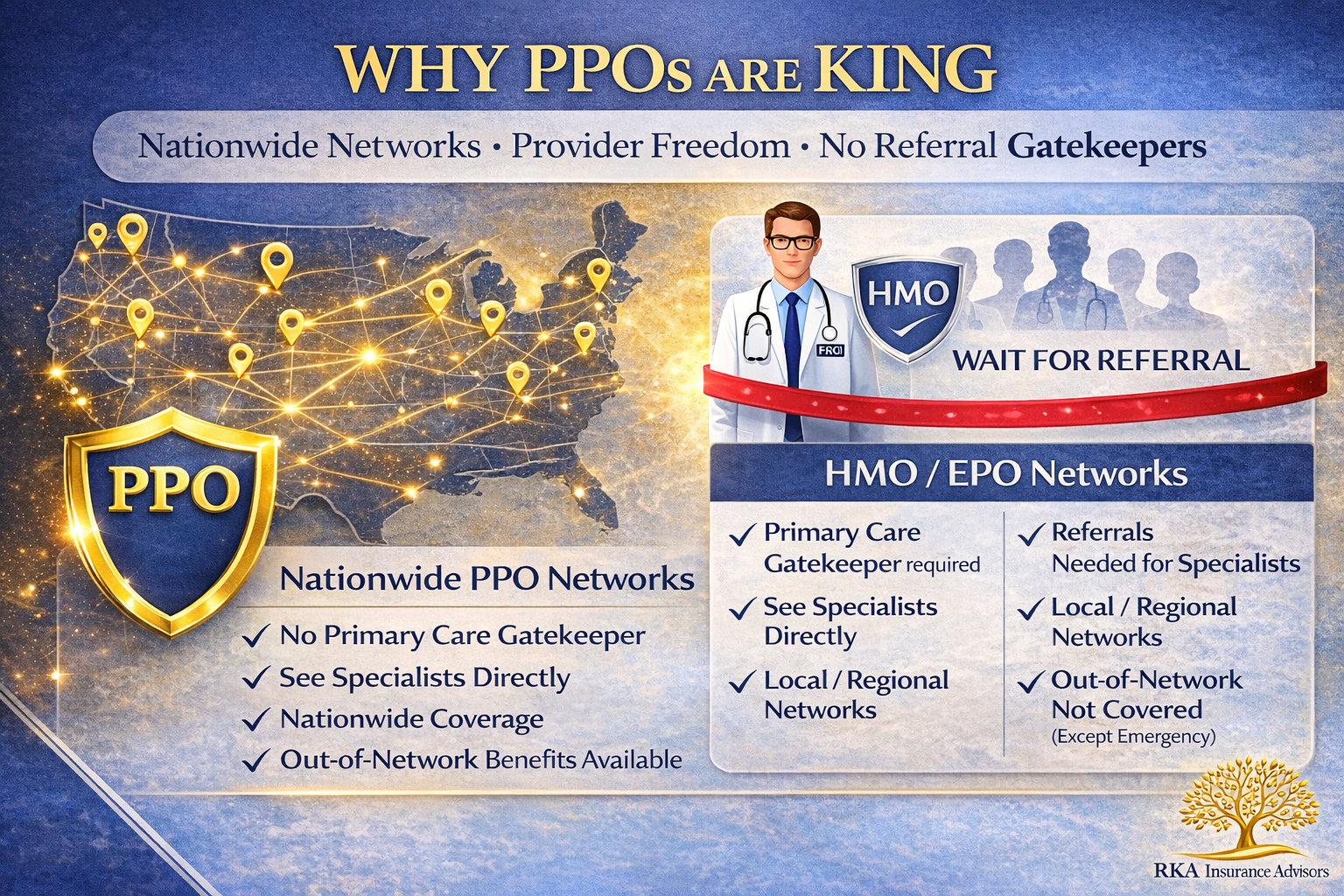
Why PPOs Are King: The Case for Nationwide Networks and Provider Freedom
Why PPOs beat HMOs for self-employed professionals, business owners, and frequent travelers: nationwide networks, no primary care gatekeepers, direct specialist access, and fewer authorization delays.
Why PPOs Are King: The Case for Nationwide Networks and Provider Freedom
Fast take: If you're self-employed, travel for work, or value direct access to specialists without referral red tape, PPO networks offer unmatched flexibility. No primary care gatekeepers, no waiting weeks for authorization, and coverage that works wherever you are—not just in your home county.
Tired of narrow HMO networks and referral requirements?
We'll show you nationwide PPO options and verify your doctors are covered—no restrictions, no runarounds.
Get Free Quotes Book a CallWhat makes PPO networks different
HMO/EPO (Most Marketplace plans)
✗ Primary care doctor required (PCP)
✗ Referrals needed for specialists
✗ Limited to local network only
✗ Out-of-network = not covered (except emergencies)
✗ Authorization delays common
PPO (Preferred Provider Organization)
✓ No primary care gatekeeper required
✓ See specialists directly—no referrals
✓ Nationwide network coverage
✓ Out-of-network benefits available
✓ Fewer authorization requirements
Who benefits most from PPO networks
Business owners & entrepreneurs
✓ Client meetings across multiple states
✓ Need care wherever business takes you
✓ Can't afford delays waiting for referrals
✓ Want specialist access without bureaucracy
Frequent travelers
✓ Snowbirds splitting time between states
✓ Digital nomads working remotely
✓ Families with second homes
✓ Need consistent coverage anywhere
People with specific provider needs
✓ Established relationship with specialist
✓ Prefer specific hospitals or facilities
✓ Need access to top-tier medical centers
✓ Don't want to change doctors
High-income households
✓ Don't qualify for meaningful ACA subsidies
✓ Paying full price either way
✓ Want maximum flexibility and choice
✓ Prefer premium networks and providers
Real-world scenarios where PPOs win
Scenario 1: The entrepreneur in pain
HMO path: Back pain → see PCP first → wait for referral → wait for specialist appointment → weeks of delays
PPO path: Back pain → call orthopedist directly → appointment this week → faster treatment
Scenario 2: The traveling consultant
HMO path: Urgent care needed in Dallas → not in network → pay full cost out-of-pocket → file claim, hope for reimbursement
PPO path: Urgent care in Dallas → nationwide network → normal copay → done
Scenario 3: The specialist relationship
HMO path: Your cardiologist isn't in network → forced to switch doctors → rebuild relationship from scratch
PPO path: Your cardiologist is in nationwide PPO → keep your doctor → continuity of care
Scenario 4: The imaging authorization
HMO path: Doctor orders MRI → need authorization → wait 5-7 business days → delay diagnosis
PPO path: Doctor orders MRI → schedule immediately → faster diagnosis and treatment
The hidden costs of HMO restrictions
Many people choose HMOs to save on monthly premiums, but the total cost equation includes more than just what you pay each month:
Time costs
✗ Waiting for PCP appointments before specialist referrals
✗ Authorization delays (5-7 days common for imaging/procedures)
✗ Extended treatment timelines due to referral requirements
✗ Lost productivity from delayed care
Out-of-pocket surprise costs
✗ Traveling for work? Out-of-network urgent care = full cost
✗ Emergency room in another state = potential balance billing
✗ Preferred specialist not in network = start over with new doctor
✗ Lab work at non-contracted facility = surprise bills
PPO networks for self-employed professionals
If you're self-employed, your health insurance needs are different from W-2 employees:
You can't afford downtime
No paid sick leave. Every day you're delayed waiting for referrals or authorizations is lost income. PPOs let you see specialists immediately and get treatment faster.
Your work location varies
Client sites, conferences, remote work from different states—you need coverage that travels with you, not just in your home county.
You control your own schedule
Don't waste time scheduling PCP visits just to get a referral. See the specialist directly and get back to work.
You're paying full freight anyway
If you don't qualify for subsidies, you're paying full price for ACA plans. PPO premiums are often comparable with far better access.
Common PPO myths debunked
❌ Myth: PPOs are always more expensive
Reality: For healthy applicants who don't qualify for subsidies, private underwritten PPOs often cost less than unsubsidized ACA plans—with better networks and lower deductibles.
❌ Myth: You don't need nationwide coverage
Reality: Even if you rarely travel, emergencies happen. Car accident on vacation? Family emergency out of state? Nationwide PPO coverage eliminates surprise bills.
❌ Myth: Referrals aren't a big deal
Reality: Referral requirements add 1-3 weeks to every specialist visit. For time-sensitive issues or busy professionals, this delay is costly.
❌ Myth: All PPOs are the same
Reality: PPO network size varies dramatically. We verify your specific doctors are in-network before you enroll—not all "nationwide" PPOs include every provider.
When to choose PPO over HMO/EPO
Choose PPO if...
✓ You're self-employed or own a business
✓ You travel frequently for work or personal reasons
✓ You have established relationships with specialists
✓ You don't qualify for meaningful ACA subsidies
✓ You value direct access without referral delays
✓ Time is money and you can't afford bureaucratic delays
HMO/EPO might work if...
✓ You qualify for strong ACA subsidies
✓ All your doctors are in a local HMO network
✓ You rarely travel and don't need out-of-area care
✓ You're comfortable with PCP gatekeeping
✓ You don't mind waiting for referrals and authorizations
✓ Lowest monthly premium is your only priority
How RKA finds the right PPO for you
Doctor verification first
We check your specific doctors, specialists, and hospitals against actual PPO networks—not just "find-a-doc" directories that are often outdated.
Multi-state coverage mapping
Travel between Florida and New York? We verify both locations have strong network coverage before you commit.
Total cost comparison
We model premiums + deductibles + expected usage for HMO vs PPO options—sometimes PPO costs less when you factor in out-of-network exposure.
Private vs Marketplace PPO options
Marketplace has limited PPO options. We compare against private underwritten PPOs that may offer better networks and lower deductibles.
Ready for nationwide PPO freedom?
We'll verify your doctors, compare PPO options, and show you total costs—no referral requirements, no network restrictions.
Get Free Quotes Book a CallQuick FAQs
Are PPOs available on the ACA Marketplace?
Some states offer limited PPO options on the Marketplace, but many areas only have HMO/EPO plans. Private underwritten PPOs (off-exchange) often offer broader networks and better benefits for healthy applicants.
Do PPOs really cost that much more than HMOs?
For subsidized plans, yes. But if you don't qualify for subsidies, private PPO premiums are often comparable to unsubsidized HMO/EPO plans—with far better access and lower deductibles.
What does "nationwide PPO" actually mean?
Network coverage in all 50 states (or most states). Specific provider availability varies—we verify your doctors are included, not just that the network exists in your state.
Can I switch from HMO to PPO mid-year?
ACA plans can only switch during Open Enrollment (or with a qualifying event). Private PPOs are available year-round if you qualify for underwriting.
For education only; network access and benefits vary by carrier and state. Always verify providers before enrollment. Eligibility for private underwritten plans subject to medical underwriting.
HMO vs PPO vs EPO vs POS: Which Network Fits Your Needs?
Confused by HMO, PPO, EPO, and POS health plans? This guide breaks down the differences in networks, referrals, flexibility, and costs so you can choose the best fit in minutes.
HMO vs PPO vs EPO vs POS
Which Network Fits Your Needs?
Health Insurance Guides • Enrollment Help • Sep 7, 2025 • Written by Robert Adams
Confused by health‑plan acronyms? In this guide we break down HMO, PPO, EPO and POS plans—networks, referrals, premiums and flexibility—so you can decide in minutes. We’ll verify your doctors and medications, compare plans side by side and show clear costs.
HMO (Health Maintenance Organization)
- ✓ You must choose a primary care doctor (PCP) in the network who coordinates your care and provides referrals.
- ✓ Coverage is limited to network providers except for emergencies; out‑of‑network care typically isn’t covered.
- ✓ Premiums are usually lower, and some plans have low or no deductible options.
PPO (Preferred Provider Organization)
- ✓ Lets you see any doctor in the network without referrals and offers the option to go out of network at a higher cost.
- ✓ Provides flexibility if you travel or want a wide choice of specialists.
- ✓ Premiums and deductibles tend to be higher because of broader access.
EPO (Exclusive Provider Organization)
- ✓ You can see any doctor within the network; no referral is required to see a specialist.
- ✓ No out‑of‑network benefits; care outside the network is generally not covered.
- ✓ Deductibles may be higher but monthly premiums are often lower than a PPO.
POS (Point‑of‑Service)
- ✓ Combines features of HMO and PPO: you have a primary doctor who gives referrals.
- ✓ Some out‑of‑network coverage is available, but you’ll pay more compared with in‑network care.
- ✓ Good compromise if you want occasional out‑of‑network flexibility without paying full PPO premiums.
How to Decide in Minutes
Pick an HMO or POS if…
- ✓ You want lower premiums and you’re comfortable staying within a local network.
- ✓ You prefer having one doctor coordinate all care and provide referrals.
- ✓ You rarely travel or need specialists outside your area.
Pick a PPO or EPO if…
- ✓ You want the freedom to see specialists without referrals and value a larger network.
- ✓ You travel often or need access to doctors across multiple states.
- ✓ You’re willing to pay higher premiums to avoid network restrictions or referrals.
Still undecided? We’ll compare all four plan types with your doctors and medications in mind and show clear, side‑by‑side costs—so you can choose quickly and confidently.
Need help choosing the best plan in your ZIP?
We’ll verify your doctors and meds, compare HMO vs PPO vs EPO vs POS and show clear costs. No pressure—just answers.
Get Free Quotes Book a CallFAQ
What’s the main difference between an HMO and a PPO?
HMOs require you to pick an in‑network primary care doctor who refers you to specialists. PPOs let you see doctors in or out of network without referrals but come with higher premiums.
Do EPOs cover out‑of‑network care?
EPOs typically only cover care within the network; there are no benefits for out‑of‑network doctors except in emergencies.
Do POS plans require referrals?
Yes. POS plans combine elements of HMOs and PPOs—you have a primary doctor and need referrals for specialists, but you still have some out‑of‑network coverage.
Which plan type is best for frequent travelers?
If you travel often or need a large network, a PPO provides broader access and doesn’t require referrals, though an EPO can work if you stay in network.
How can I find out whether my doctor is covered?
Use the insurer’s provider search tools or work with a licensed advisor who can verify that your doctors and medications are in the network before you enroll.