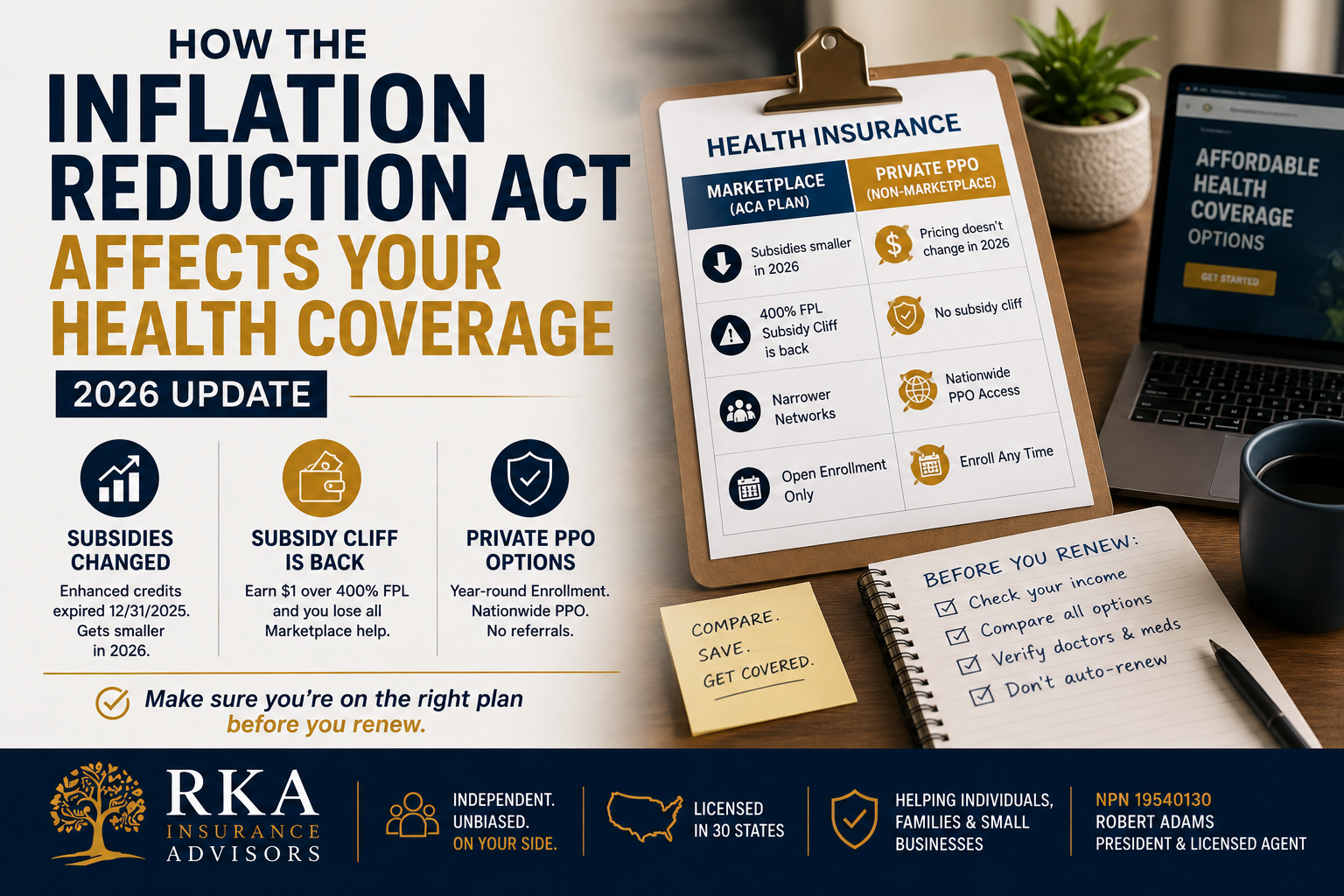
How does the Inflation Reduction Act affect your Health Coverage?
The Inflation Reduction Act's enhanced ACA subsidies expired at the end of 2025 and the 2026 subsidy cliff is back. Here's what changed, the income cutoffs, and where a private PPO now beats the marketplace.
Private PPO • Marketplace • 2026 Changes
How the Inflation Reduction Act Affects Your Health Coverage (2026 Update)
What changed for 2026
The IRA’s larger subsidies were always temporary. They ran from 2021 through 2025, and Congress did not extend them. When 2026 Open Enrollment opened, the enhanced credits were gone — and for millions of people the price to keep the same plan jumped sharply.
The cliff cutoff scales with household size — roughly $84,600 for a couple and $128,600 for a family of four in 2026. Cross it by a dollar and your Marketplace subsidy drops to zero.
Marketplace vs. Private PPO in 2026
Marketplace (ACA) Plans
- Still a strong fit if your income is under the cliff and you qualify for a subsidy
- Guaranteed issue — no health questions
- Above 400% of poverty, you now pay the full unsubsidized premium
- Networks are often narrower (HMO/EPO) with referrals
Private PPO (Non-Marketplace)
- Never used IRA subsidies — nothing about its pricing changed in 2026
- Priced on age and health, not income — often cheaper over the cliff
- Nationwide PPO access, no referrals, enroll any month
- Medically underwritten — not everyone qualifies
What to compare before you renew
Run the cost math
- Your realistic 2026 income vs. the cliff cutoff for your family size
- Full-price Marketplace premium vs. a private PPO quote
- Deductibles and out-of-pocket maximums, not just the premium
- Total annual cost across the whole year
Check the fit
- Are your doctors in each plan’s network?
- Are your prescriptions covered, and at what tier?
- Do you travel or live across state lines?
- Any planned procedure or pregnancy this year?
Not sure which side of the cliff you’re on?
We’ll put full-price Marketplace and a nationwide private PPO side by side for your exact situation — verify your doctors, check your prescriptions, and tell you honestly which wins. Free, no obligation.
Get Free Quotes Book a CallThe self-employed angle
If you run a business or work 1099, the expired subsidies hit harder — you’re buying your own coverage with no employer help, and you’re more likely to be over the cliff. That’s exactly the situation where a medically underwritten nationwide PPO can beat full-price Marketplace, priced on your health instead of your income. There’s also a tax angle: self-employed people can often deduct their premiums — worth raising with your tax professional as you compare.
Related reading
Frequently asked questions
Did the Inflation Reduction Act’s subsidies go away?
The larger enhanced credits that ran from 2021 through 2025 expired December 31, 2025. The original ACA subsidies still exist, but at smaller pre-2021 levels — and the 400% income cliff is back for 2026.
I earn just over the cliff — what are my options?
Above 400% of the federal poverty level you get no Marketplace subsidy in 2026, so you pay the full premium. For a healthy household, a medically underwritten private PPO is often less expensive with a broader nationwide network. It’s worth comparing both before you decide.
Why did my premium jump so much for 2026?
When the enhanced subsidies expired, the amount of help you receive shrank, so the net premium you pay rose — on average about 114% for subsidized enrollees to keep the same plan.
Do I still need to report income changes?
Yes. If you use Marketplace coverage, keep your income and household details updated so your subsidy stays accurate — with the cliff back in 2026, being off can mean a large bill at tax time.
Subsidy amounts, cliff cutoffs, and premiums vary by household and can change; the figures here reflect 2026 rules at the time of writing.
Robert Adams · President & Licensed Agent · NPN 19540130 · Licensed in 30 states. Premium and subsidy figures are illustrative and based on general market data — actual amounts vary by age, state, income, and health. Private medically underwritten plans are not ACA-compliant and are subject to medical underwriting — not all applicants qualify. This content is for informational purposes only and does not constitute insurance, legal, tax, or financial advice.

Robert Adams
https://www.RKAInsuranceAdvisors.com