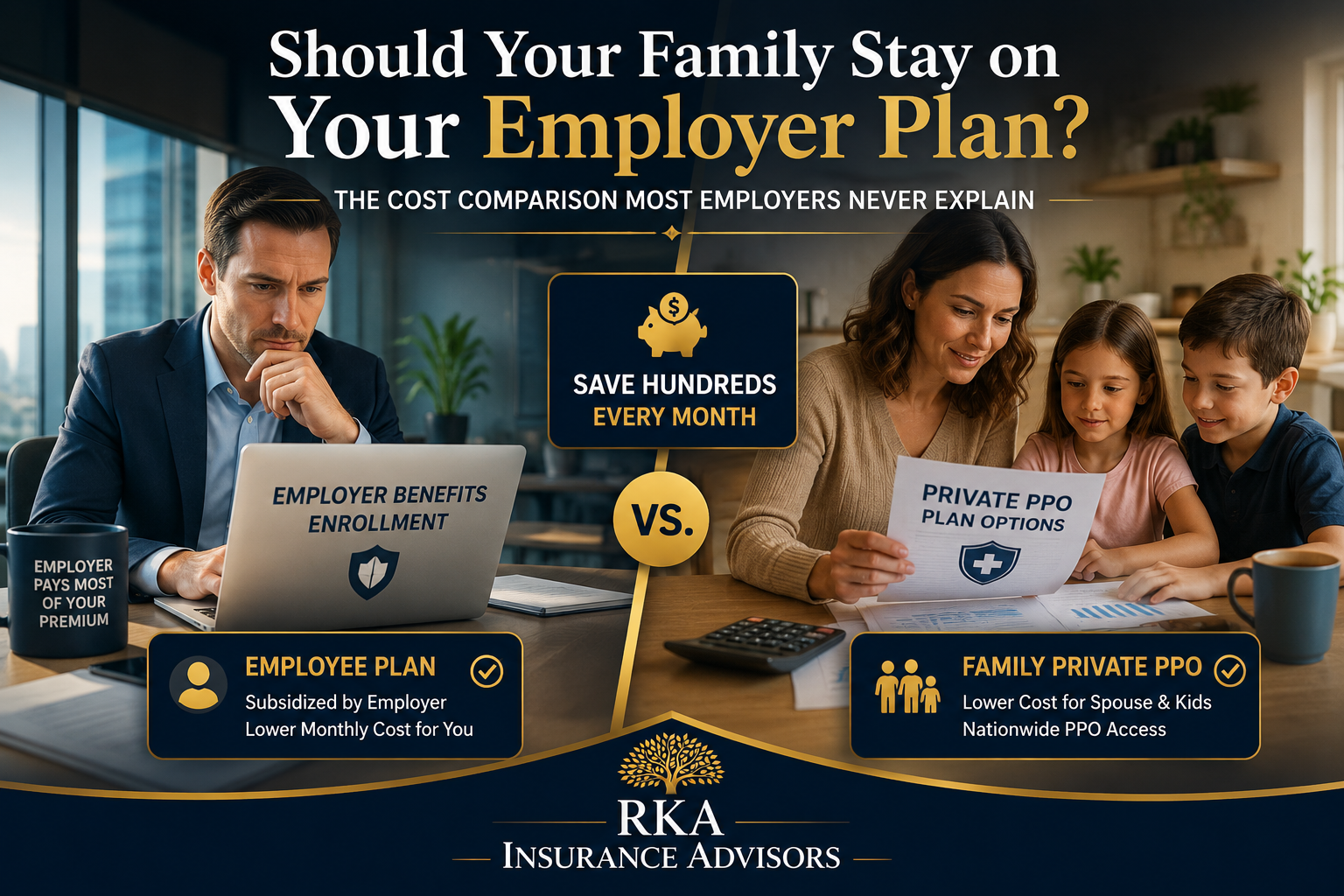
Is It Cheaper to Insure Your Family Separately From Your Employer's Plan?
Most employers heavily subsidize the employee's premium and contribute little or nothing toward a spouse or kids — so adding family to the group plan can cost hundreds a month. Here's the math nobody explains, and why "being on the same plan" matters less than you think.
Private PPO • Family Coverage
Is It Cheaper to Insure Your Family Separately From Your Employer’s Plan?
The health-insurance hack nobody talks about: what your employer really pays toward a spouse and kids — and how to pay less.
The number on your benefits sheet nobody reads
When open enrollment comes around, most people glance at the employee premium, see that it's affordable, and check the box to add their family. What they rarely do is look at how much of the family premium the employer is actually covering.
Here's the part nobody explains: employers tend to subsidize employee-only coverage — often paying somewhere between half and most of that premium — and then contribute little or nothing toward dependents. In practice, a real contribution toward a spouse or kids is rare; most people end up paying the full, unsubsidized rate to add their family. Some employers pay a flat dollar amount that barely moves when you add a spouse and kids; most pay a share of employee-only and nothing extra for family. The result is that the jump from "just me" to "me plus family" almost always lands on you — and how heavy that jump is depends entirely on your employer.
Illustrative ranges. Employer contributions vary by company — in practice a contribution toward dependents is rare. The number that decides this for you is on your own benefits sheet.
That gap is the whole game. You're not overpaying because the group plan is bad — you're overpaying because you're absorbing nearly the full cost of the people the employer doesn't subsidize.
The structure most families never consider
You don't have to put everyone on one plan. A common, completely legitimate approach for a healthy family:
You — stay on the employer plan
- Your premium is subsidized — keep it
- No change to your coverage or doctors
- Pre-tax payroll deduction stays intact
Spouse + kids — private PPO
- Priced on age and health, not the group's family rate
- Nationwide PPO network — keep your doctors, no referrals
- Available year-round — no enrollment window
- Medical underwriting — best for healthy dependents
Split the family, and you stop paying the group's unsubsidized family rate for the people the employer was never really covering. For a healthy spouse and children, a private PPO premium frequently comes in well below what the group plan charges to add them.
"But we want to be on the same plan"
This is the objection we hear most — and it's worth being honest about. A health plan is really two things: a network (which doctors and hospitals you can use) and a formulary (which medications are covered, and at what cost). "Same plan" feels meaningful, but if your providers and prescriptions are covered either way, the only real difference between being together on one plan and split across two is the price.
And that price difference is often hundreds of dollars a month. When you can see the actual savings side by side, "same plan" stops feeling like the priority it seemed to be.
This is exactly the part we handle for you: before anyone moves, we verify your spouse's and kids' doctors are in-network and their medications are covered on the new plan — so you're trading a higher bill for a lower one, not for a coverage surprise.
We'll compare keeping everyone on the group plan vs. splitting your spouse and kids onto a private PPO, verify their doctors and medications, and show you the real monthly difference. Free, no obligation.
When splitting the family makes sense — and when it doesn't
Worth comparing if…
- Your employer pays little or nothing toward dependents
- Your spouse and kids are generally healthy
- Adding family more than doubles your paycheck deduction
- You want nationwide access without referrals
Stay as-is if…
- Your employer actually subsidizes dependents too
- A family member has significant health history
- You qualify for meaningful marketplace subsidies as a family
- A key specialist isn't in the private PPO network
There's no one answer — it depends on your employer's contribution, your family's health, and your providers. The only way to know is to put the numbers next to each other.
Frequently Asked Questions
Is it allowed to keep myself on my employer plan and cover my family elsewhere?
Yes. You're not required to enroll your dependents in your employer's plan. You can keep your own employer coverage and cover your spouse and children separately on a private PPO or marketplace plan. It's a common arrangement, especially when an employer contributes little or nothing toward dependents.
How much can a family actually save doing this?
It varies by your employer's family contribution, your family's ages and health, and the plan you choose. For healthy families, the difference between the group family rate and a private PPO for a spouse and kids is often several hundred dollars a month. We run your specific numbers so you see the real figure, not an estimate.
Will my family keep their doctors?
That's the first thing we check. Private PPO plans use broad nationwide networks, so most physicians, specialists, and hospitals that accept PPO insurance are in-network — but we verify your family's specific providers and medications before anyone switches, so there are no surprises.
What if one of my kids or my spouse has a health condition?
Private plans are medically underwritten and may exclude or decline based on health history. If a dependent has significant conditions, keeping them on the group plan or using the ACA marketplace is often the better route. We'll tell you honestly which option fits each family member.
Could my family qualify for marketplace subsidies instead?
Possibly. If your employer's offer of family coverage is considered unaffordable under current rules, your spouse and children may qualify for subsidized marketplace coverage. We check that path alongside private PPO so you can compare all options on price and network.
We compare your group family rate against a private PPO for your spouse and kids, verify networks and medications, and lay out the real monthly difference. No cost, no pressure.
Robert Adams * President & Licensed Agent * NPN 19540130 * Licensed in 30 states. Premium figures and employer-contribution ranges in this article are illustrative examples, not guarantees, and vary widely by employer, plan, state, age, tobacco status, and underwriting outcome. Check your own benefits sheet for your employer's actual contribution. Private medically underwritten plans are not ACA-compliant and are subject to medical underwriting — not all applicants qualify. Marketplace subsidy eligibility depends on income and whether an employer's offer is deemed affordable. This content is for informational purposes only and does not constitute insurance, legal, tax, or financial advice. Review official plan documents and consult a licensed advisor for your situation.

2026 Premium Explosion: What to Expect and How to Protect Your Wallet | RKA
ACA premiums are projected to spike in 2026 — the steepest rise in years. Here’s what’s driving the increase and how to protect your wallet before Open Enrollment.
2026 Premium Explosion: What to Expect & How to Protect Your Wallet
Why premiums are spiking
- Medical inflation: Higher hospital and provider costs are baked into 2026 premiums.
- Prescription drugs: Specialty medications like GLP-1s are a major cost driver.
- Policy changes: Enhanced subsidies may expire, raising net costs for millions.
How much higher?
Experts estimate average increases of 10–18% nationwide — with some states seeing much more. That means a plan costing $1,200/month today could jump by $150–200. For unsubsidized families, the hit could be thousands annually.
Smart moves before 2026
- Compare Marketplace vs PPO: Don’t assume Healthcare.gov is always cheaper. Private PPOs may win if you don’t qualify for subsidies.
- Check your eligibility: Income-based savings may still apply — know your bracket.
- Time your enrollment: Lock in your plan during Open Enrollment this fall before further adjustments hit.
Get Expert Guidance Today
We’ll verify your doctors and prescriptions, compare Marketplace vs. Private PPO, and show clear costs — no pressure, just answers.
Quick FAQs
Why are ACA premiums going up in 2026?
Medical inflation, rising drug prices, and subsidy uncertainty are driving rates higher than in prior years.
How much more will I pay?
Average increases are expected to be 10–18%, with unsubsidized households seeing the steepest jumps.
Can private PPOs be cheaper than Marketplace?
Yes. If you don’t qualify for subsidies, PPO options may offer better value, especially with nationwide networks.
When should I enroll?
During Open Enrollment 2026. Lock in your coverage early before mid-season adjustments hit.
How do I protect my wallet?
Compare all your options now, confirm your doctors are covered, and work with a licensed advisor.
Bottom line
2026 premiums will be some of the highest on record. The best protection is preparation — comparing options, confirming your doctors, and working with a licensed advisor. Don’t wait until the last minute to make changes that could save you thousands.
Need help navigating 2026 premium increases? Our licensed advisors compare marketplace and private PPO health insurance options to find coverage that fits your budget. Get personalized quotes from our team.

Group Employer Open Enrollment: Rising Costs, Smarter Options for Employers & Employees | RKA
Employer plan premiums are rising this fall. During open enrollment, compare group coverage against marketplace and private PPO options—splitting family members can cut costs. We’ll verify doctors, prescriptions, and total annual cost before you commit.
Employer & Group Plans • Open Enrollment
Group Open Enrollment: Rising Costs, Smarter Options for Employers & Employees
Fast take: With medical inflation and rising utilization, many employer plans are increasing premiums and tweaking benefits this fall. Use open enrollment to compare — keeping the employee on the group plan, but placing a spouse/kids elsewhere can cut costs without giving up access. We’ll verify networks, prescriptions, and total annual cost before you choose.
Why costs are climbing
- Medical inflation: Hospital, physician, and facility prices continue to outpace wage growth.
- Rx trend: Specialty drugs (including GLP-1 therapies) are widening plan spend.
- Higher utilization: Delayed care is catching up, pushing claims higher.
- Plan design shifts: Employers may raise deductibles/copays or adjust contributions to manage increases.
What to compare during open enrollment (October–December)
Employer plan checklist
- Employee vs. family premium contributions
- Deductible, copays/coinsurance, out-of-pocket max
- HSA/HRA funding and employer credits
- Network type (HMO/EPO vs PPO) and doctor/hospital fit
- Rx formulary & prior authorization rules
Compare against alternatives
- Marketplace: Check income-based subsidies; silver cost-sharing reductions if eligible
- Private PPO (underwritten): Often lower for healthy applicants; nationwide PPO access
- Spouse’s employer plan: Sometimes better dependent rates
- COBRA: Short-term bridge if switching mid-year
When keeping the group plan and splitting the family wins
Dependent premiums on employer plans can be steep. A common savings move: keep the employee on the group plan (to capture employer contribution and HSA access) and place a spouse or kids on marketplace or a private PPO if the numbers — and networks — work better.
Decision pathway
- Send us your details: household members, providers, prescriptions, and employer plan options.
- We verify networks & Rx: employer plan vs marketplace vs private PPO.
- We model total annual cost: premium + likely usage + tax/HSA effects.
- You pick and enroll: we execute cleanly and avoid gaps.
Tips for employers (quick wins)
- Offer an HSA-compatible plan with modest employer HSA seed to offset deductibles.
- Communicate a clear “how to compare plans” guide with provider verification steps.
- Consider ICHRA/QSEHRA strategies if group renewal is unsustainable.
Quick FAQs
Is the employer plan always best?
Can you verify our doctors and hospitals first?
Can we switch mid-year?
Educational use only; benefits and eligibility vary by employer, carrier, and state. Always review official plan documents.
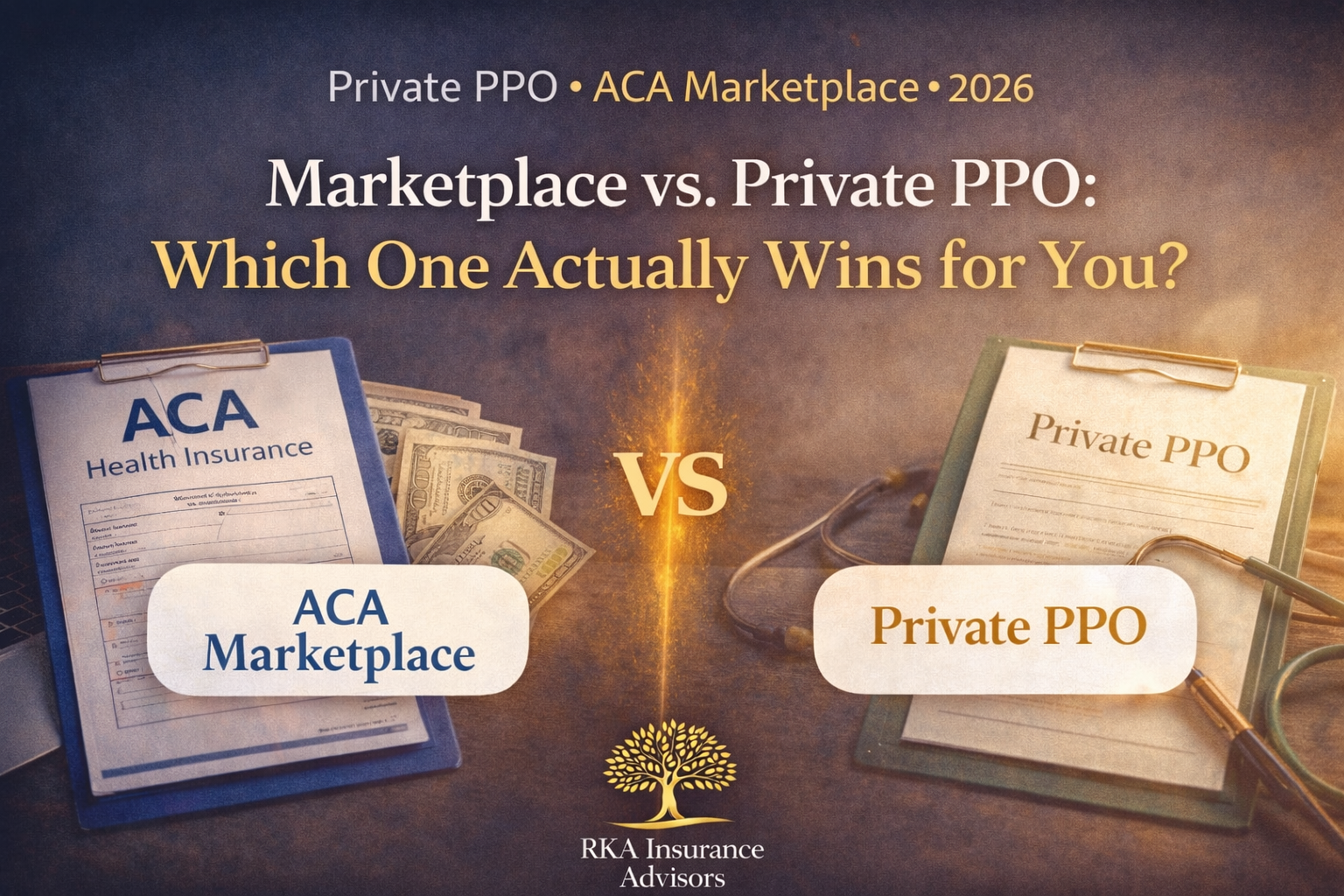
Marketplace vs Private PPO 2026 | Which Wins for You?
ACA Marketplace plans can be the right call if your income qualifies for subsidies. But if you earn above the subsidy threshold or want broader doctor access with no referral requirements, a private underwritten PPO often wins on cost, flexibility, and nationwide coverage.
Private PPO • ACA Marketplace • 2026
Marketplace vs. Private PPO:
Which One Actually Wins for You?
The core difference in one sentence
Marketplace (ACA) plans are priced based on your income and regulated by the government. Private PPO plans are priced based on your health and issued by private carriers outside the exchange.
That one difference drives everything else — cost, network, enrollment windows, and who qualifies for what.
Side-by-side comparison
- Premium tied to your income
- Subsidies available below 400% of the Federal Poverty Level (FPL)
- Open enrollment window (or qualifying life event required)
- Pre-existing conditions covered — no underwriting
- Network can be narrow depending on plan and region
- Referrals may be required on HMO-type plans
- Deductibles can be significant on unsubsidized plans
- Premium based on age and health — not income
- No subsidies — but often lower premiums for healthy applicants
- Available year-round — no enrollment window
- Medical underwriting required — health history reviewed
- Nationwide PPO network — see any PPO doctor, no referrals
- No referral requirements
- Qualify for lower deductible options, including $0 deductible plans
When the Marketplace wins
The ACA Marketplace is genuinely the better option in certain situations. It wins when:
- Your income qualifies for subsidies. Below 400% of the Federal Poverty Level (FPL), subsidies can make Marketplace plans extremely affordable — sometimes as low as $0/month. If you qualify, it's hard for a private plan to compete on price.
- You have pre-existing conditions. Marketplace plans cannot deny coverage or charge more based on health history. Private underwritten plans can decline applicants or exclude conditions — so if you have significant health history, the Marketplace may be your only path to full coverage.
- You're between jobs short-term. If you need a bridge for 30–60 days and qualify for a Special Enrollment Period, a Marketplace plan can be fast and straightforward.
When a private PPO wins
Private PPO plans tend to outperform the Marketplace when:
- Your income is above the subsidy threshold. Once you're above 400% FPL, Marketplace premiums are unsubsidized and can be steep. For a healthy individual in this bracket, a private PPO often comes in significantly lower.
- You need coverage outside open enrollment. Private PPO plans are available year-round — no qualifying life event required. If you missed open enrollment or just went self-employed mid-year, a private plan is often the only option.
- You want nationwide access. Private PPO networks typically cover you anywhere in the country with no referral requirements — important for frequent travelers, remote workers, and anyone who splits time between states.
- You're self-employed with variable income. ACA plans reprice if your income changes — under or overestimate and you pay the difference at tax time. Private PPOs have fixed premiums not tied to income.
The honest answer
There is no universally better option. The right plan depends on your income, health history, where you live, and whether you're in an open enrollment window. The only way to know which wins for you is to compare both with actual numbers.
That's exactly what we do — side-by-side, with real quotes, from a licensed advisor. Free, no obligation.
What about doctor networks?
This is where private PPO plans have a consistent advantage. Marketplace networks — especially at the Silver tier — vary significantly by state and county. In some markets they're broad; in others, major hospital systems are excluded entirely.
Private PPO plans access major nationwide carrier networks. If you have a doctor, specialist, or hospital you want to keep, we verify coverage on both options before you enroll — not after.
How RKA helps
RKA Insurance Advisors is an independent brokerage licensed in 32 states. We're not captive to any single carrier — we compare Marketplace plans and private PPO options side by side and help you pick what actually fits your situation.
- Free quote — no obligation
- We verify your doctors on both options before you commit
- We explain subsidy eligibility clearly — if you qualify, we'll tell you
- Available year-round, not just during open enrollment
See which option wins for you
We'll compare Marketplace and private PPO side by side — free, no pressure, no obligation.
Frequently Asked Questions
Can I switch from Marketplace to a private PPO anytime?
Yes — private PPO plans are available year-round with no enrollment window. You can apply and get covered in as little as a few days depending on the carrier. Cancelling your Marketplace plan mid-year may affect any advance premium tax credits received, so review your tax situation before switching.
Does a private PPO cover pre-existing conditions?
Private underwritten plans review your health history at application. Some conditions may be excluded or result in a higher premium. If you have significant pre-existing conditions, a Marketplace plan may provide broader coverage. We'll be upfront about what each option covers for your specific situation.
What does "above the subsidy threshold" mean?
ACA subsidies phase out at 400% of the Federal Poverty Level (FPL). Above that income level, you pay the full unsubsidized Marketplace premium. For many self-employed professionals and small business owners in this bracket, private PPO premiums compare favorably — often significantly so.
Can I keep my current doctors on a private PPO?
Most likely yes — private PPO networks are broad and access major hospital systems and specialist groups nationwide. We verify your specific providers on any plan before you enroll so there are no surprises.
Is RKA an ACA broker or private PPO broker?
Both. We're an independent brokerage — we're not incentivized toward either option. We compare what's available for your situation and present the numbers clearly. NPN: 19540130. Licensed in 32 states.
Educational purposes only. Plan availability, premiums, and benefits vary by state, county, and individual health profile. Review official plan documents before enrolling. RKA Insurance Advisors, NPN 19540130, licensed in 32 states.
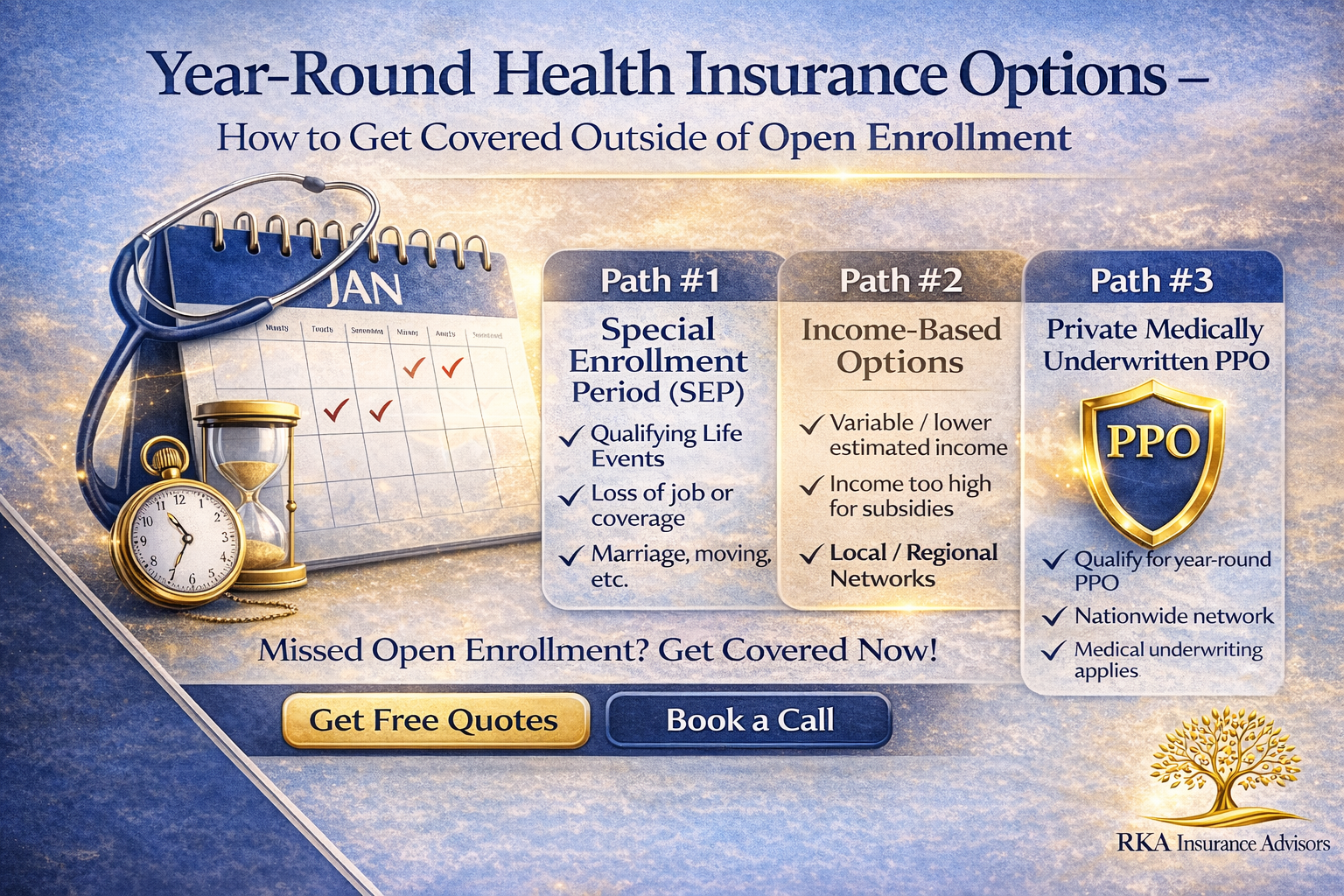
Year-Round Health Insurance Options – How to Get Covered Outside of Open Enrollment
“Can you get health insurance outside of Open Enrollment? Yes. From Special Enrollment Periods after life events to private medically underwritten PPOs with nationwide networks, there are year-round options to lock in coverage and control costs. Learn what qualifies and how RKA can help.”
Enrollment Guides • Year-Round Options
Year-Round Health Insurance Options Outside Open Enrollment
Fast take: Missed Open Enrollment? You still have paths. Qualify for a Special Enrollment Period (life event or some income situations), or—if eligible—apply for a private, medically underwritten PPO that can start any month. We’ll verify doctors, prescriptions, and start dates to avoid gaps.
Path #1: Special Enrollment Period (SEP)
If you’ve had a Qualifying Life Event, you can enroll in ACA Marketplace coverage outside the normal window. Common QLEs:
- Loss of coverage: losing employer coverage, aging off a parent’s plan, COBRA ending.
- Household changes: marriage, divorce, birth/adoption, death.
- Residence changes: moving to a new ZIP/state with different plan options.
- Income changes: shifts that affect subsidy eligibility (varies by state and year).
Timing: Most SEPs last 60 days from the event. We’ll help confirm your documentation and the correct effective date.
Path #2: Income-based options (some situations)
In certain circumstances, income within specific ranges can create ongoing or monthly SEP eligibility. If your income is variable, we’ll model your estimated MAGI and confirm your current-year eligibility.
Path #3: Private, medically underwritten PPO (if eligible)
- Year-round starts: Many private PPOs offer effective dates any month after underwriting.
- Broader networks: Often nationwide PPO access—great for frequent travelers or multi-state households.
- Underwriting: Health questions apply; we pre-screen quickly and verify your doctors/hospitals.
Avoid gaps: simple checklist
- List your providers (names, locations) and prescriptions.
- Note your QLE date and keep documents handy.
- Share your target start date so we align deadlines and carrier cutoffs.
- We’ll show total annual cost (premium + likely usage) for each option.
Quick FAQs
How fast can coverage start?
What if I don’t have a QLE?
Can you confirm my doctors?
For education only; eligibility, plan availability, and dates vary by state and carrier. Always review official Marketplace and plan documents.
Need coverage outside Open Enrollment? Our licensed advisors help you access year-round health insurance options including private PPO plans, special enrollment periods, and COBRA alternatives. Explore your options.
Open Enrollment & Your Plan Options
Open enrollment explained — metal tiers, networks, subsidies, and the private options most brokers skip.
Open Enrollment • Basics
Open Enrollment & Your Plan Options, Explained
Open enrollment is the period each year when you can sign up for health insurance or change your current coverage. In most states it opens November 1 and runs through mid-January for individual and family plans. Enroll by December 15 and coverage typically starts January 1; enroll after that (through the deadline) and coverage usually starts February 1. Some states run their own window on different dates — check with one of our benefit specialists for your state, or see the current-year guide linked above.
Marketplace metal tiers
- Bronze — lowest monthly cost, but higher deductibles and more out-of-pocket expense.
- Silver — middle-of-the-road; balances coverage and cost (and unlocks extra savings if you qualify).
- Gold — higher premium, stronger cost-sharing, lower deductibles and out-of-pocket exposure.
- Platinum — rare and only in a few counties; highest premium, lowest deductibles.
Networks: why the type matters
Most Marketplace options are HMO or EPO networks — limited to a local service area, covering you outside it only for emergencies. PPO networks are available in select areas and offer nationwide access to providers without referrals. If you travel, split time between states, or want freedom to see specialists directly, network type matters as much as price.
Subsidies (premium tax credits)
If your income falls between 100% and 400% of the federal poverty level, you may qualify for a premium tax credit that lowers your Marketplace cost — sometimes dramatically. The exact income cutoffs change each year, and earning over the top of the range means you pay full price (the "subsidy cliff"). We calculate your current-year subsidy and show your true net cost. More on the subsidy cliff →
Options beyond the Marketplace
Other options we can compare
- Short-term medical — often the most affordable; coverage for roughly 30 days up to (with some insurers) 12 months. More limited than major medical.
- Fixed indemnity — supplemental coverage that pays set cash benefits toward specific costs; a layer of protection on top of a plan, not a replacement.
- Healthcare sharing — members share medical costs via a monthly share amount; not insurance, with its own rules and limits.
Don't assume your current plan is still the best
Before you renew, talk to a benefits specialist — we'll compare Marketplace and private options, verify your doctors, and make sure you're not overpaying.
Get Free Quotes Book a CallFrequently asked questions
When exactly can I enroll?
Open enrollment opens November 1 and runs into mid-January in most states; some state marketplaces differ. See the current-year guide for exact dates, or ask us about your state.
Is the Marketplace my only choice?
No. Depending on your income and health, a private nationwide PPO or a supplemental option may be a better fit. We compare all of them for you.
How do I know I'm not overpaying?
We price your real annual cost — premium, deductible, copays, and out-of-pocket max — across every option and verify your doctors before you enroll.
For education only; eligibility, benefits, and availability vary by carrier and state. Always review official plan documents. Private plans are medically underwritten — not all applicants qualify. RKA Insurance Advisors is an independent, licensed health insurance brokerage (NPN 19540130). We do not offer Medicare. Call (561) 806-9913.