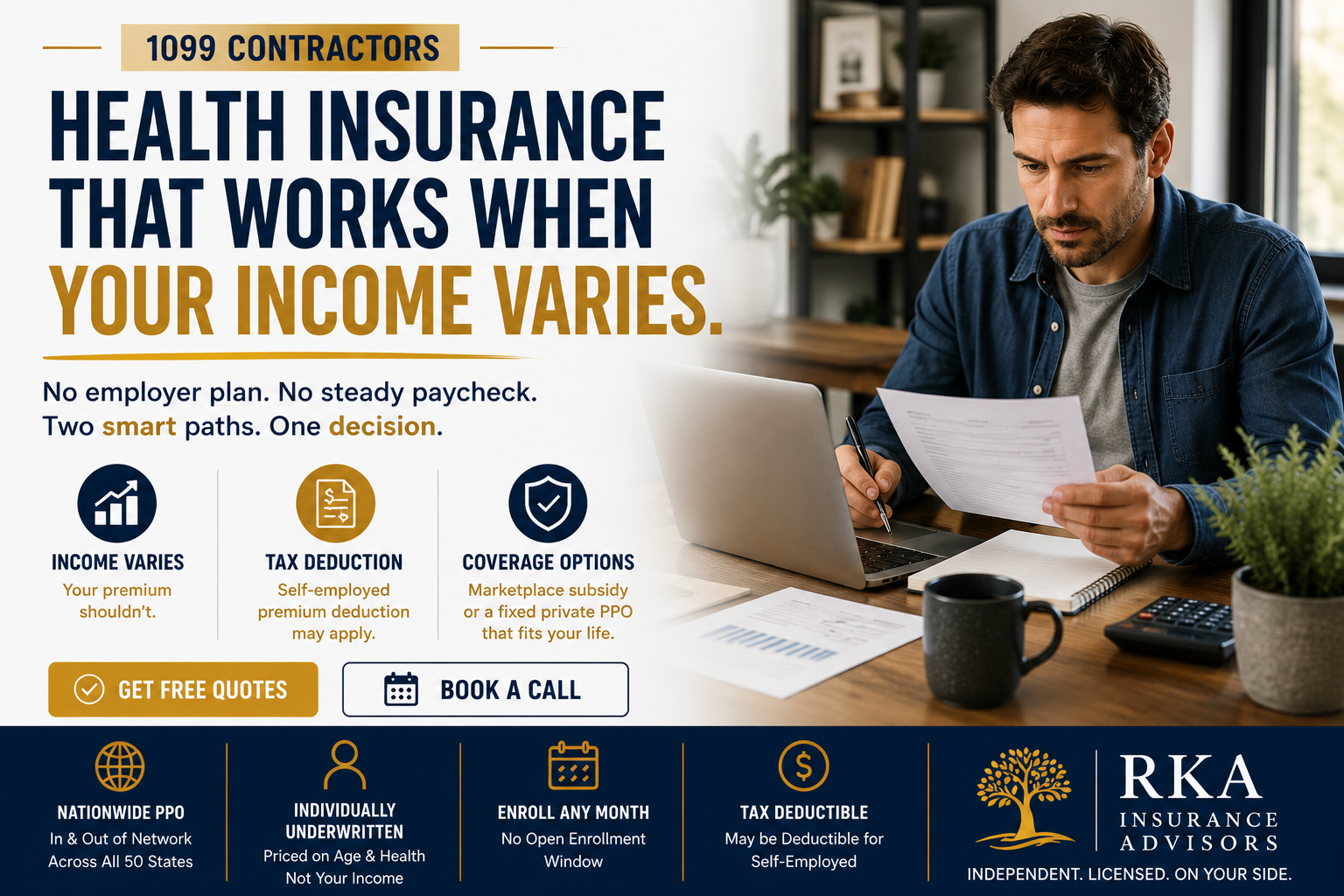
1099 Contractor Health Insurance: How to Get Covered When Your Income Varies
When you're 1099, there's no employer plan and no steady paycheck to size a premium against. That makes two things matter more than usual: estimating income for a subsidy you can't predict, and the self-employed premium deduction. Here's how contractors get covered.
Self-Employed • Private PPO • Individual Coverage
1099 Contractor Health Insurance: How to Get Covered When Your Income Varies
Why 1099 coverage is a different problem
A W-2 employee picks a plan once a year, has a fixed salary, and lets payroll deduct the premium. None of that is true for you. There's no employer splitting the cost, no HR portal, and — the part that trips people up — no predictable income to base a subsidy on. When your earnings swing month to month, the usual advice doesn't fit. The two questions below are the ones that actually decide your best move.
Question 1: Can you even predict your income?
Marketplace subsidies are based on your projected annual income. You estimate it when you enroll, the subsidy is paid in advance based on that estimate, and at tax time the IRS reconciles what you actually earned on Form 8962. For a salaried employee that's simple. For a contractor whose income depends on how many contracts close this year, it's a guess — and guessing wrong cuts both ways.
If you underestimate
- You collect a bigger subsidy during the year than you were owed
- You repay the difference at tax time — sometimes a large bill in April
- A single big contract late in the year can trigger it
If you overestimate
- You get a smaller subsidy during the year than you qualified for
- You get the difference back as a credit at tax time
- But you fronted more cash all year than you had to
The predictable alternative: a nationwide private PPO is priced on your age and health, not your income. The premium doesn't move when your income does, and there's nothing to reconcile at tax time. For a healthy contractor with variable or higher income, that predictability is often worth more than a subsidy you have to gamble on.
Question 2: Are you taking the self-employed deduction?
If you're self-employed and turn a profit, you may be able to deduct your health insurance premiums — for yourself, your spouse, and your dependents — on your federal return, whether you take the standard deduction or itemize. It's an "above-the-line" deduction, which is more valuable than most write-offs. It applies to private plans and unsubsidized marketplace plans, but not to the portion of a premium already covered by a subsidy.
This matters for the comparison: a private plan that looks more expensive on paper can be cheaper after the deduction than a partially-subsidized marketplace plan. The exact benefit depends on your tax situation, so confirm the specifics with your tax professional — but don't leave it out of the math.
Your two ways to get covered
ACA Marketplace
- Guaranteed issue — no health questions, no one is declined
- Subsidies possible if your projected income qualifies
- You must estimate income; the IRS reconciles it at tax time
- Enroll only during Open Enrollment or with a qualifying life event
- Most plans in many areas are regional HMO/EPO
Nationwide Private PPO
- Priced on health and age, not income — premium doesn't move
- Available any month, no enrollment window
- Nationwide PPO — see specialists anywhere, no referrals
- No subsidy, so nothing to reconcile at tax time
- Medically underwritten — you have to qualify
Not sure which fits your 1099 income? Let's run both.
We'll model a subsidized marketplace plan against a fixed private PPO for your actual situation — factor in the self-employed deduction, verify your doctors, and tell you straight which one wins. Free, no obligation.
Which path tends to win, honestly
Lean marketplace if…
- Your income is modest and reasonably predictable
- A subsidy makes the net premium clearly lower
- You have a health condition that underwriting might exclude
Lean private PPO if…
- You're healthy and above the subsidy line
- Your income swings and you'd rather not gamble on an estimate
- You want nationwide access and no reconciliation at tax time
This is the same honest fork we walk through with gig and rideshare workers — if you want the version focused on total cost and network freedom, see our gig workers and 1099 coverage guide.
Related reading
- Health insurance for gig workers and 1099 contractors
- Marketplace vs private PPO: an honest comparison
- Health insurance for the self-employed
Frequently asked questions
How do I estimate my income for a marketplace subsidy if I'm 1099?
You project your expected annual net income for the year and enter it when you enroll. The subsidy is paid in advance based on that number, then reconciled against your actual income on Form 8962 at tax time. Because contractor income is variable, build in a realistic buffer — underestimating means repaying subsidy in April. If your income is genuinely hard to predict, a private plan priced on health rather than income avoids the guesswork entirely.
Can I deduct my health insurance premiums as a 1099 contractor?
If you're self-employed and profitable, you generally can deduct premiums for yourself, your spouse, and your dependents as an above-the-line deduction — even without itemizing. It doesn't apply to any portion covered by a subsidy. It can make a private plan cheaper after taxes than it looks on paper. Confirm the specifics with your tax professional for your situation.
Can I get covered outside of Open Enrollment?
Private medically underwritten PPO plans are available year-round with no enrollment window — you can apply any month. Marketplace plans generally require Open Enrollment or a qualifying life event such as losing other coverage, moving, or marriage. That year-round availability is one reason contractors between contracts often look at the private path.
My income changes every month — does that affect a private plan?
No. A private plan's premium is set by your age and health at enrollment, not your income, so it doesn't move when your earnings do. That's the core appeal for contractors with variable income: a fixed cost you can budget around, and no year-end reconciliation. The tradeoff is that you have to qualify through medical underwriting.
I'm healthy and earn well — is the marketplace still worth checking?
Yes, always check both. If your income is above the subsidy line, an unsubsidized marketplace plan and a private PPO are both on the table, and the private PPO often wins on cost and network for a healthy applicant. But we compare them side by side rather than assume — occasionally a specific marketplace plan fits better, and we'll tell you when it does.
How does RKA help 1099 contractors?
We compare a subsidized marketplace plan against a fixed nationwide private PPO for your specific income and health, factor in the self-employed premium deduction, verify your doctors and prescriptions, and give you the honest call. We're independent and licensed in 30 states. NPN 19540130.
Get a fixed number you can actually budget around.
When your income isn't predictable, your health coverage can still be. We'll price both paths, factor the deduction, and pre-screen private eligibility — at no cost.
Robert Adams * President & Licensed Agent * NPN 19540130 * Licensed in 30 states. Premium estimates are illustrative and based on general market data — actual premiums vary by age, state, health profile, and underwriting outcome. Private medically underwritten plans are not ACA-compliant and are subject to medical underwriting — not all applicants qualify. Tax treatment depends on your individual circumstances — consult a qualified tax professional. This content is for informational purposes only and does not constitute insurance, legal, tax, or financial advice.

Health Insurance for Gig Workers and 1099 Contractors: How to Get Covered
Gig and 1099 work spans rideshare to six-figure consulting — and none of it comes with benefits. Here's how independent workers really compare coverage: why the monthly premium is only the sticker price, how deductibles, copays, and out-of-pocket maximums decide what you actually pay, and why a nationwide PPO's in- and out-of-network freedom often beats an in-state HMO or EPO — plus when a marketplace subsidy still makes sense.
Health Insurance for Gig Workers and 1099 Contractors: How to Get Covered
The premium is the sticker price — not the real cost
When you buy coverage, the monthly premium is simply what you pay for the product. It tells you almost nothing about what that product will actually cost you over a year, because a health plan has four separate cost levers, and premium is only one of them:
Premium
What you pay every month just to hold the plan — whether or not you ever use it.
Deductible
What you pay out of pocket before the plan starts sharing costs. Can be $0 on some plans, $9,000+ on others.
Copays & coinsurance
What you pay per visit, per prescription, or as a percentage — every time you get care.
Out-of-pocket maximum
The most you can pay in a bad year. This is the number that protects you when something serious happens.
A plan with a low premium and a high deductible isn't "cheap" — it's a bet that you won't need care. If that bet is wrong, you can end up paying far more than you would have on a plan that cost a little more each month. That's why the premium alone should never decide it.
Same person, two plans: run the real numbers
Here's the trap, in plain figures. Two plans for the same healthy person:
Plan A — low premium, high exposure
- $150 / month premium
- ~$9,200 deductible and out-of-pocket max
- In-state HMO/EPO network — no out-of-network coverage
- One serious event and you're exposed to the full $9,200
Plan B — slightly higher premium, far less exposure
- $200 / month premium
- $0 deductible
- ~$3,000 out-of-pocket max
- Nationwide PPO — in and out of network, anywhere in the U.S.
Plan B costs about $50 more a month — roughly $600 a year. But the moment you have a real claim, Plan A can expose you to $6,000+ more than Plan B, and Plan A only works inside your home state. Paying the extra $50 isn't spending more; for a lot of people it's buying thousands of dollars of protection and the freedom to see any doctor in the country. (Figures are illustrative — your actual numbers depend on age, state, health, and plan design.)
Where can you actually use it? HMO/EPO vs nationwide PPO
Cost is half the story. The other half is network — and this is where the two products really diverge. The majority of ACA marketplace plans today are HMOs or EPOs. Those plans are generally built around one state or one region, and they typically pay nothing if you go out of network (outside of emergencies). Travel, move between states, or want a specialist across the country, and you're on your own.
Marketplace HMO / EPO
- Covers pre-existing conditions, guaranteed issue
- Subsidies if your income qualifies (more on that below)
- Usually no out-of-network coverage at all
- Network tied to your resident state or region
- Out-of-pocket maximums often $9,000+
- Enroll only in open enrollment or with a qualifying life event
Private nationwide PPO (medically underwritten)
- One of the nation's largest PPO networks
- Works in and out of network, across all 50 states
- Plan designs with deductibles as low as $0
- Out-of-pocket max options as low as around $3,000
- Enroll any month — no window
- Medically underwritten — best for healthy applicants, and not designed for significant pre-existing conditions
Stop comparing premiums. Compare what you'll actually pay.
Tell us a little about your health, your income, and how you live, and we'll show you the total cost and the network for each option — side by side, in plain numbers. No cost, no pressure.
When the marketplace still makes sense
A private PPO isn't automatically the answer — it depends on your situation, and being honest about that is the whole point. If your gig income is modest, you may qualify for a marketplace subsidy, and in the lower-income cost-sharing reduction (CSR) range, a Silver plan can come with sharply reduced deductibles, copays, and out-of-pocket maximums. That can be a genuinely strong deal on cost.
Even then, run it with eyes open: those plans are still usually in-state HMOs or EPOs, so the network restrictions and lack of out-of-network coverage remain. And if you have significant pre-existing conditions, the marketplace is generally the better route, because a private PPO is medically underwritten and not everyone qualifies. The right move is to weigh your total cost against your need for network freedom. For a deeper side-by-side, see our Marketplace vs Private PPO breakdown.
How to actually decide, in four steps
1. Map how you actually use care
Do you travel or move? Want a specific hospital or specialist? Take regular prescriptions? This drives the network and out-of-pocket decision more than the premium does.
2. If your income is modest, check the marketplace — including CSR
A subsidy, and especially a cost-sharing-reduction Silver plan, can lower your total cost substantially. Get that price as your benchmark.
3. Compare total exposure, not premium
Line up premium + deductible + copays + out-of-pocket max across every option. The lowest monthly price is often not the lowest yearly cost.
4. Weigh network freedom
An in-state HMO/EPO vs a nationwide PPO that works in and out of network is a real quality-of-coverage difference — decide what that's worth to you.
Common questions from gig and 1099 workers
Isn't the plan with the lowest monthly premium the cheapest?
Not usually. The premium is only what you pay to hold the plan. A low-premium plan often carries a $9,000+ deductible and out-of-pocket max and no out-of-network coverage, so the first real claim can cost you far more than a plan that was a little more per month. Compare total exposure — premium plus deductible, copays, and out-of-pocket maximum — not the premium alone.
What's the real difference between a marketplace HMO/EPO and a private PPO?
Most marketplace plans are HMOs or EPOs built around one state, and they generally pay nothing out of network. A private nationwide PPO uses one of the country's largest networks and works in and out of network across all 50 states — useful if you travel, move, or want a specific doctor. Some private PPO designs also offer $0 deductibles and out-of-pocket maximums as low as around $3,000.
I drive rideshare or deliver part-time. What should I look at first?
If your total annual income is modest, check the marketplace first — you may qualify for a subsidy, and in the cost-sharing-reduction range a Silver plan can have low deductibles and out-of-pocket costs. Just know it's usually an in-state HMO/EPO. If you're healthy and want nationwide, in-and-out-of-network coverage with a low out-of-pocket max, we'll price a private PPO against it so you can see the full comparison.
My income is irregular. Does that affect my options?
A private PPO premium is based on your age and health, not your income, so it doesn't move month to month and there's no year-end income reconciliation. You can also enroll any month — no waiting for an open-enrollment window between gigs. Marketplace subsidies, by contrast, are tied to your estimated annual income.
How does RKA help gig and 1099 workers?
We compare the whole picture for you — total cost and network across a marketplace plan and a private PPO — verify your doctors are covered, and explain the trade-offs in plain English. There's no one-size-fits-all answer, which is exactly why a personalized comparison matters. We're licensed in 30 states, and it's free.
Get the full picture — free
One quick conversation and you'll know your total cost and your network for every option, not just the monthly price. That's how you actually get the right plan.
Robert Adams · President & Licensed Agent · NPN 19540130 · Licensed in 30 states. Premium, deductible, and out-of-pocket figures are illustrative and vary by age, state, health profile, plan design, and underwriting outcome. Subsidy and cost-sharing-reduction eligibility depend on household income, size, and location. Private medically underwritten plans are not ACA-compliant and are subject to medical underwriting; not all applicants qualify, and they are not designed for significant pre-existing conditions. This content is for informational purposes only and does not constitute insurance, legal, tax, or financial advice.