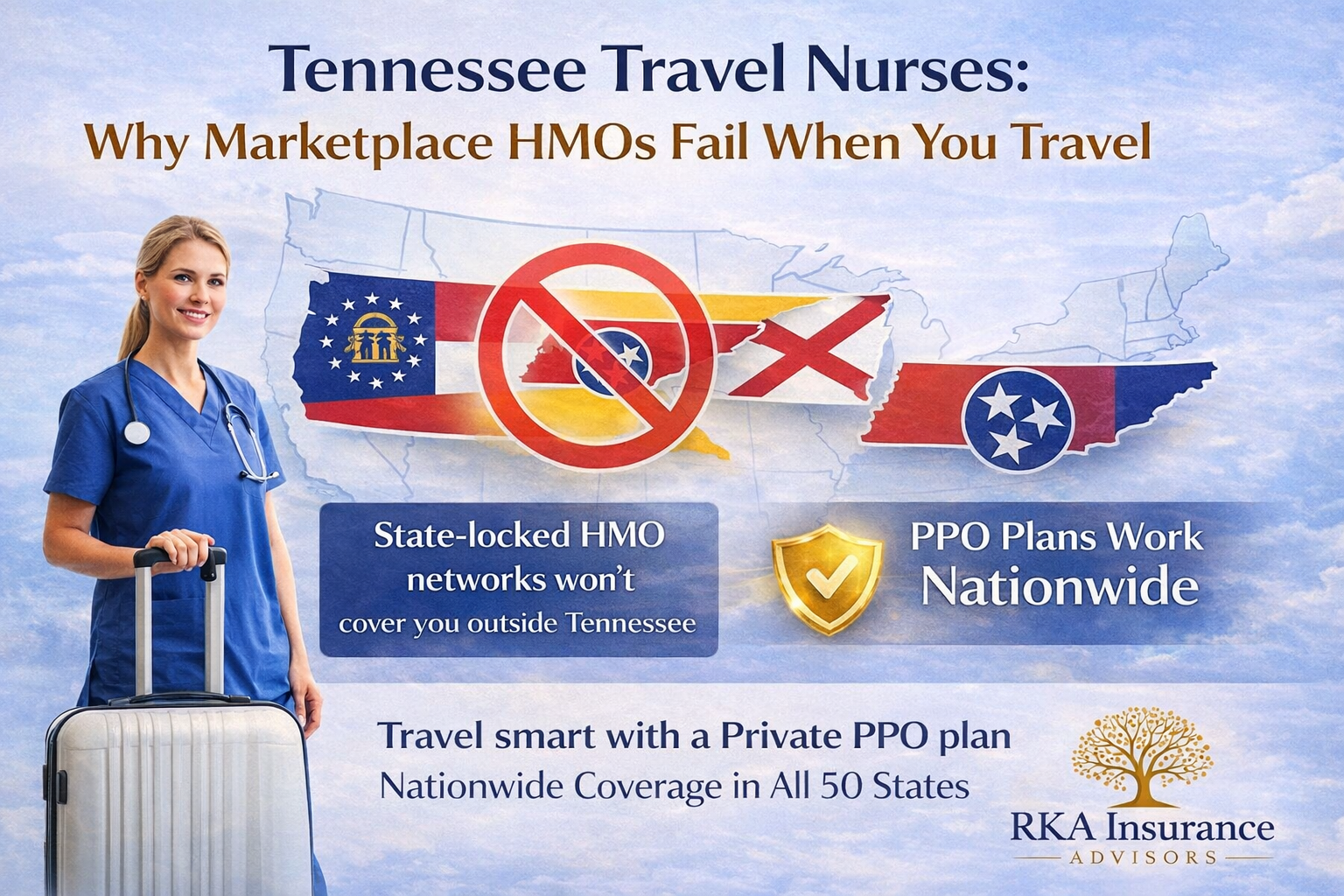
Tennessee Travel Nurses: Why Marketplace HMOs Fail When You Travel
Tennessee travel nurses: Your HMO stops at state borders. Get Private PPO plans with nationwide coverage that actually work when you travel for assignments.
Tennessee Travel Nurses: Why Marketplace HMOs Fail When You Travel
Fast take: HMO networks stop at state borders—your Tennessee HMO won't cover you in Georgia, Alabama, or any other state. Marketplace plans are designed for people who stay in one place, not travel nurses. Private PPO plans give you nationwide networks that work in all 50 states, often at lower rates than marketplace plans because of healthier risk pools.
Need Private PPO coverage that works nationwide?
We'll verify your doctors are in-network, compare marketplace vs private PPO options, and enroll you quickly.
Get Free Quotes Book a CallThe Problem: HMOs Are State-Locked
When you buy health insurance on Healthcare.gov in Tennessee, you're getting an HMO network built for Tennessee residents. The insurance carrier contracts with Tennessee hospitals and doctors. Those contracts don't extend to Georgia, Alabama, Kentucky, Virginia, North Carolina, South Carolina, Mississippi, or Missouri.
If you need care outside Tennessee, your HMO will only cover:
- True emergencies — and the insurance company decides what counts as an emergency after the fact
- Nothing else — routine care, urgent care, prescriptions, specialists are all out-of-pocket
You're traveling to Nashville, Knoxville, Memphis, and Chattanooga for assignments. But your assignments also take you to Atlanta, Birmingham, Charlotte, and Huntsville. Your marketplace HMO leaves you uncovered the moment you cross a border.
Real Example: $8,400 Emergency Room Bill
Sarah, a travel nurse from Nashville, took a 13-week contract in Birmingham, Alabama. Week 3, she developed severe abdominal pain and went to the ER. Appendicitis. Emergency surgery.
Her Tennessee marketplace HMO initially denied the claim. After appeals, they covered the surgery but not the ER physician, anesthesiologist, or follow-up care. Her out-of-pocket bill: $8,400.
A Private PPO plan would have covered the entire visit at in-network rates in Alabama.
Why Travel Nurses Need Private PPO Plans
Private PPO (Preferred Provider Organization) plans are off-exchange health insurance options available only through licensed agents. They're medically underwritten, which means you apply based on your health history instead of getting guaranteed acceptance like marketplace plans.
Why medical underwriting actually saves you money: Because Private PPO plans screen for health risks, they attract healthier applicants. This creates a lower-risk pool, which means lower premiums for everyone who qualifies. If you're healthy enough to pass a hospital's employment health screening, you'll likely qualify—and save money compared to marketplace plans.
Key Advantages for Travel Nurses
✓ Nationwide networks — Coverage works in all 50 states
✓ No referrals — See specialists directly
✓ Year-round enrollment — Apply any time
✓ Broader doctor access — Larger provider networks
✓ Lower premiums — Healthier risk pool = better rates
✓ Travel nurse-friendly — Designed for cross-state work
Who Qualifies
✓ Working full-time (healthy enough for hospital screenings)
✓ Generally younger, healthier professionals
✓ Many pre-existing conditions acceptable
✓ May be rated up for significant conditions
✓ Marketplace still available if declined
Private PPO vs Marketplace: The Real Cost Difference
Most travel nurses earning $80,000+ per year don't qualify for marketplace premium tax credits. Without subsidies, Private PPO plans are often more affordable than marketplace plans—and give you nationwide coverage.
Why Private PPO costs less (without subsidies): Medical underwriting creates a healthier risk pool. Marketplace plans must accept everyone regardless of health status, which raises premiums for all enrollees. Private PPO plans screen applicants, resulting in lower claims and lower premiums for those who qualify.
If you're earning above subsidy thresholds and you're healthy, Private PPO typically saves you money while giving you better coverage across state lines.
What About Premium Tax Credits?
If you qualify for marketplace subsidies (generally under $60,000/year for a single person), the subsidized marketplace plan will almost always be cheaper than Private PPO. However, you'll still be stuck with an HMO that doesn't work across state lines. Additionally, likely a higher deducitble and certaintly a higher out of pocket max.
Run the numbers with us:
- Compare your actual after-subsidy marketplace cost
- Compare Private PPO rates for your age and health profile
- Factor in the cost of one out-of-network ER visit, the plans deducitble and max out of pocket. ($5,000-$10,000)
How to Get Private PPO Quotes in Tennessee
Private PPO plans aren't listed on Healthcare.gov. You need to work with a licensed health insurance agent who has access to off-exchange carriers.
Application Process
1. Complete health pre qualifying questionnaire w a licensed advsior (10-15 minutes)
2. Licensed advisor submits to application
3. Complete verification call w carrier (15-20 min)
4. Receive eligibilty determination within 48 hours on avgerage
5. Coverage starts on scheduled effective date
What We Verify
✓ Your current doctors are in-network
✓ Prescriptions are covered
✓ Tennessee hospitals included
✓ Out-of-state coverage confirmed
✓ Total annual cost comparison
Ready to Compare Private PPO Plans?
Get side-by-side quotes from top carriers. We verify your doctors are in-network and explain all your options—marketplace and private.
Get Free Quotes Book a CallFrequently Asked Questions
Can I keep my Tennessee doctors with a Private PPO?
Yes. Private PPO plans include large nationwide networks. We verify your current doctors are in-network before you enroll. Most major hospital systems in Tennessee (Vanderbilt, HCA, UT Medical Center) are in-network with top PPO carriers.
What if I have a pre-existing condition?
It depends on the condition. Controlled conditions, high blood pressure, hypothroidism or past surgeries are often acceptable. Active cancer, recent heart attack, or uncontrolled chronic conditions may result in declination or higher rates.
Can I cancel my Private PPO if I get a staff position with benefits?
Yes. Private PPO plans are month-to-month. You can cancel any time with 30 days notice. No penalties or fees.
Do Private PPO plans cover prescriptions?
Yes. Most Private PPO plans include prescription coverage with tiered copays. We verify your current medications are covered before enrollment.
What's the difference between Private PPO and travel nurse agencies' health plans?
Agency contracts are typically 13 weeks, meaning any accumilation to deductible is lost after that contract, your coverage is tied to your agency and leaves you shopping coverage every 13 week.
Related Articles
HMO vs PPO vs EPO vs POS: Which Network Fits Your Needs?
Confused by network types? Learn the differences and why PPOs work best for travel nurses.
Truckers Health Insurance Guide
Another profession that crosses state lines? See how truckers get nationwide PPO coverage.
Licensed in Tennessee and 31 other states. NPN 19540130. For education only; coverage and availability vary by carrier and state.
Marketplace vs Private PPO 2026 | Which Wins for You?
ACA Marketplace plans can be the right call if your income qualifies for subsidies. But if you earn above the subsidy threshold or want broader doctor access with no referral requirements, a private underwritten PPO often wins on cost, flexibility, and nationwide coverage.
Private PPO • ACA Marketplace • 2026
Marketplace vs. Private PPO:
Which One Actually Wins for You?
The core difference in one sentence
Marketplace (ACA) plans are priced based on your income and regulated by the government. Private PPO plans are priced based on your health and issued by private carriers outside the exchange.
That one difference drives everything else — cost, network, enrollment windows, and who qualifies for what.
Side-by-side comparison
- Premium tied to your income
- Subsidies available below 400% of the Federal Poverty Level (FPL)
- Open enrollment window (or qualifying life event required)
- Pre-existing conditions covered — no underwriting
- Network can be narrow depending on plan and region
- Referrals may be required on HMO-type plans
- Deductibles can be significant on unsubsidized plans
- Premium based on age and health — not income
- No subsidies — but often lower premiums for healthy applicants
- Available year-round — no enrollment window
- Medical underwriting required — health history reviewed
- Nationwide PPO network — see any PPO doctor, no referrals
- No referral requirements
- Qualify for lower deductible options, including $0 deductible plans
When the Marketplace wins
The ACA Marketplace is genuinely the better option in certain situations. It wins when:
- Your income qualifies for subsidies. Below 400% of the Federal Poverty Level (FPL), subsidies can make Marketplace plans extremely affordable — sometimes as low as $0/month. If you qualify, it's hard for a private plan to compete on price.
- You have pre-existing conditions. Marketplace plans cannot deny coverage or charge more based on health history. Private underwritten plans can decline applicants or exclude conditions — so if you have significant health history, the Marketplace may be your only path to full coverage.
- You're between jobs short-term. If you need a bridge for 30–60 days and qualify for a Special Enrollment Period, a Marketplace plan can be fast and straightforward.
When a private PPO wins
Private PPO plans tend to outperform the Marketplace when:
- Your income is above the subsidy threshold. Once you're above 400% FPL, Marketplace premiums are unsubsidized and can be steep. For a healthy individual in this bracket, a private PPO often comes in significantly lower.
- You need coverage outside open enrollment. Private PPO plans are available year-round — no qualifying life event required. If you missed open enrollment or just went self-employed mid-year, a private plan is often the only option.
- You want nationwide access. Private PPO networks typically cover you anywhere in the country with no referral requirements — important for frequent travelers, remote workers, and anyone who splits time between states.
- You're self-employed with variable income. ACA plans reprice if your income changes — under or overestimate and you pay the difference at tax time. Private PPOs have fixed premiums not tied to income.
The honest answer
There is no universally better option. The right plan depends on your income, health history, where you live, and whether you're in an open enrollment window. The only way to know which wins for you is to compare both with actual numbers.
That's exactly what we do — side-by-side, with real quotes, from a licensed advisor. Free, no obligation.
What about doctor networks?
This is where private PPO plans have a consistent advantage. Marketplace networks — especially at the Silver tier — vary significantly by state and county. In some markets they're broad; in others, major hospital systems are excluded entirely.
Private PPO plans access major nationwide carrier networks. If you have a doctor, specialist, or hospital you want to keep, we verify coverage on both options before you enroll — not after.
How RKA helps
RKA Insurance Advisors is an independent brokerage licensed in 32 states. We're not captive to any single carrier — we compare Marketplace plans and private PPO options side by side and help you pick what actually fits your situation.
- Free quote — no obligation
- We verify your doctors on both options before you commit
- We explain subsidy eligibility clearly — if you qualify, we'll tell you
- Available year-round, not just during open enrollment
See which option wins for you
We'll compare Marketplace and private PPO side by side — free, no pressure, no obligation.
Frequently Asked Questions
Can I switch from Marketplace to a private PPO anytime?
Yes — private PPO plans are available year-round with no enrollment window. You can apply and get covered in as little as a few days depending on the carrier. Cancelling your Marketplace plan mid-year may affect any advance premium tax credits received, so review your tax situation before switching.
Does a private PPO cover pre-existing conditions?
Private underwritten plans review your health history at application. Some conditions may be excluded or result in a higher premium. If you have significant pre-existing conditions, a Marketplace plan may provide broader coverage. We'll be upfront about what each option covers for your specific situation.
What does "above the subsidy threshold" mean?
ACA subsidies phase out at 400% of the Federal Poverty Level (FPL). Above that income level, you pay the full unsubsidized Marketplace premium. For many self-employed professionals and small business owners in this bracket, private PPO premiums compare favorably — often significantly so.
Can I keep my current doctors on a private PPO?
Most likely yes — private PPO networks are broad and access major hospital systems and specialist groups nationwide. We verify your specific providers on any plan before you enroll so there are no surprises.
Is RKA an ACA broker or private PPO broker?
Both. We're an independent brokerage — we're not incentivized toward either option. We compare what's available for your situation and present the numbers clearly. NPN: 19540130. Licensed in 32 states.
Educational purposes only. Plan availability, premiums, and benefits vary by state, county, and individual health profile. Review official plan documents before enrolling. RKA Insurance Advisors, NPN 19540130, licensed in 32 states.
Truckers Health Insurance 2026: Owner-Operators & CDL Drivers Guide | RKA
Owner-operators and OTR drivers are self-employed — no employer benefits, no W-2, no payroll-deducted insurance. For healthy CDL holders, private medically underwritten PPO plans deliver real major medical with nationwide network access — often well below unsubsidized ACA. Available year-round.
Private PPO • Trucking • Self-Employed
Health Insurance for Owner-Operator and OTR Truckers in 2026
The coverage gap most truckers don't realize they have
Company drivers get a benefits package — health, dental, vision, sometimes retirement. The moment you go owner-operator, every benefit becomes your problem. Fuel, insurance on the rig, maintenance, plates, ELD service — and somewhere on that list, often near the bottom, is real health coverage for you and your family.
The result is predictable. Most owner-operators carry coverage that's either too expensive (full unsubsidized ACA), too limited (occupational accident only), or non-existent (rolling the dice). Each has a better alternative for healthy drivers.
Your four options compared
- Group benefit programs through trucker associations
- Quality varies — some real major medical, some limited benefit
- No health questions for some plans
- Often have caps, exclusions, or limited PPO networks
- Premium increases driven by entire association pool
- Guaranteed issue — no health screening
- Subsidies available below ~$60K income (single, 2026)
- Best option if you qualify for subsidies
- Many plans HMO/EPO with state-limited networks
- Full unsubsidized rate above the income threshold
- Lower premiums upfront
- Useful as 60–90 day bridge between coverage
- Doesn't cover preexisting conditions
- Often excludes maternity, mental health, prescription
- Doesn't count as minimum essential coverage
- Off-exchange plans with nationwide PPO networks
- Real major medical with defined deductibles
- Available any month — no enrollment window
- Best rates for healthy CDL holders
- Health questionnaire required — not all applicants qualify
Why nationwide PPO matters more for truckers than almost anyone
If you run a regional lane in three states, an HMO might cover you. If you run TX–FL, I-10 coast-to-coast, or any true OTR schedule, regional networks are a problem waiting to happen.
Picture this: you slip getting out of the cab in a Pilot lot in New Mexico, fracture your wrist 1,800 miles from home. The local urgent care is in your network as far as Albuquerque is concerned — but on your HMO plan, it's out-of-state. You pay full price, then fight your insurer for partial reimbursement that may or may not come.
A nationwide PPO works the same in every state. Same network rules, same in-network rate, same coverage. For multi-state lane drivers, this is the actual point of having insurance.
Multi-state lanes
- Same network rules in any state
- No out-of-network surprises
- In-network rate from coast to coast
Telehealth from the cab
- 24/7 virtual visits included on most plans
- Sick on a 14-hour day? Talk to a doctor without leaving the truck
- Prescriptions sent to any pharmacy
ER coverage anywhere
- Emergency care covered at in-network rates
- No state-specific exclusions
- Specialist access without referrals
Why owner-operators are often a strong fit for medical underwriting
Medical underwriting means the carrier reviews your health history before approving coverage. Healthy applicants get the best rates — and the average active owner-operator is healthier than the general population for one specific reason: the DOT physical.
To hold a CDL, you pass a DOT medical exam (49 CFR 391.41) — typically every 24 months. That means your blood pressure, vision, hearing, BMI, and basic cardiovascular health are tracked and acceptable, or you don't have a CDL. Most active owner-operators are functionally pre-screened on baseline health, which is exactly what private underwriting looks for.
We compare ACA, private PPO, and association options for your specific age, state, and health profile — and tell you honestly which one makes sense. No pressure, no obligation.
Occupational Accident is not health insurance
Occupational accident coverage (OccAcc) is a workers-comp-style policy many owner-operators carry through their motor carrier or independently. It pays if you're hurt while working. It does not cover anything that happens off the truck — a heart attack at home, your kid's tonsils, your wife's pregnancy, your annual physical, the flu. None of that is OccAcc territory.
OccAcc and major medical are two different products. You probably need both — but using OccAcc as a substitute for health insurance is one of the most expensive mistakes owner-operators make. One non-occupational hospital stay can wipe out years of savings.
The self-employment health insurance deduction
Owner-operators filing Schedule C can typically deduct 100% of health insurance premiums paid for themselves, their spouse, and dependents — as an above-the-line deduction on Form 1040. That doesn't reduce self-employment tax, but it does reduce federal income tax dollar-for-dollar against your premium cost.
For a driver paying $500/month and netting $90,000, the deduction often saves $1,200–$1,800 a year in federal income tax. The premium net of deduction can be meaningfully lower than the headline number. Confirm with your CPA — premiums can't exceed your net Schedule C profit for the year.
Who qualifies — and who doesn't
Likely to qualify
- Active CDL with current DOT medical card
- No hospitalizations in past 2 years
- No major chronic conditions
- Non-smoker (or quit 12+ months ago)
- BMI within DOT-acceptable range
- No active or planned major surgery
May not qualify
- Type 1 or insulin-dependent Type 2 diabetes
- Active cancer treatment or recent remission
- Recent cardiac event (heart attack, bypass, stent)
- Active autoimmune disease (MS, lupus, severe RA)
- Multiple ongoing specialty medications
If your health history puts private underwriting out of reach, ACA marketplace is the right path — guaranteed issue, no health questions, subsidies available below ~$60K income for individuals. We compare both options honestly and tell you which makes sense for your specific situation.
What private PPO actually costs
Premium depends on your age, state, tobacco status, household size, and the specific plan you choose. There is no one-size-fits-all number — what matters is the comparison between unsubsidized ACA and private PPO for your situation.
For most healthy truckers, the math frequently favors private PPO once household income crosses the ACA subsidy threshold. Younger drivers often see the biggest gap — a healthy 25-year-old can sometimes find private PPO well under what an unsubsidized ACA Bronze plan costs, with a real PPO network instead of a regional HMO.
We run the side-by-side for free. Free quotes return real numbers for your age, state, and household — not estimates pulled out of thin air.
How the timing works for an owner-operator
Step 1 — Pre-screen
- 10-minute health questions
- Confirms likelihood of approval
- No formal application yet, no record
- No obligation
Step 2 — Quote & Compare
- Side-by-side: private PPO vs ACA
- For your age, state, health profile
- Verify your existing doctors in-network
- Pick the plan that fits
Step 3 — Apply & Activate
- Formal underwriting takes 7–14 days
- Coverage typically starts 1st of next month
- Apply 30–45 days before target start date
- ID cards within 1–2 weeks
Frequently Asked Questions
Can I keep coverage when I'm running multi-state lanes?
Yes. Private PPO plans use nationwide PPO networks (BCBS PPO, Aetna PPO, UnitedHealthcare Choice Plus, and similar). Same network rules and rates apply in any state — no in-state-only restrictions like most ACA HMO plans.
What's the difference between OOIDA's plans and private PPO?
OOIDA member benefit programs are association-sponsored — quality and structure varies by program and year. Some are real major medical, some are limited benefit programs that cap payouts. Private PPO plans are individually underwritten with defined deductibles and out-of-pocket maximums consistent with traditional health insurance. We can compare your OOIDA program against private PPO options if you want a side-by-side.
I'm currently on a short-term plan. Should I switch?
Probably yes, if you're healthy enough to qualify for private PPO. Short-term plans don't cover preexisting conditions, often exclude major categories like maternity and mental health, and don't count as minimum essential coverage. They're useful as a 60–90 day bridge — not as ongoing coverage. A private PPO is real major medical with stable terms.
What if I get sick after I'm enrolled in a private PPO?
Once your policy is issued, the carrier cannot cancel you for getting sick. Underwriting only applies at the time of application. Your renewal premium can change at the next annual renewal, but the policy itself doesn't get revoked because you developed a condition after enrollment.
Does this cover my spouse and kids?
Yes. Family plans are available, priced by age and health of each adult. Dependents under 18 don't go through medical underwriting on most plans. If a spouse has a significant health condition that would disqualify them, a split-family approach is possible — one spouse on private PPO, the other on ACA marketplace — and we'll tell you when that math works in your favor.
How does the self-employed health insurance deduction work for owner-operators?
If you have net Schedule C income, you can typically deduct 100% of health insurance premiums paid for yourself, your spouse, and dependents as an above-the-line deduction on Form 1040 — which reduces federal income tax (it doesn't reduce SE tax). Confirm with your CPA for your specific situation. Premiums can't exceed your net Schedule C profit for the year.
Is RKA licensed in my state?
RKA Insurance Advisors is licensed in 30 states: AL, CO, DE, FL, GA, IA, IL, IN, KY, KS, LA, MD, MI, MO, MS, MT, NC, NE, NV, OH, OK, SC, SD, TN, TX, UT, VA, WI, WV, WY. If your home state is on this list, we can quote and enroll you. NPN 19540130.
We help owner-operators and OTR drivers compare every option — ACA, private PPO, association, short-term. Free quotes, honest advice, no pressure.
Robert Adams * President & Licensed Agent * NPN 19540130 * Licensed in 30 states. Premium estimates are illustrative ranges based on 2026 market data and are not guaranteed. Actual premiums vary by age, state, tobacco status, plan selection, carrier, and underwriting outcome. Private medically underwritten plans are not ACA-compliant and are subject to medical underwriting — not all applicants qualify. Occupational accident insurance is a separate product from major medical health insurance and does not provide equivalent coverage. The self-employed health insurance deduction availability and amount depend on individual tax situations — consult your tax advisor. This content is for informational purposes only and does not constitute insurance, legal, tax, or financial advice.
How does the Inflation Reduction Act affect your Health Coverage?
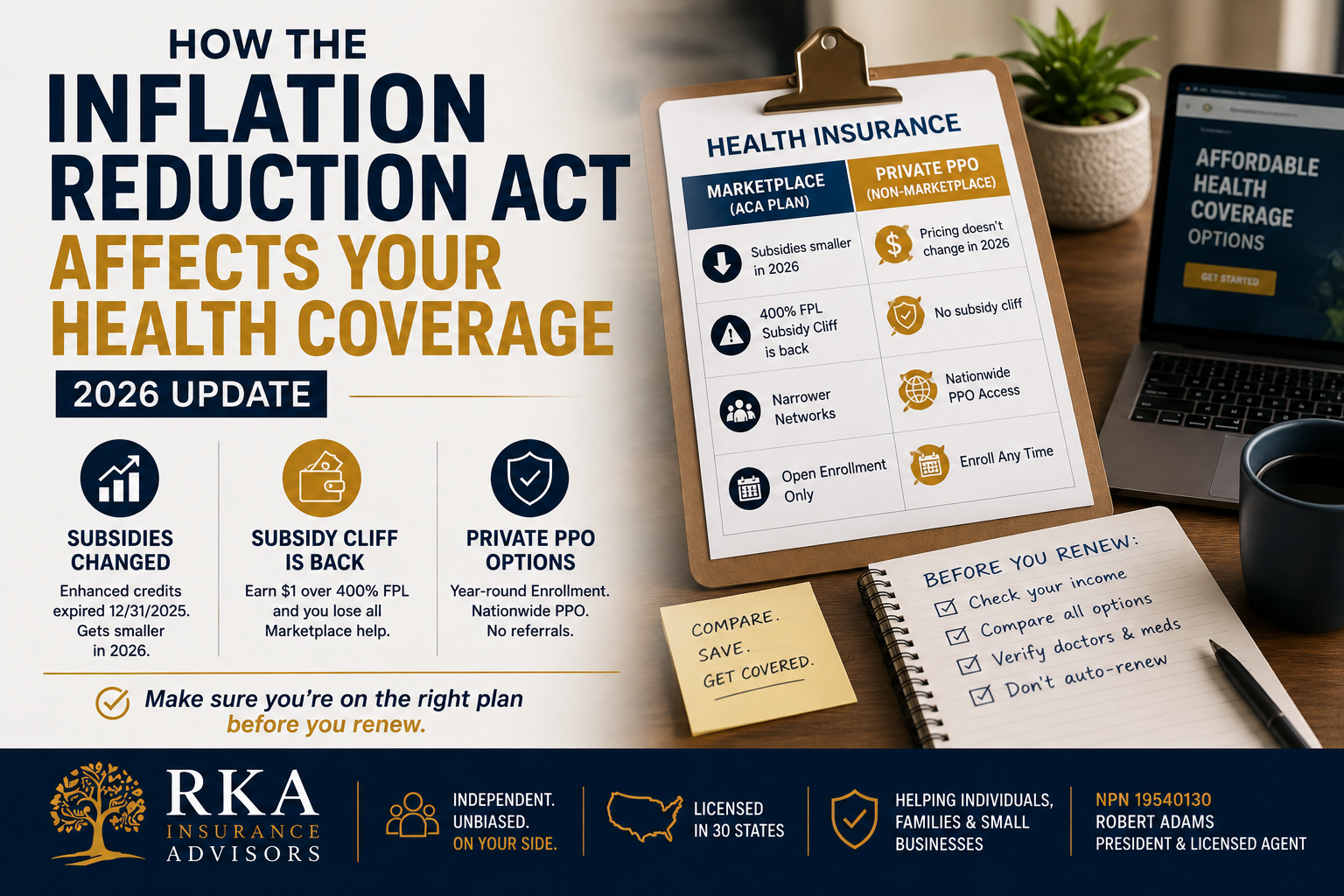
The Inflation Reduction Act's enhanced ACA subsidies expired at the end of 2025 and the 2026 subsidy cliff is back. Here's what changed, the income cutoffs, and where a private PPO now beats the marketplace.
Private PPO • Marketplace • 2026 Changes
How the Inflation Reduction Act Affects Your Health Coverage (2026 Update)
What changed for 2026
The IRA’s larger subsidies were always temporary. They ran from 2021 through 2025, and Congress did not extend them. When 2026 Open Enrollment opened, the enhanced credits were gone — and for millions of people the price to keep the same plan jumped sharply.
The cliff cutoff scales with household size — roughly $84,600 for a couple and $128,600 for a family of four in 2026. Cross it by a dollar and your Marketplace subsidy drops to zero.
Marketplace vs. Private PPO in 2026
Marketplace (ACA) Plans
- Still a strong fit if your income is under the cliff and you qualify for a subsidy
- Guaranteed issue — no health questions
- Above 400% of poverty, you now pay the full unsubsidized premium
- Networks are often narrower (HMO/EPO) with referrals
Private PPO (Non-Marketplace)
- Never used IRA subsidies — nothing about its pricing changed in 2026
- Priced on age and health, not income — often cheaper over the cliff
- Nationwide PPO access, no referrals, enroll any month
- Medically underwritten — not everyone qualifies
What to compare before you renew
Run the cost math
- Your realistic 2026 income vs. the cliff cutoff for your family size
- Full-price Marketplace premium vs. a private PPO quote
- Deductibles and out-of-pocket maximums, not just the premium
- Total annual cost across the whole year
Check the fit
- Are your doctors in each plan’s network?
- Are your prescriptions covered, and at what tier?
- Do you travel or live across state lines?
- Any planned procedure or pregnancy this year?
Not sure which side of the cliff you’re on?
We’ll put full-price Marketplace and a nationwide private PPO side by side for your exact situation — verify your doctors, check your prescriptions, and tell you honestly which wins. Free, no obligation.
Get Free Quotes Book a CallThe self-employed angle
If you run a business or work 1099, the expired subsidies hit harder — you’re buying your own coverage with no employer help, and you’re more likely to be over the cliff. That’s exactly the situation where a medically underwritten nationwide PPO can beat full-price Marketplace, priced on your health instead of your income. There’s also a tax angle: self-employed people can often deduct their premiums — worth raising with your tax professional as you compare.
Related reading
Frequently asked questions
Did the Inflation Reduction Act’s subsidies go away?
The larger enhanced credits that ran from 2021 through 2025 expired December 31, 2025. The original ACA subsidies still exist, but at smaller pre-2021 levels — and the 400% income cliff is back for 2026.
I earn just over the cliff — what are my options?
Above 400% of the federal poverty level you get no Marketplace subsidy in 2026, so you pay the full premium. For a healthy household, a medically underwritten private PPO is often less expensive with a broader nationwide network. It’s worth comparing both before you decide.
Why did my premium jump so much for 2026?
When the enhanced subsidies expired, the amount of help you receive shrank, so the net premium you pay rose — on average about 114% for subsidized enrollees to keep the same plan.
Do I still need to report income changes?
Yes. If you use Marketplace coverage, keep your income and household details updated so your subsidy stays accurate — with the cliff back in 2026, being off can mean a large bill at tax time.
Subsidy amounts, cliff cutoffs, and premiums vary by household and can change; the figures here reflect 2026 rules at the time of writing.
Robert Adams · President & Licensed Agent · NPN 19540130 · Licensed in 30 states. Premium and subsidy figures are illustrative and based on general market data — actual amounts vary by age, state, income, and health. Private medically underwritten plans are not ACA-compliant and are subject to medical underwriting — not all applicants qualify. This content is for informational purposes only and does not constitute insurance, legal, tax, or financial advice.
Robert Adams
https://www.RKAInsuranceAdvisors.com