
Back-to-School Health Insurance for Self-Employed Parents: A Coverage Checkpoint
Back-to-school season is a natural coverage checkpoint for self-employed parents — sports physicals, school forms, new prescriptions, and kids who may be aging off your plan. This guide covers the five things to confirm before September, why a nationwide PPO often fits families better than an in-state marketplace HMO for specialists and travel-sports injuries, when a marketplace subsidy is still the smarter family move, and a tax perk many self-employed parents miss.
Back-to-School Health Insurance for Self-Employed Parents: A Coverage Checkpoint
Why back-to-school is the right time to check your family's coverage
Summer ends and the paperwork begins: physical forms, immunization records, sports clearances, and a fresh round of "does our plan cover this?" It's also the season when kids actually use their coverage — checkups, urgent care, and the occasional trip to the ER. That makes late summer the natural checkpoint to make sure your family plan fits before you need it, not after. And because a private PPO enrolls year-round, you're not stuck waiting for open enrollment to fix a plan that no longer works.
The checklist: what to confirm before September
Physicals & immunizations
Confirm your plan's preventive-care coverage and that your pediatrician is in-network before the fall rush of forms and appointments.
Sports injuries & the ER
A broken wrist or a torn ligament means urgent care, imaging, and orthopedics — sometimes out of network. Check what your plan pays when it's not a scheduled visit.
Keep the pediatrician & specialists
Make sure the doctors your kids already see are covered — and whether you need a referral to reach a specialist.
Prescriptions
Recheck the drug list. Formularies change every year, and a medication that was covered can move tiers or drop off.
A kid aging off your plan
Children can stay on a parent's plan until 26. If one is turning 26 this year, plan their transition before there's a gap.
A college kid out of state
If a child is heading to school in another state, confirm they're actually covered there — many in-state plans aren't.
The network problem parents feel first
Cost matters, but for families the network is usually what bites first. Most ACA marketplace plans today are HMOs or EPOs built around one state or region. They often require referrals to see a specialist, and they typically pay nothing out of network outside of a true emergency. For a family, that shows up in very specific moments: a pediatric specialist across the state line, a travel-sports tournament three states away, a college freshman two time zones from home, or co-parenting across state lines.
Marketplace HMO / EPO
- Covers pre-existing conditions, guaranteed issue
- Subsidies if your household income qualifies
- Usually no out-of-network coverage (except emergencies)
- Network tied to your home state or region
- Referrals often required to see specialists
- Enroll only in open enrollment or with a qualifying life event
Private nationwide PPO (medically underwritten)
- One of the nation's largest PPO networks
- Works in and out of network across all 50 states
- No referrals needed to see a specialist
- Plan designs with deductibles as low as $0
- Enroll any month — no window
- Medically underwritten — best for healthy families, and not designed for significant pre-existing conditions
Same family, two plans: why the cheapest premium can cost more
Here's the trap in plain figures. Two family plans, same healthy household — and remember the premium is only the sticker price. What you actually pay is premium plus deductible, copays, and the out-of-pocket maximum, plus where the plan actually works:
Plan A — lower premium, higher exposure
- Lower monthly premium
- Family out-of-pocket max often $18,000+
- In-state HMO — no out-of-network coverage
- Referrals to reach pediatric specialists
- A single bad season can expose the full max
Plan B — nationwide PPO
- Modestly higher premium
- $0 deductible designs available
- Lower family out-of-pocket max
- In and out of network across all 50 states
- No referrals — see the specialist directly
Plan A can look cheaper every month right up until a kid breaks an arm at an away game or needs a specialist your HMO doesn't cover — then the low premium is beside the point. Paying a little more for Plan B often isn't spending more; it's buying thousands of dollars of protection and the freedom to get your kids care anywhere in the country. (Figures are illustrative — your actual numbers depend on ages, state, health, and plan design.)
See your real family options — free
Tell us your family's ages, health, doctors, and income, and we'll line up a marketplace plan against a nationwide PPO — total cost and network, side by side. No cost, no pressure.
When the marketplace still wins for families
A private PPO isn't automatically the answer, and being honest about that is the whole point. If your household income is modest, you may qualify for a marketplace subsidy, and in the lower-income cost-sharing reduction (CSR) range a Silver plan can come with sharply reduced deductibles, copays, and out-of-pocket maximums for the whole family. That can be a genuinely strong deal.
Even then, go in with eyes open: those plans are usually still in-state HMOs or EPOs, so the network limits and referral rules remain. And if a family member has significant pre-existing conditions, the marketplace is generally the better route, because a private PPO is medically underwritten and not everyone qualifies. The right move is to weigh your family's total cost against your need for network freedom. For a deeper side-by-side, see our Marketplace vs Private PPO breakdown.
A perk many self-employed parents miss: your premiums may be deductible
If you're self-employed and not eligible for coverage through a spouse's employer, the self-employed health insurance deduction may let you deduct your family's health, dental, and qualifying long-term-care premiums — which can meaningfully lower the true cost of a family plan. It's an above-the-line deduction, so you don't have to itemize. The rules depend on your business structure and net income, so confirm the details with your tax professional. (This is general information, not tax advice.)
How to decide, in four steps
1. Map how your family actually uses care
Which doctors do you want to keep? Do kids travel for sports or head out of state for school? Any regular prescriptions? This drives the network decision more than the premium does.
2. If income is modest, check the marketplace — including CSR
A subsidy, and especially a cost-sharing-reduction Silver plan, can lower your family's total cost substantially. Get that price as your benchmark.
3. Compare total exposure, not premium
Line up premium + deductible + copays + family out-of-pocket max across every option. The lowest monthly price is often not the lowest yearly cost.
4. Weigh network freedom
An in-state HMO vs a nationwide PPO that works in and out of network is a real difference for a family — decide what that's worth to you.
Common questions from self-employed parents
Why does back-to-school matter for my health insurance?
Because it's when your family actually uses coverage — physicals, forms, new prescriptions, urgent care, and sports injuries all cluster around the start of the school year. Checking now means you catch problems before you need care, not after. And since a private PPO enrolls any month, you can act on what you find right away.
My kids play sports — what coverage matters most?
Injuries rarely happen on a schedule, so look at urgent care, imaging, orthopedics, and the ER — and whether your plan pays out of network. Most marketplace HMOs cover little to nothing outside their home-state network except in a true emergency. A nationwide PPO covers your kids in and out of network across all 50 states, which matters for travel sports and away games.
One of my kids is heading to college out of state — will our plan cover them there?
Often not, if you have an in-state HMO or EPO — those typically only cover emergencies out of state. A nationwide PPO works across all 50 states, so a college student keeps full coverage away from home. It's one of the most common reasons families switch before fall.
My income varies — should I look at the marketplace or a private PPO?
If your household income is modest, check the marketplace first — you may qualify for a subsidy, and a cost-sharing-reduction Silver plan can carry low deductibles and out-of-pocket costs for the family. If you're healthy and above the subsidy range, a nationwide private PPO often wins on network and total cost. We price both so you can see the full comparison.
Can I deduct my family's health insurance premiums?
Many self-employed parents can, through the self-employed health insurance deduction, if you're not eligible for coverage through a spouse's employer plan. It can lower the real cost of a family plan meaningfully. The specifics depend on your business structure and income, so confirm with your tax professional — this isn't tax advice.
Do I have to wait for open enrollment to change our plan?
For a marketplace plan, generally yes — you need open enrollment or a qualifying life event. A private medically underwritten PPO enrolls any month of the year, so if your back-to-school check turns up a problem, you don't have to wait to fix it.
Get your family's coverage right before the school year starts
One quick conversation and you'll know your total cost and your network for every option — marketplace and private PPO — with your kids' doctors verified. Free, and no pressure.
Robert Adams · President & Licensed Agent · NPN 19540130 · Licensed in 30 states. Premium, deductible, and out-of-pocket figures are illustrative and vary by age, state, health profile, plan design, and underwriting outcome. Subsidy and cost-sharing-reduction eligibility depend on household income, size, and location. Private medically underwritten plans are not ACA-compliant and are subject to medical underwriting; not all applicants qualify, and they are not designed for significant pre-existing conditions. Tax information is general and not tax advice; consult your tax professional. This content is for informational purposes only and does not constitute insurance, legal, tax, or financial advice.

Health Insurance for Gig Workers and 1099 Contractors: How to Get Covered
Gig and 1099 work spans rideshare to six-figure consulting — and none of it comes with benefits. Here's how independent workers really compare coverage: why the monthly premium is only the sticker price, how deductibles, copays, and out-of-pocket maximums decide what you actually pay, and why a nationwide PPO's in- and out-of-network freedom often beats an in-state HMO or EPO — plus when a marketplace subsidy still makes sense.
Health Insurance for Gig Workers and 1099 Contractors: How to Get Covered
The premium is the sticker price — not the real cost
When you buy coverage, the monthly premium is simply what you pay for the product. It tells you almost nothing about what that product will actually cost you over a year, because a health plan has four separate cost levers, and premium is only one of them:
Premium
What you pay every month just to hold the plan — whether or not you ever use it.
Deductible
What you pay out of pocket before the plan starts sharing costs. Can be $0 on some plans, $9,000+ on others.
Copays & coinsurance
What you pay per visit, per prescription, or as a percentage — every time you get care.
Out-of-pocket maximum
The most you can pay in a bad year. This is the number that protects you when something serious happens.
A plan with a low premium and a high deductible isn't "cheap" — it's a bet that you won't need care. If that bet is wrong, you can end up paying far more than you would have on a plan that cost a little more each month. That's why the premium alone should never decide it.
Same person, two plans: run the real numbers
Here's the trap, in plain figures. Two plans for the same healthy person:
Plan A — low premium, high exposure
- $150 / month premium
- ~$9,200 deductible and out-of-pocket max
- In-state HMO/EPO network — no out-of-network coverage
- One serious event and you're exposed to the full $9,200
Plan B — slightly higher premium, far less exposure
- $200 / month premium
- $0 deductible
- ~$3,000 out-of-pocket max
- Nationwide PPO — in and out of network, anywhere in the U.S.
Plan B costs about $50 more a month — roughly $600 a year. But the moment you have a real claim, Plan A can expose you to $6,000+ more than Plan B, and Plan A only works inside your home state. Paying the extra $50 isn't spending more; for a lot of people it's buying thousands of dollars of protection and the freedom to see any doctor in the country. (Figures are illustrative — your actual numbers depend on age, state, health, and plan design.)
Where can you actually use it? HMO/EPO vs nationwide PPO
Cost is half the story. The other half is network — and this is where the two products really diverge. The majority of ACA marketplace plans today are HMOs or EPOs. Those plans are generally built around one state or one region, and they typically pay nothing if you go out of network (outside of emergencies). Travel, move between states, or want a specialist across the country, and you're on your own.
Marketplace HMO / EPO
- Covers pre-existing conditions, guaranteed issue
- Subsidies if your income qualifies (more on that below)
- Usually no out-of-network coverage at all
- Network tied to your resident state or region
- Out-of-pocket maximums often $9,000+
- Enroll only in open enrollment or with a qualifying life event
Private nationwide PPO (medically underwritten)
- One of the nation's largest PPO networks
- Works in and out of network, across all 50 states
- Plan designs with deductibles as low as $0
- Out-of-pocket max options as low as around $3,000
- Enroll any month — no window
- Medically underwritten — best for healthy applicants, and not designed for significant pre-existing conditions
Stop comparing premiums. Compare what you'll actually pay.
Tell us a little about your health, your income, and how you live, and we'll show you the total cost and the network for each option — side by side, in plain numbers. No cost, no pressure.
When the marketplace still makes sense
A private PPO isn't automatically the answer — it depends on your situation, and being honest about that is the whole point. If your gig income is modest, you may qualify for a marketplace subsidy, and in the lower-income cost-sharing reduction (CSR) range, a Silver plan can come with sharply reduced deductibles, copays, and out-of-pocket maximums. That can be a genuinely strong deal on cost.
Even then, run it with eyes open: those plans are still usually in-state HMOs or EPOs, so the network restrictions and lack of out-of-network coverage remain. And if you have significant pre-existing conditions, the marketplace is generally the better route, because a private PPO is medically underwritten and not everyone qualifies. The right move is to weigh your total cost against your need for network freedom. For a deeper side-by-side, see our Marketplace vs Private PPO breakdown.
How to actually decide, in four steps
1. Map how you actually use care
Do you travel or move? Want a specific hospital or specialist? Take regular prescriptions? This drives the network and out-of-pocket decision more than the premium does.
2. If your income is modest, check the marketplace — including CSR
A subsidy, and especially a cost-sharing-reduction Silver plan, can lower your total cost substantially. Get that price as your benchmark.
3. Compare total exposure, not premium
Line up premium + deductible + copays + out-of-pocket max across every option. The lowest monthly price is often not the lowest yearly cost.
4. Weigh network freedom
An in-state HMO/EPO vs a nationwide PPO that works in and out of network is a real quality-of-coverage difference — decide what that's worth to you.
Common questions from gig and 1099 workers
Isn't the plan with the lowest monthly premium the cheapest?
Not usually. The premium is only what you pay to hold the plan. A low-premium plan often carries a $9,000+ deductible and out-of-pocket max and no out-of-network coverage, so the first real claim can cost you far more than a plan that was a little more per month. Compare total exposure — premium plus deductible, copays, and out-of-pocket maximum — not the premium alone.
What's the real difference between a marketplace HMO/EPO and a private PPO?
Most marketplace plans are HMOs or EPOs built around one state, and they generally pay nothing out of network. A private nationwide PPO uses one of the country's largest networks and works in and out of network across all 50 states — useful if you travel, move, or want a specific doctor. Some private PPO designs also offer $0 deductibles and out-of-pocket maximums as low as around $3,000.
I drive rideshare or deliver part-time. What should I look at first?
If your total annual income is modest, check the marketplace first — you may qualify for a subsidy, and in the cost-sharing-reduction range a Silver plan can have low deductibles and out-of-pocket costs. Just know it's usually an in-state HMO/EPO. If you're healthy and want nationwide, in-and-out-of-network coverage with a low out-of-pocket max, we'll price a private PPO against it so you can see the full comparison.
My income is irregular. Does that affect my options?
A private PPO premium is based on your age and health, not your income, so it doesn't move month to month and there's no year-end income reconciliation. You can also enroll any month — no waiting for an open-enrollment window between gigs. Marketplace subsidies, by contrast, are tied to your estimated annual income.
How does RKA help gig and 1099 workers?
We compare the whole picture for you — total cost and network across a marketplace plan and a private PPO — verify your doctors are covered, and explain the trade-offs in plain English. There's no one-size-fits-all answer, which is exactly why a personalized comparison matters. We're licensed in 30 states, and it's free.
Get the full picture — free
One quick conversation and you'll know your total cost and your network for every option, not just the monthly price. That's how you actually get the right plan.
Robert Adams · President & Licensed Agent · NPN 19540130 · Licensed in 30 states. Premium, deductible, and out-of-pocket figures are illustrative and vary by age, state, health profile, plan design, and underwriting outcome. Subsidy and cost-sharing-reduction eligibility depend on household income, size, and location. Private medically underwritten plans are not ACA-compliant and are subject to medical underwriting; not all applicants qualify, and they are not designed for significant pre-existing conditions. This content is for informational purposes only and does not constitute insurance, legal, tax, or financial advice.
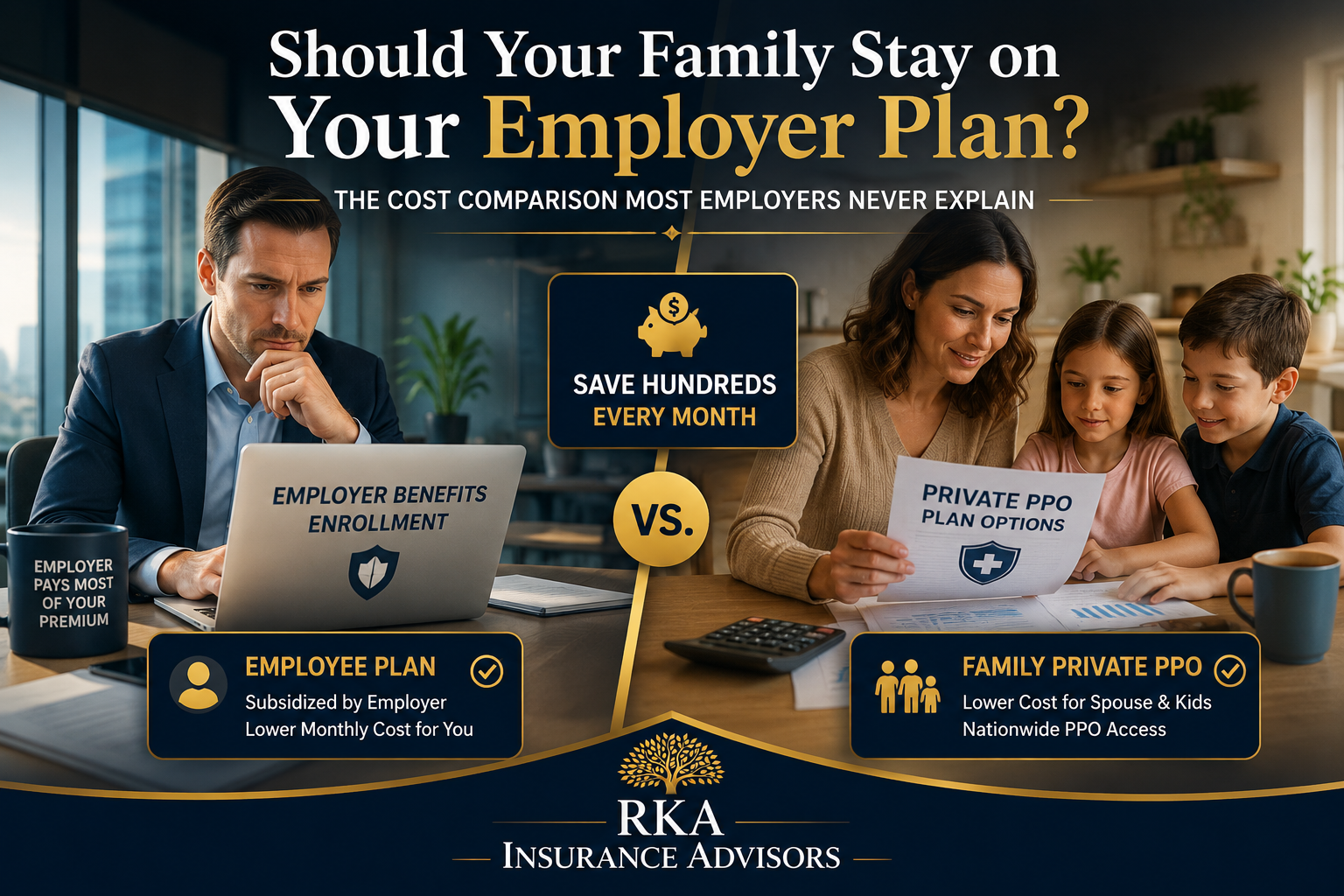
Is It Cheaper to Insure Your Family Separately From Your Employer's Plan?
Most employers heavily subsidize the employee's premium and contribute little or nothing toward a spouse or kids — so adding family to the group plan can cost hundreds a month. Here's the math nobody explains, and why "being on the same plan" matters less than you think.
Private PPO • Family Coverage
Is It Cheaper to Insure Your Family Separately From Your Employer’s Plan?
The health-insurance hack nobody talks about: what your employer really pays toward a spouse and kids — and how to pay less.
The number on your benefits sheet nobody reads
When open enrollment comes around, most people glance at the employee premium, see that it's affordable, and check the box to add their family. What they rarely do is look at how much of the family premium the employer is actually covering.
Here's the part nobody explains: employers tend to subsidize employee-only coverage — often paying somewhere between half and most of that premium — and then contribute little or nothing toward dependents. In practice, a real contribution toward a spouse or kids is rare; most people end up paying the full, unsubsidized rate to add their family. Some employers pay a flat dollar amount that barely moves when you add a spouse and kids; most pay a share of employee-only and nothing extra for family. The result is that the jump from "just me" to "me plus family" almost always lands on you — and how heavy that jump is depends entirely on your employer.
Illustrative ranges. Employer contributions vary by company — in practice a contribution toward dependents is rare. The number that decides this for you is on your own benefits sheet.
That gap is the whole game. You're not overpaying because the group plan is bad — you're overpaying because you're absorbing nearly the full cost of the people the employer doesn't subsidize.
The structure most families never consider
You don't have to put everyone on one plan. A common, completely legitimate approach for a healthy family:
You — stay on the employer plan
- Your premium is subsidized — keep it
- No change to your coverage or doctors
- Pre-tax payroll deduction stays intact
Spouse + kids — private PPO
- Priced on age and health, not the group's family rate
- Nationwide PPO network — keep your doctors, no referrals
- Available year-round — no enrollment window
- Medical underwriting — best for healthy dependents
Split the family, and you stop paying the group's unsubsidized family rate for the people the employer was never really covering. For a healthy spouse and children, a private PPO premium frequently comes in well below what the group plan charges to add them.
"But we want to be on the same plan"
This is the objection we hear most — and it's worth being honest about. A health plan is really two things: a network (which doctors and hospitals you can use) and a formulary (which medications are covered, and at what cost). "Same plan" feels meaningful, but if your providers and prescriptions are covered either way, the only real difference between being together on one plan and split across two is the price.
And that price difference is often hundreds of dollars a month. When you can see the actual savings side by side, "same plan" stops feeling like the priority it seemed to be.
This is exactly the part we handle for you: before anyone moves, we verify your spouse's and kids' doctors are in-network and their medications are covered on the new plan — so you're trading a higher bill for a lower one, not for a coverage surprise.
We'll compare keeping everyone on the group plan vs. splitting your spouse and kids onto a private PPO, verify their doctors and medications, and show you the real monthly difference. Free, no obligation.
When splitting the family makes sense — and when it doesn't
Worth comparing if…
- Your employer pays little or nothing toward dependents
- Your spouse and kids are generally healthy
- Adding family more than doubles your paycheck deduction
- You want nationwide access without referrals
Stay as-is if…
- Your employer actually subsidizes dependents too
- A family member has significant health history
- You qualify for meaningful marketplace subsidies as a family
- A key specialist isn't in the private PPO network
There's no one answer — it depends on your employer's contribution, your family's health, and your providers. The only way to know is to put the numbers next to each other.
Frequently Asked Questions
Is it allowed to keep myself on my employer plan and cover my family elsewhere?
Yes. You're not required to enroll your dependents in your employer's plan. You can keep your own employer coverage and cover your spouse and children separately on a private PPO or marketplace plan. It's a common arrangement, especially when an employer contributes little or nothing toward dependents.
How much can a family actually save doing this?
It varies by your employer's family contribution, your family's ages and health, and the plan you choose. For healthy families, the difference between the group family rate and a private PPO for a spouse and kids is often several hundred dollars a month. We run your specific numbers so you see the real figure, not an estimate.
Will my family keep their doctors?
That's the first thing we check. Private PPO plans use broad nationwide networks, so most physicians, specialists, and hospitals that accept PPO insurance are in-network — but we verify your family's specific providers and medications before anyone switches, so there are no surprises.
What if one of my kids or my spouse has a health condition?
Private plans are medically underwritten and may exclude or decline based on health history. If a dependent has significant conditions, keeping them on the group plan or using the ACA marketplace is often the better route. We'll tell you honestly which option fits each family member.
Could my family qualify for marketplace subsidies instead?
Possibly. If your employer's offer of family coverage is considered unaffordable under current rules, your spouse and children may qualify for subsidized marketplace coverage. We check that path alongside private PPO so you can compare all options on price and network.
We compare your group family rate against a private PPO for your spouse and kids, verify networks and medications, and lay out the real monthly difference. No cost, no pressure.
Robert Adams * President & Licensed Agent * NPN 19540130 * Licensed in 30 states. Premium figures and employer-contribution ranges in this article are illustrative examples, not guarantees, and vary widely by employer, plan, state, age, tobacco status, and underwriting outcome. Check your own benefits sheet for your employer's actual contribution. Private medically underwritten plans are not ACA-compliant and are subject to medical underwriting — not all applicants qualify. Marketplace subsidy eligibility depends on income and whether an employer's offer is deemed affordable. This content is for informational purposes only and does not constitute insurance, legal, tax, or financial advice. Review official plan documents and consult a licensed advisor for your situation.

Divorce and Health Insurance: What Happens to Your Coverage in 2026
Divorce ends the coverage you carried on a spouse's plan — usually within 30 days of the decree. For healthy, higher-income professionals who don' qualify for subsidies, a private medically underwritten PPO often costs far less than COBRA, with nationwide access and year-round enrollment.
Private PPO • Individual Coverage • Compare Plans
Divorce and Health Insurance: What Happens to Your Coverage in 2026
When exactly does your coverage end?
If you were the spouse carried on the other's employer or individual plan, divorce removes you as an eligible dependent. In most cases coverage ends on the last day of the month the divorce is finalized — though the exact date can be set by your decree or your plan administrator. Confirm it in writing so you know your real cutoff.
Your options after divorce
- Keeps the exact same plan, doctors, and network
- No health screening required
- Available for up to 36 months after divorce
- You pay the full premium — your share plus the employer's
- Often $500–$900+/month for one adult
- Most expensive route for a healthy person
- Best value if your employer covers 70%+ of premium
- Losing spousal coverage is a qualifying event to enroll
- Pre-existing conditions covered — no underwriting
- Only an option if your job offers benefits
- Enroll within your employer's election window (often 30 days)
- Guaranteed issue — covers any health history
- Losing coverage = 60-day Special Enrollment Period
- Subsidies possible only if income is below the threshold
- Higher earners pay the full unsubsidized rate
- Often HMO/EPO — regional networks
- Premium based on your health and age — not your income
- Nationwide PPO — see any participating doctor, no referrals
- $0 and low-deductible options available
- Available any month — no enrollment window
- For healthy applicants, often less than COBRA
- Health questionnaire required — not for every health history
Why a private PPO often fits higher-income professionals after divorce
If you're self-employed, a business owner, or simply earn above the subsidy threshold, the ACA marketplace charges you the full unsubsidized rate — and COBRA charges you the entire group premium. Neither is priced in your favor.
A private medically underwritten PPO is priced on your health and age instead of your income, so a healthy applicant frequently lands below both COBRA and unsubsidized ACA for comparable or broader coverage. And because it's a nationwide PPO with no referrals, it travels with you — useful if your work, your kids, or your post-divorce life now spans more than one state.
- Healthy, no major chronic conditions or ongoing specialty care
- Income above the ACA subsidy threshold (or variable self-employed income)
- Self-employed, business owner, or higher-earning professional
- Want nationwide coverage rather than a regional HMO/EPO network
Don't forget the kids
If your children were covered on the plan you're losing, they need a coverage plan too. Typically the parent providing coverage per the divorce decree enrolls them — through their own employer plan, the ACA marketplace, or a family private PPO. Coordinate this with your decree so there's no lapse and no duplication.
What coverage actually costs after divorce
Here's a realistic comparison for a healthy 45-year-old non-smoker with no major health history, in Florida or Texas — two of our most common markets:
COBRA (ex-spouse's plan)
- $500–$900+/mo for one adult
- Same plan and doctors
- Up to 36 months
- Full group premium + admin fee
- Most expensive for healthy people
ACA Marketplace (unsubsidized)
- Silver: $560–$720/mo
- Gold: $680–$860/mo
- Subsidies only below income threshold
- Often regional HMO/EPO networks
- Income reconciliation at tax time
Private Medically Underwritten PPO
- Often $300–$500/mo for a healthy 45-year-old
- Nationwide PPO — no referrals
- $0 deductible options available
- Not income-dependent — no reconciliation
- Available any month
*Estimates based on 2026 market data for healthy non-smokers in FL and TX. Actual figures vary by age, state, plan, health history, and underwriting outcome.
How to time the switch with no gap
30–45 days before coverage ends
- Confirm your exact coverage end date in writing
- Get pre-screened for private PPO eligibility
- Compare COBRA cost, ACA estimate, and private PPO side by side
At and after the decree
- 60-day special enrollment window opens when coverage ends
- COBRA can serve as a short backstop if underwriting is still processing
- Private plan effective the 1st of the following month — no gap if timed right
We compare COBRA, ACA, and private PPO for your exact situation — and pre-screen private eligibility before you apply. No pressure, no obligation.
Frequently Asked Questions
When does my coverage on my spouse's plan actually end?
In most cases it ends on the last day of the month the divorce is finalized, though your decree or plan administrator may set a different date. Confirm the exact cutoff in writing with the plan administrator so you can line up replacement coverage with no gap.
Is divorce a qualifying event for new coverage?
Yes. Losing coverage due to divorce triggers a 60-day Special Enrollment Period on the ACA marketplace, and it's also a qualifying event to join your own employer's plan (usually within about 30 days). Private medically underwritten PPO plans don't require a qualifying event at all — they're available any month.
How long can I keep COBRA after a divorce?
Divorce is a qualifying event that allows the former spouse to elect COBRA for up to 36 months. The trade-off is cost: you pay the full group premium plus a small administrative fee, which is why COBRA is often the most expensive option for a healthy person.
Will my income from the divorce affect ACA subsidies?
Possibly. ACA subsidies are based on Modified Adjusted Gross Income, and a settlement or change in income can move you above or below the threshold. Tax treatment of support payments depends on when your agreement was finalized. Work with your CPA on the numbers — and note that a private PPO is priced on health, not income, so it sidesteps this entirely.
What about coverage for my kids?
If your children were on the plan you're losing, the parent responsible for their coverage under the decree enrolls them — through an employer plan, the ACA marketplace, or a family private PPO. Coordinate it so there's no lapse and you're not paying for duplicate coverage.
What if I have a health condition and don't qualify for a private plan?
If private underwriting isn't available based on your health history, COBRA and the ACA marketplace remain solid options — the ACA is guaranteed issue regardless of health. We compare all three honestly and tell you which fits before you apply for anything.
Independent broker. We run COBRA, ACA, and private PPO side by side for your situation. Free quotes, honest advice, no pressure.
Robert Adams * President & Licensed Agent * NPN 19540130 * Licensed in 30 states. Premium estimates are illustrative ranges based on 2026 market data and are not guaranteed. Actual premiums vary by age, state, tobacco status, plan selection, carrier, and underwriting outcome. Private medically underwritten plans are not ACA-compliant and are subject to medical underwriting — not all applicants qualify. COBRA timelines and costs vary by plan; coverage end dates vary by decree and plan administrator. This content is for informational purposes only and does not constitute insurance, legal, tax, or financial advice — consult your attorney and CPA for your specific situation.

Independence Day 2026 — A Note From RKA Insurance Advisors
Independence Day • July 4, 2026
Happy Independence Day
248 years ago, a group of people decided to bet on themselves. That spirit never stopped.
The Declaration of Independence wasn't just a political document. It was the founding act of a nation built on the idea that individuals have the right to chart their own course — to pursue their own happiness, build their own lives, and take responsibility for what happens next.
That same spirit lives in every entrepreneur who left a steady paycheck to build something. Every freelancer who traded a cubicle for the freedom to work on their own terms. Every small business owner who signed the front of a check instead of the back.
Self-employment is one of the most American things a person can do. It comes with real risk. It comes with uncertainty. And it comes without a safety net that most people take for granted — including health insurance.
That's part of why we do what we do. We believe people who bet on themselves deserve real options — not just whatever's left on the marketplace after the subsidies run out.
Today, though — none of that matters. Today is for cookouts and fireworks and the people you love. For gratitude to the men and women who defended this country's right to exist. For the freedom that makes every ambitious, risky, uncertain American dream worth chasing.
Happy Independence Day from our team to yours. Go enjoy it.
NPN 19540130 • Licensed in 32 States
rkainsuranceadvisors.com

Kentucky Derby 2026 — The Health Insurance Problem Horse Country Doesn't Talk About
Kentucky's horse industry employs 60,000+ people — jockeys, trainers, grooms, exercise riders, equine vets — and almost all of them are 1099. Almost none have group health insurance. Here's why ACA fails this workforce in 2026, and what private PPO options actually look like for healthy self-employed Kentucky workers.
Private PPO • Kentucky • Self-Employed • 2026
Kentucky Derby Week — and the Health Insurance Problem Nobody in Horse Country Talks About
The workforce behind the roses
The Kentucky Derby is the most watched two minutes in sports. Churchill Downs, the pageantry, the fashion, the horses — it's one of the great American spectacles. But behind every race is a workforce that operates almost entirely outside the traditional employment model.
Jockeys are independent contractors. Trainers run their own operations as self-employed business owners. Grooms, exercise riders, hot walkers, and stable hands are often paid per horse or per week — no benefits, no HR department, no group health plan. Veterinarians in private equine practice are self-employed professionals. The entire horse racing ecosystem in Kentucky and beyond runs on 1099 workers.
And virtually none of them have health insurance that actually works for the way they live and work.
Why this workforce is chronically underinsured
The ACA problem for horse industry workers
- Income is often variable — per horse, per race, per season
- Subsidy reconciliation creates tax risk when income varies year to year
- ACA premiums up 18–20% in 2026 — largest increase since 2018
- Kentucky marketplace often offers limited plan choices in rural counties
- HMO/EPO networks are regional — don't work when traveling to other racing states
Why private PPO fits this workforce
- Premium based on health — not income variability
- No subsidy reconciliation — no year-end tax surprise
- Nationwide PPO — works in Kentucky, Florida, California, New York, anywhere they race
- No referrals — see any specialist, any state, any time
- Available any month — no enrollment window
- For healthy applicants, often significantly less than ACA
The travel problem — and why ACA often fails horse industry workers
The racing calendar doesn't stay in Kentucky. Trainers, jockeys, and their teams follow the horses — Keeneland in the spring, Churchill Downs for Derby week, Saratoga in August, Gulfstream in Florida, Santa Anita in California, Belmont in New York.
An ACA marketplace plan purchased in Kentucky often uses a Kentucky-based HMO or EPO network. The moment you're in Florida or California, you're out of network — and you're paying out of pocket for everything except emergencies.
A nationwide private PPO has no such restriction. You're in-network at any participating provider in any state. For a workforce that moves with the horses, this isn't a nice-to-have. It's the difference between usable coverage and coverage that fails you exactly when you need it.
What does private PPO actually cost in Kentucky?
For healthy applicants in Kentucky, private medically underwritten plan estimates in 2026:
Age 25–35, healthy
- $125–$255/month typical range
- $0 deductible options available
- Nationwide PPO access
Age 35–50, healthy
- $225–$415/month typical range
- Multiple deductible options
- Works in all 50 states
vs ACA Kentucky (unsubsidized)
- Silver: $345–$520/month
- Gold: $420–$620/month
- Often regional network only
- Up 18–20% in 2026
*Estimates for healthy non-smokers. Actual premiums vary by age, plan, health history, and underwriting outcome.
Who this applies to beyond horse country
The same coverage gap exists for self-employed professionals across Kentucky — not just those in the horse industry. Independent contractors in Louisville, Lexington, Bowling Green, and across the state face identical challenges with ACA marketplace plans and the same opportunity with private PPO.
Horse industry workers
- Jockeys — independent contractors
- Trainers — self-employed
- Grooms and stable hands — variable income
- Equine veterinarians — private practice
- Exercise riders — per-horse compensation
Other Kentucky self-employed
- Real estate agents across Kentucky
- Independent contractors in Louisville's logistics sector
- Bourbon industry consultants and independent distillers
- Freelancers and remote workers statewide
- Small business owners without group plans
The common thread
- 1099 income or self-employed
- No employer group plan available
- Often healthy — priced well for private PPO
- May travel or work in multiple states
- ACA full rate is expensive without subsidies
We compare ACA marketplace vs private PPO options for your specific situation. We're licensed in Kentucky and 31 other states. No pressure, no obligation — just an honest comparison.
Frequently Asked Questions
Is RKA Insurance licensed in Kentucky?
Yes. RKA Insurance Advisors is licensed in Kentucky and 31 other states. We work with self-employed professionals and 1099 workers across Kentucky — from Louisville and Lexington to rural horse country.
Can I get coverage that works in multiple states if I travel with the racing circuit?
Yes — this is exactly what private medically underwritten PPO plans are designed for. A nationwide PPO gives you in-network access at any participating provider anywhere in the country, with no referrals and no prior authorization for most services. It's the only plan type that genuinely works for someone who follows the racing calendar across multiple states.
My income varies by season. Does that affect my premium?
No — private PPO premiums are based on your health, not your income. This is a significant advantage over ACA marketplace plans, where income fluctuation can create subsidy reconciliation issues and unexpected tax bills. With private PPO, your rate is set at underwriting and doesn't change based on what you earn that year.
What if I've been injured before — does that affect eligibility?
It depends on the nature and timing of the injury. Minor, fully resolved injuries often don't affect private plan eligibility. Ongoing orthopedic issues, surgeries within the past few years, or chronic conditions may affect underwriting. We pre-screen applicants before submitting a formal application so you have a realistic picture before anything goes on record.
What if I don't qualify for private PPO?
If private underwriting isn't available based on your health history, ACA marketplace coverage remains a solid option — and losing previous coverage is a qualifying life event that opens a special enrollment period. We'll give you an honest side-by-side comparison of both paths.
Independent broker. Licensed in Kentucky and 31 other states. Free quotes for self-employed horse industry workers and Kentucky professionals. No pressure, honest advice.
Robert Adams * President & Licensed Agent * NPN 19540130 * Licensed in 32 states including Kentucky. Premium estimates are illustrative ranges based on 2026 market data and are not guaranteed. Actual premiums vary by age, state, tobacco status, plan selection, carrier, and underwriting outcome. Private medically underwritten plans are not ACA-compliant and subject to medical underwriting — not all applicants qualify. This content is for informational purposes only and does not constitute insurance, legal, or financial advice.
Health Insurance for Self-Employed Floridians: What to Know in 2026
Florida has more solo incorporated businesses per capita than any other state. If you're self-employed and above the ACA subsidy threshold, you may be overpaying for coverage. Private medically underwritten plans often cost 30-50% less for healthy Floridians.
Private PPO • Florida • Self-Employed
Health Insurance for Self-Employed Floridians: What to Know in 2026
We'll compare private and marketplace options side by side — no obligation.
Why Florida Has a Health Insurance Problem Worth Talking About
Florida consistently ranks first in the nation for incorporated self-employed workers per capita. The combination of no state income tax, warm weather, and a business-friendly regulatory environment has attracted hundreds of thousands of freelancers, consultants, sole proprietors, and small business owners over the past decade — and that number keeps growing as remote work enables relocation from high-tax states like New York, California, and Illinois.
That's great for Florida's economy. But it creates a concentrated population of people who have to buy their own health insurance — and many of them are paying far more than they need to.
The ACA Subsidy Cliff: Who It Hits Hardest
The Affordable Care Act offers significant premium subsidies for households earning up to 400% of the federal poverty level (FPL). In 2026, that's roughly $62,000 for a single person and $127,000 for a family of four. Enhanced subsidies through recent legislation have expanded eligibility somewhat, but there's still a hard threshold beyond which you receive little or no federal assistance.
For self-employed Floridians whose income exceeds that threshold — or whose net income fluctuates year to year — full marketplace rates can be steep:
Single, Age 35
- Bronze ACA: $320–$420/mo
- Silver ACA: $430–$560/mo
- Gold ACA: $530–$680/mo
Unsubsidized. Full premium.
Single, Age 45
- Bronze ACA: $420–$560/mo
- Silver ACA: $560–$720/mo
- Gold ACA: $680–$860/mo
Unsubsidized. Full premium.
Couple, Ages 40/42
- Bronze ACA: $780–$980/mo
- Silver ACA: $1,000–$1,280/mo
- Gold ACA: $1,200–$1,500/mo
Unsubsidized. Full premium.
These are estimates based on 2026 Florida marketplace rates in major metro areas. Actual premiums vary by zip code, carrier, and plan. The point: if you're not receiving subsidies, marketplace coverage is expensive — and many self-employed Floridians have an alternative worth exploring.
The Alternative: Private Medically Underwritten Coverage
Outside the ACA marketplace, a separate market exists for private medically underwritten plans with a nationwide PPO network. These plans are not sold on healthcare.gov. They require a health questionnaire and, in some cases, a brief medical review. If you qualify, the savings can be significant.
Guaranteed Issue
- No health questions required
- Everyone pays the same rate by age/zip
- Subsidies available below income threshold
- Premiums high above subsidy cliff
- Limited networks in some FL counties
- Risk pool includes all health conditions
Medically Underwritten
- Health questionnaire required
- Lower premiums for healthy applicants
- Nationwide PPO network access
- Flexible plan designs and deductibles
- No open enrollment window required
- Not available if significant health history
For a healthy 40-year-old in Florida, a private medically underwritten plan with a nationwide PPO network starts at $266/month and typically runs $266–$350/month — compared to $420–$560/month for an unsubsidized ACA Silver plan. That's a savings of $900–$1,800/year for comparable coverage.
Who Qualifies in Florida
Eligibility is based on your health history, not your income. The underwriting process typically reviews the past 3–5 years of medical records and asks about conditions including but not limited to: diabetes, heart disease, cancer, autoimmune disorders, ongoing prescription medication use, and recent hospitalizations.
Likely to Qualify
- No major chronic conditions
- No recent hospitalizations (past 2 years)
- No ongoing specialty care
- Minimal or no prescription medications
- Non-smoker (or quit 12+ months ago)
- Healthy BMI range
May Not Qualify
- Type 1 or Type 2 diabetes
- Heart disease or prior cardiac events
- Active cancer treatment or recent history
- Multiple ongoing prescriptions
- Autoimmune conditions (lupus, MS, etc.)
- Recent surgery or planned procedures
If you don't qualify for a private plan, the ACA marketplace remains the right option — especially if subsidies are available. There's no one-size-fits-all answer, which is why it makes sense to compare both before enrolling.
Florida-Specific Considerations
A few things that make Florida's self-employed health insurance landscape distinct:
No State Income Tax Advantage
- Self-employed health insurance premiums are deductible federally
- No Florida state income tax to offset
- Premium savings go straight to your bottom line
- Lower monthly cost = more cash flow for the business
New Residents from High-Cost States
- Relocating from NY, CA, IL? Rates are lower here
- New to self-employment after a move? No COBRA required
- Can apply for private coverage any time of year
- No open enrollment window to wait for
We run quotes on both private and marketplace options so you can compare apples to apples before deciding.
What the Process Looks Like
If you're interested in a private medically underwritten plan, here's what to expect from start to finish:
Step 1 — Get Quotes
- Submit basic info and health snapshot
- Receive side-by-side comparison
- Private vs marketplace vs hybrid options
- No obligation, takes about 5 minutes
Step 2 — Review & Apply
- Choose a plan that fits your budget
- Complete the health questionnaire
- Underwriting review (typically 3–7 days)
- Approval, counteroffer, or decline issued
Step 3 — Coverage Starts
- Effective date typically 1st of following month
- ID cards issued within 1–2 weeks
- Access to full nationwide PPO network immediately
- No waiting for open enrollment
Frequently Asked Questions
Is a private medically underwritten plan legal in Florida?
Yes. Private medically underwritten plans are legal in Florida and in all states where RKA operates. They are not sold on the ACA marketplace and are not subject to ACA guaranteed-issue rules, but they are fully licensed and regulated products.
Can I deduct the premiums as a self-employed person?
In most cases, yes. Self-employed individuals can deduct 100% of health insurance premiums paid for themselves, their spouse, and dependents as an above-the-line deduction on federal taxes. Consult your CPA for your specific situation, as deductibility depends on your business structure and net profit.
What if I get sick after I enroll — can they cancel my coverage?
No. Once you are approved and enrolled, the carrier cannot cancel your coverage due to a new diagnosis or change in health. The underwriting only applies at the time of application. Renewal rates may change, but the plan cannot be rescinded for medical reasons after approval.
Do these plans cover specialists and hospitals in Florida?
Yes. Private medically underwritten plans through RKA use a nationwide PPO network with access to major hospital systems and specialists throughout Florida, including in Miami, Tampa, Orlando, Jacksonville, and other metro areas. You can verify specific providers before enrolling.
What if I don't qualify for a private plan?
If you don't qualify based on your health history, we'll show you the best available ACA marketplace options for your zip code and income level. If subsidies are available, we factor those in too. You leave with a clear picture either way — no pressure to buy anything.
I moved to Florida recently. Can I still apply?
Yes. There's no residency waiting period for a private medically underwritten plan. If you recently relocated to Florida from another state, you can apply immediately — no open enrollment window required. A recent move may also qualify you for a Special Enrollment Period on the ACA marketplace if you prefer that route.
RKA Insurance Advisors runs quotes on private medically underwritten plans and ACA options so you can compare both — free, no obligation.
Premium estimates are illustrative ranges based on 2026 Florida marketplace data and are not guaranteed. Actual premiums vary by age, zip code, tobacco status, plan selection, and carrier. Private medically underwritten plan availability and pricing are subject to underwriting approval. RKA Insurance Advisors LLC, NPN 19540130, licensed in 32 states. This content is for informational purposes only and does not constitute insurance advice.

New to Texas? Health Insurance—Fast Guide (Marketplace vs Private PPO)
Texas health insurance, made simple: Marketplace credits vs Private PPO, how networks differ, start dates, and what to verify first. We’ll check your doctors and show clear costs.
New to Texas? Health Insurance—Fast Guide (Marketplace vs Private PPO)
Just moved to TX? Here’s how coverage works, what proof you’ll need, and how to keep your doctors. We’ll verify providers and show clear costs—no pressure.
- Can be cheapest if your income qualifies for credits.
- Many plans are HMO/EPO; referrals are common.
- Options vary by county/ZIP.
- Move = special enrollment (time-limited). Credits reconcile at tax time.
- Nationwide PPO access when eligible; keep key doctors/hospitals.
- Typically no referrals; fewer hoops for specialists.
- Pricing isn’t tied to ACA income credits.
- Good for travel, provider choice, and specialist access.
What to do first (takes 5 minutes)
1) Gather quick proof
- New TX address (lease, closing docs, utility, USPS change).
- Prior coverage details if switching.
2) List providers & meds
- Doctors, specialists, hospitals you want to keep.
- Current prescriptions (name + dosage).
3) Decide priorities
- Lowest premium vs. broad network.
- Referrals OK or prefer no referrals?
- Travel out of state?
What drives cost in Texas
Marketplace
- Income & household size (for tax credits).
- Plan level & network (HMO/EPO common).
- County—options can change across county lines.
Private PPO
- Age, ZIP, benefit level, and network size.
- No ACA credits; premiums are straightforward.
- Great when keeping providers is the priority.
Simple decision guide
Choose Marketplace if…
- Your income qualifies for strong credits.
- You’re OK with HMO/EPO rules & referrals.
- Lowest premium is the top priority.
Choose Private PPO if…
- You want broad, often nationwide PPO access.
- You prefer no referrals to see specialists.
- Keeping specific doctors/hospitals matters most.
New to Texas? Let’s lock the best fit in your ZIP.
We’ll verify your doctors and meds, compare Marketplace vs Private PPO, and show clear costs. No pressure—just answers.
FAQ for recent Texas moves
Do I get a special enrollment window when I move to Texas?
What proof of my move do I need?
When will coverage start?
Can I keep my current doctors?
What if I’m coming from COBRA?
This overview is educational, not tax or legal advice. Availability and rules vary by carrier and county. Eligibility and enrollment subject to plan terms.
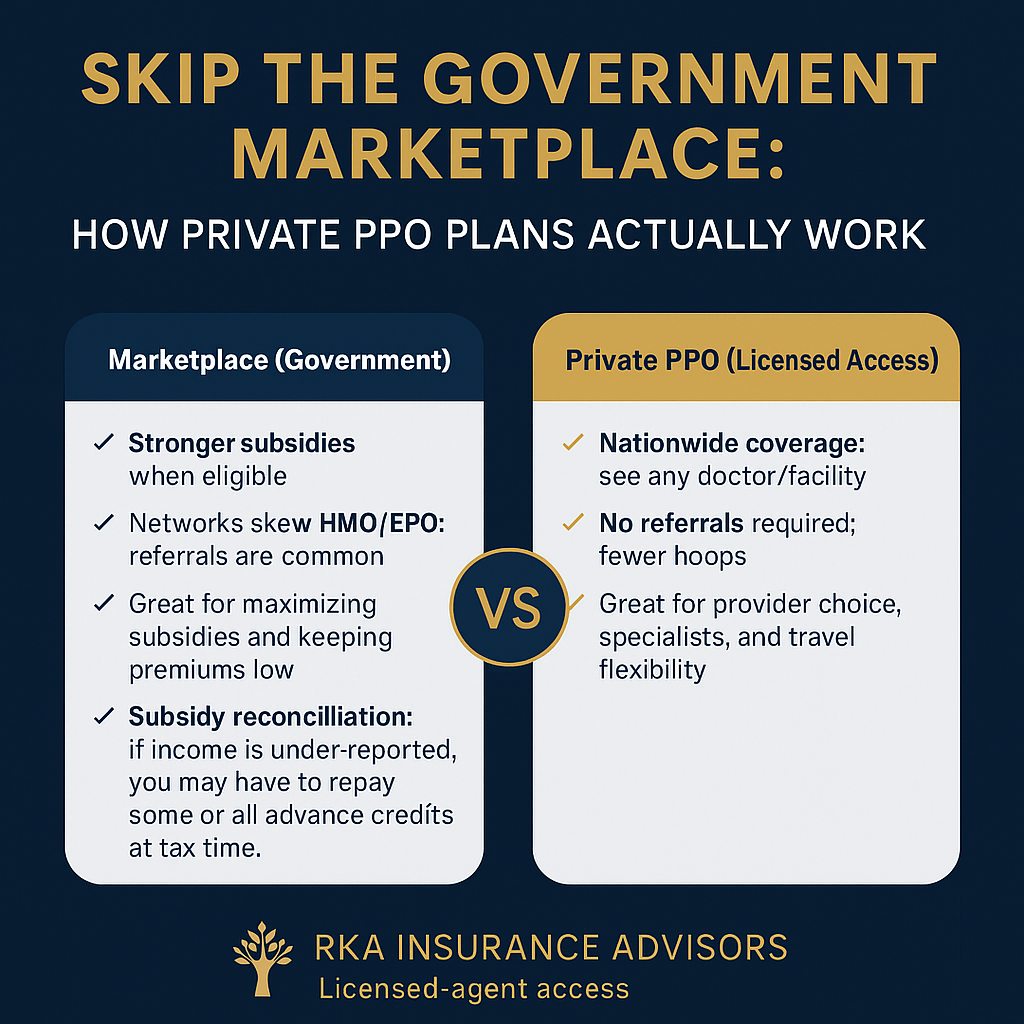
Skip the Government Marketplace: How Private PPO Plans Actually Work
Fast guide to non-Marketplace Private PPOs—how they bill, who they fit, and what to verify first. We’ll confirm your doctors, compare options, and show clear costs.
Skip the Government Marketplace: How Private PPO Plans Actually Work
Prefer private, licensed-access coverage? Here’s the fast, practical guide—what it is, how it bills, and how to check if it fits your doctors, travel, and budget.
Why some people skip the Marketplace
- Keep specific doctors/hospitals. Many Marketplace options are HMO/EPO with referrals.
- Travel flexibility. Want nationwide, not just local networks.
- Fewer gatekeepers. Prefer no referrals for specialists or imaging.
- Income too high for meaningful subsidies—or you don’t want tax-credit involvement.
- If your income qualifies, Marketplace can be the cheapest route.
- Credits reconcile on your tax return; under-reporting income can create payback.
- Private PPOs skip subsidies entirely—pricing is based on age, ZIP, benefits, and network.
How Private PPO actually works
- Nationwide PPO access in eligible networks—keep your specialists and preferred hospitals.
- No referrals for specialists (typical), fewer hoops to schedule care.
- Enroll through a licensed agent; options vary by state and carrier.
- Premiums aren’t tied to ACA income credits.
- Your exact doctors and facilities are in-network (we check for you).
- Copays vs coinsurance on high-ticket items (imaging, outpatient surgery).
- Prescription tiers and any prior-auth on key meds.
- Out-of-pocket maximum is a number you can live with.
What drives price (non-subsidized)
The big levers
- Age rating for adults; kids usually add less than another adult.
- ZIP/county + network breadth.
- Deductibles, coinsurance, copays, and the out-of-pocket max.
Ways to keep it efficient
- Don’t overbuy—match benefits to how you actually use care.
- Choose networks that include your real providers (not just brand names).
- Use generics when clinically appropriate; we’ll check formulary tiers.
Who typically chooses Private PPO
Strong fit
- Self-employed/1099 families who want broad doctor choice.
- Frequent travelers or multi-state households.
- People who dislike referral bottlenecks.
Maybe not a fit
- Households whose main goal is max subsidies and the lowest possible premium.
- Anyone who does not have specific providers to keep and rarely needs out-of-area care.
Want the best non-Marketplace fit in your ZIP?
We’ll verify your doctors and meds, compare PPO options, and show clear costs. No pressure—just answers.
FAQ
Are Private PPOs the same as Marketplace plans?
Do Private PPOs need referrals?
Will I owe taxes if I’m not using subsidies?
How do I know if my doctor is covered?
How do we start?
This overview is educational, not tax or legal advice. Plan availability and rules vary by state and carrier. Eligibility and enrollment subject to underwriting/plan terms where applicable.

New to Florida? Health Insurance—Fast Guide (Marketplace vs Private PPO)
Fast guide for Floridians who just moved—how coverage works, proof to have ready, and how to keep your doctors. We compare Marketplace vs Private PPO and show clear costs.
New to Florida? Health Insurance—Fast Guide (Marketplace vs Private PPO)
Just moved to FL? Here’s how coverage works, what proof you’ll need, and how to keep your doctors. We’ll verify providers and show clear costs—no pressure.
- Can be cheapest if your income qualifies for credits.
- Many plans are HMO/EPO; referrals are common.
- County-based options; networks vary by ZIP.
- Move = special enrollment (time-limited). Credits reconcile at tax time.
- Nationwide PPO access when eligible; keep key doctors/hospitals.
- Typically no referrals; fewer hoops for specialists.
- Pricing isn’t tied to ACA income credits.
- Good for travel, provider choice, and specialist access.
What to do first (takes 5 minutes)
1) Gather quick proof
- New FL address (lease, closing docs, utility, USPS change).
- Prior coverage details if switching.
2) List providers & meds
- Doctors, specialists, hospitals you want to keep.
- Current prescriptions (name + dosage).
3) Decide priorities
- Lowest premium vs. broad network.
- Referrals OK or prefer no referrals?
- Travel out of state?
What drives cost in Florida
Marketplace
- Income & household size (for tax credits).
- Plan level & network (HMO/EPO common).
- County—options can change across county lines.
Private PPO
- Age, ZIP, benefit level, and network size.
- No ACA credits; premiums are straightforward.
- Great when keeping providers is the priority.
Simple decision guide
Choose Marketplace if…
- Your income qualifies for strong credits.
- You’re OK with HMO/EPO rules & referrals.
- Lowest premium is the top priority.
Choose Private PPO if…
- You want broad, often nationwide PPO access.
- You prefer no referrals to see specialists.
- Keeping specific doctors/hospitals matters most.
New to Florida? Let’s lock the best fit in your ZIP.
We’ll verify your doctors and meds, compare Marketplace vs Private PPO, and show clear costs. No pressure—just answers.
FAQ for recent Florida moves
Do I get a special enrollment window when I move to Florida?
What proof of my move do I need?
When will coverage start?
Can I keep my current doctors?
What if I’m coming from COBRA?
This overview is educational, not tax or legal advice. Availability and rules vary by carrier and county. Eligibility and enrollment subject to plan terms.
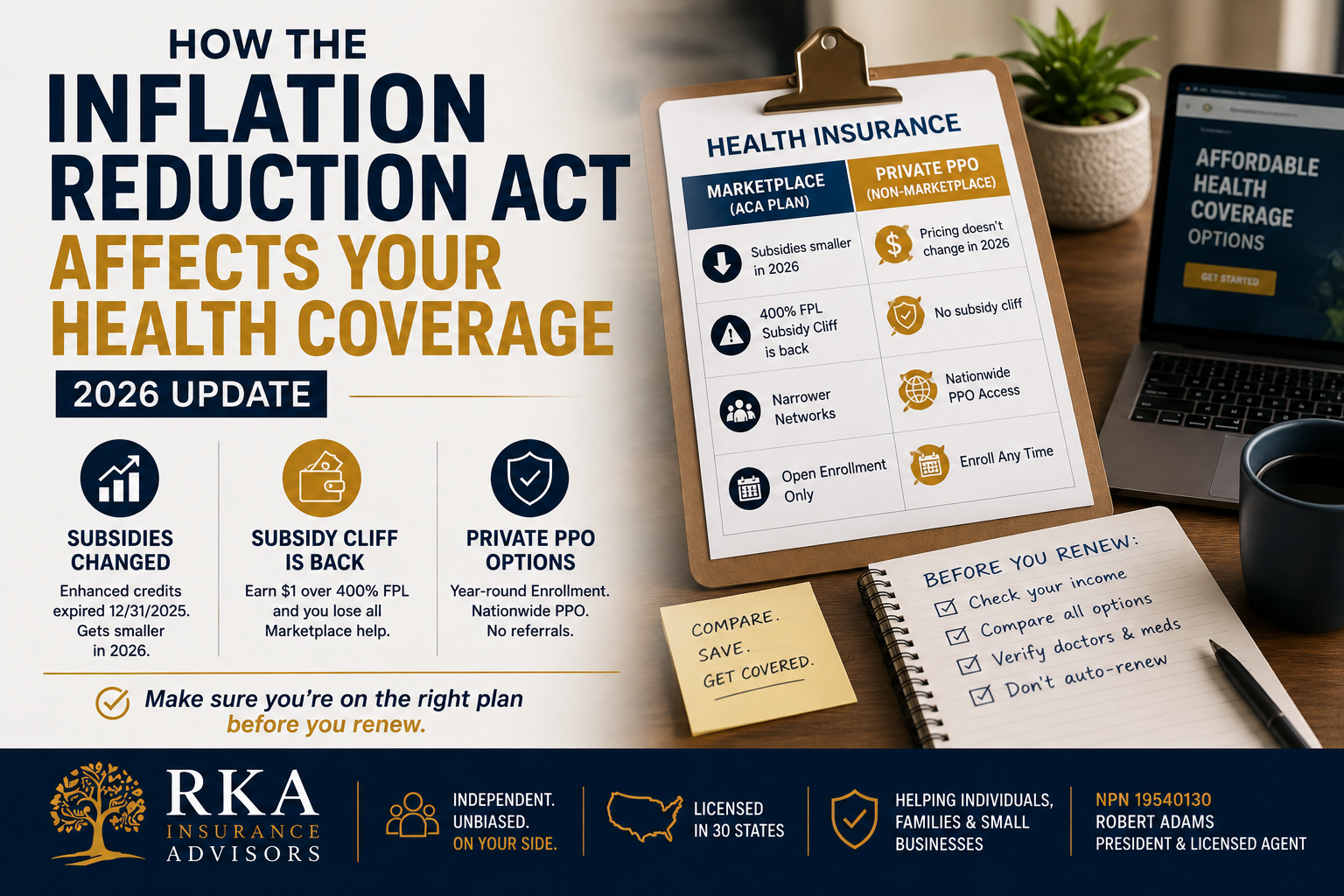
How does the Inflation Reduction Act affect your Health Coverage?
The Inflation Reduction Act's enhanced ACA subsidies expired at the end of 2025 and the 2026 subsidy cliff is back. Here's what changed, the income cutoffs, and where a private PPO now beats the marketplace.
Private PPO • Marketplace • 2026 Changes
How the Inflation Reduction Act Affects Your Health Coverage (2026 Update)
What changed for 2026
The IRA’s larger subsidies were always temporary. They ran from 2021 through 2025, and Congress did not extend them. When 2026 Open Enrollment opened, the enhanced credits were gone — and for millions of people the price to keep the same plan jumped sharply.
The cliff cutoff scales with household size — roughly $84,600 for a couple and $128,600 for a family of four in 2026. Cross it by a dollar and your Marketplace subsidy drops to zero.
Marketplace vs. Private PPO in 2026
Marketplace (ACA) Plans
- Still a strong fit if your income is under the cliff and you qualify for a subsidy
- Guaranteed issue — no health questions
- Above 400% of poverty, you now pay the full unsubsidized premium
- Networks are often narrower (HMO/EPO) with referrals
Private PPO (Non-Marketplace)
- Never used IRA subsidies — nothing about its pricing changed in 2026
- Priced on age and health, not income — often cheaper over the cliff
- Nationwide PPO access, no referrals, enroll any month
- Medically underwritten — not everyone qualifies
What to compare before you renew
Run the cost math
- Your realistic 2026 income vs. the cliff cutoff for your family size
- Full-price Marketplace premium vs. a private PPO quote
- Deductibles and out-of-pocket maximums, not just the premium
- Total annual cost across the whole year
Check the fit
- Are your doctors in each plan’s network?
- Are your prescriptions covered, and at what tier?
- Do you travel or live across state lines?
- Any planned procedure or pregnancy this year?
Not sure which side of the cliff you’re on?
We’ll put full-price Marketplace and a nationwide private PPO side by side for your exact situation — verify your doctors, check your prescriptions, and tell you honestly which wins. Free, no obligation.
Get Free Quotes Book a CallThe self-employed angle
If you run a business or work 1099, the expired subsidies hit harder — you’re buying your own coverage with no employer help, and you’re more likely to be over the cliff. That’s exactly the situation where a medically underwritten nationwide PPO can beat full-price Marketplace, priced on your health instead of your income. There’s also a tax angle: self-employed people can often deduct their premiums — worth raising with your tax professional as you compare.
Related reading
Frequently asked questions
Did the Inflation Reduction Act’s subsidies go away?
The larger enhanced credits that ran from 2021 through 2025 expired December 31, 2025. The original ACA subsidies still exist, but at smaller pre-2021 levels — and the 400% income cliff is back for 2026.
I earn just over the cliff — what are my options?
Above 400% of the federal poverty level you get no Marketplace subsidy in 2026, so you pay the full premium. For a healthy household, a medically underwritten private PPO is often less expensive with a broader nationwide network. It’s worth comparing both before you decide.
Why did my premium jump so much for 2026?
When the enhanced subsidies expired, the amount of help you receive shrank, so the net premium you pay rose — on average about 114% for subsidized enrollees to keep the same plan.
Do I still need to report income changes?
Yes. If you use Marketplace coverage, keep your income and household details updated so your subsidy stays accurate — with the cliff back in 2026, being off can mean a large bill at tax time.
Subsidy amounts, cliff cutoffs, and premiums vary by household and can change; the figures here reflect 2026 rules at the time of writing.
Robert Adams · President & Licensed Agent · NPN 19540130 · Licensed in 30 states. Premium and subsidy figures are illustrative and based on general market data — actual amounts vary by age, state, income, and health. Private medically underwritten plans are not ACA-compliant and are subject to medical underwriting — not all applicants qualify. This content is for informational purposes only and does not constitute insurance, legal, tax, or financial advice.

Robert Adams
https://www.RKAInsuranceAdvisors.com