Whether you’re on the road for work, chasing weekend getaways, or planning a cross‑country move, having reliable coverage that travels with you matters. Traveler‑friendly plans—often built on nationwide PPO networks—help you access urgent care, ERs, and a broad set of in‑network doctors across the U.S.
New to Texas? Health Insurance—Fast Guide (Marketplace vs Private PPO)
Texas health insurance, made simple: Marketplace credits vs Private PPO, how networks differ, start dates, and what to verify first. We’ll check your doctors and show clear costs.
New to Texas? Health Insurance—Fast Guide (Marketplace vs Private PPO)
Just moved to TX? Here’s how coverage works, what proof you’ll need, and how to keep your doctors. We’ll verify providers and show clear costs—no pressure.
- Can be cheapest if your income qualifies for credits.
- Many plans are HMO/EPO; referrals are common.
- Options vary by county/ZIP.
- Move = special enrollment (time-limited). Credits reconcile at tax time.
- Nationwide PPO access when eligible; keep key doctors/hospitals.
- Typically no referrals; fewer hoops for specialists.
- Pricing isn’t tied to ACA income credits.
- Good for travel, provider choice, and specialist access.
What to do first (takes 5 minutes)
1) Gather quick proof
- New TX address (lease, closing docs, utility, USPS change).
- Prior coverage details if switching.
2) List providers & meds
- Doctors, specialists, hospitals you want to keep.
- Current prescriptions (name + dosage).
3) Decide priorities
- Lowest premium vs. broad network.
- Referrals OK or prefer no referrals?
- Travel out of state?
What drives cost in Texas
Marketplace
- Income & household size (for tax credits).
- Plan level & network (HMO/EPO common).
- County—options can change across county lines.
Private PPO
- Age, ZIP, benefit level, and network size.
- No ACA credits; premiums are straightforward.
- Great when keeping providers is the priority.
Simple decision guide
Choose Marketplace if…
- Your income qualifies for strong credits.
- You’re OK with HMO/EPO rules & referrals.
- Lowest premium is the top priority.
Choose Private PPO if…
- You want broad, often nationwide PPO access.
- You prefer no referrals to see specialists.
- Keeping specific doctors/hospitals matters most.
New to Texas? Let’s lock the best fit in your ZIP.
We’ll verify your doctors and meds, compare Marketplace vs Private PPO, and show clear costs. No pressure—just answers.
FAQ for recent Texas moves
Do I get a special enrollment window when I move to Texas?
What proof of my move do I need?
When will coverage start?
Can I keep my current doctors?
What if I’m coming from COBRA?
This overview is educational, not tax or legal advice. Availability and rules vary by carrier and county. Eligibility and enrollment subject to plan terms.
Skip the Government Marketplace: How Private PPO Plans Actually Work
Fast guide to non-Marketplace Private PPOs—how they bill, who they fit, and what to verify first. We’ll confirm your doctors, compare options, and show clear costs.
Skip the Government Marketplace: How Private PPO Plans Actually Work
Prefer private, licensed-access coverage? Here’s the fast, practical guide—what it is, how it bills, and how to check if it fits your doctors, travel, and budget.
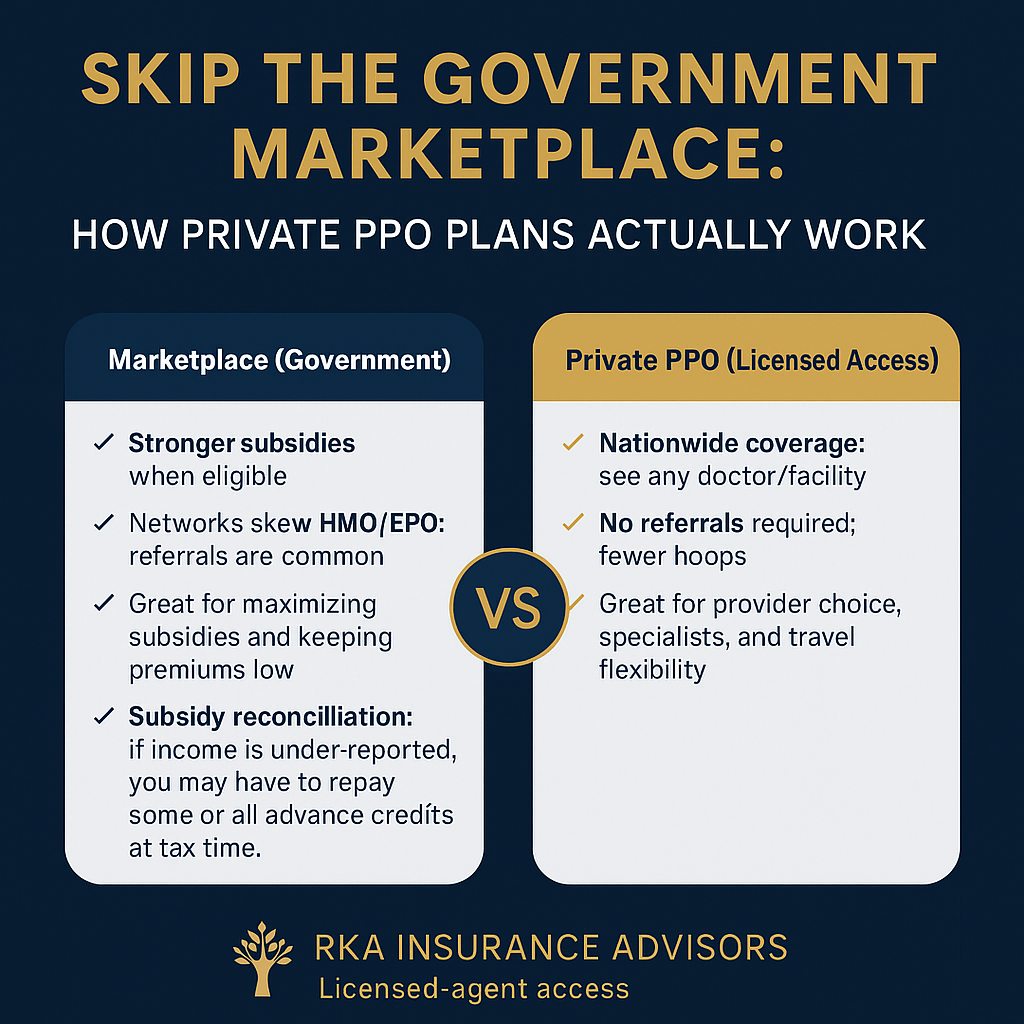
Why some people skip the Marketplace
- Keep specific doctors/hospitals. Many Marketplace options are HMO/EPO with referrals.
- Travel flexibility. Want nationwide, not just local networks.
- Fewer gatekeepers. Prefer no referrals for specialists or imaging.
- Income too high for meaningful subsidies—or you don’t want tax-credit involvement.
- If your income qualifies, Marketplace can be the cheapest route.
- Credits reconcile on your tax return; under-reporting income can create payback.
- Private PPOs skip subsidies entirely—pricing is based on age, ZIP, benefits, and network.
How Private PPO actually works
- Nationwide PPO access in eligible networks—keep your specialists and preferred hospitals.
- No referrals for specialists (typical), fewer hoops to schedule care.
- Enroll through a licensed agent; options vary by state and carrier.
- Premiums aren’t tied to ACA income credits.
- Your exact doctors and facilities are in-network (we check for you).
- Copays vs coinsurance on high-ticket items (imaging, outpatient surgery).
- Prescription tiers and any prior-auth on key meds.
- Out-of-pocket maximum is a number you can live with.
What drives price (non-subsidized)
The big levers
- Age rating for adults; kids usually add less than another adult.
- ZIP/county + network breadth.
- Deductibles, coinsurance, copays, and the out-of-pocket max.
Ways to keep it efficient
- Don’t overbuy—match benefits to how you actually use care.
- Choose networks that include your real providers (not just brand names).
- Use generics when clinically appropriate; we’ll check formulary tiers.
Who typically chooses Private PPO
Strong fit
- Self-employed/1099 families who want broad doctor choice.
- Frequent travelers or multi-state households.
- People who dislike referral bottlenecks.
Maybe not a fit
- Households whose main goal is max subsidies and the lowest possible premium.
- Anyone who does not have specific providers to keep and rarely needs out-of-area care.
Want the best non-Marketplace fit in your ZIP?
We’ll verify your doctors and meds, compare PPO options, and show clear costs. No pressure—just answers.
FAQ
Are Private PPOs the same as Marketplace plans?
Do Private PPOs need referrals?
Will I owe taxes if I’m not using subsidies?
How do I know if my doctor is covered?
How do we start?
This overview is educational, not tax or legal advice. Plan availability and rules vary by state and carrier. Eligibility and enrollment subject to underwriting/plan terms where applicable.
New to Florida? Health Insurance—Fast Guide (Marketplace vs Private PPO)
Fast guide for Floridians who just moved—how coverage works, proof to have ready, and how to keep your doctors. We compare Marketplace vs Private PPO and show clear costs.
New to Florida? Health Insurance—Fast Guide (Marketplace vs Private PPO)
Just moved to FL? Here’s how coverage works, what proof you’ll need, and how to keep your doctors. We’ll verify providers and show clear costs—no pressure.
- Can be cheapest if your income qualifies for credits.
- Many plans are HMO/EPO; referrals are common.
- County-based options; networks vary by ZIP.
- Move = special enrollment (time-limited). Credits reconcile at tax time.
- Nationwide PPO access when eligible; keep key doctors/hospitals.
- Typically no referrals; fewer hoops for specialists.
- Pricing isn’t tied to ACA income credits.
- Good for travel, provider choice, and specialist access.
What to do first (takes 5 minutes)
1) Gather quick proof
- New FL address (lease, closing docs, utility, USPS change).
- Prior coverage details if switching.
2) List providers & meds
- Doctors, specialists, hospitals you want to keep.
- Current prescriptions (name + dosage).
3) Decide priorities
- Lowest premium vs. broad network.
- Referrals OK or prefer no referrals?
- Travel out of state?
What drives cost in Florida
Marketplace
- Income & household size (for tax credits).
- Plan level & network (HMO/EPO common).
- County—options can change across county lines.
Private PPO
- Age, ZIP, benefit level, and network size.
- No ACA credits; premiums are straightforward.
- Great when keeping providers is the priority.
Simple decision guide
Choose Marketplace if…
- Your income qualifies for strong credits.
- You’re OK with HMO/EPO rules & referrals.
- Lowest premium is the top priority.
Choose Private PPO if…
- You want broad, often nationwide PPO access.
- You prefer no referrals to see specialists.
- Keeping specific doctors/hospitals matters most.
New to Florida? Let’s lock the best fit in your ZIP.
We’ll verify your doctors and meds, compare Marketplace vs Private PPO, and show clear costs. No pressure—just answers.
FAQ for recent Florida moves
Do I get a special enrollment window when I move to Florida?
What proof of my move do I need?
When will coverage start?
Can I keep my current doctors?
What if I’m coming from COBRA?
This overview is educational, not tax or legal advice. Availability and rules vary by carrier and county. Eligibility and enrollment subject to plan terms.
Marketplace vs Private PPO 2026 | Which Wins for You?
ACA Marketplace plans can be the right call if your income qualifies for subsidies. But if you earn above the subsidy threshold or want broader doctor access with no referral requirements, a private underwritten PPO often wins on cost, flexibility, and nationwide coverage.
Private PPO • ACA Marketplace • 2026
Marketplace vs. Private PPO:
Which One Actually Wins for You?
The core difference in one sentence
Marketplace (ACA) plans are priced based on your income and regulated by the government. Private PPO plans are priced based on your health and issued by private carriers outside the exchange.
That one difference drives everything else — cost, network, enrollment windows, and who qualifies for what.
Side-by-side comparison
- Premium tied to your income
- Subsidies available below 400% of the Federal Poverty Level (FPL)
- Open enrollment window (or qualifying life event required)
- Pre-existing conditions covered — no underwriting
- Network can be narrow depending on plan and region
- Referrals may be required on HMO-type plans
- Deductibles can be significant on unsubsidized plans
- Premium based on age and health — not income
- No subsidies — but often lower premiums for healthy applicants
- Available year-round — no enrollment window
- Medical underwriting required — health history reviewed
- Nationwide PPO network — see any PPO doctor, no referrals
- No referral requirements
- Qualify for lower deductible options, including $0 deductible plans
When the Marketplace wins
The ACA Marketplace is genuinely the better option in certain situations. It wins when:
- Your income qualifies for subsidies. Below 400% of the Federal Poverty Level (FPL), subsidies can make Marketplace plans extremely affordable — sometimes as low as $0/month. If you qualify, it's hard for a private plan to compete on price.
- You have pre-existing conditions. Marketplace plans cannot deny coverage or charge more based on health history. Private underwritten plans can decline applicants or exclude conditions — so if you have significant health history, the Marketplace may be your only path to full coverage.
- You're between jobs short-term. If you need a bridge for 30–60 days and qualify for a Special Enrollment Period, a Marketplace plan can be fast and straightforward.
When a private PPO wins
Private PPO plans tend to outperform the Marketplace when:
- Your income is above the subsidy threshold. Once you're above 400% FPL, Marketplace premiums are unsubsidized and can be steep. For a healthy individual in this bracket, a private PPO often comes in significantly lower.
- You need coverage outside open enrollment. Private PPO plans are available year-round — no qualifying life event required. If you missed open enrollment or just went self-employed mid-year, a private plan is often the only option.
- You want nationwide access. Private PPO networks typically cover you anywhere in the country with no referral requirements — important for frequent travelers, remote workers, and anyone who splits time between states.
- You're self-employed with variable income. ACA plans reprice if your income changes — under or overestimate and you pay the difference at tax time. Private PPOs have fixed premiums not tied to income.
The honest answer
There is no universally better option. The right plan depends on your income, health history, where you live, and whether you're in an open enrollment window. The only way to know which wins for you is to compare both with actual numbers.
That's exactly what we do — side-by-side, with real quotes, from a licensed advisor. Free, no obligation.
What about doctor networks?
This is where private PPO plans have a consistent advantage. Marketplace networks — especially at the Silver tier — vary significantly by state and county. In some markets they're broad; in others, major hospital systems are excluded entirely.
Private PPO plans access major nationwide carrier networks. If you have a doctor, specialist, or hospital you want to keep, we verify coverage on both options before you enroll — not after.
How RKA helps
RKA Insurance Advisors is an independent brokerage licensed in 32 states. We're not captive to any single carrier — we compare Marketplace plans and private PPO options side by side and help you pick what actually fits your situation.
- Free quote — no obligation
- We verify your doctors on both options before you commit
- We explain subsidy eligibility clearly — if you qualify, we'll tell you
- Available year-round, not just during open enrollment
See which option wins for you
We'll compare Marketplace and private PPO side by side — free, no pressure, no obligation.
Frequently Asked Questions
Can I switch from Marketplace to a private PPO anytime?
Yes — private PPO plans are available year-round with no enrollment window. You can apply and get covered in as little as a few days depending on the carrier. Cancelling your Marketplace plan mid-year may affect any advance premium tax credits received, so review your tax situation before switching.
Does a private PPO cover pre-existing conditions?
Private underwritten plans review your health history at application. Some conditions may be excluded or result in a higher premium. If you have significant pre-existing conditions, a Marketplace plan may provide broader coverage. We'll be upfront about what each option covers for your specific situation.
What does "above the subsidy threshold" mean?
ACA subsidies phase out at 400% of the Federal Poverty Level (FPL). Above that income level, you pay the full unsubsidized Marketplace premium. For many self-employed professionals and small business owners in this bracket, private PPO premiums compare favorably — often significantly so.
Can I keep my current doctors on a private PPO?
Most likely yes — private PPO networks are broad and access major hospital systems and specialist groups nationwide. We verify your specific providers on any plan before you enroll so there are no surprises.
Is RKA an ACA broker or private PPO broker?
Both. We're an independent brokerage — we're not incentivized toward either option. We compare what's available for your situation and present the numbers clearly. NPN: 19540130. Licensed in 32 states.
Educational purposes only. Plan availability, premiums, and benefits vary by state, county, and individual health profile. Review official plan documents before enrolling. RKA Insurance Advisors, NPN 19540130, licensed in 32 states.
Trump’s “Big, Beautiful Bill” & Healthcare in 2025: Florida Private PPO vs ACA
Trump’s “Big, Beautiful Bill” could reshape health insurance in 2025. Learn how Florida families, self-employed professionals, and small business owners are weighing private PPO plans with $0 deductibles as alternatives to ACA subsidies and government-backed options.
Florida • Coverage Strategy
Trump’s “Big, Beautiful Bill” & Healthcare: Florida ACA vs. Private PPO in 2025–2026
Fast take: Policy changes tied to federal budget/reform efforts may mean tighter subsidies, new Medicaid limits, and rising employer/ACA costs. For Florida families and self-employed workers, the smartest play is to compare ACA plans vs. private, medically underwritten PPOs—and verify networks before you lock in coverage.
What’s in the “Big, Beautiful Bill” conversation?
- Potential reductions or phase-downs of some ACA subsidies and stricter eligibility rules.
- More flexibility for states and carriers on Medicaid and plan design.
- Expanded room for alternative private plans (including PPO options) alongside marketplace plans.
Bottom line: If parts of this agenda move forward, many Floridians who rely on subsidies—or make just over subsidy thresholds—could see higher net costs. That’s why it’s critical to compare across paths, not just inside Healthcare.gov.
How it could affect Florida households
- Unsubsidized middle-income families: may face higher premiums and deductibles.
- Self-employed/1099 workers: may prefer PPO flexibility and national networks, especially if they travel.
- Employer coverage: adding family members can be costly—splitting coverage (employee on group; spouse/kids on ACA or PPO) can save.
ACA vs. Private PPO (2025 snapshot)
ACA Marketplace
- Deductibles: often $9,000–$18,000
- Networks: HMO/EPO-heavy; state-limited
- Premiums: depend on income-based subsidies
- Pre-existing: always covered
- Good fit: strong subsidy eligibility; in-network providers available
Private PPO (Underwritten)
- $0-deductible options in many cases
- Nationwide PPO access; out-of-network benefits common
- Premiums: often lower for healthy applicants
- Pre-existing: case-by-case underwriting
- Good fit: unsubsidized families, frequent travelers, provider-specific needs
COBRA & health-share notes
- COBRA: keeps your old plan but you pay the full freight + fees; can be a short-term bridge.
- Health-share ministries: not insurance; limited protections and exclusions.
Your decision path (simple)
- Send providers & prescriptions. We verify ACA and PPO networks/tiers first.
- Compare total annual cost (premium + likely usage + max out-of-pocket).
- Choose and enroll with clean effective dates—avoid gaps.
Quick FAQs
Is a private PPO always cheaper?
Can you time my start date?
Can I split my family?
For education only; eligibility, benefits and rules vary by carrier and state. Always review official plan documents and current federal/state guidance.
Affordable Health Insurance in Florida for the Self-Employed – 2025 Guide
Florida • Self-Employed Guide
Florida Self-Employed Health Insurance (2025): Your Practical Guide
Fast take: If you’re self-employed in Florida, you can choose between ACA Marketplace plans (with potential subsidies) and private medically underwritten PPOs if eligible—plus HSA strategies that may lower taxes. The right fit depends on income, doctors, travel needs, and how you prefer to pay (premium vs. out-of-pocket).
Your main paths in 2025
1) ACA Marketplace (Obamacare)
- Why it wins: Guaranteed issue, potential premium tax credits and cost-sharing reductions based on your 2025 MAGI.
- Consider: Networks can be narrower; compare your doctors and Rx tiers before enrolling.
- Best for: Variable income or households likely to qualify for subsidies.
2) Private Medically Underwritten PPO
- Why it wins: Broad PPO access and potentially lower premiums vs. unsubsidized ACA plans for healthy applicants.
- Consider: Approval is selective; eligibility depends on your health profile. We pre-screen quickly.
- Best for: Frequent travelers, provider-sensitive households, and those who pass underwriting.
3) HSA-friendly plan strategy
- Why it wins: Contributions may reduce taxable income; funds roll over year to year.
- Consider: You’ll want a cushion for routine care; HSAs work best if you can save steadily.
- Best for: Self-employed with predictable or lower annual usage who value tax efficiency.
How to choose (simple framework)
- Income: If you likely qualify for subsidies → price the ACA first.
- Doctors/hospitals: If specific providers matter → confirm networks (ACA vs. PPO) before anything else.
- Travel: If you work around Florida/US → PPO flexibility can reduce out-of-network surprises.
- Cash flow: Prefer predictable premiums? Consider richer plans or PPOs; comfortable with variability? HSA paths can win.
Quick FAQs (Florida • Self-Employed • 2025)
How do I estimate my 2025 income for subsidies?
Can I switch from ACA to a private PPO mid-year?
Do HSAs work if I’m self-employed?
Will you verify my providers?
For education only; benefits and eligibility vary by carrier and state. Always review official plan documents.

Year-Round Health Insurance Options – How to Get Covered Outside of Open Enrollment
“Can you get health insurance outside of Open Enrollment? Yes. From Special Enrollment Periods after life events to private medically underwritten PPOs with nationwide networks, there are year-round options to lock in coverage and control costs. Learn what qualifies and how RKA can help.”
Enrollment Guides • Year-Round Options
Year-Round Health Insurance Options Outside Open Enrollment
Fast take: Missed Open Enrollment? You still have paths. Qualify for a Special Enrollment Period (life event or some income situations), or—if eligible—apply for a private, medically underwritten PPO that can start any month. We’ll verify doctors, prescriptions, and start dates to avoid gaps.
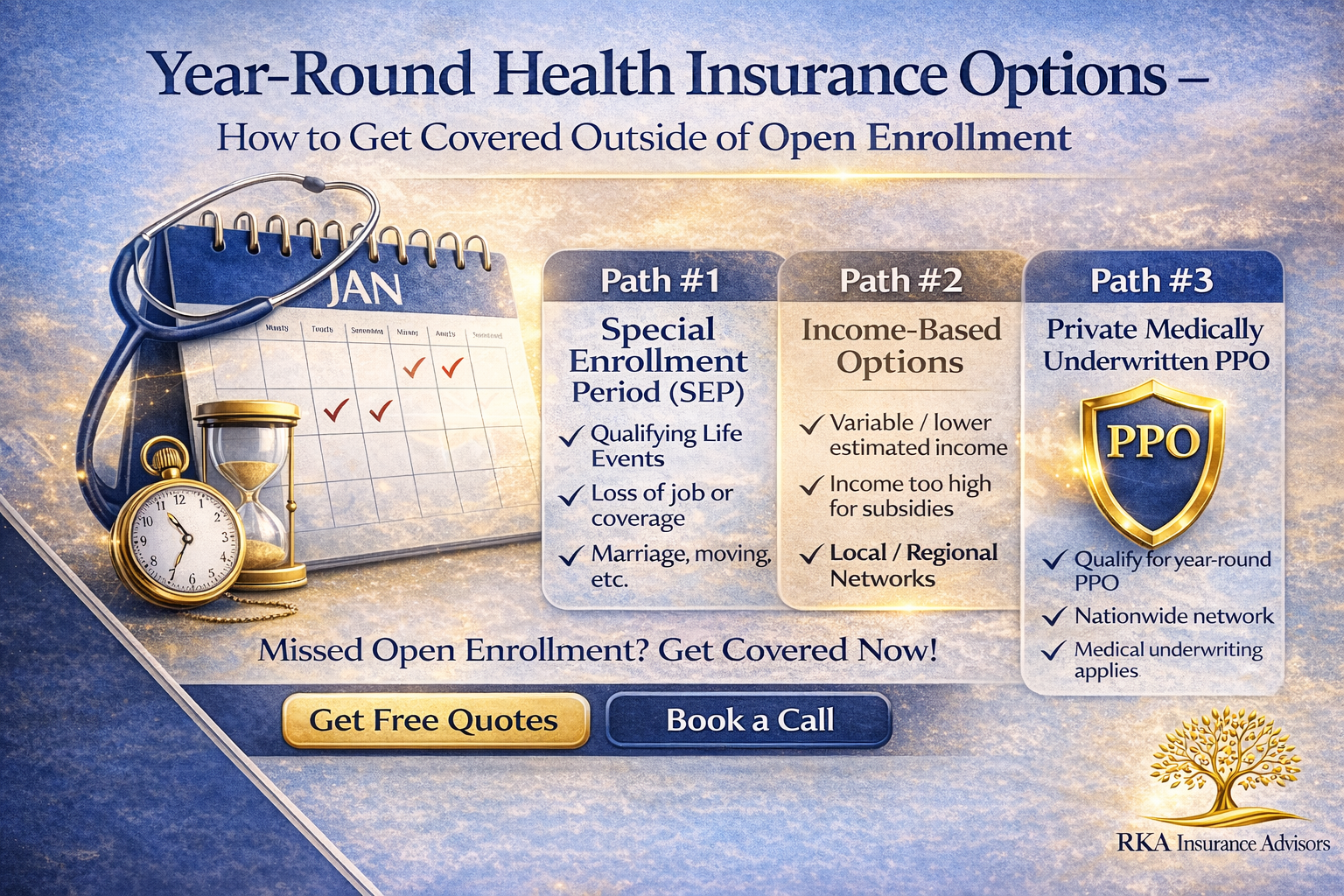
Path #1: Special Enrollment Period (SEP)
If you’ve had a Qualifying Life Event, you can enroll in ACA Marketplace coverage outside the normal window. Common QLEs:
- Loss of coverage: losing employer coverage, aging off a parent’s plan, COBRA ending.
- Household changes: marriage, divorce, birth/adoption, death.
- Residence changes: moving to a new ZIP/state with different plan options.
- Income changes: shifts that affect subsidy eligibility (varies by state and year).
Timing: Most SEPs last 60 days from the event. We’ll help confirm your documentation and the correct effective date.
Path #2: Income-based options (some situations)
In certain circumstances, income within specific ranges can create ongoing or monthly SEP eligibility. If your income is variable, we’ll model your estimated MAGI and confirm your current-year eligibility.
Path #3: Private, medically underwritten PPO (if eligible)
- Year-round starts: Many private PPOs offer effective dates any month after underwriting.
- Broader networks: Often nationwide PPO access—great for frequent travelers or multi-state households.
- Underwriting: Health questions apply; we pre-screen quickly and verify your doctors/hospitals.
Avoid gaps: simple checklist
- List your providers (names, locations) and prescriptions.
- Note your QLE date and keep documents handy.
- Share your target start date so we align deadlines and carrier cutoffs.
- We’ll show total annual cost (premium + likely usage) for each option.
Quick FAQs
How fast can coverage start?
What if I don’t have a QLE?
Can you confirm my doctors?
For education only; eligibility, plan availability, and dates vary by state and carrier. Always review official Marketplace and plan documents.
Need coverage outside Open Enrollment? Our licensed advisors help you access year-round health insurance options including private PPO plans, special enrollment periods, and COBRA alternatives. Explore your options.
Affordable Health Insurance in Florida for the Self-Employed – 2025-2026 Guide
Open Enrollment is here! Learn key 2026 health insurance deadlines, who qualifies for Special Enrollment, and how to compare ACA vs private PPO plans before the window closes
Guide • Open Enrollment
Open Enrollment Health Insurance Deadlines: What to Know & When to Enroll
Fast take: Open Enrollment is the main window to choose coverage for the upcoming year. If you miss it, you’ll need a Special Enrollment Period (life event or qualifying income) or you can explore eligible private PPO options if you qualify.
Key windows at a glance
Open Enrollment (most states)
- Occurs in late fall through mid-January for coverage beginning Jan 1 (or Feb 1 for later selections).
- Best time to compare ACA plans and confirm doctors/Rx.
- We’ll confirm this year’s exact dates for your state.
Special Enrollment (life events)
- Qualifying Life Events (QLEs): loss of coverage, marriage/divorce, birth/adoption, move, etc.
- Typically a 60-day window (varies by event/state).
- We help document and enroll before the deadline.
Income-based SEP (some situations)
- Certain income ranges may unlock a monthly SEP in some states.
- Helpful if income fluctuates or you missed OEP.
- We’ll check eligibility and project your MAGI.
Private PPO (if eligible)
- Some medically underwritten options enroll year-round.
- We pre-screen underwriting and confirm nationwide access.
- Useful for travelers or doctor-specific households.
How to avoid missing your window
- Set reminders: Book a consult ahead of OEP so we can verify doctors and run cost projections.
- Gather details: Provider list (names & locations), prescriptions, and estimated income (MAGI).
- Pick confidently: We’ll show total annual cost (premium + likely usage) and confirm effective dates.
Quick FAQs
Do state-based Marketplace dates differ?
Can I switch plans mid-year?
Are private PPOs available in my state?
For education only; eligibility, plan availability, and dates vary by state and carrier. Always review official Marketplace notices and plan documents.
Open Enrollment 2026: Why Working with a Licensed Advisor is Essential
Open Enrollment 2025 is here. Don’t go it alone—licensed advisors know ACA vs. private PPO options, deadlines, and ways to save. Acting early avoids rate hikes and limited plan choices.
Enrollment Guides • Open Enrollment 2025
Open Enrollment 2025: The Hidden Costs of Doing It Alone
Fast take: Open Enrollment is your only chance each year to secure or update coverage—but going solo can cost you. Licensed advisors know deadlines, subsidies, and private PPO alternatives to help you avoid higher premiums and missed benefits.
Why working with an advisor matters
A licensed advisor not only has access to all available plans—including ACA Marketplace and private options—but also the expertise to evaluate your needs and recommend coverage tailored to your situation. Many unlicensed brokers push limited-benefit plans that don’t protect you when it matters most.
Key benefits of guidance
- Accurate info on what your plan covers.
- Verification of which doctors are in-network.
- Projection of maximum out-of-pocket costs.
- Strategies to maximize savings based on income & health.
How a licensed advisor may save you money
Private PPOs can reward good health with lower premiums—similar to car insurance rewarding safe drivers. ACA Marketplace plans offer income-based savings. By reviewing both, advisors help you avoid costly mistakes and secure the best value.
Quick steps to start enrollment with confidence
Open Enrollment runs November 1 – January 15, but acting early locks in better options:
- Nov 1: Open Enrollment begins.
Preparing for Open Enrollment 2026: Key Steps Every Consumer Should Know
Open Enrollment 2026 runs Nov 1, 2025 – Jan 15, 2026. Learn key deadlines, cost trends, and smart moves to compare ACA Marketplace vs. private PPO options. Get guidance from RKA Insurance Advisors to lock the right coverage before prices ju
Preparing for Open Enrollment 2026: Dates, Deadlines, and Smart Moves
Fast take: For most states, Open Enrollment runs Nov 1, 2025 – Jan 15, 2026. Enroll by Dec 15 for a Jan 1 start; enroll by Jan 15 for a Feb 1 start. We compare Marketplace (government) vs. Private PPO (licensed access) side-by-side, verify doctors & prescriptions, and lock 2026 costs—no pressure, just answers.
Need help choosing the best fit in your ZIP?
We’ll verify your doctors and medications, compare Marketplace vs. Private PPO, and show clear costs—no pressure, just answers.
Why costs are climbing
- Medical inflation: Hospital, physician, and facility prices continue to outpace wage growth.
- Rx trend: Specialty drugs (including GLP-1 therapies) are widening spend.
- Higher utilization: Delayed care is catching up, pushing claims higher.
- Plan design shifts: Employers may raise deductibles/copays or adjust contributions.
What to compare during open enrollment (October–December)
Marketplace (Government)
- Premium tax credits available if income qualifies.
- HMO/EPO networks are common; referrals often required.
- County-based networks; choices vary by ZIP.
- Available during Open Enrollment or a qualifying life event.
Private PPO (Licensed Access)
- Broad PPO access; referrals typically not required.
- Medically underwritten—can be lower-cost for healthy households.
- Often better for travel, provider choice, or specialist access.
- Available year-round (subject to eligibility and effective-date rules).
Key 2026 enrollment timing
- Enroll by Dec 15, 2025 for coverage starting Jan 1, 2026.
- Enroll by Jan 15, 2026 for coverage starting Feb 1, 2026.
- State-based exchanges may vary—ask us to confirm your state’s exact dates.
How RKA helps (no pressure—just answers)
- Side-by-side comparisons: Marketplace vs. Private PPO, matched to your doctors and prescriptions.
- Network & Rx checks: We confirm providers and tiers up front to prevent surprises.
- Year-round support: We stay with you for renewals, plan changes, and claims questions.
Want a side-by-side Marketplace vs. Private PPO analysis?
We’ll verify networks and medications, compare plans in your ZIP, and show clear costs—no pressure, just answers.
Quick FAQs
Is the employer plan always best?
Not always. If spousal or child premiums are high, placing them on Marketplace or Private PPO can cut total household cost while keeping access. We’ll model both paths.
Can you verify our doctors and hospitals first?
Yes. We confirm providers and prescriptions up front so you avoid out-of-network surprises or Rx tier shocks later.
Can we switch mid-year?
Generally only with a qualifying life event. Otherwise, Open Enrollment is your main window. Private PPOs may offer licensed access year-round if eligible.
Educational use only; benefits and eligibility vary by employer, carrier, and state. Always review official plan documents.

Understanding Insurance Networks: A Key Component of Your Health Coverage
HMO, PPO, EPO, POS—your plan’s network determines which doctors you can see and what you’ll pay. Learn the key differences, when referrals apply, how out-of-network care works, and which network type best fits your doctors, prescriptions, and travel needs.
Guide • Networks & Access
Understanding Health Insurance Networks: HMO vs PPO vs EPO vs POS
Fast take: Your network determines where you can get care and what you’ll pay. If you have must-keep doctors, travel frequently, or want nationwide access, choose your network type first—then compare deductibles and copays.
The four common network types
HMO — “Stay in the circle”
- Primary Care Physician (PCP) and referrals usually required.
- No out-of-network coverage (except emergencies).
- Often lower premiums; tight local networks.
PPO — “More flexibility”
- No referrals needed to see specialists.
- Out-of-network benefits (higher costs); national networks vary.
- Good for travelers or multi-state families.
EPO — “HMO-like, no referrals”
- Referrals typically not required.
- Little to no out-of-network coverage beyond emergencies.
- Popular on ACA Marketplace; check local access.
POS — “Hybrid”
- PCP + referrals for in-network care.
- Some out-of-network benefits at higher cost.
- Useful when you want a PCP gatekeeper with flexibility.
Key rules to check before you enroll
- Provider verification: Search by doctor name + NPI and confirm at the practice level.
- Facility alignment: A doctor can be in network while their preferred hospital is not—verify both.
- Prior authorization: Imaging, infusions, surgeries, and some meds may need pre-approval.
- Rx formulary & tiers: Confirm your drugs, quantity limits, and preferred pharmacies.
- Out-of-area care: If you travel or have college students away from home, read the away-from-home rules.
Which network should I choose?
- Keep local doctors, low cost: HMO/EPO may work—verify providers and prior-auth rules.
- Travel frequently / multi-state family: PPO or a plan with nationwide access is usually safer.
- Want a coordinating PCP but some flexibility: POS can balance referrals with out-of-network options.
Quick FAQs
Are urgent care visits covered out of network?
My doctor says they “take” my plan—am I safe?
Can I change networks mid-year?
For education only; benefits and eligibility vary by carrier and state. Always review official plan documents.
How Biden’s 2025 Short-Term Insurance Rule Changes Affect You
Biden’s new short-term insurance rule cuts plans to 3 months with only a 1-month renewal. Self-employed workers and contractors may be at risk—see ACA, PPO, and employer coverage alternatives with RKA.
Health Insurance Updates • Policy Change
What Changed in Biden’s Short-Term Insurance Rule?
Fast take: Starting in September 2025, new federal rules limit short-term medical plans to 3 months, with just a 1-month renewal. This change reduces flexibility and leaves many—especially self-employed workers—needing new solutions.
Why the new rules put many at risk
Providers like Golden Rule, National General, Everest, and Pivot Health have offered short-term plans as flexible, stopgap coverage. Under the new rule, these plans are much less viable. Many households will need to reassess coverage options before losing protection.
Your alternatives: Marketplace vs. underwritten plans
ACA Marketplace Plans
These plans guarantee acceptance regardless of pre-existing conditions. Subsidies may reduce premiums, but networks and deductibles can vary widely.
Medically Underwritten Plans
For healthy individuals, private PPOs may provide lower monthly costs and nationwide access. Underwriting applies, but these plans often mean lower out-of-pocket exposure compared to unsubsidized ACA coverage.
Employer Coverage
If you’re eligible through an employer, group plans remain strong options. However, adding dependents can drive up costs—so review carefully.
Secure your coverage today
The new rules significantly reduce the flexibility of short-term plans. Acting now ensures you avoid gaps in coverage and rising costs. At RKA Insurance Advisors, we specialize in navigating these changes and finding the right coverage in 32 states.
Quick FAQs
When does the new rule take effect?
Can short-term plans still be useful?
How can RKA help?
For education only; eligibility, availability, and pricing vary by carrier and state. Always review official plan documents.
Understanding Health Insurance Networks: PPO vs. HMO for Small Businesses
PPO vs. HMO for small businesses: referrals, out-of-network rules, costs, and network fit. Learn how a licensed advisor can design the right coverage for your employees and budget.
Small Business • Networks & Access
Understanding Health Insurance Networks: PPO vs. HMO for Small Businesses
Fast take: Picking the right network type can save your company money and headaches. PPOs emphasize flexibility and out-of-network benefits; HMOs emphasize lower premiums and coordinated in-network care. We’ll help you match the network to your people, locations, and providers.
What is an insurance network—and why it matters
Networks determine where employees can get care and what they’ll pay. Choosing between a PPO (Preferred Provider Organization) and an HMO (Health Maintenance Organization) affects specialist access, referrals, travel coverage, and out-of-network costs.
PPO — flexibility & broader access
- No referrals required to see specialists.
- Out-of-network coverage available (higher cost-share).
- Often better for multi-state or traveling teams.
- The insurer typically does not dictate treatment via gatekeeping.
HMO — tight networks & coordinated care
- Primary Care Physician (PCP) required; referrals common.
- Generally no out-of-network coverage (emergencies excepted).
- Often lower premiums with strong in-network coordination.
- The plan may have more say in course of care via approvals.
PPO vs. HMO: cost, flexibility, and coverage
- Costs: HMOs can look cheaper monthly, but PPOs may avoid expensive out-of-network surprises for certain providers or travel patterns.
- Access: PPOs allow direct specialist access; HMOs typically require PCP referrals.
- Network fit: Always verify doctors + facilities; a doctor may be in network while their hospital is not.
Why a licensed advisor makes a difference
- Expert guidance: Understand fine print on referrals, prior auth, and tiered networks.
- Customized designs: Plan mixes (HMO + PPO), contribution strategies, HSA compatibility.
- Compliance assurance: Avoid penalties and stay aligned with regulations.
- Real savings: Prevent gaps and capture cost-savings your team will actually feel.
Risks of going it alone
- Incomplete coverage: Overlooking network or facility alignment can create costly surprises.
- Compliance issues: Missteps can trigger penalties or employee complaints.
- Missed savings: Without modeling total annual cost, you can overpay for the wrong network.
Quick FAQs
Is a PPO always the safer choice?
Do HMOs ever cover out-of-network care?
How do we verify our doctors?
For education only; benefits and eligibility vary by carrier and state. Always review official plan documents.
Avoid Tax Penalties: Navigating Health-Insurance Income Reporting (2025–2026) | RKA
Taking ACA premium credits? Keep your income estimate current and reconcile correctly to avoid surprise tax bills. Here’s how MAGI works, when to update, and how RKA helps.
Guides • Taxes & Reporting
Avoid Tax Penalties: Navigating Health-Insurance Income Reporting
Fast take: If you get ACA premium tax credits, your final subsidy is based on your actual year-end income (MAGI). To avoid surprise tax bills, keep estimates current, report life changes quickly, and reconcile correctly at tax time.
MAGI 101: What actually counts
- Start with AGI (from your 1040), then adjust for items like tax-exempt interest and nontaxable Social Security.
- Household MAGI includes the income of everyone on the return who must file taxes, not just the policyholder.
- Self-employed? Use net profit (after allowable business expenses), and revisit as the year unfolds.
Update income at the right times
- After big changes: new contract, raise/bonus, switching jobs, adding/removing a dependent, or moving.
- Quarterly check-ins: especially for variable/1099 income—prevents large year-end paybacks.
- Document it: keep notes on when/why you updated; it helps at tax time.
A simple, low-stress workflow
- Estimate annual MAGI (with a conservative range).
- Choose a plan; take only the advance credit you’re comfortable with.
- Track YTD income and adjust through your Marketplace account when needed.
- At tax time, reconcile with Form 1095-A and Form 8962.
Self-employed tips
- Buffer fund: set aside part of any premium savings for potential reconciliation.
- HSA strategy: if you’re in an HSA-eligible plan, contributions may lower MAGI.
- Quarterly rhythm: align income updates with your estimated tax payments.
Quick FAQs
What if I overestimated income?
Do I need to report small fluctuations?
Can you update my application for me?
This article is educational and not tax advice. Eligibility and benefits vary by carrier and state. Consult your tax professional about your specific situation.
Traveler-Friendly Health Insurance: Stay Covered Wherever You Go
Traveler-friendly health insurance with nationwide PPO access. Get urgent care & ER coverage on the road. Compare options & enroll fast with RKA.
Travel Health Coverage
Traveler‑Friendly Health Insurance: Stay Covered Wherever You Go
Why traveler‑friendly health insurance?
If you spend time outside your home area, a PPO gives you flexibility without referrals and, on many plans, nationwide in‑network access. That can mean lower bills and faster check‑in when you need care away from home.
Key features frequent travelers value
1) Nationwide provider access
Tap into large, national networks so you can see in‑network providers in most cities and states, from urgent care to specialists.
2) Emergency & urgent care coverage on the road
Emergencies don’t wait. With the right plan, ER and urgent care visits while traveling are covered per your policy terms, with predictable cost sharing.
3) Help coordinating care
We’ll confirm network participation, estimate costs, and schedule appointments for you—so you focus on the trip, not the paperwork.
4) Options for international travel
Going abroad? Pair your domestic plan with short‑term travel medical for overseas emergencies and evacuation benefits.
How RKA Insurance Advisors helps
- Plan matching: We compare traveler‑friendly PPO options across carriers in the 30+ states where we’re licensed.
- Concierge verification: Message us a clinic name, and we’ll check network status and expected costs before you go.
- Fast enrollment: Same‑day enrollments available in many cases; options exist year‑round depending on your situation.
Want proof you’re in good hands? See our Google reviews and learn about our services.
Traveler FAQs
Does PPO health insurance cover me while traveling out of state?
Do I need separate travel medical insurance for international trips?
What’s better for travelers: PPO or HMO?
How do I check if a provider is in‑network while traveling?
Can I get short‑term coverage just for a trip?
Year-Round Health Insurance Options: Finding Coverage Anytime, Anywhere
Coverage Guide
Year-Round Health Insurance Options: How to Get Covered Outside Open Enrollment
Missed Open Enrollment? You still have options. Depending on your situation, you may qualify for a Special Enrollment Period, Medicaid/CHIP, or a private, medically underwritten PPO. RKA verifies doctors, prescriptions, and costs side-by-side so you don’t overpay—or go uncovered.
What “year-round options” really means
Outside the annual Open Enrollment window, these paths can unlock coverage:
1) Special Enrollment Period (SEP)
- Triggering events: loss of employer coverage, move to a new state, marriage/divorce, birth/adoption, household income change, and more.
- Timing matters: most SEPs provide a 60-day window from the event date—earlier action = more plan choices.
- We help: confirm eligibility, compare plans, and submit the right documentation to avoid delays.
2) Medicaid & CHIP (year-round)
- Income-based programs with comprehensive benefits; eligibility varies by state and household size.
- Enrollment is open all year—no need to wait for Open Enrollment.
3) Private, medically underwritten PPOs
- For healthy individuals/families who qualify, these plans can offer lower premiums, nationwide PPO access, and predictable costs.
- Eligibility depends on health history; we pre-screen quickly and verify your doctors and facilities.
4) COBRA & short-term options
- COBRA: convenient continuation of employer coverage, but often expensive (full premium + admin fee).
- Short-term medical: limited, temporary coverage and rules vary. Good for narrow gaps; not a long-term substitute.
How we keep you covered without overpaying
- Doctor & Rx checks: we confirm networks and drug tiering before you enroll.
- Cost projection: premium + likely usage to estimate your real annual cost.
- Fast placement: we handle the paperwork and keep your start date on track.
For education only; benefits and eligibility vary by carrier and state. Always review official plan documents.
Health Insurance for the Self-Employed: A Comprehensive Guide
Need help choosing the best fit in your ZIP?
We’ll verify your doctors and prescriptions, compare Marketplace vs. Private PPO, and show clear costs—just answers.
Challenges of Self-Employed Health Insurance
- Variable income: budgeting premiums can be tricky when revenue fluctuates.
- No employer contribution: the full premium falls on you without cost-sharing.
- Too many choices: ACA vs. private PPO vs. short-term can feel overwhelming.
Main Coverage Options
ACA Marketplace (Government)
- Premium tax credits may lower costs if income qualifies.
- Networks: HMO/EPO are common; referrals often required; networks vary by county/ZIP.
- Timing: available during Open Enrollment or special enrollment after qualifying life events.
Private PPO Coverage (Licensed Access)
- Nationwide PPO access when eligible; typically no referrals to see specialists.
- Underwriting: medically underwritten—healthy applicants may see lower premiums.
- Good fit: keeping specific doctors/hospitals, frequent travelers, out-of-state care.
Short-Term Health Insurance (Bridge)
- Temporary: coverage for a few months up to a year; not a long-term solution.
- Use case: bridging gaps between jobs or enrollment periods.
Supplemental Coverage
- Accident, critical illness, hospital indemnity can reduce out-of-pocket exposure alongside your main plan.
Dental & Vision
- Affordable add-ons for cleanings, dental work, eye exams, glasses, and contacts.
Tax Advantages for the Self-Employed
Many self-employed professionals can deduct premiums for themselves, a spouse, and dependents using the Self-Employed Health Insurance Deduction. Always confirm details with your tax advisor.
What to Do First (Takes 5 Minutes)
- Gather quick proof: business/1099 income docs; prior coverage details if switching.
- List providers & meds: the doctors/hospitals you want to keep; current prescriptions (name + dosage).
- Decide priorities: lowest premium vs. broader network; referrals OK vs. prefer no referrals; travel out of state?
Get Expert Guidance Today
We’ll verify your doctors and meds, compare Marketplace vs. Private PPO, and show clear costs—no pressure.
Robert Adams | RKA Insurance Advisors
Quick FAQs
- Can I enroll outside Open Enrollment? Yes, with a qualifying life event; otherwise we can explore private PPO eligibility or short-term bridge options.
- Will my doctors be in-network? We verify networks on both ACA and private PPO options before you enroll.
- Can I keep HSA access? If needed, we’ll identify HSA-eligible options, but we won’t push HSA/HRA—fit first.
Open Enrollment 2026: What You Need to Know
Premiums are rising again. 2026 Marketplace plans are pricier with higher deductibles and OOP limits. Here’s what’s driving it — and how to compare Marketplace vs Private PPO options before Open Enrollment.
Open Enrollment 2026: What You Need to Know
Important dates
Get Expert Guidance Today
We’ll verify your doctors and meds, compare Marketplace vs. Private PPO, and show clear costs—no pressure, just answers.
What’s changing for 2026?
- Medical inflation & utilization: Hospital and provider costs continue to ripple through next year’s premiums.
- Prescription drugs: High-cost specialty meds remain a driver; formularies and tiers can shift.
- Subsidy math: Income and household size determine savings. We’ll confirm your eligibility band before you choose.
- Networks: HMO vs PPO vs EPO—pick based on the doctors/hospitals you actually use, not just the premium.
How to choose the right plan (quick framework)
- Doctors & facilities first: We confirm in-network status and referral rules.
- Rx check: We price your actual meds across plans (tier, prior auth, step therapy, mail-order).
- True annual cost: Compare premium + expected usage (copays/coinsurance + deductible + max out-of-pocket).
- Access & travel: If you need multi-state flexibility or out-of-network options, consider PPO over HMO.
Quick FAQs
When should I enroll?
Enroll early. Dec 15 starts Jan 1 coverage; Jan 15 starts Feb 1 coverage.
Can private PPOs be cheaper than Marketplace?
Yes—especially for healthy households that don’t qualify for large subsidies. We’ll model both paths.
Can you confirm my doctors and hospitals?
Absolutely. We verify providers and prescriptions before we present options.
Bottom line
Open Enrollment 2026 is your chance to realign cost, access, and coverage. We’ll do the homework—net cost, doctors, medications, and network rules—so you can enroll with confidence.
Licensed in AL, CO, DE, FL, GA, IA, IL, IN, KY, KS, LA, MD, MI, MO, MS, MT, NC, NE, NV, OH, OK, SC, SD, TN, TX, UT, VA, WI, WV, WY
2025 vs. 2026 Marketplace Health Plans: Why Costs Are Jumping and What to Do Now
OPEN ENROLLMENT 2026
Open Enrollment • Nov 2 • Written by Robert Adams
2025 vs. 2026 Marketplace Health Plans: Why Costs Are Jumping and What to Do Now
Fast take:
2026 Marketplace plans are coming in higher than 2025 — and the max out-of-pocket limits are climbing too. At the same time, the federal fight over enhanced ACA subsidies means some families will see their net premiums rise even if their income stays the same. Best move: let us run Marketplace vs. Private PPO vs. COBRA escape for your exact household before you lock in the wrong plan.
- • Lower monthly premium than 2026 for same family profile
- • Max OOP was lower
- • Enhanced subsidies still helped a lot of ZIPs
- • Same kind of plan, higher premium
- • Higher max out-of-pocket — bad for families that actually use care
- • If enhanced subsidies roll back → net cost goes up again
Why are 2026 numbers worse?
What you noticed in Healthcare.gov was real — not a glitch. A few things are stacking at once:
- Medical trend & claims are higher → carriers file higher premiums.
- Max out-of-pocket is indexed → it creeps up every year, so 2026 is just… more.
- Subsidy uncertainty → if enhanced credits are rolled back, you feel the full hike instead of it being hidden by APTC.
- Family of 4 = multiplier → higher OOP hurts more when it’s 4 people hitting deductibles, RX, and visits.
What this means for a family of four (your example)
You were looking at a pretty normal setup — two 36-year-old adults, two kids. In 2025, you could still find a Marketplace EPO/Bronze that didn’t look insane. In 2026, that same lane is now showing:
- • Monthly premium noticeably higher
- • Deductible still high
- • Max OOP even higher → this is the real pain number
That’s exactly why we tell families: don’t shop Marketplace in a vacuum. Run it next to a private, medically underwritten PPO and, if you just lost a job, a COBRA-exit strategy.
Let’s lock the right 2026 plan for your ZIP.
We’ll run Marketplace vs. Private PPO vs. COBRA escape for your exact family of 4, verify doctors, and tell you which enrollment window you’re actually in.
What to do right now
1) Send household details
Ages, ZIP, income range → we can see if credits still help you.
2) Tell us your doctors
We’ll verify networks — 2026 plans don’t all keep the same providers.
3) Compare 3 paths
Marketplace (2025 vs 2026) • Private PPO (if eligible) • COBRA exit if you got laid off.
Quick FAQs
Will everyone see 2026 go up?
Not everyone — but families that don’t qualify for strong credits will feel it the most. That’s why we try to keep you in a credit-eligible lane or move you to a private PPO if that’s cleaner.
What if enhanced ACA subsidies get extended?
Great — we’ll re-run it. But you shouldn’t plan your whole year on Congress doing the right thing. Lock a plan that works even if credits shrink.
Can I switch mid-year if 2026 is too high?
Sometimes — if you get a Qualifying Life Event or if you’re eligible for a private PPO that takes applications year-round. That’s why we map both.
Robert Adams
RKA Insurance Advisors • Private & Marketplace Health Coverage • 561-806-9913 • robert@rkainsuranceadvisors.com
2026 Open Enrollment Changes: What’s New, What’s Driving Cost, and What to Do Now
Major 2026 Open Enrollment updates: Premiums up, out-of-pocket limits higher, and subsidy extensions uncertain. Compare Marketplace vs Private PPOs before it’s too late.
Enrollment Help • Nov 5 • Written by Robert Adams
2026 Open Enrollment Changes: What’s New, What’s Driving Cost, and What to Do Now
Fast take:
The 2026 open enrollment is bringing significant shifts — premium hikes, higher out-of-pocket caps, and subsidy uncertainty all combine to change the game from previous years. If you’re qualifying for coverage for 2026, it’s time to compare [Marketplace](chatgpt://generic-entity?number=0) vs. private medically-underwritten PPOs vs. COBRA exit strategies and pick your right window **before the clock runs out**.
- • Premium filings show increases for 2026 in many states.
- • Max out-of-pocket limits are rising — you may pay more if you use care.
- • Subsidy changes are unconfirmed — if enhanced credits fade, your “net” cost could jump.
- • Not tied to federal subsidy legislation — pricing is independent.
- • Often broader PPO networks and fewer referral restrictions.
- • Eligibility required, but it’s a powerful option when Marketplace costs spike.
What’s new for 2026 open enrollment
The landscape has shifted in part due to macro-factors and in part due to policy. Here’s what’s driving the changes:
- Carrier cost-trend is higher → claims, drugs, and specialty care all escalate and carriers file accordingly.
- Higher out-of-pocket maximums → The yearly cap is creeping up again, meaning more financial risk for members.
- Subsidy uncertainty → If enhanced credits aren’t extended or phase down, even a stable income could leave you paying more.
- COBRA exposure remains extreme → If you’re losing employer coverage, staying on COBRA might cost more than shopping alternatives now.
What this means for you and your family
For example: a 45-year-old couple with two children saw a typical Bronze Marketplace renewal jump from $1,250 / mo in 2025 to around $1,650 / mo in 2026. The max out-of-pocket climbed from $8,700 to $10,000. That means:
- • You’ll pay a higher premium just to stay in the same segment.
- • If you or a family member use care early in the year, you’ll hit higher OOP sooner.
- • If subsidies are reduced, your net cost could rise again — even if your plan looked okay today.
That’s why we tell households: don’t renew blind. Compare Marketplace vs Private PPO vs COBRA alternative to see your real cost before you lock in.
What to do next: Your 3-step checklist
1) Submit your details
ZIP, ages, income estimate — so we can test all paths for you.
2) Verify your doctors & prescriptions
Network changes in 2026 are real. Let us check before you pick a plan.
3) Compare your three paths
Marketplace vs Private PPO vs COBRA exit — pick the one that fits your risk-level and timing.
Let’s lock the right 2026 plan for your ZIP.
We’ll run Marketplace vs Private PPO vs COBRA escape for your exact family, verify your doctors, and tell you which enrollment window you’re actually in.
Quick FAQs
Will I automatically see higher 2026-costs if I stayed in the same plan?
Often yes — even if your benefits didn’t change. Because premiums and OOP maximums are rising across the board.
What if enhanced subsidies get extended again?
Great if they are — but don’t bet on it. We prepare your plan assuming worst-case and then re-run if credits improve.
Can I switch mid-year if I pick wrong?
Maybe — but limited. That’s why we use a licensed advisor to match your timing, plan, and risk exposure before you enroll.
Robert Adams
RKA Insurance Advisors • Private & Marketplace Health Coverage • 561-806-9913 • robert@rkainsuranceadvisors.com