
FINAL DAY: Open Enrollment Ends Tonight | Act Now
Open Enrollment ends tonight at 11:59 PM. If you don't enroll or update your plan by midnight, you're locked out until next year. Don't let auto-enrollment cost you thousands—compare all options before the deadline.
FINAL DAY: Open Enrollment Ends Tonight at Midnight
Fast take: Open Enrollment for 2026 health insurance ends tonight at 11:59 PM. If you don't enroll or update your plan by midnight, you're locked out until next year—unless you qualify for a Special Enrollment Period. Don't let auto-enrollment cost you thousands.
⏰ DEADLINE: TONIGHT AT MIDNIGHT
We'll compare your options, verify networks, and walk you through enrollment in minutes—before time runs out.
Get Free Quotes NOW Book Emergency CallWhat happens if you miss tonight's deadline
No coverage
✗ No health insurance for 2026
✗ Pay full price for all medical care
✗ Can't enroll again until November 2026
✗ No protection from surprise medical bills
Auto-enrollment trap
✗ Stuck in current plan at higher 2026 rates
✗ Miss cheaper plan options
✗ Doctors may no longer be in-network
✗ Could overpay thousands annually
If you don't have coverage: Do this NOW
Contact us immediately
We'll pull all available plans in your area, calculate your tax credit if you qualify, and show you every option side-by-side in minutes.
Compare plans fast
We'll focus on monthly premium, deductible, out-of-pocket maximum, and whether your doctors are in-network. Having coverage is better than having no coverage—we'll help you decide quickly.
Enroll before midnight
We'll handle the enrollment process and make sure everything's completed before 11:59 PM tonight. You can always change plans next year, but you can't go back and enroll today once the deadline passes.
If you have Marketplace coverage: Review before auto-enrollment locks you in
We'll review your current plan
Plans change every year—networks shift, premiums adjust, benefits get redesigned. We'll check if your current plan is still the best option or if better alternatives exist.
Update your income for accurate subsidies
If your income changed from last year, this recalculates your tax credit and shows your true monthly cost. We'll update this for you and compare all available plans based on your actual 2026 pricing.
Compare every available plan
We'll look at total annual cost—not just premium. We factor in deductible, copays, out-of-pocket maximum, and expected usage based on your health needs. We also verify your doctors and prescriptions are still covered.
Actively select your plan
Don't rely on auto-enrollment. It's designed for convenience, not savings. We'll help you select the best plan and can save you hundreds or thousands of dollars in 2026.
If you're paying full price: Consider private health insurance
If you don't qualify for subsidies or your income is above 400% of the federal poverty level, you're not required to use Marketplace plans.
- Private PPOs often cost less: For those paying full premium, private plans frequently offer better value with broader networks
- Year-round enrollment: Private plans aren't limited to Open Enrollment periods for ACA-compliant coverage
- Nationwide networks: Many private PPOs offer coast-to-coast access without referrals or HMO restrictions
- Direct specialist access: No primary care gatekeepers—see specialists when you need them
If Marketplace premiums jumped significantly and you're receiving minimal or no tax credits, we'll show you private options before midnight.
Why tonight's deadline matters
Open Enrollment ends at 11:59 PM tonight. Not tomorrow morning. Not next week. Tonight.
Once the deadline passes, you're locked out until November 2026 unless you experience a qualifying life event like losing other coverage, getting married, or having a baby.
Medical costs don't care if you missed the deadline. Emergency room visits can cost thousands. Routine prescriptions add up fast. Doctor appointments, specialist visits, lab work—all of it comes out of your pocket without insurance.
Stop reading. Call us now.
We'll compare your options and walk you through enrollment in minutes—before midnight tonight.
Get Free Quotes NOW Book Emergency CallFAQ
What if I miss tonight's deadline?
You're locked out until November 2026 Open Enrollment unless you qualify for a Special Enrollment Period due to losing coverage, marriage, birth, adoption, or moving to a new state.
Can you still help me enroll tonight?
Yes—contact us immediately. We'll walk you through your options and complete enrollment in minutes before the deadline.
Are private PPOs cheaper than Marketplace plans?
If you don't qualify for subsidies, private PPOs can offer lower total costs with broader networks—especially for healthy applicants. We'll compare both options for you.
For education only; eligibility and benefits vary by carrier and state. Always review official plan documents.

Marketplace Premium Change Notifications: What They Mean & How to Respond
Marketplace premiums are jumping for 2026. If you received a rate increase notification, don't auto-renew without comparing options. We verify your doctors, compare ACA vs private PPO plans, and show total annual costs before the January 15 deadline.
Marketplace Premium Change Notifications: What They Mean & How to Respond
Fast take: If you received a Marketplace premium change notification, your 2026 rate is likely increasing—sometimes significantly. Don't auto-renew without comparing options. We'll verify your doctors, compare ACA plans vs. private PPOs, and show total annual costs before you commit.
Got a premium increase notice?
We'll compare your current plan against new Marketplace options and private PPOs—and verify your doctors stay in-network.
Get Free Quotes Book a CallWhat your notification means
Premium increase
✓ Your monthly cost is going up for 2026
✓ Increase can range from 10-30%+ depending on your state
✓ Driven by medical inflation, drug costs, and policy changes
Plan changes
✓ Network may have changed—verify your doctors
✓ Deductibles and out-of-pocket maximums may be higher
✓ Prescription formulary tiers may have shifted
Why premiums are jumping for 2026
- Medical inflation: Hospital and provider costs continue rising faster than general inflation
- Specialty drugs: GLP-1 medications and other high-cost drugs are pushing claims higher
- Subsidy uncertainty: Enhanced ACA subsidies may expire, raising net costs for middle-income families
- Carrier adjustments: Insurers are repricing based on 2024-2025 utilization patterns
What to do right now
1) Don't auto-renew blindly
If you do nothing, your current plan will automatically renew at the higher 2026 rate. You have until January 15 to switch plans during Open Enrollment.
2) Verify your provider network
Marketplace plans frequently change networks. Your current doctors may no longer be in-network for 2026—check before you commit.
3) Compare total annual cost
Don't just look at premium changes. Factor in:
- New deductible amounts
- Copays and coinsurance changes
- Out-of-pocket maximum increases
- Expected usage based on your health needs
4) Check alternative options
If your Marketplace premium is jumping significantly and you don't qualify for strong subsidies, private PPO options may offer:
- Lower total annual costs for healthy applicants
- Broader nationwide PPO networks
- Fewer referral requirements and restrictions
How to decide in minutes
Stay on Marketplace if...
✓ You qualify for strong income-based subsidies
✓ Your doctors are still in-network for 2026
✓ A different Marketplace plan offers better value
✓ You're comfortable with HMO/EPO restrictions
Consider Private PPO if...
✓ Your premium jumped 20%+ and subsidies are minimal
✓ You want nationwide PPO access and flexibility
✓ You travel frequently or need specialists
✓ You prefer direct access without referrals
How RKA handles premium increase notifications
- Network verification: We confirm your doctors are in-network for 2026—before you commit
- Side-by-side comparison: Current plan vs. new Marketplace options vs. private PPOs
- Total cost projection: Annual costs including premiums, deductibles, and expected usage
- Fast enrollment: We'll switch you to the best option before the January 15 deadline
Don't pay more without comparing options
We'll verify your doctors, compare all available plans, and show clear annual costs—before January 15.
Get Free Quotes Book a CallFAQ
Can I switch plans after getting a premium increase notice?
Yes—during Open Enrollment (through January 15), you can switch to any Marketplace plan or explore private PPO options if eligible.
Will my doctors still be covered in 2026?
Not necessarily. Networks change annually. We verify your specific providers before you commit to any plan.
Are private PPOs always more expensive than Marketplace?
No. If you don't qualify for subsidies, private PPOs can offer lower total costs with broader networks—especially for healthy applicants.
For education only; eligibility and benefits vary by carrier and state. Always review official plan documents.
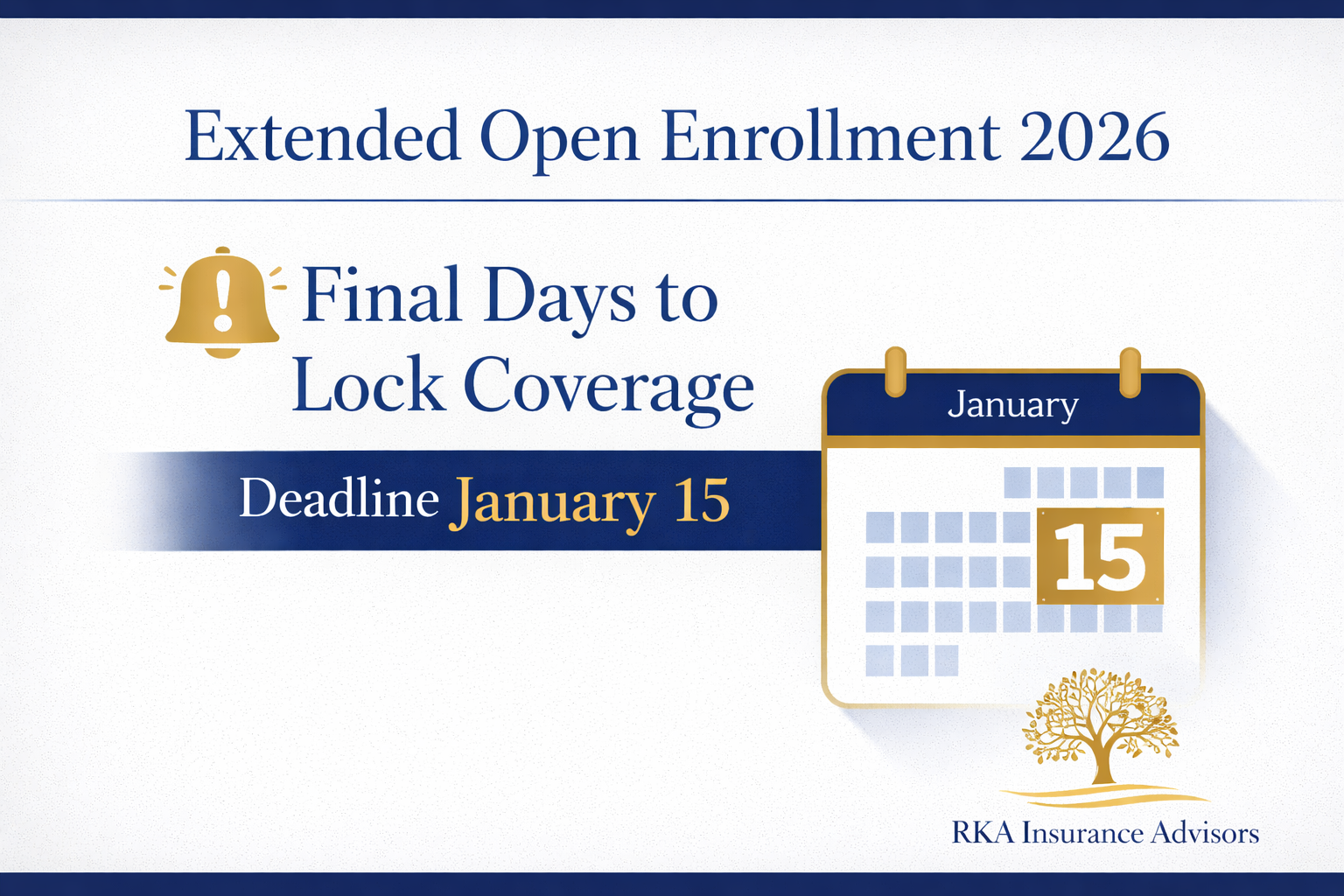
Extended Open Enrollment 2026: Final Days Before January 15 Deadline | RKA
Open Enrollment 2026 closes January 15. Enroll by Dec 15 for Jan 1 coverage, or by Jan 15 for Feb 1 coverage. Don't auto-renew into higher 2026 rates—compare ACA Marketplace plans vs private PPOs and verify your doctors are covered.
Extended Open Enrollment 2026: Final Days to Lock Coverage – Deadline January 15
Fast take: Open Enrollment 2026 runs through January 15 in most states. If you enroll by December 15, coverage starts January 1. Enroll by January 15, coverage starts February 1. This is your last window to compare ACA Marketplace plans vs. private PPOs and secure your 2026 rate.
Need help choosing the best plan before Jan 15?
We'll verify your doctors and prescriptions, compare ACA vs. PPO options, and show clear costs—no pressure, just answers.
Get Free Quotes Book a CallKey dates to remember
Open Enrollment Window
Nov 1, 2025 → Jan 15, 2026
(most states)
Enroll by Dec 15
Coverage starts Jan 1, 2026
Enroll by Jan 15
Coverage starts Feb 1, 2026
What to do before the deadline
1) Verify your providers
Marketplace networks can be narrow—HMO/EPO-heavy with referral requirements. Private PPOs often offer broader access. We'll confirm your doctors are in-network before you enroll.
2) Compare total annual cost
Don't just look at premiums. Factor in deductibles, copays, coinsurance, and out-of-pocket maximums with your expected usage patterns.
3) Check subsidy eligibility
Income-based tax credits can dramatically lower Marketplace premiums. We'll estimate your 2026 subsidy eligibility and show net costs.
4) Consider private PPO alternatives
If you don't qualify for subsidies or need nationwide PPO access, private medically underwritten PPOs may offer lower total costs and fewer restrictions.
How to decide in minutes
Pick an HMO or POS if…
✓ You want lower premiums and you're comfortable staying within a local network.
✓ You prefer having one doctor coordinate all care and provide referrals.
✓ You rarely travel or need specialists outside your area.
Pick a PPO or EPO if…
✓ You want the freedom to see specialists without referrals and value a larger network.
✓ You travel often or need access to doctors across multiple states.
✓ You're willing to pay higher premiums to avoid network restrictions or referrals.
How RKA helps with last-minute enrollment
- Fast comparisons: ACA vs. PPO side-by-side with your providers
- Network verification: We confirm your doctors before you commit
- Clean enrollment: We'll hit the deadline and set your correct effective date
Quick FAQs
What if I miss the January 15 deadline?
You'll need a Qualifying Life Event for a Special Enrollment Period, or you'll wait until next Open Enrollment. Private PPOs may still be available year-round if eligible.
Can I change plans if I already enrolled?
During Open Enrollment, you can switch plans. After January 15, changes require an SEP.
Will my 2025 plan auto-renew?
Yes, but you may pay more in 2026. Many insurers raised rates significantly—review before auto-renewal hits.
Missing the deadline doesn't mean you're out of options. Our licensed advisors help you explore marketplace plans, private PPO options, and special enrollment opportunities year-round. Get coverage options now.
For education only; eligibility and benefits vary by carrier and state. Always review official plan documents.

Alabama 2026 Health Insurance Premiums: What to Do Before Prices Jump
Alabama premiums may rise in 2026. Learn what’s driving costs and compare ACA vs. private PPOs to protect your budget.
Alabama • Premium Watch
Alabama 2026 Health Insurance Premiums: What to Do Before Prices Jump
Fast take: Alabama carriers have filed for notable premium increases for 2026. Medical inflation, specialty drugs, and subsidy uncertainty are pushing prices higher. Here’s how to prepare and compare now.
What’s driving the increase?
- Medical inflation & utilization: Provider and hospital costs continue to rise.
- Specialty drugs: High-cost medications (including GLP-1s) impact trend.
- Policy factors: If enhanced subsidies lapse after 2025, net costs could rise for many households.
Moves to consider now
1) Check your plan type
Frequent travel or specific provider needs? A nationwide PPO may offer better access than an HMO/EPO. We’ll confirm networks before you switch.
2) Time your enrollment
Open Enrollment later this year sets your 2026 price. We’ll compare options side-by-side—marketplace plans and eligible PPO alternatives.
3) Explore private PPO eligibility
Private, medically underwritten PPOs can reduce premiums for healthy households. We pre-screen underwriting quickly and verify your doctors and hospitals.
How RKA helps Alabama families
- Plan comparisons: ACA vs. PPO cost projections with your expected usage.
- Network checks: We verify your doctors, hospitals, and key medications.
- Fast enrollment: Set your 2026 coverage on time and avoid gaps.
Quick FAQs
Will 2026 premiums apply to my plan immediately?
Are PPOs available in Alabama?
Can RKA confirm my doctors?
For education only; eligibility and benefits vary by carrier and state. Always review official plan documents.

Wyoming 2026 Health Insurance Premiums: What to Do Before Prices Jump | RKA
Wyoming health insurance premiums may rise in 2026. Learn what’s driving costs and compare ACA vs. private PPOs to protect your budget.
Wyoming • Premium Watch
Wyoming 2026 Health Insurance Premiums: What to Do Before Prices Jump
Fast take: Wyoming insurers have filed for notable premium increases for 2026. Rising medical costs, specialty drugs, and subsidy uncertainty could push net prices higher. Here’s how to prepare and compare now.
What’s driving the increase?
- Medical inflation: Higher provider costs and hospital charges are impacting trend.
- Specialty drugs: Expensive medications like GLP-1 therapies are raising premiums.
- Policy shifts: Enhanced ACA subsidies may expire, impacting net household costs.
Moves to consider now
1) Review your plan type
If you travel across state lines, a nationwide PPO may provide broader access and lower surprise costs than an HMO.
2) Time your enrollment
Open Enrollment later this year sets your 2026 price. We’ll help compare ACA and private PPO options side by side.
3) Explore private PPO eligibility
Private, medically underwritten PPOs can offer lower premiums for healthy households. We pre-screen underwriting and confirm provider networks.
How RKA helps Wyoming families
- Plan comparisons: ACA vs. PPO side-by-side analysis.
- Network checks: Verify your doctors and hospitals are covered.
- Quick enrollment: Avoid coverage gaps and set 2026 pricing now.
Quick FAQs
Will 2026 premiums apply to my plan immediately?
Are PPOs available in Wyoming?
Can RKA confirm if my doctors are in-network?
For education only; eligibility and benefits vary by carrier and state. Always review official plan documents.
Open Enrollment Shock: 2026 Rates & Out-of-Pocket Costs Jump as Subsidy Enhancements Roll Back
2026 Marketplace health insurance rates are out—and they’re higher across the board. Premiums, deductibles, and maximum out-of-pocket costs are all climbing as enhanced subsidies roll back. See how these changes affect families heading into Open Enrollment and explore lower-cost Private PPO options.
Oct 30 • Written by Robert Adams
Open Enrollment Shock: 2026 Rates & Out-of-Pocket Costs Jump as Subsidy Enhancements Roll Back
Fast take: 2026 Marketplace premiums are up, maximum out-of-pocket limits increased, and enhanced subsidies are rolling back. A typical family of four (two 36-year-old adults + two kids) saw the lowest Bronze option jump from $1,267/mo in 2025 (OOP max $9,200) to $1,667/mo in 2026 (OOP max $10,000).
Open Enrollment is here. If you simply “let it renew,” you’ll likely pay more in 2026—often for less protection. Rate filings show across-the-board increases driven by medical inflation and policy changes. With the enhanced subsidies rolling back, many middle-income families now feel the full price pressure.
What changed for 2026
- Premiums: Double-digit increases are common across Bronze/Silver/Gold.
- Max out-of-pocket: Raised again for 2026 (example above: $9,200 → $10,000).
- Subsidy rollbacks: The expanded tax credits that softened 2024–2025 pricing are fading, raising net costs for many households.
Real-world snapshot (family of 4)
- 2025 lowest Bronze: $1,267/mo • Deductible $6,500 • OOP max $9,200.
- 2026 lowest Bronze: $1,667/mo • Deductible $7,500 • OOP max $10,000.
Same family, same metal tier—meaningfully higher monthly cost and higher exposure before the plan pays fully.
Don’t renew blind. We compare ACA vs. Private PPO side-by-side and confirm your doctors.
Moves to make now
- Price the real year: Premium + expected usage (copays/coinsurance) + deductible + OOP risk.
- Check doctors & meds: Verify network and formulary before you enroll.
- Compare ACA vs. Private PPO: If you qualify medically, PPOs can cut total cost and OOP exposure.
We’ll verify your doctors/prescriptions, model 2026 costs, and enroll you correctly—no pressure, just answers.
Quick FAQs
Will 2026 increases hit me immediately?
Yes—your 2026 premium and OOP limits apply based on your effective date. We’ll confirm your exact numbers.
Are Private PPOs available in my state?
Often, yes (underwriting required). We’ll pre-screen and confirm networks.
Can you confirm my doctors are in-network?
Yes. That’s step one before we quote anything.
For education only; eligibility, benefits, and availability vary by carrier and state. Always review official plan documents.
Robert Adams
RKA Insurance Advisors • Private & Marketplace Health Coverage
561-806-9913 •
info@RKAinsuranceadvisors.com •
Book an Appointment
Amazon Layoffs & Your Health Coverage: Why COBRA Is Too Expensive and What to Do Instead
After Amazon layoffs, many workers face COBRA sticker shock. Learn how to cut costs and keep coverage using ACA or private PPO alternatives.
Nov 21 • Written by Robert Adams
Amazon Layoffs & Your Health Coverage: Why COBRA Is Too Expensive and What to Do Instead
Fast take: After Amazon layoffs, COBRA makes you pay the full employer plan cost—often hundreds more per month. With subsidy uncertainty and rising rates, many households can cut costs by switching to ACA or private PPO options during their Special Enrollment window.
Need help choosing the best plan after a layoff?
We’ll verify your doctors and prescriptions, compare ACA vs. private PPO options, and show clear costs—no pressure, just answers.
What’s driving the cost spike?
- COBRA = full freight. You carry the employer share + your share + up to 2% in admin fees.
- Subsidy uncertainty. Federal budget fights threaten enhanced credits, raising net premiums for many.
- Network fit. Employer HMOs can be narrow; qualified PPOs may provide better access for travel/specialists.
Moves to make now
- Protect your window. Job loss triggers a Special Enrollment Period (typically 60 days). Don’t let it lapse.
- Bring the details. Providers (names/locations), prescriptions (dosage), and your expected 2026 MAGI.
- Compare side-by-side. We’ll model COBRA vs. ACA vs. private PPO with total annual cost (premium + likely usage).
- Choose for access & price. Keep doctors in-network and avoid surprise Rx tiers.
How RKA helps laid-off Amazon employees
- Plan comparisons: ACA vs. PPO analysis with transparent cost projections.
- Network checks: We verify your doctors and hospitals are covered.
- Quick enrollment: Avoid gaps and set your 2026 pricing now.
Secure your 2026 coverage today
Quick FAQs
Is COBRA ever the right move?
Yes—short gaps, complex care mid-treatment, or high incomes (reduced subsidies) can justify COBRA. We’ll model it honestly.
Can private PPOs beat COBRA?
Often. If you qualify underwriting, PPOs can provide nationwide access at a lower net cost.
What if I miss my SEP?
We’ll use Open Enrollment timing and check paths that may reopen eligibility.
Robert Adams
RKA Insurance Advisors • Private & ACA Health Coverage
561-806-9913 •
info@RKAinsuranceadvisors.com •
Book an Appointment
For education only; eligibility and benefits vary by carrier and state. Always review official plan documents.

Government Shutdown & ACA Subsidies: What It Means for You
Federal subsidy delays could impact millions of Americans if a government shutdown continues. Learn how to protect your coverage and compare PPO alternatives before Open Enrollment 2026.
Open Enrollment 2026
Oct 1 • Written by Robert Adams
Nov 1, 2025 → Jan 15, 2026 (most states)
Coverage starts Jan 1, 2026
Coverage starts Feb 1, 2026
Premium hikes already on the horizon
According to insurer filings and multiple reports, 2026 premiums are projected to rise 10–18% on average, with some state requests topping 30%. That can mean hundreds more per month for unsubsidized families—and thousands annually. See the map below for where requests are running hottest.

If subsidies pause (shutdown/lapse), what actually happens?
- No one is “kicked off” a plan mid-month. Carriers still bill the full premium; the advance-credit portion can be delayed.
- Net premium could temporarily jump until payments resume or are reconciled at tax time.
- Eligibility doesn’t vanish. Credits reconcile on your tax return; amounts due can be settled then.
- Timelines matter. Short pauses may be smoothed by carriers; longer gaps create real cash-flow strain.
How to protect your wallet now
- Lock in your coverage window. Enroll early so your start date and network are set.
- Model the true annual cost. Premium + expected usage (copays/coinsurance + deductible + max OOP).
- Verify doctors & meds first. Keep your physicians in-network and Rx tiers on-formulary.
- Compare Marketplace vs Private PPO. If you don’t qualify for large subsidies, PPOs can beat exchange nets for access.
- Have a back-up payment plan. Be ready to bridge a month if a subsidy delay hits to avoid cancellation.
Not sure which option fits your family?
We’ll compare ACA vs PPOs, check doctors, and give you a clean cost forecast so you can enroll with confidence about 2026.
Get Free Quotes Book a CallQuick FAQs
Will a shutdown cancel my plan?
No — coverage continues, but billing may shift.
How much more could I pay?
Some families could see hundreds more per month unsubsidized if subsidies pause.
Can a Private PPO be cheaper than Marketplace?
Yes — depending on income, network, and benefits, PPOs may beat ACA net cost.
What if my subsidy is delayed?
Have a bridge plan (savings, credit, or employer coverage) to avoid cancellation risk.
Robert Adams • President & Licensed Agent • NPN 19540130
Licensed in AL, CO, DE, FL, GA, IA, IL, IN, KY, KS, LA, MD, MI, MO, MS, MT, NC, NE, NV, OH, OK, SC, SD, TN, TX, UT, VA, WI, WV, WY
For education only; eligibility and benefits vary by carrier and state. Always review official plan documents.

2026 Premium Explosion: What to Expect and How to Protect Your Wallet | RKA
ACA premiums are projected to spike in 2026 — the steepest rise in years. Here’s what’s driving the increase and how to protect your wallet before Open Enrollment.
2026 Premium Explosion: What to Expect & How to Protect Your Wallet
Why premiums are spiking
- Medical inflation: Higher hospital and provider costs are baked into 2026 premiums.
- Prescription drugs: Specialty medications like GLP-1s are a major cost driver.
- Policy changes: Enhanced subsidies may expire, raising net costs for millions.
How much higher?
Experts estimate average increases of 10–18% nationwide — with some states seeing much more. That means a plan costing $1,200/month today could jump by $150–200. For unsubsidized families, the hit could be thousands annually.
Smart moves before 2026
- Compare Marketplace vs PPO: Don’t assume Healthcare.gov is always cheaper. Private PPOs may win if you don’t qualify for subsidies.
- Check your eligibility: Income-based savings may still apply — know your bracket.
- Time your enrollment: Lock in your plan during Open Enrollment this fall before further adjustments hit.
Get Expert Guidance Today
We’ll verify your doctors and prescriptions, compare Marketplace vs. Private PPO, and show clear costs — no pressure, just answers.
Quick FAQs
Why are ACA premiums going up in 2026?
Medical inflation, rising drug prices, and subsidy uncertainty are driving rates higher than in prior years.
How much more will I pay?
Average increases are expected to be 10–18%, with unsubsidized households seeing the steepest jumps.
Can private PPOs be cheaper than Marketplace?
Yes. If you don’t qualify for subsidies, PPO options may offer better value, especially with nationwide networks.
When should I enroll?
During Open Enrollment 2026. Lock in your coverage early before mid-season adjustments hit.
How do I protect my wallet?
Compare all your options now, confirm your doctors are covered, and work with a licensed advisor.
Bottom line
2026 premiums will be some of the highest on record. The best protection is preparation — comparing options, confirming your doctors, and working with a licensed advisor. Don’t wait until the last minute to make changes that could save you thousands.
Need help navigating 2026 premium increases? Our licensed advisors compare marketplace and private PPO health insurance options to find coverage that fits your budget. Get personalized quotes from our team.
HMO vs PPO vs EPO vs POS: Which Network Fits Your Needs?
Confused by HMO, PPO, EPO, and POS health plans? This guide breaks down the differences in networks, referrals, flexibility, and costs so you can choose the best fit in minutes.
HMO vs PPO vs EPO vs POS
Which Network Fits Your Needs?
Health Insurance Guides • Enrollment Help • Sep 7, 2025 • Written by Robert Adams
Confused by health‑plan acronyms? In this guide we break down HMO, PPO, EPO and POS plans—networks, referrals, premiums and flexibility—so you can decide in minutes. We’ll verify your doctors and medications, compare plans side by side and show clear costs.
HMO (Health Maintenance Organization)
- ✓ You must choose a primary care doctor (PCP) in the network who coordinates your care and provides referrals.
- ✓ Coverage is limited to network providers except for emergencies; out‑of‑network care typically isn’t covered.
- ✓ Premiums are usually lower, and some plans have low or no deductible options.
PPO (Preferred Provider Organization)
- ✓ Lets you see any doctor in the network without referrals and offers the option to go out of network at a higher cost.
- ✓ Provides flexibility if you travel or want a wide choice of specialists.
- ✓ Premiums and deductibles tend to be higher because of broader access.
EPO (Exclusive Provider Organization)
- ✓ You can see any doctor within the network; no referral is required to see a specialist.
- ✓ No out‑of‑network benefits; care outside the network is generally not covered.
- ✓ Deductibles may be higher but monthly premiums are often lower than a PPO.
POS (Point‑of‑Service)
- ✓ Combines features of HMO and PPO: you have a primary doctor who gives referrals.
- ✓ Some out‑of‑network coverage is available, but you’ll pay more compared with in‑network care.
- ✓ Good compromise if you want occasional out‑of‑network flexibility without paying full PPO premiums.
How to Decide in Minutes
Pick an HMO or POS if…
- ✓ You want lower premiums and you’re comfortable staying within a local network.
- ✓ You prefer having one doctor coordinate all care and provide referrals.
- ✓ You rarely travel or need specialists outside your area.
Pick a PPO or EPO if…
- ✓ You want the freedom to see specialists without referrals and value a larger network.
- ✓ You travel often or need access to doctors across multiple states.
- ✓ You’re willing to pay higher premiums to avoid network restrictions or referrals.
Still undecided? We’ll compare all four plan types with your doctors and medications in mind and show clear, side‑by‑side costs—so you can choose quickly and confidently.
Need help choosing the best plan in your ZIP?
We’ll verify your doctors and meds, compare HMO vs PPO vs EPO vs POS and show clear costs. No pressure—just answers.
Get Free Quotes Book a CallFAQ
What’s the main difference between an HMO and a PPO?
HMOs require you to pick an in‑network primary care doctor who refers you to specialists. PPOs let you see doctors in or out of network without referrals but come with higher premiums.
Do EPOs cover out‑of‑network care?
EPOs typically only cover care within the network; there are no benefits for out‑of‑network doctors except in emergencies.
Do POS plans require referrals?
Yes. POS plans combine elements of HMOs and PPOs—you have a primary doctor and need referrals for specialists, but you still have some out‑of‑network coverage.
Which plan type is best for frequent travelers?
If you travel often or need a large network, a PPO provides broader access and doesn’t require referrals, though an EPO can work if you stay in network.
How can I find out whether my doctor is covered?
Use the insurer’s provider search tools or work with a licensed advisor who can verify that your doctors and medications are in the network before you enroll.

Montana 2026 Health Insurance Premiums: What to Do Before Prices Jump | RKA
Montana health insurance premiums are projected to rise in 2026, with insurers citing higher medical costs and subsidy uncertainty. Families could see significant changes in out-of-pocket costs. Here’s what to know—and how private PPO options may help you save before rates jump.
Montana • Premium Watch
Montana 2026 Health Insurance Premiums: What to Do Before Prices Jump
Fast take: Montana insurers have filed for notable premium increases for 2026. Rising medical costs, specialty drugs, and subsidy uncertainty could push net prices higher. Here’s how to prepare and compare now.
What’s driving the increase?
- Medical inflation: Higher provider costs and hospital charges are impacting trend.
- Specialty drugs: Expensive medications like GLP-1 therapies are raising premiums.
- Policy shifts: Enhanced ACA subsidies may expire, impacting net household costs.
Moves to consider now
1) Review your plan type
If you travel across state lines, a nationwide PPO may provide broader access and lower surprise costs than an HMO.
2) Time your enrollment
Open Enrollment later this year sets your 2026 price. We’ll help compare ACA and private PPO options side by side.
3) Explore private PPO eligibility
Private, medically underwritten PPOs can offer lower premiums for healthy households. We pre-screen underwriting and confirm provider networks.
How RKA helps Montana families
- Plan comparisons: ACA vs. PPO side-by-side analysis.
- Network checks: Verify your doctors and hospitals are covered.
- Quick enrollment: Avoid coverage gaps and set 2026 pricing now.
Quick FAQs
Will 2026 premiums apply to my plan immediately?
Are PPOs available in Montana?
Can RKA confirm if my doctors are in-network?
For education only; eligibility and benefits vary by carrier and state. Always review official plan documents.

Group Employer Open Enrollment: Rising Costs, Smarter Options for Employers & Employees | RKA
Employer plan premiums are rising this fall. During open enrollment, compare group coverage against marketplace and private PPO options—splitting family members can cut costs. We’ll verify doctors, prescriptions, and total annual cost before you commit.
Employer & Group Plans • Open Enrollment
Group Open Enrollment: Rising Costs, Smarter Options for Employers & Employees
Fast take: With medical inflation and rising utilization, many employer plans are increasing premiums and tweaking benefits this fall. Use open enrollment to compare — keeping the employee on the group plan, but placing a spouse/kids elsewhere can cut costs without giving up access. We’ll verify networks, prescriptions, and total annual cost before you choose.
Why costs are climbing
- Medical inflation: Hospital, physician, and facility prices continue to outpace wage growth.
- Rx trend: Specialty drugs (including GLP-1 therapies) are widening plan spend.
- Higher utilization: Delayed care is catching up, pushing claims higher.
- Plan design shifts: Employers may raise deductibles/copays or adjust contributions to manage increases.
What to compare during open enrollment (October–December)
Employer plan checklist
- Employee vs. family premium contributions
- Deductible, copays/coinsurance, out-of-pocket max
- HSA/HRA funding and employer credits
- Network type (HMO/EPO vs PPO) and doctor/hospital fit
- Rx formulary & prior authorization rules
Compare against alternatives
- Marketplace: Check income-based subsidies; silver cost-sharing reductions if eligible
- Private PPO (underwritten): Often lower for healthy applicants; nationwide PPO access
- Spouse’s employer plan: Sometimes better dependent rates
- COBRA: Short-term bridge if switching mid-year
When keeping the group plan and splitting the family wins
Dependent premiums on employer plans can be steep. A common savings move: keep the employee on the group plan (to capture employer contribution and HSA access) and place a spouse or kids on marketplace or a private PPO if the numbers — and networks — work better.
Decision pathway
- Send us your details: household members, providers, prescriptions, and employer plan options.
- We verify networks & Rx: employer plan vs marketplace vs private PPO.
- We model total annual cost: premium + likely usage + tax/HSA effects.
- You pick and enroll: we execute cleanly and avoid gaps.
Tips for employers (quick wins)
- Offer an HSA-compatible plan with modest employer HSA seed to offset deductibles.
- Communicate a clear “how to compare plans” guide with provider verification steps.
- Consider ICHRA/QSEHRA strategies if group renewal is unsustainable.
Quick FAQs
Is the employer plan always best?
Can you verify our doctors and hospitals first?
Can we switch mid-year?
Educational use only; benefits and eligibility vary by employer, carrier, and state. Always review official plan documents.

Texas 2026 Health Insurance Premiums: What to Do Before Prices Jump
Texas marketplace insurers are signaling higher 2026 premiums. Here’s how to lower costs—plan timing, private PPO options, and Rx strategy
Texas • Premium Watch
Texas 2026 Health Insurance Premiums: What to Do Before Prices Jump
Fast take: Texas marketplace insurers have filed for notable premium increases for 2026. Costs are being driven by higher medical prices, utilization, and pricey drugs. If enhanced federal subsidies expire after 2025, some households could see larger net costs. Here’s how to prepare—and options to compare now.
What’s behind the increase?
- Medical inflation & utilization: Providers and hospitals are charging more, and people are using more care.
- High-cost drugs: GLP-1 medications and other specialty drugs are materially affecting trend.
- Policy uncertainty: If enhanced ACA subsidies end after 2025, net premiums may rise for many families.
Moves to consider now
1) Audit your plan type
Check whether your current plan fits your usage. If you travel or work across state lines, a nationwide PPO may offer better access and predictable costs on the road.
2) Time your enrollment
Open Enrollment later this year sets your 2026 price. We can compare multiple options side-by-side—including marketplace plans and other eligible choices—so you don’t overpay.
3) Consider private PPO with medical underwriting
For healthy individuals and families, private, medically underwritten PPO options can offer lower premiums than unsubsidized ACA plans, broad nationwide PPO access, and predictable day-to-day costs. Eligibility depends on underwriting; we’ll pre-screen quickly and confirm network access so you know if it’s a fit.
4) Rx strategy
Know your drug tiering and prior auth rules. When appropriate, ask about generics, patient assistance, or discount programs to lower out-of-pocket costs.
How RKA helps Texans
- Plan matching: We compare options from major carriers and traveler-friendly PPOs.
- Cost projection: We estimate your annual cost with premiums + likely usage so you choose confidently.
- Fast enrollment: We can place coverage quickly and help you avoid gaps.
Quick FAQs
Will 2026 marketplace prices impact my plan right away?
Are there alternatives if I’m healthy and want lower premiums?
Can RKA verify if my doctors are in-network?
For education only; benefits and eligibility vary by carrier and state. Always review official plan documents.

Remembering 9/11
On September 11th, 2001, life seemed to stop. As a sophomore in South Jersey just hours from NYC, I watched in disbelief as the towers fell. My family’s service with the Longport NJ Volunteer Fire Dept at Ground Zero showed me that unity and service are responsibilities we all share. We will never forget.
Reflection • September 11th
Remembering 9/11
“We will never forget.”
September 11th, 2001 is a day forever etched in my memory. I was a sophomore in high school in South Jersey—just two and a half hours from New York City. That morning, life seemed to stop. Everyone was glued to the television, watching in disbelief as the towers crumbled live on the screen. The silence in our community was deafening, broken only by the sounds of worry, grief, and prayers. It was something no human has ever witnessed. No one knew what to do, what to say.
For my family, service to others has always been a foundation. Members of the Longport, NJ Volunteer Fire Department went to Ground Zero in the days that followed, helping with rescue and cleanup efforts. Their courage—and the unity I saw across our nation in those days—left a lasting impression on me. It reinforced the belief that no matter the challenge, we are stronger when we come together in service of one another.
Today, as we remember those we lost and honor the bravery of first responders and everyday heroes, I am reminded that unity and service are not just values—they are responsibilities. On this day, we pause not only to remember but to recommit ourselves to looking out for one another.
— Robert Adams
RKA Insurance Advisors

Florida 2026 Health Insurance Premiums: What to Do Before Prices Jump
Florida health insurance premiums are projected to rise in 2026. Learn what’s driving the increases, how subsidies and PPO options compare, and the steps you can take now to protect your budget.
Florida • Premium Watch
Florida 2026 Health Insurance Premiums: What to Do Before Prices Jump
Fast take: Florida insurers are signaling notable rate increases for 2026. Rising medical costs, expensive prescriptions, and potential loss of federal subsidies mean many households could face higher bills. Here’s how to prepare now.
Why are rates climbing?
- Medical inflation: Hospitals and providers are charging more each year.
- Prescription costs: High-cost drugs like GLP-1s are putting pressure on premiums.
- Policy shifts: Enhanced ACA subsidies could expire after 2025, raising net costs for many Floridians.
Smart moves for Florida households
1) Audit your plan type
Does your plan still fit? If you travel or want wider access, a PPO may reduce out-of-network surprises and give better provider choice.
2) Plan enrollment timing
Open Enrollment later this year locks in your 2026 premiums. We’ll run side-by-side comparisons of ACA marketplace plans and private options so you don’t overpay.
3) Explore private PPOs
For healthy applicants, private, medically underwritten PPOs may deliver lower premiums, broad provider networks, and more predictable costs. RKA will pre-screen and verify eligibility quickly.
4) Prescription strategy
Check formulary tiers, ask about generics, and use discount programs or assistance where available to lower Rx spending.
How RKA supports Floridians
- Custom plan matching: We compare major carriers and PPO alternatives.
- Cost projection: Annual cost estimates include both premiums and expected usage.
- Fast enrollment: We help you secure coverage quickly without gaps.
Quick FAQs
When will Florida’s 2026 rates affect me?
Are private PPOs available in Florida?
Can RKA confirm my doctors are covered?
For education only; benefits and eligibility vary by carrier and state. Always review official plan documents.

COBRA vs Marketplace vs Private PPO: What to Do Right After You Lose Employer Coverage
Quick guide to COBRA vs Marketplace vs Private PPO—costs, networks, and when each wins. We’ll verify your doctors and show clear prices.
COBRA vs Marketplace vs Private PPO: What to Do Right After You Lose Employer Coverage
Laid off, new job, or between jobs? Here’s the fast, practical guide—costs, networks, deadlines, and how to decide in minutes. We’ll verify your doctors and show clear costs.
- Same network/benefits you already know.
- Usually most expensive (you pay full premium + 2%).
- Time-limited (18 months); retroactive if elected on time.
- Good when in treatment and changing plans is risky.
- May be cheapest if your income qualifies for credits.
- Many plans are HMO/EPO; referrals are common.
- Mid-year move allowed due to loss of coverage.
- Credits reconcile at tax time—under-reporting income can create payback.
- Nationwide PPO when eligible; keep specialists/hospitals.
- Typically no referrals; fewer hoops.
- Advance premium tax credits do not apply to Private PPOs.
- Pricing = age, ZIP, benefits, and network.
- Great when you travel or want doctor choice.
What tends to cost more—and why
Why COBRA is often pricey
- You pay the entire employer premium + 2% admin fee.
- Large-group plan designs can carry higher OOP maxes.
- No income-based help.
How non-Marketplace Private PPO prices
- Based on age, ZIP, network size, and benefits.
- Good fits: provider choice, travel, specialist access, fewer referrals.
- We verify your doctors before you switch.
How to decide in minutes
Pick COBRA if…
- You’re mid-treatment and can’t risk network changes.
- You can stomach short-term higher premiums.
- You need exactly the same plan and doctors right now.
Pick Private PPO if…
- You want nationwide PPO and typically no referrals.
- You travel, use specialists, or dislike gatekeepers.
- Credits don’t help you—or you prefer not to use them.
Want the best post-employer fit in your ZIP?
We’ll verify your doctors and meds, compare COBRA vs Marketplace vs Private PPO, and show clear costs. No pressure—just answers.
FAQ
How long do I have to elect COBRA?
Can I switch from COBRA to other coverage later?
Do Private PPOs use ACA tax credits?
How do I know if my doctors are covered?
How do we start?
This overview is educational, not tax or legal advice. Availability varies by state and carrier. Eligibility and enrollment subject to plan terms.
Losing employer coverage creates options most people don't know about. Our licensed advisors compare COBRA, marketplace plans, and private PPO alternatives to find the best fit for your situation. Compare your options now.

New to Texas? Health Insurance—Fast Guide (Marketplace vs Private PPO)
Texas health insurance, made simple: Marketplace credits vs Private PPO, how networks differ, start dates, and what to verify first. We’ll check your doctors and show clear costs.
New to Texas? Health Insurance—Fast Guide (Marketplace vs Private PPO)
Just moved to TX? Here’s how coverage works, what proof you’ll need, and how to keep your doctors. We’ll verify providers and show clear costs—no pressure.
- Can be cheapest if your income qualifies for credits.
- Many plans are HMO/EPO; referrals are common.
- Options vary by county/ZIP.
- Move = special enrollment (time-limited). Credits reconcile at tax time.
- Nationwide PPO access when eligible; keep key doctors/hospitals.
- Typically no referrals; fewer hoops for specialists.
- Pricing isn’t tied to ACA income credits.
- Good for travel, provider choice, and specialist access.
What to do first (takes 5 minutes)
1) Gather quick proof
- New TX address (lease, closing docs, utility, USPS change).
- Prior coverage details if switching.
2) List providers & meds
- Doctors, specialists, hospitals you want to keep.
- Current prescriptions (name + dosage).
3) Decide priorities
- Lowest premium vs. broad network.
- Referrals OK or prefer no referrals?
- Travel out of state?
What drives cost in Texas
Marketplace
- Income & household size (for tax credits).
- Plan level & network (HMO/EPO common).
- County—options can change across county lines.
Private PPO
- Age, ZIP, benefit level, and network size.
- No ACA credits; premiums are straightforward.
- Great when keeping providers is the priority.
Simple decision guide
Choose Marketplace if…
- Your income qualifies for strong credits.
- You’re OK with HMO/EPO rules & referrals.
- Lowest premium is the top priority.
Choose Private PPO if…
- You want broad, often nationwide PPO access.
- You prefer no referrals to see specialists.
- Keeping specific doctors/hospitals matters most.
New to Texas? Let’s lock the best fit in your ZIP.
We’ll verify your doctors and meds, compare Marketplace vs Private PPO, and show clear costs. No pressure—just answers.
FAQ for recent Texas moves
Do I get a special enrollment window when I move to Texas?
What proof of my move do I need?
When will coverage start?
Can I keep my current doctors?
What if I’m coming from COBRA?
This overview is educational, not tax or legal advice. Availability and rules vary by carrier and county. Eligibility and enrollment subject to plan terms.
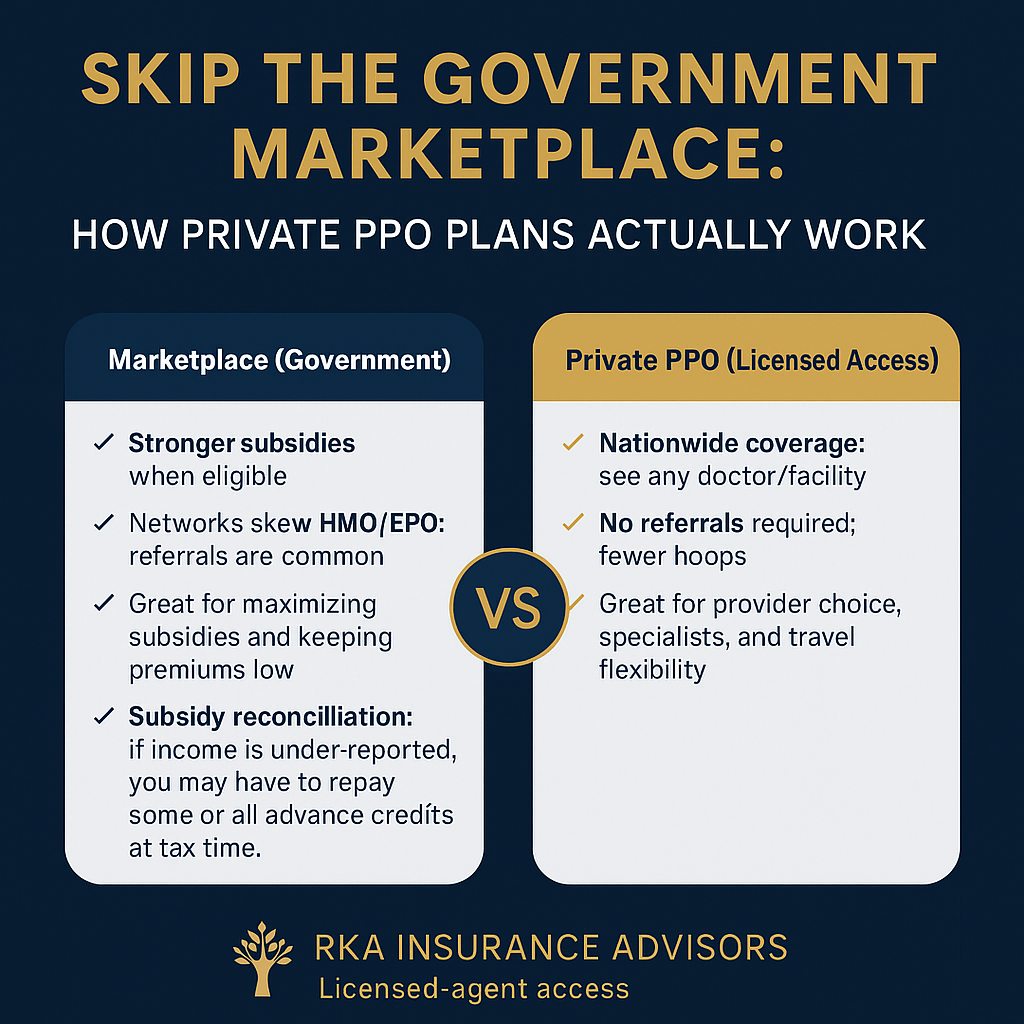
Skip the Government Marketplace: How Private PPO Plans Actually Work
Fast guide to non-Marketplace Private PPOs—how they bill, who they fit, and what to verify first. We’ll confirm your doctors, compare options, and show clear costs.
Skip the Government Marketplace: How Private PPO Plans Actually Work
Prefer private, licensed-access coverage? Here’s the fast, practical guide—what it is, how it bills, and how to check if it fits your doctors, travel, and budget.
Why some people skip the Marketplace
- Keep specific doctors/hospitals. Many Marketplace options are HMO/EPO with referrals.
- Travel flexibility. Want nationwide, not just local networks.
- Fewer gatekeepers. Prefer no referrals for specialists or imaging.
- Income too high for meaningful subsidies—or you don’t want tax-credit involvement.
- If your income qualifies, Marketplace can be the cheapest route.
- Credits reconcile on your tax return; under-reporting income can create payback.
- Private PPOs skip subsidies entirely—pricing is based on age, ZIP, benefits, and network.
How Private PPO actually works
- Nationwide PPO access in eligible networks—keep your specialists and preferred hospitals.
- No referrals for specialists (typical), fewer hoops to schedule care.
- Enroll through a licensed agent; options vary by state and carrier.
- Premiums aren’t tied to ACA income credits.
- Your exact doctors and facilities are in-network (we check for you).
- Copays vs coinsurance on high-ticket items (imaging, outpatient surgery).
- Prescription tiers and any prior-auth on key meds.
- Out-of-pocket maximum is a number you can live with.
What drives price (non-subsidized)
The big levers
- Age rating for adults; kids usually add less than another adult.
- ZIP/county + network breadth.
- Deductibles, coinsurance, copays, and the out-of-pocket max.
Ways to keep it efficient
- Don’t overbuy—match benefits to how you actually use care.
- Choose networks that include your real providers (not just brand names).
- Use generics when clinically appropriate; we’ll check formulary tiers.
Who typically chooses Private PPO
Strong fit
- Self-employed/1099 families who want broad doctor choice.
- Frequent travelers or multi-state households.
- People who dislike referral bottlenecks.
Maybe not a fit
- Households whose main goal is max subsidies and the lowest possible premium.
- Anyone who does not have specific providers to keep and rarely needs out-of-area care.
Want the best non-Marketplace fit in your ZIP?
We’ll verify your doctors and meds, compare PPO options, and show clear costs. No pressure—just answers.
FAQ
Are Private PPOs the same as Marketplace plans?
Do Private PPOs need referrals?
Will I owe taxes if I’m not using subsidies?
How do I know if my doctor is covered?
How do we start?
This overview is educational, not tax or legal advice. Plan availability and rules vary by state and carrier. Eligibility and enrollment subject to underwriting/plan terms where applicable.

New to Florida? Health Insurance—Fast Guide (Marketplace vs Private PPO)
Fast guide for Floridians who just moved—how coverage works, proof to have ready, and how to keep your doctors. We compare Marketplace vs Private PPO and show clear costs.
New to Florida? Health Insurance—Fast Guide (Marketplace vs Private PPO)
Just moved to FL? Here’s how coverage works, what proof you’ll need, and how to keep your doctors. We’ll verify providers and show clear costs—no pressure.
- Can be cheapest if your income qualifies for credits.
- Many plans are HMO/EPO; referrals are common.
- County-based options; networks vary by ZIP.
- Move = special enrollment (time-limited). Credits reconcile at tax time.
- Nationwide PPO access when eligible; keep key doctors/hospitals.
- Typically no referrals; fewer hoops for specialists.
- Pricing isn’t tied to ACA income credits.
- Good for travel, provider choice, and specialist access.
What to do first (takes 5 minutes)
1) Gather quick proof
- New FL address (lease, closing docs, utility, USPS change).
- Prior coverage details if switching.
2) List providers & meds
- Doctors, specialists, hospitals you want to keep.
- Current prescriptions (name + dosage).
3) Decide priorities
- Lowest premium vs. broad network.
- Referrals OK or prefer no referrals?
- Travel out of state?
What drives cost in Florida
Marketplace
- Income & household size (for tax credits).
- Plan level & network (HMO/EPO common).
- County—options can change across county lines.
Private PPO
- Age, ZIP, benefit level, and network size.
- No ACA credits; premiums are straightforward.
- Great when keeping providers is the priority.
Simple decision guide
Choose Marketplace if…
- Your income qualifies for strong credits.
- You’re OK with HMO/EPO rules & referrals.
- Lowest premium is the top priority.
Choose Private PPO if…
- You want broad, often nationwide PPO access.
- You prefer no referrals to see specialists.
- Keeping specific doctors/hospitals matters most.
New to Florida? Let’s lock the best fit in your ZIP.
We’ll verify your doctors and meds, compare Marketplace vs Private PPO, and show clear costs. No pressure—just answers.
FAQ for recent Florida moves
Do I get a special enrollment window when I move to Florida?
What proof of my move do I need?
When will coverage start?
Can I keep my current doctors?
What if I’m coming from COBRA?
This overview is educational, not tax or legal advice. Availability and rules vary by carrier and county. Eligibility and enrollment subject to plan terms.
Marketplace vs Private PPO 2026 | Which Wins for You?
ACA Marketplace plans can be the right call if your income qualifies for subsidies. But if you earn above the subsidy threshold or want broader doctor access with no referral requirements, a private underwritten PPO often wins on cost, flexibility, and nationwide coverage.
Private PPO • ACA Marketplace • 2026
Marketplace vs. Private PPO:
Which One Actually Wins for You?
The core difference in one sentence
Marketplace (ACA) plans are priced based on your income and regulated by the government. Private PPO plans are priced based on your health and issued by private carriers outside the exchange.
That one difference drives everything else — cost, network, enrollment windows, and who qualifies for what.
Side-by-side comparison
- Premium tied to your income
- Subsidies available below 400% of the Federal Poverty Level (FPL)
- Open enrollment window (or qualifying life event required)
- Pre-existing conditions covered — no underwriting
- Network can be narrow depending on plan and region
- Referrals may be required on HMO-type plans
- Deductibles can be significant on unsubsidized plans
- Premium based on age and health — not income
- No subsidies — but often lower premiums for healthy applicants
- Available year-round — no enrollment window
- Medical underwriting required — health history reviewed
- Nationwide PPO network — see any PPO doctor, no referrals
- No referral requirements
- Qualify for lower deductible options, including $0 deductible plans
When the Marketplace wins
The ACA Marketplace is genuinely the better option in certain situations. It wins when:
- Your income qualifies for subsidies. Below 400% of the Federal Poverty Level (FPL), subsidies can make Marketplace plans extremely affordable — sometimes as low as $0/month. If you qualify, it's hard for a private plan to compete on price.
- You have pre-existing conditions. Marketplace plans cannot deny coverage or charge more based on health history. Private underwritten plans can decline applicants or exclude conditions — so if you have significant health history, the Marketplace may be your only path to full coverage.
- You're between jobs short-term. If you need a bridge for 30–60 days and qualify for a Special Enrollment Period, a Marketplace plan can be fast and straightforward.
When a private PPO wins
Private PPO plans tend to outperform the Marketplace when:
- Your income is above the subsidy threshold. Once you're above 400% FPL, Marketplace premiums are unsubsidized and can be steep. For a healthy individual in this bracket, a private PPO often comes in significantly lower.
- You need coverage outside open enrollment. Private PPO plans are available year-round — no qualifying life event required. If you missed open enrollment or just went self-employed mid-year, a private plan is often the only option.
- You want nationwide access. Private PPO networks typically cover you anywhere in the country with no referral requirements — important for frequent travelers, remote workers, and anyone who splits time between states.
- You're self-employed with variable income. ACA plans reprice if your income changes — under or overestimate and you pay the difference at tax time. Private PPOs have fixed premiums not tied to income.
The honest answer
There is no universally better option. The right plan depends on your income, health history, where you live, and whether you're in an open enrollment window. The only way to know which wins for you is to compare both with actual numbers.
That's exactly what we do — side-by-side, with real quotes, from a licensed advisor. Free, no obligation.
What about doctor networks?
This is where private PPO plans have a consistent advantage. Marketplace networks — especially at the Silver tier — vary significantly by state and county. In some markets they're broad; in others, major hospital systems are excluded entirely.
Private PPO plans access major nationwide carrier networks. If you have a doctor, specialist, or hospital you want to keep, we verify coverage on both options before you enroll — not after.
How RKA helps
RKA Insurance Advisors is an independent brokerage licensed in 32 states. We're not captive to any single carrier — we compare Marketplace plans and private PPO options side by side and help you pick what actually fits your situation.
- Free quote — no obligation
- We verify your doctors on both options before you commit
- We explain subsidy eligibility clearly — if you qualify, we'll tell you
- Available year-round, not just during open enrollment
See which option wins for you
We'll compare Marketplace and private PPO side by side — free, no pressure, no obligation.
Frequently Asked Questions
Can I switch from Marketplace to a private PPO anytime?
Yes — private PPO plans are available year-round with no enrollment window. You can apply and get covered in as little as a few days depending on the carrier. Cancelling your Marketplace plan mid-year may affect any advance premium tax credits received, so review your tax situation before switching.
Does a private PPO cover pre-existing conditions?
Private underwritten plans review your health history at application. Some conditions may be excluded or result in a higher premium. If you have significant pre-existing conditions, a Marketplace plan may provide broader coverage. We'll be upfront about what each option covers for your specific situation.
What does "above the subsidy threshold" mean?
ACA subsidies phase out at 400% of the Federal Poverty Level (FPL). Above that income level, you pay the full unsubsidized Marketplace premium. For many self-employed professionals and small business owners in this bracket, private PPO premiums compare favorably — often significantly so.
Can I keep my current doctors on a private PPO?
Most likely yes — private PPO networks are broad and access major hospital systems and specialist groups nationwide. We verify your specific providers on any plan before you enroll so there are no surprises.
Is RKA an ACA broker or private PPO broker?
Both. We're an independent brokerage — we're not incentivized toward either option. We compare what's available for your situation and present the numbers clearly. NPN: 19540130. Licensed in 32 states.
Educational purposes only. Plan availability, premiums, and benefits vary by state, county, and individual health profile. Review official plan documents before enrolling. RKA Insurance Advisors, NPN 19540130, licensed in 32 states.