Health Insurance “Hacks”
Real, easy health insurance “hacks” that actually save time and money — use telehealth, urgent care, stay in-network, and compare Marketplace vs. Private PPO options.
Health Insurance Guides • Updated Nov 5 • Written by Robert Adams
Health Insurance “Hacks” — Real Tips That Actually Save Time & Money
Fast take:
Skip the gimmicks. Use telehealth for routine issues, choose the right site of care (Urgent Care vs ER), stay in-network to avoid surprise bills, and—if you’re generally healthy—ask about private, medically underwritten PPO options that can drop premiums. When in doubt, have us review your plan and show a side-by-side comparison.
- • Most plans include telehealth/telemedicine with low or $0 copay for common ailments.
- • Typical visit: ~15 minutes by video/phone—no waiting room.
- • Great for colds, rashes, UTI screens, refills, minor issues.
- • Non-emergencies → Primary Care or Urgent Care (faster, lower copays).
- • True emergencies → ER. Otherwise, ER = big bill + deductibles.
- • Ask your plan for preferred Urgent Care centers near you.
- • HMO/EPO: out-of-network = not covered (except emergencies).
- • PPO: out-of-network allowed, but you’ll pay more.
- • Call us—our team will verify your providers are in-network.
- • Medically underwritten PPOs can offer lower premiums for healthy applicants.
- • Often no referrals; broader access for specialists/hospitals.
- • Not for everyone—get a side-by-side with Marketplace plans.
Quick decision guide
Choose Telehealth if…
It’s routine/minor, you want fast care, and your plan shows $0–low copay visits.
Choose Urgent Care if…
It’s same-day non-emergency (stitches, x-rays, infections) and you want to avoid ER costs.
Call us if…
You’re unsure about networks, copays, deductibles, or whether a private PPO could save money.
Want us to check your “hacks” against your actual plan?
We’ll verify your doctors, map Urgent Care options, and compare Marketplace vs. Private PPO side-by-side.
Quick FAQs
Is telehealth really covered?
Most modern plans include it; many charge $0–low copays. We’ll check your specific policy.
How do I confirm a doctor is in-network?
Send us the doctor’s name and location—we’ll verify against your plan’s current network file.
Who should consider private PPO?
Applicants in good health who want broader access and potentially lower premiums. Not everyone qualifies—we’ll show a clean comparison.
Robert Adams
RKA Insurance Advisors • Private & Marketplace Health Coverage • 561-806-9913 • robert@rkainsuranceadvisors.com
How does the Inflation Reduction Act affect your Health Coverage?
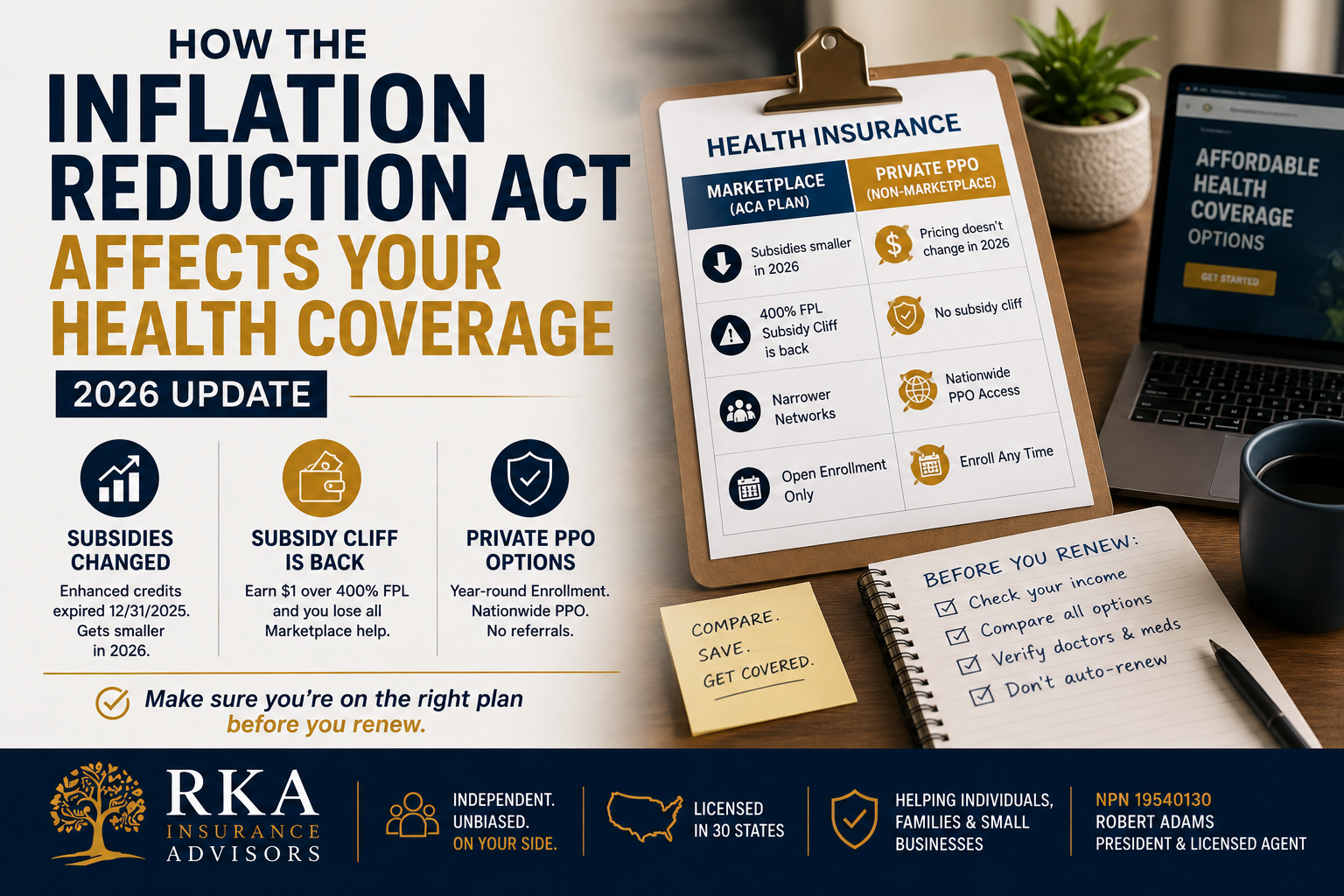
The Inflation Reduction Act's enhanced ACA subsidies expired at the end of 2025 and the 2026 subsidy cliff is back. Here's what changed, the income cutoffs, and where a private PPO now beats the marketplace.
Private PPO • Marketplace • 2026 Changes
How the Inflation Reduction Act Affects Your Health Coverage (2026 Update)
What changed for 2026
The IRA’s larger subsidies were always temporary. They ran from 2021 through 2025, and Congress did not extend them. When 2026 Open Enrollment opened, the enhanced credits were gone — and for millions of people the price to keep the same plan jumped sharply.
The cliff cutoff scales with household size — roughly $84,600 for a couple and $128,600 for a family of four in 2026. Cross it by a dollar and your Marketplace subsidy drops to zero.
Marketplace vs. Private PPO in 2026
Marketplace (ACA) Plans
- Still a strong fit if your income is under the cliff and you qualify for a subsidy
- Guaranteed issue — no health questions
- Above 400% of poverty, you now pay the full unsubsidized premium
- Networks are often narrower (HMO/EPO) with referrals
Private PPO (Non-Marketplace)
- Never used IRA subsidies — nothing about its pricing changed in 2026
- Priced on age and health, not income — often cheaper over the cliff
- Nationwide PPO access, no referrals, enroll any month
- Medically underwritten — not everyone qualifies
What to compare before you renew
Run the cost math
- Your realistic 2026 income vs. the cliff cutoff for your family size
- Full-price Marketplace premium vs. a private PPO quote
- Deductibles and out-of-pocket maximums, not just the premium
- Total annual cost across the whole year
Check the fit
- Are your doctors in each plan’s network?
- Are your prescriptions covered, and at what tier?
- Do you travel or live across state lines?
- Any planned procedure or pregnancy this year?
Not sure which side of the cliff you’re on?
We’ll put full-price Marketplace and a nationwide private PPO side by side for your exact situation — verify your doctors, check your prescriptions, and tell you honestly which wins. Free, no obligation.
Get Free Quotes Book a CallThe self-employed angle
If you run a business or work 1099, the expired subsidies hit harder — you’re buying your own coverage with no employer help, and you’re more likely to be over the cliff. That’s exactly the situation where a medically underwritten nationwide PPO can beat full-price Marketplace, priced on your health instead of your income. There’s also a tax angle: self-employed people can often deduct their premiums — worth raising with your tax professional as you compare.
Related reading
Frequently asked questions
Did the Inflation Reduction Act’s subsidies go away?
The larger enhanced credits that ran from 2021 through 2025 expired December 31, 2025. The original ACA subsidies still exist, but at smaller pre-2021 levels — and the 400% income cliff is back for 2026.
I earn just over the cliff — what are my options?
Above 400% of the federal poverty level you get no Marketplace subsidy in 2026, so you pay the full premium. For a healthy household, a medically underwritten private PPO is often less expensive with a broader nationwide network. It’s worth comparing both before you decide.
Why did my premium jump so much for 2026?
When the enhanced subsidies expired, the amount of help you receive shrank, so the net premium you pay rose — on average about 114% for subsidized enrollees to keep the same plan.
Do I still need to report income changes?
Yes. If you use Marketplace coverage, keep your income and household details updated so your subsidy stays accurate — with the cliff back in 2026, being off can mean a large bill at tax time.
Subsidy amounts, cliff cutoffs, and premiums vary by household and can change; the figures here reflect 2026 rules at the time of writing.
Robert Adams · President & Licensed Agent · NPN 19540130 · Licensed in 30 states. Premium and subsidy figures are illustrative and based on general market data — actual amounts vary by age, state, income, and health. Private medically underwritten plans are not ACA-compliant and are subject to medical underwriting — not all applicants qualify. This content is for informational purposes only and does not constitute insurance, legal, tax, or financial advice.
Robert Adams
https://www.RKAInsuranceAdvisors.com
What Is A PPO Health Insurance Plan?
PPO plans explained in plain English — how they work, why there are no referrals, the out-of-network flexibility, what they cost, and how marketplace and private PPO options compare.
PPO • Health Insurance Basics
What Is a PPO Health Insurance Plan? (Understanding the Ins & Outs)
What a PPO is — and how it works
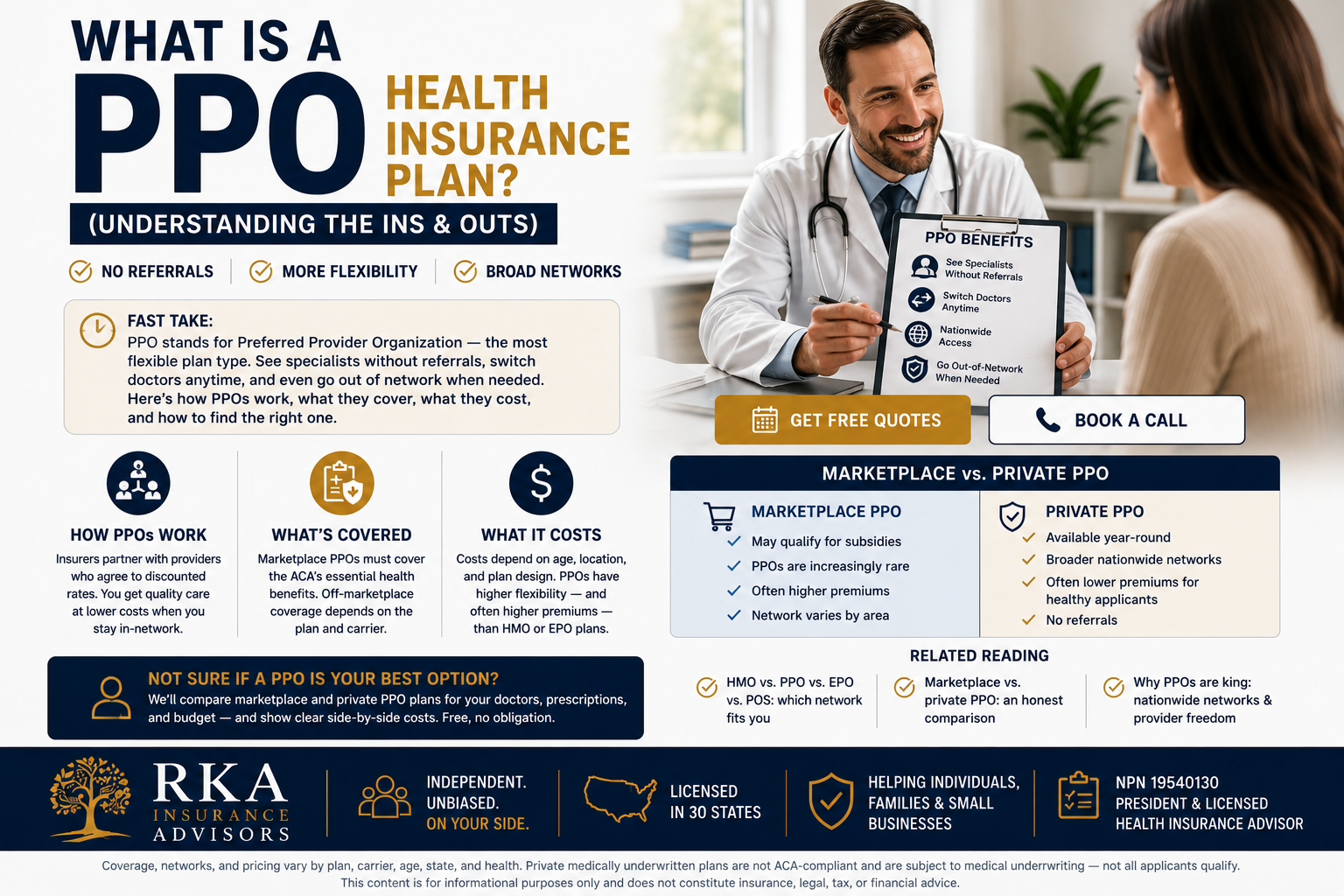
A PPO contracts with a network of doctors, hospitals, and facilities that agree to charge set rates for their services. Stay in-network and you get significant savings versus going outside it. The reason it works is simple: insurers bring the members, providers bring the care, and both agree on a discounted rate up front — a win for the carrier, the provider, and, most importantly, you.
The feature people love most is flexibility. Unlike an HMO, a PPO doesn’t make you pick a primary care physician, and you don’t need a referral to see a specialist.
Why PPO flexibility matters
- See a specialist without a referral — saves time and a co-pay
- Don’t like a doctor? Switch to another in-network doctor, no approval needed
- Skip routine visits or see any in-network doctor whenever you want
What’s covered
- Marketplace PPOs must cover the ACA’s essential health benefits
- Off-marketplace coverage depends on the specific plan and carrier
- Most PPOs offer broad coverage thanks to large provider networks
How much does a PPO cost?
Cost comes down to a few things: your age, how many people are covered, your ZIP code, and the plan’s network size, copays, deductible, and out-of-pocket maximum. One catch on the marketplace: true PPOs are increasingly hard to find there, and when they exist they’re often pricier than HMO or EPO options.
Off the marketplace, private PPOs are available in most areas. Some are short-term plans that are technically PPOs but provide limited benefits — always talk to a licensed advisor before enrolling in one. Others are medically underwritten: because the risk pool is healthier, the carrier can often offer lower rates, real PPO networks, and stronger benefits for people with a smaller claims history.
Where to start your search
The best place to start is right here. We take an educational approach and review all the options available in your area — marketplace and private — so you can see the full picture. It’s worth a conversation even if you just want a second opinion on your current plan.
Not sure if a PPO is your best option?
We’ll compare PPO options — marketplace and private — for your doctors, prescriptions, and budget, and show clear side-by-side costs. Free, no obligation.
Get Free Quotes Book a CallRelated reading
Frequently asked questions
Do I need a referral with a PPO?
No. PPOs let you see specialists directly, without a referral from a primary care doctor — one of the main reasons people choose them.
Can I use out-of-network doctors with a PPO?
Yes, though you’ll usually pay more than in-network. The flexibility to go out of network when you need to is a core PPO benefit.
Are PPOs available on the marketplace?
Fewer than there used to be, and they’re often more expensive than HMO or EPO plans there. Many true PPOs are found off-marketplace as private plans — worth comparing both.
Is a private PPO cheaper than a marketplace plan?
For a healthy household above the subsidy line, a medically underwritten private PPO is frequently less expensive with a broader network. If you qualify for a subsidy, a marketplace plan may win. Compare both to be sure.
Short-term plans are not ACA-compliant and provide limited benefits — always review the details with a licensed advisor before enrolling.
Robert Adams · President & Licensed Agent · NPN 19540130 · Licensed in 30 states. Coverage, networks, and pricing vary by plan, carrier, age, state, and health. Private medically underwritten plans are not ACA-compliant and are subject to medical underwriting — not all applicants qualify. This content is for informational purposes only and does not constitute insurance, legal, tax, or financial advice.
Robert Adams
https://www.RKAInsuranceAdvisors.com
Nationwide PPO Health Plans for Truckers
Not everyone knows how the trucking industry plays a vital role in our economy. CDL truck drivers are necessary for not only economic growth but the modern marketplace's ability to exist at all. Often these truckers are overworked and, in reality, not compensated enough for their role in the economy and our day-to-day lives. Without them, our lives do not function and are drastically impacted. Recently, we have seen surging prices for gas, food, and other goods. According to U.S. Bureau of Labor Statistics, this has catapulted U.S. inflation to a 40-year high in June, further pressuring all Americans, especially truckers.
As a result, truckers, in particular, have been one of the occupations hit the hardest. With record fuel prices and an occupation predicated on driving, this is not an ideal situation for truckers. In addition, many truckers are self-employed & contracted, further exacerbating the issue for them as they are responsible for all their costs.
Times like this are when you can start looking at areas to reduce cost—figuring out which areas we can cut to save some extra cash. One of the last areas truckers usually check is how much they are paying in health insurance costs. Once they have coverage, most people don't think to check to see if there are more affordable options. Or, at the very least, get a second opinion to ensure they have the best level of coverage at the most affordable rate and make sure the plan will cover you outside your resident state.
Truck drivers are among the most vulnerable workers in the U.S. labor force. They have one of the highest injury and illness rates for any occupation in America. Unfortunately, they are among the least likely to have health insurance coverage. According to HD Fleet, the average cost of a truck accident with one injured driver is $148,279. The cost can reach up to $7 million when it involves a fatality. Over-the-road and long-haul truck drivers are prone to accidents, leading to severe injuries. As a result, truck drivers end up in emergency rooms. Even using ERs for non-emergency services when it would have been much more cost-efficient for them with online telemedicine or urgent care treated by a Doctor or Nurse Practitioner. According to the U.S. Department of Transportation, long-haulers are more vulnerable to developing severe health conditions due to the nature of their job, making health insurance for truck drivers an essential need. These conditions are hypertension, insomnia, sleep apnea, spinal disorders, headaches and migraines, stress and depression, arthritis, sinus problems, and lung diseases.
The same research report highlights that prevalence of obesity in the average American worker is 31%. In addition, the prevalence of diabetes in truck drivers is 14% compared to 7% of the average American worker. The report shows that 17% of American workers don't have a health insurance plan. On the other hand, over-the-road and long-haul drivers are the most underprivileged regarding health insurance because 38% of drivers lack a proper coverage plan.
Due to the long-haul truck driver experiencing higher health risks, every truck driver needs health insurance. But unfortunately, most drivers don't have insurance to cover their health costs or their families' medical expenses.
This is why it's important for truck drivers, especially long-haul truckers, to secure Nationwide PPO coverage. Most options available on the marketplace exchange, otherwise known as ACA plans or Obamacare plans, are HMO or EPO networks, limiting your coverage area. These plans are terrific because they do accept everyone. Still, again you can be subjected to limited or smaller localized networks. Typically not allowing services to be covered outside of your resident state. That is not a good position to be on for an occupation requiring being out of the state more often than not. Also, being Self-Employed and not having a group health plan through a large employer.
PPO Networks provide nationwide access to doctors, facilities & hospitals. You have the freedom and flexibility to go to any medical provider. It's always best to stay within the provider network, of course. However, if you cannot, you'll still have coverage, which is excellent news for Self-Employed truckers. Health insurance is a considerable expense for truckers. That's why it's crucial to have a Licensed Health Coverage Advisor help navigate these complexities. The various networks and what insurance carriers have more extensive nationwide networks. Which options have unlimited telemedicine if you need a quick prescription filled, you have a 15 min phone or video consultation with a board-certified physician, and it's called into a pharmacy near your travels.
Most people are not aware of the vast amount of private nationwide PPO plans available. Most Self-Employed people prefer these plans as they are nationwide PPO plans and usually have low or no deductible options. Most of the time, extensive Networks like United, Cigna, and PHCS, to name a few.
Now not every single private plan is efficient coverage. So, again, more reason to have one of our Licensed Advisors do this work for you and with you. Frequently, this results in individuals finding comprehensive and quality health coverage that you can take anywhere with you nationwide and saving a couple of extra dollars. Saving people money and getting them in a better position with health coverage is precisely what we pride ourselves on. So reach out today and allow us to help you find the coverage that will not let you down when you need it most at a more affordable rate.
561-806-9913
Robert@RKAinsuranceadvisors.com
www.RKAinsuranceadvisors.com
Self-Employed & Health Coverage. What are my options?
It's an exciting time when we take that leap on our own to go Self-Employed & leave behind working for someone else & your traditional 9-5. There is so much that goes into that exciting decision. One of the most significant decisions is where to turn for health coverage.
Most of the time, we have jobs that pay a large portion of our health coverage costs. Most employers pay 50%, and even some will pay 100%. We put all this effort into getting our business set up, and we put in our two weeks with our soon-to-be old employer & then we get the letter stating the cost of Cobra. At that point, we typically lose the employer contribution and are subject to paying the total cost of the coverage. Most of the time, that number isn't a number we are comfortable looking at, let alone paying!
Going Self-Employed, one of the most challenging areas to navigate is obtaining health coverage, especially if you have a family. Most people go online, start browsing around & enter their information. Next thing you know, you're phone starts to ring non-stop, all while you're trying to get your new business up and running. Various companies, brokers, and agents are calling you. It's a story we are all too familiar with hearing. You see some cheap plans browsing online. Then, a little deeper look & you realize those plans do not provide many benefits at all & have a higher max out-of-pocket & deductibles than what you're used to. You may be lucky enough to be able to stumble across healthcare.gov. Losing the previous employer coverage does open a special enrollment period for you. The issue there is, that predicting the total combined household income for the year before taxes is tricky. Also, underreporting income can lead to being penalized when you file taxes the following year if you received a subsidy. Suppose your annual tax filings exceed what you reported to the marketplace. In that case, you will be responsible for paying back the subsidy amount that was provided. It's not something a new business wants to be faced with.
So, the question remains: what do you do, where do you turn?
That's an area in which RKA Insurance Advisors can help. Access to private medically underwritten plans that are not subjected or tied to your annual income are available. They are what a lot of self-employed individuals do prefer. The reason is, that often these plans will be much more affordable than the offerings of Cobra from your previous employer. Unless receiving a subsidized premium on the marketplace, these options will also be more affordable. These plans will have large nationwide PPO networks, where you are covered nationally. Not just the localized coverage like many of the HMOs found on the marketplace. Being medically underwritten ensures the risk pool is healthier individuals; therefore; as a result, rates and out-of-pocket exposure are usually lower because there is less claim loss. Some of these options are guaranteed renewable to age 65. Some are designed specifically for a more affordable option with many benefits upfront without meeting a deductible. There are also select guaranteed issued private plans not based on medical history. Each person & their situation, needs, and budget are different. When deciding to go self-employed, it's always best you speak with a licensed Health Coverage Advisor.
RKA Insurance Advisors can and will ensure to go through ALL your available options with you. Educating you on the important things when selecting a plan. Such as the different networks, making sure your doctors & facility are within the plan's network, & going over co-pays for services, deductibles, and max-out-of-pocket. All the what-if scenarios that may occur. We specialize & pride ourselves in delivering the best understanding of health coverage. How to get the most out of your coverage and provide the education to determine which plan(s) best suits you in your new endeavor of going self-employed. Reach out to us via Email, call, or text. You can schedule a time and day for an appointment directly on our website.
We look forward to hearing from you!
www.RKAInsuranceadvisors.com
561-806-9913
Robert@RKAInsuranceadvisors.com
Potential Cost Increase in Marketplace Coverage for 13 million Americans.
Every day isn’t a good day in the health insurance industry. With premiums set to raise upwards of 50% for individuals that have coverage through the Marketplace (also known as the ACA, or ObamaCare.) In 2021 Congress signed the “American Rescue Plan” into law on March 2021, which increased the subsidy income cap to receive a subsidized premium. Of the 14.5 Million enrolled in a government, 13 Million receive subsidized premiums. If you are one of the ones who does have coverage through the Marketplace & receive a subsidized premium, expect higher premiums next year. Unless Congress acts quickly, enhanced subsidies you’ve been receiving for the last two years will disappear, affecting roughly 13 million Americans.
Most Enrollees, including self-employed & workers with no job-based health coverage, will be significantly affected. It’s uncertain whether Congress will revive the provision via other legislation that may try to get through before Open-Enrollment.
Here’s a hypothetical example, based on a report from the Congressional Budget Office: A 64-year-old with $58,000 in income — about 430% of the 2022 poverty level of $13,590 — has insurance through the Marketplace. The 8.5% limit currently in place means they would pay no more than $4,950 for premiums this year. However, if faced with a 400% cap on eligibility in 2023 (which it was before the “American Rescue Plan”), that same person would pay $12,900 for premiums annually because they’d no longer qualify for subsidies.
This is precisely what we are here for. The Marketplace isn’t the only way to secure coverage. Private Options, not subjected and based on your income, are available. These options are based on a health risk assessment to determine eligibility. These plans, on avg, are more affordable and provide lower deductibles & out-of-pocket exposure. In addition, Nationwide PPO networks. Even some options are guaranteed renewable till age 65. It’s important to speak to one of our licensed health coverage advisors to determine if you can be eligible for these options. Regardless of your current coverage situation, it’s essential to ensure you are in the best possible position from a coverage & cost standpoint. We are here to help. Reach out today if you are insured through the Marketplace, have general questions, need quotes, and want to compare options. Our team of licensed specialists will be here for you.
Nationwide PPO Health Plans
There is good news in the world of health insurance! Yes, I know, finally! This time of year, the only options usually available are Limited Benefit Plans, Short Term Medical Plans, and HealthShare plans. Which are not full coverage, and provide limited benefits that can leave you exposed to a lot of claims left unpaid. Unless of course, you have a qualifying life event, then you have the ability to shop marketplace options. Depending on the person, income, medical history & situation even those plans might not be the best fit for you.
Recently released, is a new medically approved plan. Designed to offer lower out-of-pocket exposure, lower deductibles, and more upfront benefits where a deductible doesn’t have to be met to cover services such as Dr visits, specialist visits, prescriptions, labs, X-rays, MRIs, and many more services. In addition to that, it offers nationwide coverage through one of the largest PPO networks in the country. Of course, there are already in existence medically approved plans that are guaranteed renewable to 65 as well.
With the rising cost of services and goods recently. Its important to always check your expenses to see if there are any potential savings. For anyone who has been affected by the recent rise in costs of things such as gas & food, and is currently insured, reach out! We can review your current health coverage costs & levels of care. Compare to existing and new plans released. It’s very likely you could be overpaying. In the event you aren’t taking a few minutes to reassure you are in a good position is worth it. Send us a message, call, or e-mail, and one of our state-licensed advisors can answer any questions or guide you through the available options with an educational approach!
What to do when you need coverage & it’s not Open Enrollment?
Lost coverage and it's not open enrollment? Your special-enrollment and year-round private options, explained.Coverage Outside Open Enrollment
Need Coverage When It's Not Open Enrollment? Here's What to Do
It happens all the time — you lose coverage and it's nowhere near open enrollment. Maybe a job ended, you went self-employed, you moved, or a policy lapsed. There are a lot of reasons coverage ends mid-year, and the good news is you have real options.
What can open a Special Enrollment Period
- You lost coverage in the past 60 days
- You changed where you live in the past 60 days
- A birth or death in the household in the past 60 days
- A change in eligibility status in the past 60 days
- You got married or divorced
Private plans — available 365 days a year
- Enroll any month — no life event required
- Broad nationwide networks, often lower total cost for healthy applicants
- Medically underwritten — not for everyone; we pre-screen so you know before you apply
These plans aren't right for everyone — which is exactly why it's worth a quick call with a licensed advisor. We look at your situation, cut through the hundreds of options, and narrow it to the best fit so you're not overpaying.
Lost coverage? Let's get you insured fast.
Whether it's a recent loss of coverage, comparing what you have, or a quick quote — talk to a licensed specialist. No pressure, just answers.
Get Free Quotes Book a CallQuick FAQs
How long do I have after losing coverage?
Most Special Enrollment Periods last 60 days from the qualifying event. Acting quickly avoids a gap — and a private plan can enroll you year-round.
Can I get covered if I don't have a life event?
Often yes — through a private plan that enrolls year-round, if you pass medical underwriting. We pre-screen quickly and tell you if it's a fit.
Will a private plan really cost less?
For healthy applicants, frequently yes — lower premiums, deductibles, and out-of-pocket exposure with a broader network. We compare it against your marketplace options so you can see the real numbers.
For education only; eligibility, plan availability, and dates vary by state and carrier. Always review official plan documents. Private plans are medically underwritten — not all applicants qualify. RKA Insurance Advisors is an independent, licensed health insurance brokerage (NPN 19540130). We do not offer Medicare. Call (561) 806-9913.
Missed Open-Enrollment?
If you missed 2022 open-enrollment period, you may be asking yourself what do I do & can I still secure coverage? The short answer is YES. The long answer is……
Outside of the open enrollment period options can of course be limited. First, if you still are uninsured for 2022, we can always check to see if you qualify for a special enrollment on the marketplace. What is that exactly? Simply means you have had a qualifying life event, some of which are, loss of coverage in the past 60 days, change of primary address, change of household size, just to name a few.
Also, there are what’s called medically underwritten or medically approved options. These options can be very hard to be approved for bc they are based upon health history. Not everyone can qualify for this option. However, if you can it usually leads to more affordable premiums, nationwide PPO networks & lower out-of-pocket exposure. Some of these options are guaranteed renewable till age 65 as well.
Then there are short-term medical plans, Indemnity plans & health-share plans as well. Usually, these options can work to fill a gap whereas you only need coverage for a month or so. These plans typically are really cheap as well. As a long-term solution, these options can lead to having to pay a lot more out of pocket for your medical expenses.
If you haven’t secured coverage 2022 yet, schedule an appointment, send us a message, or give us a call. Our team of licensed advisors are here to answer any questions you may have. There is no cost to review your options. Also, if you aren’t satisfied with your current plan you do not have to wait till the next open enrollment. Reach out and review your options & see where and what options you can qualify for.
Inflation and why health coverage is more important than ever
When we think of inflation as we are currently seeing the highest levels in 30 years. We typically think of day-to-day expenses, food, goods, electricity, gas, etc. What we don’t think of is inflation as it pertains to our medical costs. Yes, that’s right our medical cost. For the last decade, health care prices have consistently grown at roughly a rate of 1 percent to 2 percent. Already, in the last 18 months, prices for hospital and physician prices have exceeded a 3 percent inflation rate. Although the percentage of increase is less than other sectors and consumer products. The same problems driving up prices in the rest of the economy — rising costs within the supply chain, difficulty finding workers for open jobs — are issues in the health care sector too. The workforce crisis in particular is acute and not likely to go away any time soon, given how many nurses and doctors have left their jobs during the pandemic. As a result of these things, it is now more important to make sure you have quality health coverage. Not only quality health coverage but make sure you speak to a licensed agent prior to making a decision when it comes to coverage & not just picking the first plan you see or the most affordable option. Decisions like that can leave you vulnerable to a lot of out-of-pocket exposure. More now than in recent years as a continual rise in healthcare costs. With rising medical costs, the uncertainty of the pandemic, shortages of other goods, having quality health coverage is more important than it has ever been. Reach out today & speak to a licensed agent to discuss your situation, needs, and options.
Changes to 2022 Open Enrollment
Open Enrollment • What Changes
Open Enrollment: The Changes Worth Knowing Before You Renew
The enrollment window
Dates can vary by state and shift year to year — always confirm the current window (see the guide linked above) or ask us about your state.
Subsidies and income
Premium tax credits lower your Marketplace cost if your household income falls between 100% and 400% of the federal poverty level. The exact income thresholds update every year, and lower-income households can sometimes find $0-premium plans after credits. Earn above the top of the range and you pay full price — which is often where a private plan wins. We calculate your current-year subsidy and show your true net cost. More on the subsidy cliff →
Out-of-pocket limits
The maximum out-of-pocket limit for in-network essential health benefits rises most years (it applies per person and per family). Not every plan runs at the max, and some plans outside the Marketplace offer lower out-of-pocket exposure. We compare total annual cost — premium plus deductible plus out-of-pocket risk — not just the monthly price.
Which carriers are in your market
Carriers enter and exit the Marketplace every year, so your options change even if you don't. Major national carriers — UnitedHealthcare among them — carry broad footprints and large networks, while others pull back. When your current plan's carrier leaves, you'll be choosing something new. We track who's in your area and match you to the strongest fit.
Lose your job? You don't have to wait
Beyond the Marketplace
Don't renew blind — know your options first
We'll explain the current-year changes, compare Marketplace and private options, verify your doctors, and make sure you're not overpaying.
Get Free Quotes Book a CallFrequently asked questions
Can I switch plans, or do I have to keep my current one?
During open enrollment you can switch to any available plan. Auto-renewal is convenient but rarely the best value — it's worth comparing every year.
What if I lose my coverage mid-year?
Losing job-based coverage opens a Special Enrollment Period, and you may qualify for a subsidy — often cheaper than COBRA. A private PPO can also enroll you year-round.
What if I don't qualify for a subsidy?
You're not limited to the Marketplace. A private nationwide PPO may cost less with a broader network. We compare both for you.
For education only; eligibility, benefits, and availability vary by carrier and state and change yearly. Always review official plan documents. Private plans are medically underwritten — not all applicants qualify. RKA Insurance Advisors is an independent, licensed health insurance brokerage (NPN 19540130). We do not offer Medicare. Call (561) 806-9913.
Open Enrollment & Your Plan Options
Open enrollment explained — metal tiers, networks, subsidies, and the private options most brokers skip.
Open Enrollment • Basics
Open Enrollment & Your Plan Options, Explained
Open enrollment is the period each year when you can sign up for health insurance or change your current coverage. In most states it opens November 1 and runs through mid-January for individual and family plans. Enroll by December 15 and coverage typically starts January 1; enroll after that (through the deadline) and coverage usually starts February 1. Some states run their own window on different dates — check with one of our benefit specialists for your state, or see the current-year guide linked above.
Marketplace metal tiers
- Bronze — lowest monthly cost, but higher deductibles and more out-of-pocket expense.
- Silver — middle-of-the-road; balances coverage and cost (and unlocks extra savings if you qualify).
- Gold — higher premium, stronger cost-sharing, lower deductibles and out-of-pocket exposure.
- Platinum — rare and only in a few counties; highest premium, lowest deductibles.
Networks: why the type matters
Most Marketplace options are HMO or EPO networks — limited to a local service area, covering you outside it only for emergencies. PPO networks are available in select areas and offer nationwide access to providers without referrals. If you travel, split time between states, or want freedom to see specialists directly, network type matters as much as price.
Subsidies (premium tax credits)
If your income falls between 100% and 400% of the federal poverty level, you may qualify for a premium tax credit that lowers your Marketplace cost — sometimes dramatically. The exact income cutoffs change each year, and earning over the top of the range means you pay full price (the "subsidy cliff"). We calculate your current-year subsidy and show your true net cost. More on the subsidy cliff →
Options beyond the Marketplace
Other options we can compare
- Short-term medical — often the most affordable; coverage for roughly 30 days up to (with some insurers) 12 months. More limited than major medical.
- Fixed indemnity — supplemental coverage that pays set cash benefits toward specific costs; a layer of protection on top of a plan, not a replacement.
- Healthcare sharing — members share medical costs via a monthly share amount; not insurance, with its own rules and limits.
Don't assume your current plan is still the best
Before you renew, talk to a benefits specialist — we'll compare Marketplace and private options, verify your doctors, and make sure you're not overpaying.
Get Free Quotes Book a CallFrequently asked questions
When exactly can I enroll?
Open enrollment opens November 1 and runs into mid-January in most states; some state marketplaces differ. See the current-year guide for exact dates, or ask us about your state.
Is the Marketplace my only choice?
No. Depending on your income and health, a private nationwide PPO or a supplemental option may be a better fit. We compare all of them for you.
How do I know I'm not overpaying?
We price your real annual cost — premium, deductible, copays, and out-of-pocket max — across every option and verify your doctors before you enroll.
For education only; eligibility, benefits, and availability vary by carrier and state. Always review official plan documents. Private plans are medically underwritten — not all applicants qualify. RKA Insurance Advisors is an independent, licensed health insurance brokerage (NPN 19540130). We do not offer Medicare. Call (561) 806-9913.
Understanding Health Coverage
With Open Enrollment starting on Nov 1st this year, it’s time for us to discuss some of the different coverage options and what to look for. The most important thing is understanding your options, what is good for you and your family might not be for the next person. A lot of factors going into finding the “right plan”, income, health, lifestyle, and even employment. The ACA made it law to cover all pre-existing conditions on the federal marketplace exchange. In addition, depending on your income, subsidies are available for individuals who can qualify based upon their household income, which is great news! Most options on the marketplace these days, with the exception of a couple of states, are HMO plans which only provide coverage in your direct service area & only cover for emergencies outside of the service area. Certain lifestyles and employment whereas you travel frequently or have children in college in different states, more than likely, it’s best to seek a nationwide PPO option which is typically found on the private market. The marketplace isn’t the only option for coverage, there are private underwritten options that are guaranteed renewable plans until 65, there are short-term options, healthshare plans, catastrophic plans. Understing your situation will help a licensed agent narrow down the options that are best for you.
Some of the other factors when choosing a health plan is what is my out-of-pocket exposure. Most people typically “price shop”, they look for the cheapest plan. Which for some people might be appropriate, paying 25 or 50/month for coverage sounds great! Having a deductible of over 8k in a restricted HMO network with a coinsurance of 50% may not be. What does that exactly even mean? Well, it means for most medical services the deductible needs to be satisfied for the insurance to pay claims. That means 8k out of your pocket BEFORE the insurance pays claims. NOT IDEAL! In addition, “coinsurance” is the share amount between you and the insurance company AFTER your deductible is met. So, if it’s 50% that means it paying only half the claims after your deductible. I recently saw a short-term medical plan that had a coinsurance of 15k every 6 months, so that’s 30k per calendar year. Do the math. You are looking at a hefty out-of-pocket expense! Ideally, we pay a monthly premium to cover our medical costs if they arise. 15 min can save you thousands a year not only in monthly premiums but out-of-pocket exposure in the event of a major medical event. Reach out & schedule a free consultation today and speak with a licensed benefit advisor, review ALL avilable coverage options prior to selecting a plan.
Health Coverage & Self Employed
Being your own boss is exciting! You’re in control and doing something that more than likely you’re passionate about! Being self-employed could mean anything from owning your own business to working a steady freelance contracting gig. Whatever it is, you’re walking the tightrope of being your own boss and being in charge of everything including your health coverage. That’s where things can not only get confusing but costly. Being self-employed, you miss out on the luxury of having employer-sponsored health plans that your employer paid upward of 50% of the monthly premium. If your business is booming and you do not receive any subsidies for reduced monthly premiums on the marketplace exchange. You could be paying a pretty penny for health coverage. Coverage that you don’t even use too often. Owning your own business is a big deal. Making sure you have the right coverage being self-employed is also a big deal. Being self-employed & healthy can benefit you when it does come to coverage options. Private options with nationwide PPO networks, can not only be more affordable if you can qualify but reduce your out-of-pocket exposure without jeopardizing levels of coverage. Which is very important for someone running a business. If you are self-employed and feel you are overpaying or starting to looking into your own health coverage option. reach out today and let a benefit specialist show you all your available options and advise and educate you through the process to determine which plan is best for you.
Health Coverage for Nurses
The past almost 2 years have been well, a lot on our nurses. From being on the front lines, being hero’s saving lives, to being overworked and understaffed. They have been through and risked their health the most in the few years. Our nurses of course have to protect themselves as well. Now a good portion of nurses have health coverage through their employer which is great bc they are at a minimum paying 50% of monthly premiums.
What about our travel nurses? Who basically jump Into the fire of the hotspots of covid-19. Unfortunately, for most travel nurses, health benefits are not offered to them. So they check the marketplace exchange and realize they can get coverage but it’s in a restricted HMO or EPO network that only covers in that specific zip code they reside in. Unfortunately, that type of network wouldn’t be sufficient for a travel nurse, simply bc when they now travel outside of their resident zip code they have no coverage. Risking and jeopardizing your health daily working in covid hotspots and not having the proper coverage isn’t a risk I would advise taking.
Most people, nurses especially would benefit from being in a nationwide PPO network. Where you have coverage anywhere in the nation and have the freedom and flexibility to even go outside of the network if need be. Now, PPO networks are extremely limited on the federal marketplace exchange. They are available on the private market. If you are a travel nurse and do not have the right coverage for you or no coverage at all reach out today speak to a benefit specialist to review all your available coverage options. Even if you are not a nurse and travel frequently being in a nationwide PPO network would benefit you. You want to be covered anywhere you go, being in a nationwide PPO network provides that!
Overpaying for Health Coverage that you don’t use?
Health Coverage is designed for you an individual to pay medical claims that typically we wouldn’t be able to afford. Of course, we want it coverage our small claims as well. However, the main purpose of health coverage is to cover catastrophic claims, that’s the real reason why we obtain health coverage. We don’t get auto insurance for oil changes and tire rotations, we get it for the major stuff. However, without receiving a government subsidy to reduce premium costs. Plans on the federal exchange can be well, expensive. With large out-of-pocket exposure. Now for someone who doesn’t use their health coverage very often and is relatively healthy. Why are they going to want to overpay for health coverage they do not use? Fortunately, when relatively healthy there are plans on the private market that are based upon health NOT income like it is on the marketplace exchange. These plans are typically in nationwide PPO networks that do not limit your network like HMO & EPO networks, they typically carry very low out-of-pocket exposure and carry very affordable monthly premiums. You ask how is that possible? Well, Insurance in its self is about risk pooling. When the risk pool is unhealthy and you have guaranteed issued plans like on the marketplace exchange, more claims are going to be submitted. The insurance company has to offset the claim loss they are going to receive. How do they do that? They raise the monthly premiums and out-of-pocket exposure. A healthy risk pool has fewer claims naturally, which in turn the insurance company can reduce monthly premiums and out-of-pocket exposure. Now, this isn’t saying that the marketplace is a bad thing bc, in fact, it’s great for individuals who do make a lower income and can qualify for a subsidy and or have major medical issues, bc they cannot be denied coverage on the marketplace per the ACA. However, if you are healthy and or do not receive a government subsidy for reduced premiums there are more affordable coverage options with less out-of-pocket exposure available. I always advise you to review all your coverage options and to speak with a licensed specialist prior to making any decisions regarding coverage. Reach out today and speak to one of our licensed benefit specialists and review all your avilable coverage options.